

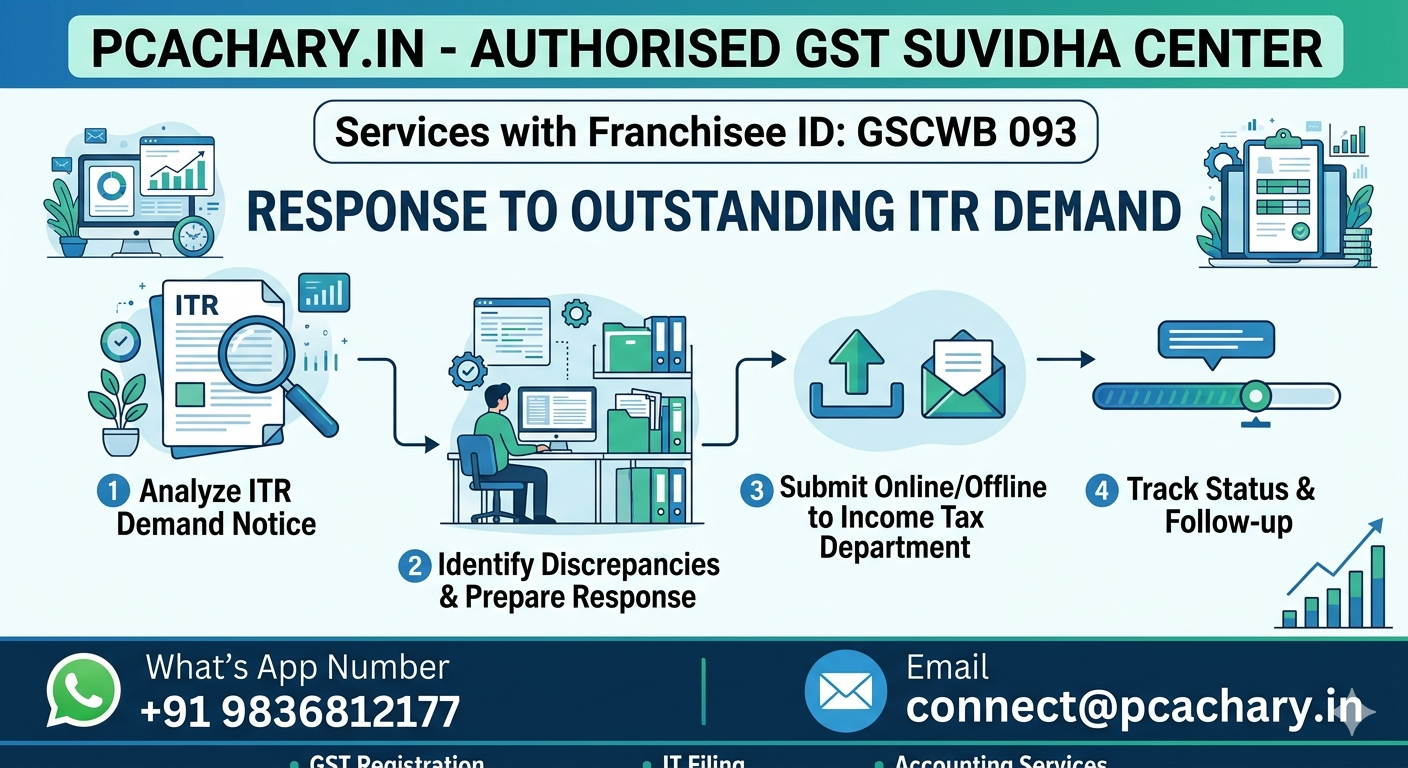

Comprehensive Guide: Responding to Outstanding Income Tax Demands
A Service of pcachary.in (GST Suvidha Center Franchisee ID: GSC WB093)
Receiving a notice from the Income Tax Department regarding an “Outstanding Demand” can be a stressful experience for any taxpayer. However, an outstanding demand is not necessarily a final verdict of wrongdoing; it is often a discrepancy that needs clarification, correction, or adjustment.
At pcachary.in, an authorized GST Suvidha Center (Franchisee ID: GSC WB093), we specialize in navigating these complexities. This guide provides an exhaustive look at how to handle outstanding Income Tax Returns (ITR) demands, ensuring you remain compliant while protecting your financial interests.
1. Understanding the Outstanding Demand Notice
An outstanding tax demand usually arises when there is a mismatch between the tax you have declared in your ITR and the tax calculated by the Income Tax Department’s system (CPC – Centralized Processing Center).
Why Do Demands Occur?
- Errors in Data Entry: Simple typos in income figures or tax credit claims.
- TDS Mismatches: Differences between the TDS claimed in your ITR and the data available in Form 26AS or the Annual Information Statement (AIS).
- Disallowance of Deductions: The department may disallow certain deductions under Chapter VI-A due to lack of proof or incorrect filing.
- Calculation Errors: Errors in calculating interest under Sections 234A, 234B, or 234C.
- Non-Adjustment of Refunds: Sometimes, a previous year’s refund is not correctly adjusted against a past liability.
2. Locating Your Outstanding Demand
Before you can respond, you must verify the demand. Not every email or SMS is legitimate; always verify through the official e-filing portal.
Steps to View Demand:
- Log in to the Income Tax e-Filing portal.
- Navigate to the ‘Pending Actions’ tab.
- Select ‘Response to Outstanding Demand’.
- You will see a table listing the Assessment Year, Section Code, Demand Notification Number, Date on which demand was raised, and the Outstanding Demand Amount.
3. How to Respond: The Decision Matrix
Once you see the demand, you generally have two paths: Agree or Disagree.
A. If You Agree with the Demand
If you review your records and realize the department is correct (e.g., you forgot to declare a source of interest income), you should pay the demand.
- Payment: Pay the amount via the “Pay Now” link using the appropriate Challan.
- Post-Payment: Once paid, the demand will be marked as “Satisfied” after the system processes the challan.
B. If You Disagree with the Demand (Full or Partial)
This is where professional assistance becomes vital. You must provide reasons for your disagreement. Common reasons include:
- Demand paid but not reflected (provide Challan Identification Number – CIN).
- Demand reduced by Rectification/Appellate Order.
- Rectification/Appeal is pending.
- TDS/TCS credit not fully allowed.
4. The Rectification Process (Section 154)
If the demand is due to a “mistake apparent from the record,” you can file a Rectification Request. This is common for:
- Arithmetic errors.
- Incomplete processing of TDS.
- Gender or residential status errors.
Note: You cannot use Rectification to introduce new evidence or change your income significantly; that requires a revised return or an appeal.
5. Potential Consequences of Ignoring Demands
Ignoring an official notice is never advisable. The department has the power to:
- Adjust against Refunds: If you are owed a refund for a subsequent year, the department will adjust the outstanding demand (plus interest) against that refund under Section 245.
- Levy Interest: Interest continues to accrue under Section 220(2) at 1% per month.
- Recovery Proceedings: In extreme cases, the Tax Recovery Officer (TRO) can attach bank accounts or property.
6. How pcachary.in Can Assist You
Managing tax litigation and demand responses requires technical expertise and a deep understanding of tax law. As a GST Suvidha Center, we bridge the gap between the taxpayer and the authorities.
Our Specialized Services:
- Demand Analysis: We perform a deep dive into your Form 26AS, AIS, and past ITRs to find the root cause of the demand.
- Drafting Responses: We draft legal and factual submissions to be uploaded to the portal.
- Rectification Filing: We handle the technical process of filing Section 154 requests.
- Communication with A.O.: If the demand is old and requires manual intervention at the jurisdictional office, we guide you through the process.
7. Expert Tips for Taxpayers
- Timeliness: You generally have 30 days to respond to a notice. Delay can lead to the demand being treated as “final.”
- Documentation: Keep all challans and TDS certificates (Form 16/16A) organized.
- Stay Updated: Regularly check your registered email and the e-filing portal for updates.
Contact Information
Don’t let tax demands disrupt your peace of mind. Reach out to the experts for a professional resolution.
Service Provider: pcachary.in
Designation: Authorized GST SUVIDHA CENTER
Franchisee ID: GSC WB093
Get in Touch:
-
- WhatsApp: +91 9836812177
- Email: connect@pcachary.in
- Website: www.pcachary.in
Disclaimer: While this guide provides general information, tax laws are subject to change. Always consult with a professional regarding your specific case.
Why Choose a GST Suvidha Center?
GST Suvidha Centers are designed to provide an affordable, accessible, and reliable point of contact for small business owners and individuals to handle their tax and compliance needs. By choosing pcachary.in, you are opting for a verified partner with the tools and authorization to handle your data securely and efficiently.
Reviews
There are no reviews yet.