
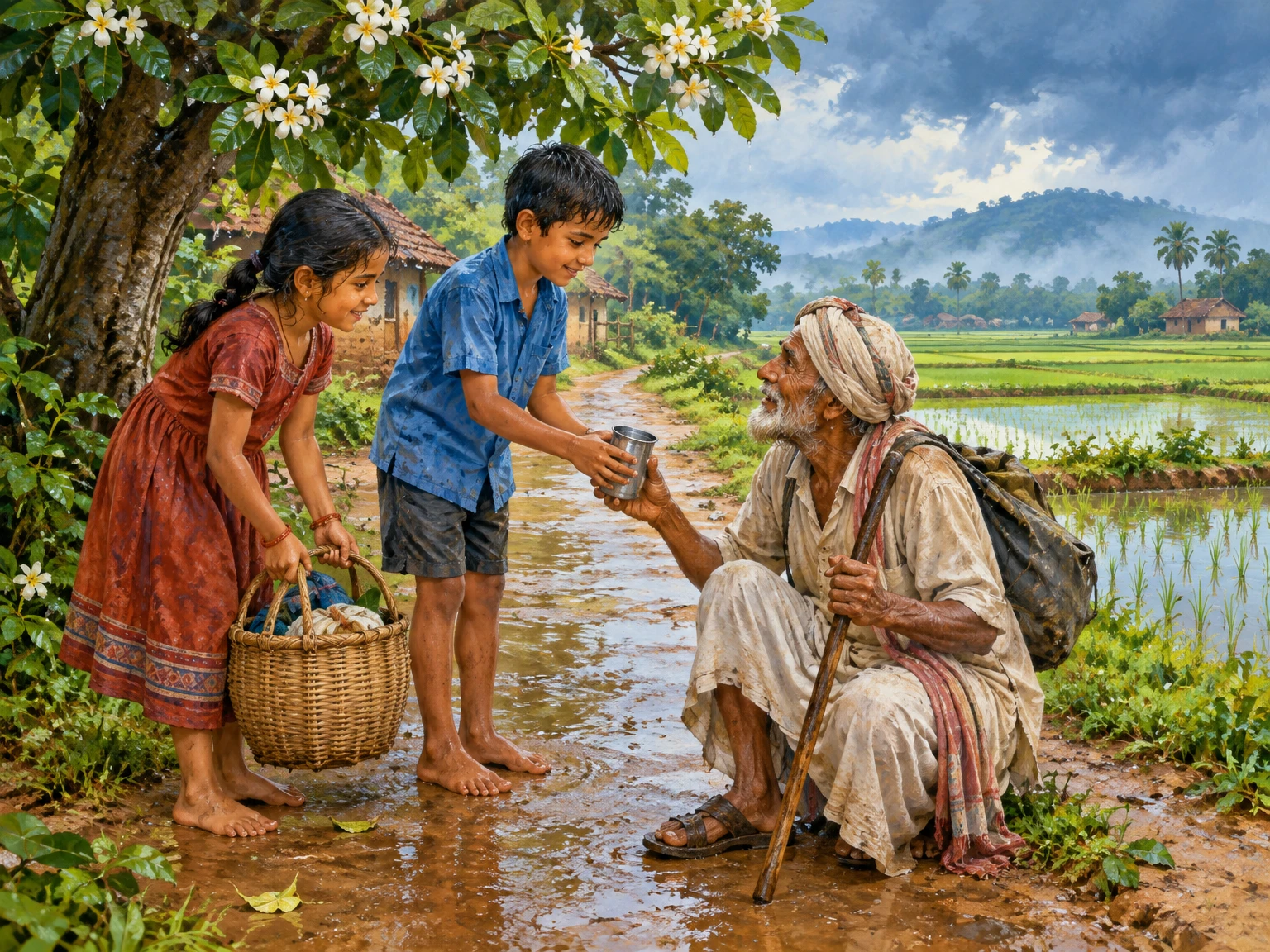
“The fragrance stays in the hand that gives the rose.” This familiar image captures a generous truth: help changes both the person who receives it and the person who offers it. The Odia phrase “Sahajyara Suphala,” commonly rendered as “the fruits of helping,” gives this reflection its point of departure. The essay below is an original meditation on mutual aid, kindness, responsibility and community. It is not a transcription or substitute for any school lesson. The title and theme evoke a primary-school moral story, but the exact wording and details of any textbook edition should be checked against the relevant book.
A small phrase with a wide horizon
Some lessons enter memory not through complicated theories but through a brief scene: someone is in difficulty, another person notices, and a choice has to be made. A child may understand the scene before being able to explain its ethical meaning. That is one reason a simple story about help can travel so far beyond the classroom. It gives a name to a quality that is otherwise abstract. “Sahajya” is not merely a pleasant feeling toward another person; it becomes visible in attention, effort and a willingness to share what one can. “Suphala,” the good fruit, invites a question: what grows after such an act? The answer need not be a reward or a debt. It may be a safer path, a restored confidence, a stronger relationship or a community more capable of facing the next difficulty. The fruit is often distributed among people who never meet the original helper.
Reading a moral story without flattening it
A moral tale can be treated as a command—“be good”—or as an invitation to think. The second approach respects a young reader more. Rather than handing down a finished verdict, a story can open questions: Who needed help? What did the helper know? Was assistance offered freely? What changed afterward? Could the act have caused harm if done carelessly? Asking such questions does not weaken the lesson. It makes the lesson usable in a world more complicated than the page. A narrative about kindness is not a universal instruction to intervene in every situation in the same way. Good help requires attention to circumstances, consent, safety and the wishes of the person concerned. The story’s enduring value lies in the habit it encourages: notice another person’s need, consider what is actually useful, and respond with humility rather than self-display.
The moment before helping
Many acts of generosity begin before any visible action. They begin with noticing. A crowded room, a schoolyard or a village path may contain someone who has been excluded, left behind or quietly struggling. Yet seeing a person is not the same as seeing the problem. We may assume that we know what someone needs because we recognize a familiar situation. We may hurry to offer advice when the person wants to be heard, or take control when they want a choice. The pause before helping matters: “Would this be useful?” “What would make this easier for you?” “Is there a safer way?” A child learning this pause learns that kindness includes respect. Assistance is not a performance in which the helper becomes the hero. It is a cooperative act in which the other person remains a person with judgment, preferences and dignity.
Need, ability and the size of an act
People often imagine that meaningful help must be grand. That belief can become an excuse for doing nothing: if we cannot solve the whole problem, we conclude that a small contribution has no value. But communities are built from actions of many sizes. A friend can explain one difficult idea; a neighbor can carry a container; a classmate can make room at a table; a passerby can call someone better equipped to help. Each act is limited, and that limitation is not a defect. It is honest. A useful response fits the need and the helper’s capacity. Giving time, information, attention, practical skill or a safe connection may matter more than giving money. The ethical question is not “Was the gesture impressive?” but “Did it responsibly improve the situation?” A modest act offered consistently can create conditions for a larger change without pretending to be the whole solution.
Reciprocity is not a bill
The language of “return” can be misunderstood. If we help only because we expect repayment, praise or influence, kindness begins to resemble a transaction. Human beings do need fair exchange, and promises should be kept; but an act of care is not automatically a loan. Its return may be indirect, shared or impossible to measure. A person helped today may never be able to repay the original helper. Later, that person may support someone else, make a group more welcoming or simply recover the freedom to pursue a life of their own. None of these outcomes is a personal payment. They are ways that social trust circulates. The “fruit” is not a receipt issued to the giver. It is the possibility that good conditions become easier to reproduce. A generous society does not keep a private ledger of who owes whom for every kindness.
Why trust grows slowly
Trust is not created by a single gesture alone. It grows when words and actions meet repeatedly. A promise to help followed by silence may injure more than it assists. A small commitment kept can be more reassuring than a sweeping offer that cannot be fulfilled. This is why reliable help is often unglamorous: arriving when agreed, listening without gossip, explaining what one can and cannot do, and following up when it is appropriate. Trust also requires boundaries. No one can carry every burden, and pretending otherwise eventually produces exhaustion or resentment. Saying “I can do this part, but I cannot do the rest” may be more ethical than promising everything. When people know the limits of an offer, they can make informed choices and seek other support. Honest limits do not cancel kindness; they give it a stable shape.
From individual virtue to shared arrangements
Personal goodwill matters, but it cannot replace fair institutions or shared responsibility. If a community repeatedly faces the same preventable hardship, it is not enough to praise individual rescuers. We should also ask why the difficulty keeps occurring and what collective arrangement could reduce it. A neighbor who helps a child reach school performs a humane act; a safe route and accessible transport would address the wider condition. A person who shares food during a crisis offers immediate relief; dependable systems of support can make relief less dependent on chance. These levels of response work together. Compassion helps people through the present moment, while organization can alter the conditions that create repeated need. A moral story can therefore prompt both tenderness and inquiry. Who is being helped, and what would make such help less necessary next time?
The Odia setting: relationship, work and place
The phrase is rooted in an Odia linguistic and cultural setting, and that setting deserves care rather than decorative generalization. Odisha contains many regions, communities, occupations and traditions; no single sentence can represent all of them. Still, everyday life in any place is shaped by relationships and interdependence. A household depends on labor performed beyond its walls. Fields, markets, roads, schools and public services connect people who may never know one another personally. The language of helping can make those connections visible. It can remind a young reader that one person’s effort often rests on the effort of many others: the person who grows food, teaches a class, repairs a path, cares for a child or keeps a public place usable. Recognizing interdependence does not erase individual achievement. It gives achievement a fuller setting and helps us see the invisible support beneath it.
Children as moral thinkers
Children are often told what goodness looks like, but they also notice when rules are applied unevenly. They recognize who gets invited to play, whose mistakes are forgiven, who is expected to share and who is left carrying the work. A classroom discussion about helping can begin with these observations. Instead of asking only whether a character behaved well, an adult can ask what made help possible, whether the recipient had a choice, and how the group might have acted differently. These questions let children practice judgment without demanding that they solve adult problems. They also help distinguish generosity from pressure. Sharing is meaningful when it is freely offered, not forced from someone who has little. Listening to children’s interpretations can reveal details that adults overlooked. A lesson about care becomes deeper when learners are treated as participants in ethical thought rather than as containers for a slogan.
Learning by watching
Children observe the everyday behavior around them more closely than adults sometimes realize. They see whether people speak respectfully to workers, whether a family member’s contribution is acknowledged, whether an apology is followed by repair, and whether help is offered only to those who can return a favor. These examples teach as much as a formal lesson. If adults want children to value generosity, they can make their own decisions visible in ordinary language: “I am helping because this matters, and I will ask what would be useful”; “I cannot do that safely, so I will find someone who can”; “I made a mistake, and I need to repair it.” Such explanations demonstrate that kindness involves thought. They also show that a person can be caring without being perfect. A culture of help is not created by demanding flawless heroes, but by making considerate, accountable behavior normal and learnable.
Empathy and imagination
Empathy begins with an attempt to imagine another person’s experience, but imagination is not identical to knowledge. We can picture what someone might feel and still be mistaken. For that reason, empathy should lead us toward listening, not away from it. A story allows readers to rehearse perspective-taking: What does the traveler notice? What worries the child? What might the helper misunderstand? In real life, the person receiving support should not be reduced to a lesson for others. Their hardship is not a prop to make a helper appear generous. A respectful story keeps attention on human complexity, and respectful action does the same. It allows the other person to speak, refuse, decide or participate. Imagination opens the door; conversation helps us find out whether we have entered the right room. This distinction is especially important when discussing people facing poverty, disability, illness or social exclusion.
Care without humiliation
Help can solve one problem and create another if it exposes or shames the person who receives it. Publicly announcing someone’s difficulty, sharing an image without permission or making assistance conditional on gratitude can turn generosity into a loss of privacy. The way an act is offered matters as much as its material value. Quiet support may protect dignity better than a dramatic gesture. In a school setting, that may mean offering a classmate help without making them the subject of a crowd’s attention. In a community setting, it may mean asking before sharing personal details with others. Care should not demand a performance of thankfulness. A person can appreciate assistance and still feel uncomfortable with how it was given. Learning to separate the helper’s good intention from the recipient’s experience is an important part of ethical maturity. Good intentions are a beginning, not proof that every choice was right.
When helping means asking for help
People sometimes imagine that the generous person must always be the one who gives. That picture is incomplete. Accepting support can be an act of trust, and asking for assistance can help a group understand what is needed. Pride, fear of judgment or a wish not to burden others may keep people silent. A welcoming community makes requests less costly by responding without mockery and by avoiding the assumption that need reveals weakness. It also gives people more than one way to ask: privately, through a trusted adult, or through an organized service. Support should not depend on someone being able to make a polished speech about their hardship. This insight changes the meaning of reciprocity. At one time a person may give, at another they may receive, and often both happen in the same relationship. Mutual care is not a ranking of strong and weak; it is a shared recognition of changing circumstances.
Fairness in the distribution of care
Kindness can be sincere and still uneven. We often notice people who resemble us, speak as we do, or belong to our immediate circle. A story about helping can invite a broader question: who is routinely visible, and who must struggle to be noticed? Fairness asks us to look beyond preference without pretending every situation is identical. It may require giving more attention to someone who has had fewer opportunities, or changing a shared rule that disadvantages a particular person. Fairness is not always achieved by dividing everything into equal portions. It means taking relevant differences seriously and making decisions that people can understand and question. An act of assistance becomes more durable when it is connected to fair treatment rather than personal favoritism. The goal is not to eliminate close bonds, but to prevent closeness from becoming the only doorway through which compassion can pass.
Help and the natural world
Our language of mutual aid can extend beyond human relationships, though it should not turn nature into a simple moral illustration. Soil, water, plants, animals and people exist in connected systems, but that does not mean every natural process is gentle or fair. It means that choices affecting land and living beings have consequences that cross boundaries. A child who plants and waters a seed learns patience; a family that keeps a water source clean protects more than its own household; a community that cares for shared trees improves a place for future residents. These acts are not substitutes for careful environmental policy, and they should not be romanticized as effortless solutions. They do, however, make responsibility tangible. The fruit of care may arrive slowly, in shade, healthier soil, cleaner surroundings or a habit of stewardship. Such outcomes remind us that some forms of help are directed toward people we will never meet.
Digital life and the temptation of display
Modern tools can help people find assistance quickly, but they can also turn kindness into public content. A photograph, message or fundraising post may bring needed attention; it may also expose someone’s identity, circumstances or emotions without consent. The question is not whether digital sharing is always wrong or always useful. It is whether the person affected understands and agrees to what is being shared, whether the information is accurate, and whether the post directs attention toward a real need rather than toward the helper’s reputation. Online praise can be pleasant, but it is not a reliable measure of value. Some of the most consequential acts remain private. A young reader can learn to pause before forwarding a story: Is it verified? Does it reveal someone’s private information? Could I help by contacting an appropriate service instead? In digital spaces, responsibility includes the consequences of attention as well as action.
Measuring an outcome carefully
It is tempting to describe every kind act as a complete success. Life is rarely so neat. Assistance may improve one part of a situation while leaving the larger difficulty unresolved. A person may receive a useful resource and still face hardship tomorrow. A conversation may reduce loneliness without removing every cause of it. Recognizing partial outcomes is not cynicism; it helps us learn. We can ask what changed, what did not, and whether the person’s own view of the result matches ours. This prevents the helper from claiming more than the evidence supports. It also protects the receiver from being made responsible for validating someone else’s story of success. The “good fruit” may be a first step rather than a final harvest. If we treat progress honestly, we can continue with better understanding instead of congratulating ourselves prematurely. Reflection is a form of care because it improves what we may do next.
The difference between kindness and control
Because help can create influence, it is important to notice when an offer begins to become control. Assistance should not be used to demand obedience, access, silence or loyalty. A person who receives help does not surrender the right to disagree. In a classroom, a supportive adult should not require a child to disclose more than necessary. In a community, a donation should not become a reason to dictate the recipient’s private choices. The boundary can be subtle: “I know what is best for you” may sound caring while ignoring what the other person has said. The remedy is not to avoid responsibility but to share it. Explain the options, ask what the person wants, and make clear what conditions genuinely apply. When help is part of a professional or safety process, those rules should be stated honestly. Respectful support leaves room for choice wherever choice is possible.
Gratitude, obligation and freedom
Gratitude can strengthen a relationship when it is freely felt and expressed. It becomes harmful when it is demanded as the price of assistance. A person who has been helped may be relieved, grateful, confused, tired or all of these at once. They may need time before they can respond. The helper’s responsibility is to offer support without insisting on a particular emotional reaction. Similarly, receiving help does not create a permanent obligation to repay the giver in the exact same form. Fair agreements are different from emotional debt: a clear loan or shared task may involve a promise, while a kind gesture may not. Distinguishing these things helps both sides. It allows people to accept genuine generosity without fear that invisible conditions will later appear. A healthy culture honors gratitude but does not weaponize it. The deepest fruit of giving may be that people retain their freedom and dignity afterward.
Community memory and inherited kindness
Communities remember more than famous events. They remember who opened a door in a difficult season, who made room for a newcomer, who shared knowledge without guarding it, and who repaired a shared space after others had left. These memories can become informal guidance for the next generation. They also deserve to be told accurately and with permission. No community is made only of noble acts, and a balanced memory should not hide conflict or inequality. Still, stories of practical care show that cooperation is not an abstract ideal; it is something people have repeatedly attempted in ordinary conditions. A child hearing such stories can ask how the act worked, who contributed, and what would make the community more inclusive now. Memory becomes valuable when it does not merely praise the past but helps people recognize opportunities in the present. The inherited lesson is not “everything was better before,” but “our choices can make life more livable together.”
What a classroom can do with the theme
Teachers and families can extend this theme with activities that do not require copying a textbook passage. Children might map the people and services that help a meal reach the table, then notice where cooperation occurs. They could discuss a fictional dilemma in which a character wants assistance but has not asked for it, and consider safe ways to respond. They might practice phrases that offer help without pressure: “Would you like me to stay?” “Should I find an adult?” “Would you prefer to try first?” Another exercise is to identify one small improvement a group can make to a shared space, then reflect on who benefits and who does the work. Such activities make ethics concrete while allowing different answers. They also demonstrate that a lesson is not a demand to perform charity. It is an invitation to notice, think, ask and act responsibly. The best discussion leaves room for uncertainty and disagreement.
A short original reflection
A hand opens, not to own the rain,
but to let one thirsty seed remain.
A path is safer where two walk,
and fear grows lighter when we talk.
The gift is not a golden chain,
nor praise that must be paid again.
It is a place where both can stand,
with choice still resting in each hand.
This short verse is newly written for this essay and is not presented as a traditional poem. Its images are deliberately simple: rain, a path, conversation and an open hand. The point is not that kindness always solves a problem. The point is that care can create room for the next possible step. Sometimes that step is practical, sometimes emotional, and sometimes it is simply making sure a person is not left alone while a better solution is found.
Questions for reflection
Readers can carry the theme into daily life through questions rather than slogans. What do I know about the situation, and what am I only assuming? Have I asked what kind of support is wanted? Is the person safe? Am I able to offer what I am promising? Could another person or service respond more effectively? Will my action protect privacy and dignity? Does this difficulty point to a shared condition that needs a collective response? If the person declines my offer, can I respect that decision? These questions are not meant to make kindness slow or timid. They help make it dependable. A quick offer can still be thoughtful if it is guided by attention. Over time, asking these questions builds judgment—the ability to adapt a generous intention to a real person and a real moment, rather than applying the same gesture everywhere.
Conclusion: the harvest is shared
“Sahajyara Suphala” can be read as a reminder that assistance has consequences beyond the moment of giving. A thoughtful act may ease an immediate burden, protect dignity, strengthen trust, invite further cooperation or reveal a problem that needs a wider response. None of these results is guaranteed, and none should be claimed without listening to the people involved. The metaphor of fruit is useful precisely because growth takes time and depends on conditions. A seed needs care, but care does not command the season. In the same way, generosity matters, but it does not give one person control over another’s life. Its best outcomes are shared: people gain more room to participate, communities become more reliable, and help can circulate without turning into a debt. The lesson is not that every problem can be solved by goodwill. It is that a humane society begins by noticing one another, responding with respect and continuing to ask what fairness requires.
Video resource
For readers who would like to explore the school-lesson context, this third-party educational video is titled “Sahajya ra Suphala | ସାହାଯ୍ୟର ସୁଫଳ | Class 3 | Ama Bhasa Ama Sahitya | Chapter 9”: https://www.youtube.com/watch?v=anqR6Cp9Kd0. It is linked as an external classroom resource, not reproduced here. The article is an independent reflection and does not transcribe or reproduce the video or a textbook chapter.
Disclaimer
This content is a collection of ancient history,books and various articles and collection of library and news and other post ; all details may not be the same. Readers are requested to verify the information themselves. Readers are not allowed to take any disciplinary action; content is only for educational purposes. If readers do not agree about the contents, they may send a personal comment to my personal email ID: achary.purna@gmail.com.
