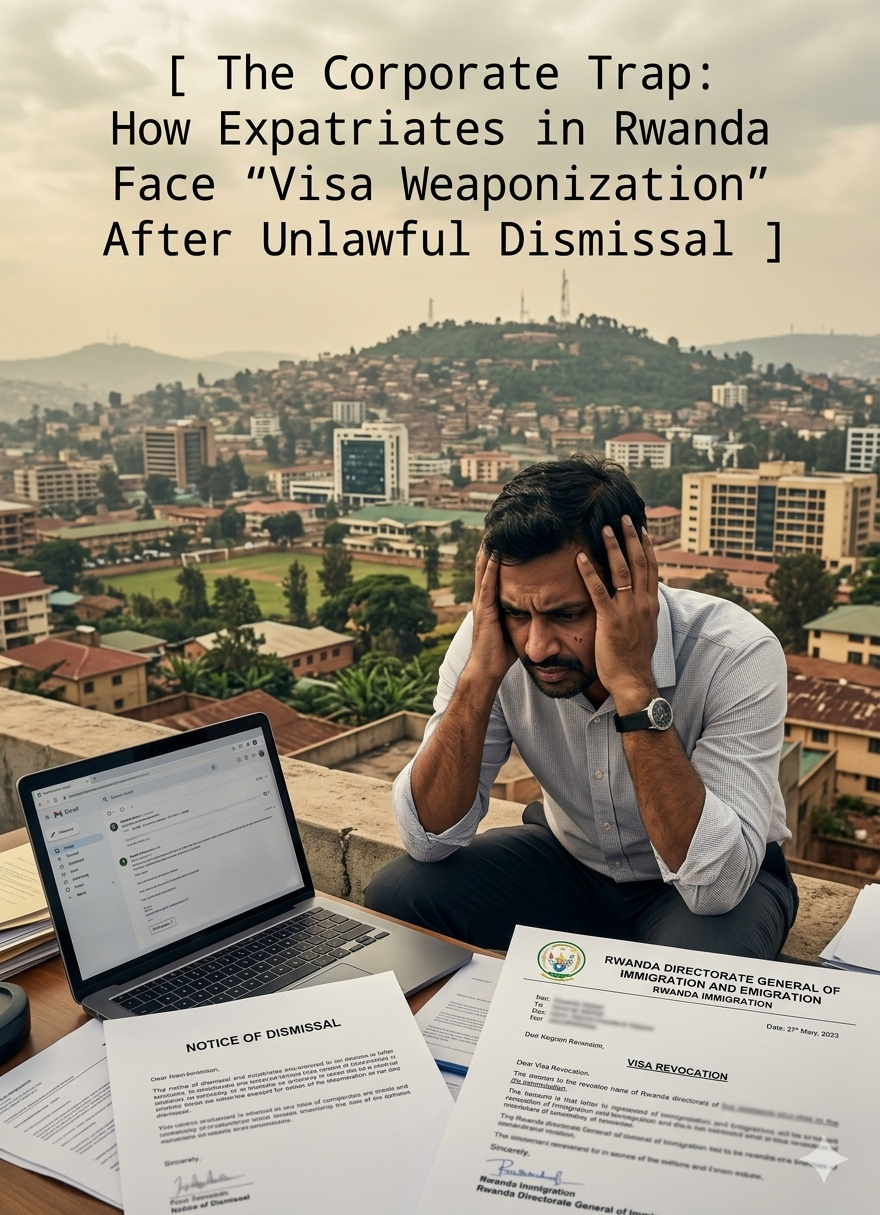


When a foreign professional signs an international employment contract, they are not merely relocating for a career opportunity. They are placing their legal status, livelihood, and human dignity into the hands of an employer. In Rwanda, foreign professionals on standard corporate work permits operate under Class H1 Visas, which are strictly employer-sponsored. But what happens when an employer weaponizes that visa? What happens when they unlawfully terminate you, cut off your income, and remain deliberately silent when you request basic visa compliance in order to pursue your case in court?
This is not one individual’s isolated experience. It is a systemic corporate vulnerability that many foreign professionals face when employment relationships break down. This article provides a thorough legal analysis of how employers attempt to distort Rwandan Labour Law (Law N° 66/2018) and Immigration Law (Law N° 57/2018), why those arguments fail decisively at the High Court level, and how an expatriate can respond firmly and authoritatively to dismissive corporate conduct.
Part I: The Employer’s Unlawful Arguments — Exposed
When an international professional obtains an unlawful termination ruling at the Intermediate Court, defensive employers frequently deploy three fundamentally illegal arguments to evade full liability.
1. The Myth of the “Job Certificate” as a Free Pass
What the Employer Claims: “We issued your job certificate on December 28, 2023. You are free to seek other employment; we bear no further responsibility for your visa costs.”
What Rwandan Law Provides: This argument is a deliberate distortion of Ministerial Order N° 06/01 of 29/05/2019 relating to Immigration and Emigration. A Class H1 visa is legally bound to a specific corporate sponsor. An expatriate cannot simply present a job certificate to a new employer and commence work. Any prospective employer would be required to initiate an entirely new work permit application — a process that is functionally obstructed when the original sponsor remains engaged in an active, unresolved labour dispute arising from an illegal dismissal. By issuing a non-contractual notice and unilaterally withdrawing sponsorship, the employer deliberately rendered alternative lawful employment a legal impossibility.
Applicable International Law: This conduct also conflicts with Article 6 of the International Covenant on Economic, Social and Cultural Rights (ICESCR), to which Rwanda is a signatory, which recognises every person’s right to gain their living through freely chosen and accepted work. Obstructing a worker’s ability to access lawful employment through administrative manipulation is a direct infringement of this right.
2. The Bad-Faith “Silence” and the Immigration Rescue
What the Employer Claims: “Your visa expired in January 2024. We are not responsible for what happened thereafter.”
What Rwandan Law Provides: When the employee formally emailed the employer in January 2024 requesting a temporary visa extension solely to complete the pending labour dispute process, the employer’s complete silence constituted a serious breach of contractual good faith. The employer deliberately sought to engineer the worker’s reclassification as an undocumented person — effectively attempting to trigger administrative deportation and destroy the labour case by removing the plaintiff from the country.
The Directorate General of Immigration and Emigration, acting under Law N° 57/2018, saw through this corporate strategy. By converting the Class H1 visa to a Temporary Residence Visa, the Rwandan state formally acknowledged the employee as a victim of an active legal dispute, entirely invalidating the employer’s attempt to deploy immigration status as a tool of coercion and physical duress.
Applicable International Law: Under the ILO Termination of Employment Convention, 1982 (No. 158), Articles 8 and 13, workers must have access to effective remedies following unlawful dismissal, and employers are prohibited from taking any action that undermines a worker’s ability to pursue such remedies. Using visa non-renewal as an instrument of procedural obstruction is a direct violation of this Convention. Furthermore, the UN Basic Principles on the Role of Lawyers affirm every individual’s right to effective access to legal remedies — a right that is nullified when a claimant is administratively expelled from the jurisdiction where their case is pending.
3. The “Youth and Capability” Fallacy
What the Employer Claims: “You are young and capable. You can go elsewhere, find alternative employment, or accept a lower-paying position while this case continues.”
What Rwandan Law Provides: Under Article 74 of Law N° 66/2018, an employee who has suffered unfair and unlawful dismissal is entitled to full restitution. An employer cannot commit an unlawful act — illegal termination — and then instruct the victim to mitigate damages by violating immigration regulations or accepting employment incompatible with their professional standing and contractual grade. A foreign national cannot legally take informal or casual employment in Rwanda without breaching the explicit conditions of their authorised stay.
Applicable International Law: Article 7 of the ICESCR guarantees every worker the right to just and favourable conditions of employment. An employer who causes unlawful harm cannot subsequently demand that the victim accept unjust or inferior conditions as a remedy. The ILO Discrimination (Employment and Occupation) Convention, 1958 (No. 111), further protects workers from distinctions that impair equality of opportunity — and directing a foreign professional to accept sub-standard employment, whilst a domestic worker in the same position would receive full restitution, constitutes precisely such discrimination.
Part II: The Authoritative Response to Corporate Gaslighting
Should an employer attempt to diminish your rights by suggesting that youth and capability are relevant to their statutory obligations, the following response is professional, precise, and legally unassailable:
“Your assessment of my professional capabilities and personal circumstances is entirely irrelevant to your statutory and contractual obligations under Rwandan law. My abilities do not grant you a legal licence to breach an employment contract, nor do they excuse the unlawful termination already recognised by a court of law.
You claim that I had the option to seek alternative employment using a job certificate. However, as a foreign professional operating under Rwandan immigration law, you are fully aware that my legal right to work was directly and exclusively tied to your corporate sponsorship. By unlawfully terminating my contract and maintaining deliberate silence in response to formal requests for visa compliance, you actively and knowingly blocked every avenue of lawful alternative employment. You did not provide me with an option; you constructed a deliberate administrative trap designed to force me into structural and economic vulnerability.
The intervention of the Directorate General of Immigration and Emigration, which granted me a Temporary Residence Visa, confirms that Rwanda’s regulatory authorities recognised my status as a legitimate litigant pursuing justice against your unlawful conduct. Every visa fee, every regulatory cost, and every day of forced professional inactivity I have endured since January 2024 is a direct and foreseeable consequence of your illegal termination and bad-faith omissions. I am not seeking options from you. I am seeking full legal restitution before the High Court of Rwanda, and your liability for these damages is absolute.”
Part III: Defeating This Strategy Before the Rwandan High Court
This matter must not be presented to the High Court merely as a straightforward dismissal dispute. It must be framed precisely as a case of Administrative and Economic Duress inflicted through deliberate corporate bad faith.
1. Restitutio in Integrum — Full Financial Restitution
Under the civil liability principles applied in Rwandan courts, a party must be restored to the position they would have occupied had the wrongful act not occurred. Every visa fee, immigration cost, and associated expense incurred in maintaining lawful residency since January 2024 must be recovered in full. Those costs would not have existed but for the employer’s unlawful termination. The principle of restitutio in integrum demands nothing less than complete restoration.
2. Continuous Back-Pay for Structural Forced Unemployment
Because an H1 visa holder cannot legally transition to alternative employment during an active sponsorship dispute, the employer effectively placed the worker under a form of structural economic confinement — legally barred from earning locally and legally unable to abandon the proceedings without forfeiting their rights.
The High Court submission must invoke Article 74 of the Labour Law and demand maximum indemnity and full back-pay for the entire duration of the proceedings. The submission should state plainly: the plaintiff did not choose unemployment; the defendant’s illegal acts and deliberate refusal to facilitate immigration compliance legally barred the plaintiff from re-entering the workforce.
Under ILO Convention No. 158, Article 12, workers unlawfully dismissed are entitled to adequate compensation, and that compensation must account for the full scope of loss — including loss caused by the employer’s conduct during the post-termination period.
3. Exposing Deliberate Silence as Proven Malice
The digital record from January 2024 must be placed squarely before the High Court. The evidence must demonstrate that while the employee was actively pursuing the legal process through the Labour Inspector’s Office, the employer consciously and deliberately ignored formal communications concerning visa compliance. This evidence transforms the case from administrative negligence into deliberate, proven bad faith — exposing the employer to maximum damages.
Under the UNIDROIT Principles of International Commercial Contracts, Article 1.7, parties to a contract are bound by an overriding obligation of good faith and fair dealing. Silence in the face of formal compliance requests — when that silence predictably causes severe harm to the other party — is an independent and serious breach of this obligation.
A Final Note for International Professionals
The High Court of Rwanda is a venue of genuine institutional integrity. Its laws are designed to protect workers from predatory corporate conduct, without distinction of nationality. When a corporation believes it can exploit a foreign professional’s lack of local administrative roots by severing their visa lifeline, it is not merely acting unethically — it is exposing itself to severe judicial consequences.
The law does not permit an employer to manufacture an administrative crisis and then stand aside, arms folded, while the victim drowns in immigration costs and professional stagnation. International legal frameworks — from the ICESCR to ILO Conventions — exist precisely to ensure that corporate power cannot override fundamental human and labour rights, wherever in the world that power is exercised.
No employer stands above the law. And no foreign professional should ever be made to feel that their lack of local roots diminishes the full force of their legal rights.
This blog is intended for informational purposes only and does not constitute formal legal advice. Readers facing specific legal situations are encouraged to consult a qualified legal professional.