



















.jpg?w=218&resize=218,150&ssl=1 "UNESCO Zollverein Coal Mine Industrial Complex & Other Things to do in Essen, Germany | My Travelogue")











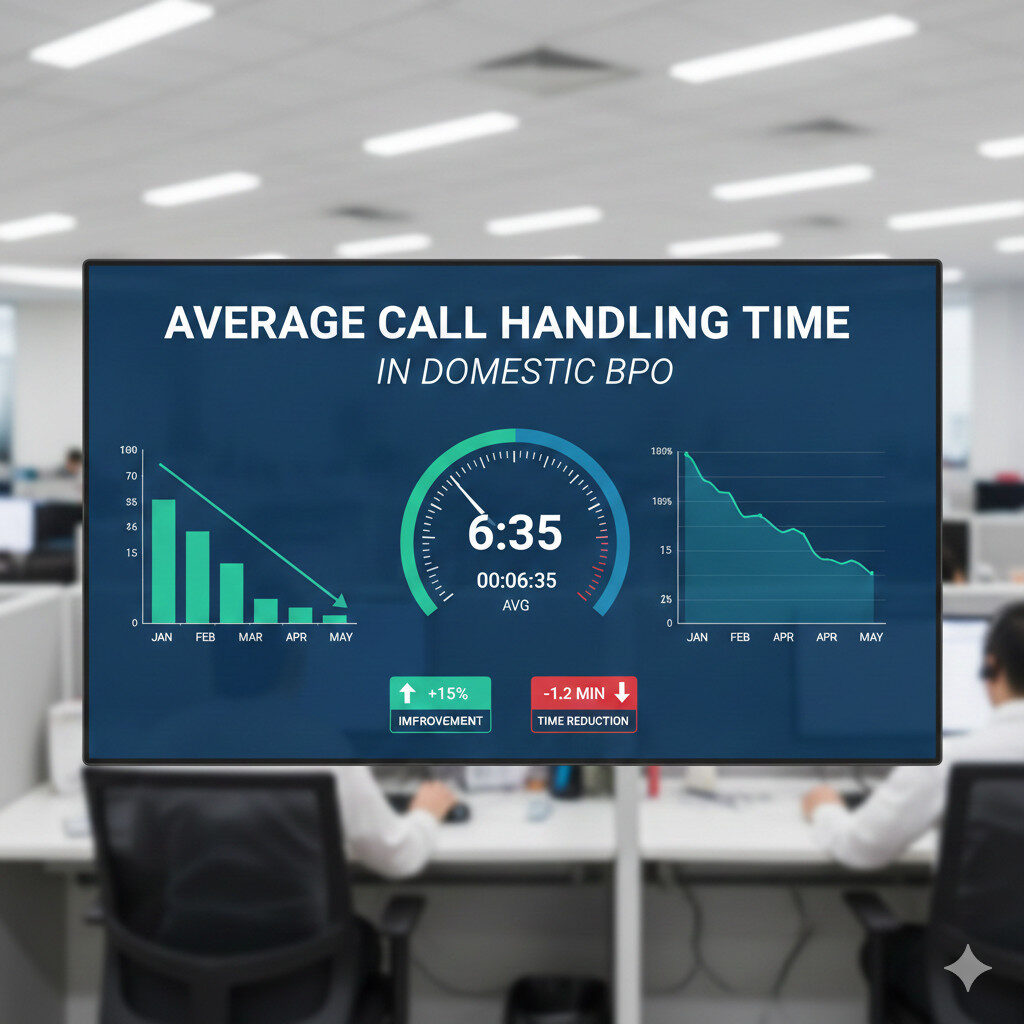
Average Call Handling Time (AHT) is one of the most scrutinized and debated metrics in the Business Process Outsourcing (BPO) industry. Within the context of Domestic BPO—where services are provided to clients within the same country—AHT takes on a unique flavor influenced by local language nuances, cultural familiarity, and specific regional market expectations.
While the mathematical formula is universal, the application and strategic value of AHT in a domestic setting differ significantly from international offshore centers.
1. Defining Average Call Handling Time (AHT)
AHT is a Key Performance Indicator (KPI) that measures the average duration of an entire customer transaction from start to finish. It is not merely the time spent talking; it encompasses the total lifecycle of an agent’s involvement in a single interaction.
The Formula
AHT =Total Talk Time + Total Hold Time + Total After-Call Work (ACW) / Total Number of Calls Handled
The Three Pillars of AHT
- Talk Time: The actual duration of the verbal exchange between the agent and the customer.
- Hold Time: The time a customer spends waiting while an agent researches information, consults a supervisor, or navigates a slow system.
- After-Call Work (ACW) / Wrap-up: The time an agent spends after the caller hangs up to update the CRM, send confirmation emails, or log the nature of the inquiry.
2. The Domestic BPO Context: A Critical Distinction
In a Domestic BPO, agents and customers share the same primary language and cultural background. This leads to several unique characteristics:
- Linguistic Nuances: Domestic calls often involve local dialects or slang. While this can speed up rapport, it can also lead to longer “small talk” compared to the more clinical, structured nature of international calls.
- Cultural Context: Agents in domestic centers understand the local context (e.g., local holidays, current weather events affecting delivery, or regional payment habits). This shared context often eliminates the need for lengthy explanations, theoretically lowering AHT.
- Customer Expectations: Domestic customers often have higher expectations for empathy and “human” connection. A rushed call that prioritizes a low AHT might be perceived as rude or dismissive in a domestic market, damaging Brand Loyalty.
3. Industry Benchmarks for 2025
AHT varies wildly by industry. A 2-minute call is excellent for a pizza delivery order but disastrous for a technical troubleshooting session. Current 2025 benchmarks for domestic operations generally fall into these ranges:
| Industry Sector | Typical AHT (Minutes) | Focus |
| Telecommunications | 5 – 8 | Technical fixes and plan upgrades. |
| Retail & E-commerce | 3 – 5 | Tracking orders and return processing. |
| Banking & Finance | 4 – 7 | Security verification and fraud claims. |
| Technical Support | 8 – 15+ | Complex problem solving and step-by-step guides. |
| Healthcare | 6 – 9 | Patient scheduling and insurance verification. |
4. Factors Influencing AHT in Domestic BPOs
Several internal and external factors can cause AHT to fluctuate:
A. Agent Proficiency
Experienced agents have a “muscle memory” for the CRM and internal knowledge bases. They can predict customer questions and address them proactively, significantly reducing both talk and hold times.
B. System Latency and UI Design
If a domestic BPO uses legacy systems or multiple disconnected applications, agents spend more time “waiting for the screen to load” or “copy-pasting data.” This inflates the Hold Time and ACW.
C. Complexity of Inquiry
As Domestic BPOs increasingly use AI and self-service bots for simple queries (like balance checks), the calls that actually reach human agents are becoming more complex. Consequently, the industry is seeing a natural rise in AHT because the “easy” calls are gone.
D. Compliance and Scripts
Mandatory disclosures—legal scripts that agents must read verbatim—add fixed time to every call that cannot be optimized without changing legal requirements.
5. Challenging the Logic: The “AHT Paradox”
In our role as intellectual sparring partners, we must challenge the assumption that Lower AHT = Higher Efficiency. This is a common trap in BPO management.
The Argument for Higher AHT
If an agent spends an extra 60 seconds on a call to ensure the customer fully understands the solution, they may prevent three “repeat calls” later.
- AHT Logic: Lowering AHT saves money now.
- Truth Logic: Improving First Call Resolution (FCR) saves more money in the long run, even if it requires a higher AHT.
The Danger of “Rushing”
When agents are incentivized solely on AHT, they may:
- Transfer customers to other departments to “get them off their clock.”
- Provide incomplete answers to end the call quickly.
- Hang up on customers “accidentally” when a call is running long.
6. Strategies to Optimize AHT (Without Killing Quality)
Optimization should focus on removing “dead time” rather than rushing the conversation.
- Effective IVR Routing: Ensure the customer reaches the right department the first time. Transfers are the biggest AHT killers.
- AI Copilots: Using Real-Time Agent Assist tools that listen to the call and automatically pull up relevant knowledge base articles can cut search time by 30%.
- Streamlined ACW: Automating data entry and using “one-click” dispositions can reduce wrap-up time from 60 seconds to 10 seconds.
- Robust Training: Focus on “Active Listening.” If an agent understands the problem the first time, they don’t need the customer to repeat themselves—a major source of inflated Talk Time.
7. Conclusion: The Shift to “Total Resolution Time”
As we move through 2025, the Domestic BPO industry is pivoting away from AHT as a standalone “God Metric.” Leading firms now view AHT alongside Customer Satisfaction (CSAT) and Net Promoter Score (NPS).