


















.jpg?w=218&resize=218,150&ssl=1 "UNESCO Zollverein Coal Mine Industrial Complex & Other Things to do in Essen, Germany | My Travelogue")










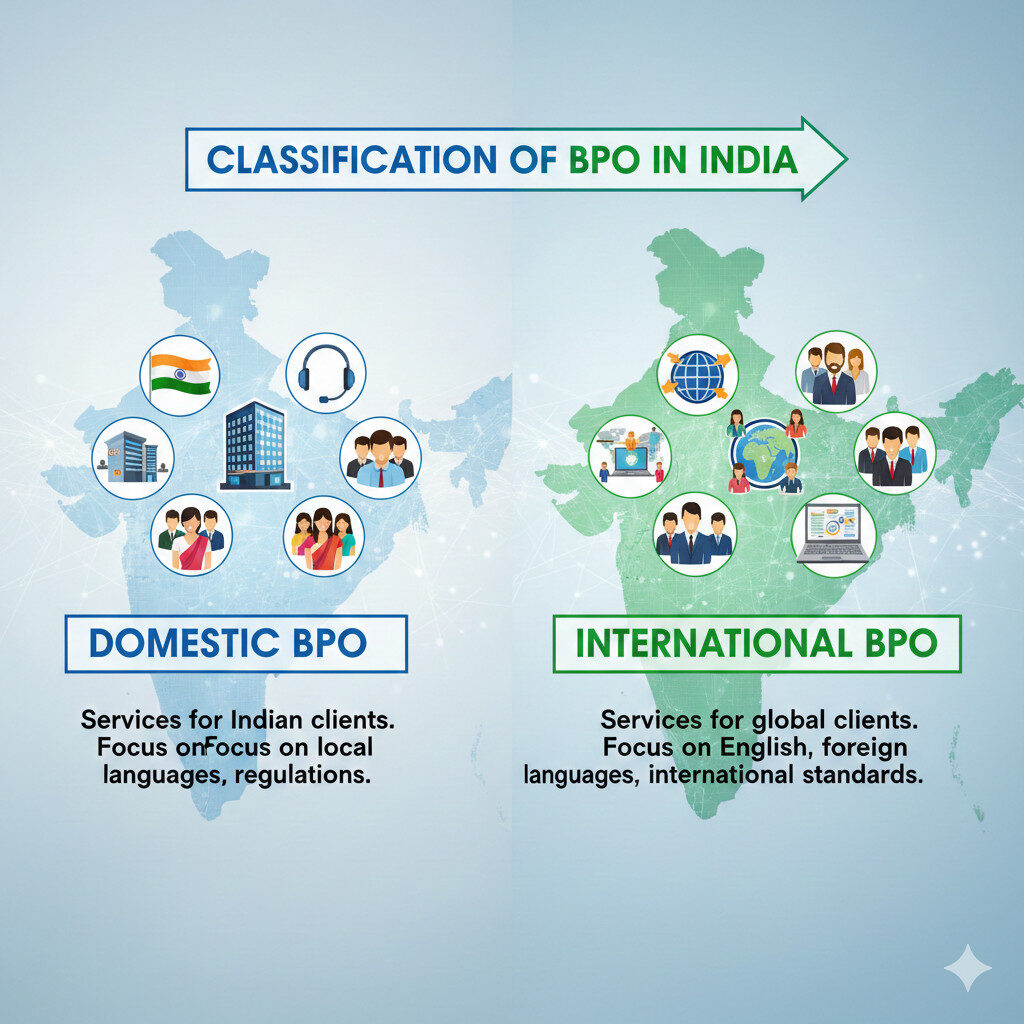
At its core, the classification is based on geographic proximity and market orientation.
- International BPO (Offshore): This involves providing business services to clients located outside of India—primarily in the United States, United Kingdom, Europe, and Australia. India acts as the “back office” of the world.
- Domestic BPO (Onshore): This involves providing services to clients within the Indian borders. The clients are Indian corporations (like Reliance, HDFC, or Tata) or the Indian government, and the end-users are Indian citizens.
2. Classification by Service Type
Regardless of whether a BPO is domestic or international, the industry is classified by the nature of the work performed.
A. Customer Interaction Services (Front Office)
This is the most visible segment, often referred to as “voice-based” services.
- International: Handling global technical support, credit card inquiries, or travel bookings for Western customers. Requires neutral accents and “Global English.”
- Domestic: Handling queries for Indian telecom providers, banks, or e-commerce platforms (e.g., Flipkart, Amazon India). This requires proficiency in regional Indian languages (Hindi, Tamil, Marathi, etc.) rather than just English.
B. Back-Office Operations (Administrative)
- Data Entry and Processing: Managing high volumes of repetitive data.
- Finance and Accounting (FAO): Handling payroll, accounts payable/receivable, and tax compliance.
- Human Resources (HRO): Recruitment, employee record management, and training.
C. Knowledge Process Outsourcing (KPO)
A higher-value tier involving specialized domain expertise.
- Legal Process Outsourcing (LPO): Patent filing, legal research, and contract drafting.
- Medical BPO: Medical transcription, billing, and clinical research.
- Data Analytics: Using Big Data to provide business insights for global and local retail chains.
3. Detailed Comparison: Domestic vs. International
| Feature | Domestic BPO | International BPO |
| Client Base | Indian companies / Govt. | Multi-national corporations (MNCs) |
| Language | Regional languages + English | Neutral/Westernized English |
| Shift Timing | Standard (9 AM – 6 PM) | Night shifts (to match US/UK time) |
| Revenue Model | Higher volume, lower margins | Arbitrage-driven, higher margins |
| Quality Focus | Cultural nuance & local context | Global standardization & SLAs |
| Compliance | Indian laws (IT Act, GST) | International (GDPR, HIPAA, SOC2) |
4. The Growth Drivers: Why the Distinction is Blurring
For decades, the International BPO was the “golden goose” because of cost arbitrage—paying an Indian worker in Rupees to save a US company Dollars. However, the Domestic BPO market is currently experiencing a “silent revolution.”
The “Digital India” Push
With the expansion of the Unified Payments Interface (UPI) and 5G connectivity, millions of Indians are entering the digital economy. This has created a massive demand for domestic support. Indian startups (Unicorns) now require sophisticated BPO support to manage millions of local users, rivaling the complexity of international operations.
Tier 2 and Tier 3 Expansion
Previously, BPOs were concentrated in “Tier 1” cities like Bangalore and Gurgaon. Today, Domestic BPOs are moving to cities like Indore, Jaipur, and Coimbatore.
- Benefit: Lower operational costs and access to a talent pool that is more comfortable with regional languages.
- Impact: This decentralization is driving rural employment more effectively than the international segment ever did.
5. Challenging the Assumptions: A Socratic Critique
As your sparring partner, let’s test the logic of current BPO classifications.
Assumption: “International BPOs offer better career prospects.”
Counterpoint: While international BPOs offer higher initial salaries, they often trap employees in night-shift cycles that lead to high attrition and health issues. Domestic BPOs offer “normal” life cycles and, increasingly, higher-level roles in management for India’s booming retail and tech sectors. If India becomes the world’s 3rd largest economy by 2030, the “domestic” client may soon be wealthier and more influential than many “international” mid-market clients.
Assumption: “AI will kill the BPO industry.”
Counterpoint: AI is not killing the industry; it is killing the commodity tasks. Low-end data entry is disappearing. However, this forces both domestic and international BPOs to move toward KPO (Knowledge Process Outsourcing). The BPO of the future is a “Human-in-the-loop” model where AI handles the query, but a human manages the complex empathy and logic-based edge cases.
6. Emerging Trends in 2025
The Rise of GCCs (Global Capability Centers)
Many companies are moving away from third-party international BPOs and setting up their own GCCs in India. These are “captive units” where the company owns the facility and employs the staff directly. This blurs the line between “outsourcing” and “global operations.”
Omnichannel and Hyper-Personalization
Modern BPOs are no longer just “call centers.” They are Experience Centers. They manage:
- Social Media: Responding to complaints on X (formerly Twitter) or Instagram.
- Video Commerce: Helping customers through live video demonstrations (very popular in domestic Indian retail).
- WhatsApp Automation: Managing the entire customer lifecycle via chat.
7. Strategic Outlook
The classification of BPO in India is evolving from a geographic distinction to a value-based distinction.
- Low-Value BPO: Basic voice and data tasks (Highly susceptible to AI).
- Mid-Value BPO: Specialized customer experience and technical support (Domestic and International).
- High-Value KPO: Strategic consulting, legal, and medical analytics (The future of Indian exports).
Conclusion:
India remains the “BPO capital,” but the narrative has shifted. The international segment is no longer just about cheap labor; it is about high-end technical expertise. Simultaneously, the domestic segment is no longer just a “small brother” to the export market; it is a vital engine of the Indian digital economy, serving 1.4 billion people.