




















.jpg?w=218&resize=218,150&ssl=1 "UNESCO Zollverein Coal Mine Industrial Complex & Other Things to do in Essen, Germany | My Travelogue")












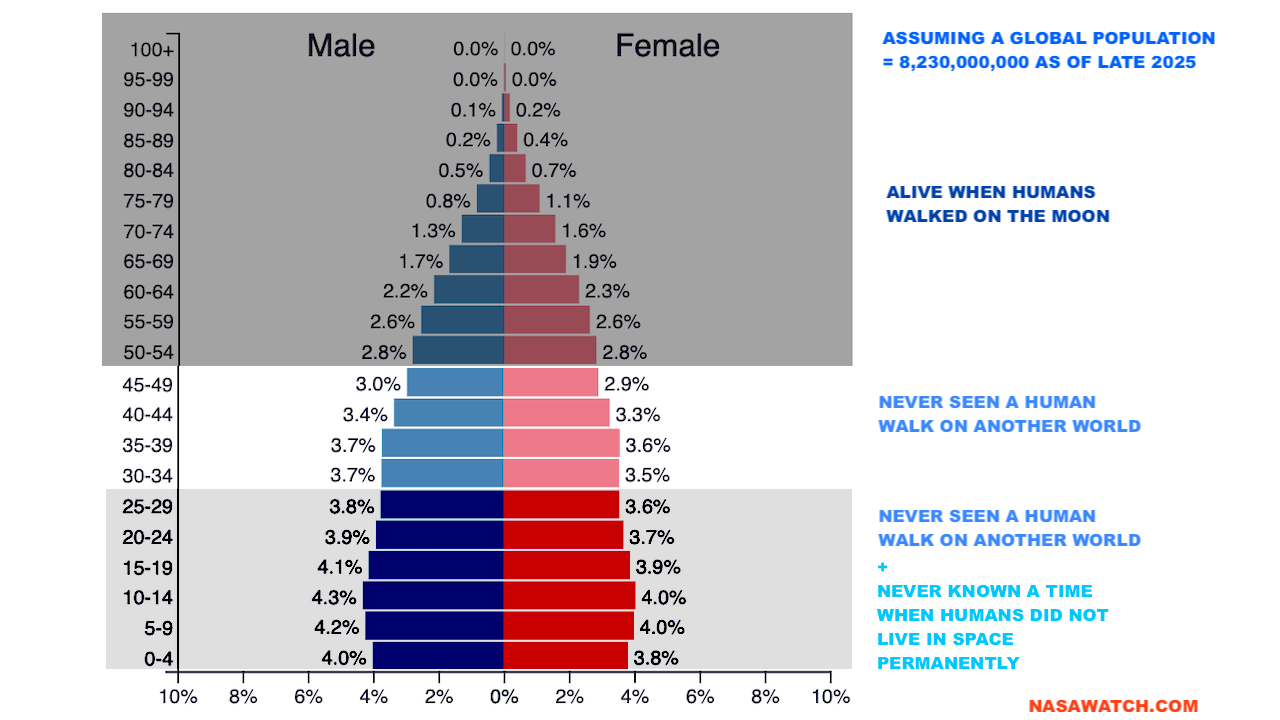
75% – 3/4 of the people on this planet have never seen humans walk on another world. — NASAWatch
Keith’s note: 75% – 3/4 of the people on this planet have never seen humans walk on another world. We’re suddenly in a race to go back to the Moon and we are not clearly in the lead. The next time humans walk on the Moon will be the first time this happens as far as most of humanity is concerned. History is just history. Instead of grainy, flickering black and white imagery on a hulking television we’ll all see people bouncing on the Moon in 4K streaming on our cellphones. How does NASA adapt to this paradigm shift? So far, it is not doing that well. More below.
I first published this in 2017/2018. Listening to all of the talk about going (back) to the Moon – and asking for a show of hands in the audience at NASA HQ for those who saw it live – I thought I’d give Jim Bridenstine Jared Isaacman something to think about. Note the revised chart of Earth’s population above.
Roughly speaking of all 8,230,000,000+ people on Earth today :
- 25.8% were alive when humans walked on the Moon
- 74.4% were not alive when humans walked on the Moon
- 47.3% were not alive when humans walked on the Moon – yet have no recollection of a world where humans did not live in space permanently.
My earlier post look at the U.S. population only. Now we have multiple nations sending things to the Moon. NASA will bring Canadians, Japanese, and European astronauts along. And we are in a self-proclaimed race with China to land humans on the Moon (again). This is now an issue with truly global participation – and competition.
The emergent property of this global population analysis is much the same – more so now – than when I first wrote this: 75% – 3/4 of our world’s population has never seen a human walk on another world. But they have always known spaceflight. And of that younger cohort nearly half of our world has never known a time when humans were living in space – permanently. When I was a boy growing up int he Apollo era spaceflight was only a few years old. My parents read Buck Rogers comic strips in the newspaper.
For most of humanity – regardless of where they live – this 21st century era of lunar exploration will be their FIRST human landing on the Moon. Back in the Apollo era the notion that this was faked or never happened was not a thing people talked about. Today – people either do not know, or do not care about the Apollo landings. Many ask why we want to do something we did half a century ago. And anyone with a cellphone can now created convincing fake moon landing videos. So “why” is a good question to ask.
Snark and cynicism aside, the whole notion of entering space and reaching toward the Moon has remained an Acme of accomplishment for many other nations – just as it was for America and Russia back in the 60s. And these other nations are willing to go with – or without us. But go they will. This is one way to make an entire nation proud and show that they have earned a seat at the table of great nations. Hard to resist that.
I’ll end with this: there are as many reasons to go back to the Moon as there are people to harbor them – and probably as many equally pressing reasons to focus on other things instead. China is going. Full stop. If America wants to extricate itself from its chronically late and over budget lunar effort then something has got to change – now.
I get the impression that Jared Isaacman is up to that challenge. Stay tuned.
Keith’s original 28 November 2017 note: There is a lot of talk these days about yet another pivot in America’s civilian space policy. This time it is “back” to the Moon. Mars is not off the agenda – but it is not moving forward either. Personally I think we have unfinished business on the Moon and that creating a vibrant cis-lunar space infrastructure is the best way to enable humans to go to many places in the solar system – including Mars. Regardless of your stance on this issue, a common refrain about going back to the Moon – starting with President Obama is that “We’ve been there before”.
Humans first reached the South Pole by an overland route in 1911/1912. While we visited the pole by plane in the intervening years, no one traversed Antarctica’s surface again until 1958. 46 years between Antarctic polar traverses. Why did we go back to do something – again – in a similar way – to a place “we’ve been [to] before” after 46 years? Because there was still something of interest there – something we’d only had a fleeting exposure to – and we had developed new ways to traverse polar environments.
James Cameron revisited the Challenger Deep in 2012 – after a human absence of 52 years. Why? See above. It is understandable that explorers seek to explore new places and not redo what has been done before. There is only so much funding and there are still so many places yet to be explored. But it is also not uncommon for explorers to revisit old, previously visited locations with new tools – and new mindsets.
Look at the stunning imagery Juno is sending back of Jupiter. Compare that to what we got from Galileo – and Voyager – and Pioneer. Why send yet another mission to the same destination unless, well, you have better tools – tools that enable the pursuit of ever greater exploration goals.
I was 15 when humans first walked on the Moon. The generations who have followed mine have never seen humans land and walk on the Moon. Indeed a lot of them seem to think it never happened. But American space policy is made by Baby Boomers (and older) population cohorts so we just operate on our own biases i.e. been there, done that.
Take a look at the chart below. More than half of the Americans alive today never saw humans walk on the Moon – as it happened – including the person slated to become the next administrator of NASA and the entire 2013 and 2017 astronaut classes. If/when we go back to the Moon in the next 5-10 years this number will increase. For them these future Moon landings will be THEIR FIRST MOON LANDINGS. That’s several hundred million Americans waiting to see what I saw in 1969.
Just sayin’

Source link
[Disclaimer]
pcachary.in aggregates news from various RSS feeds. We are not responsible for the accuracy or completeness of third-party content. Readers should verify information independently.