

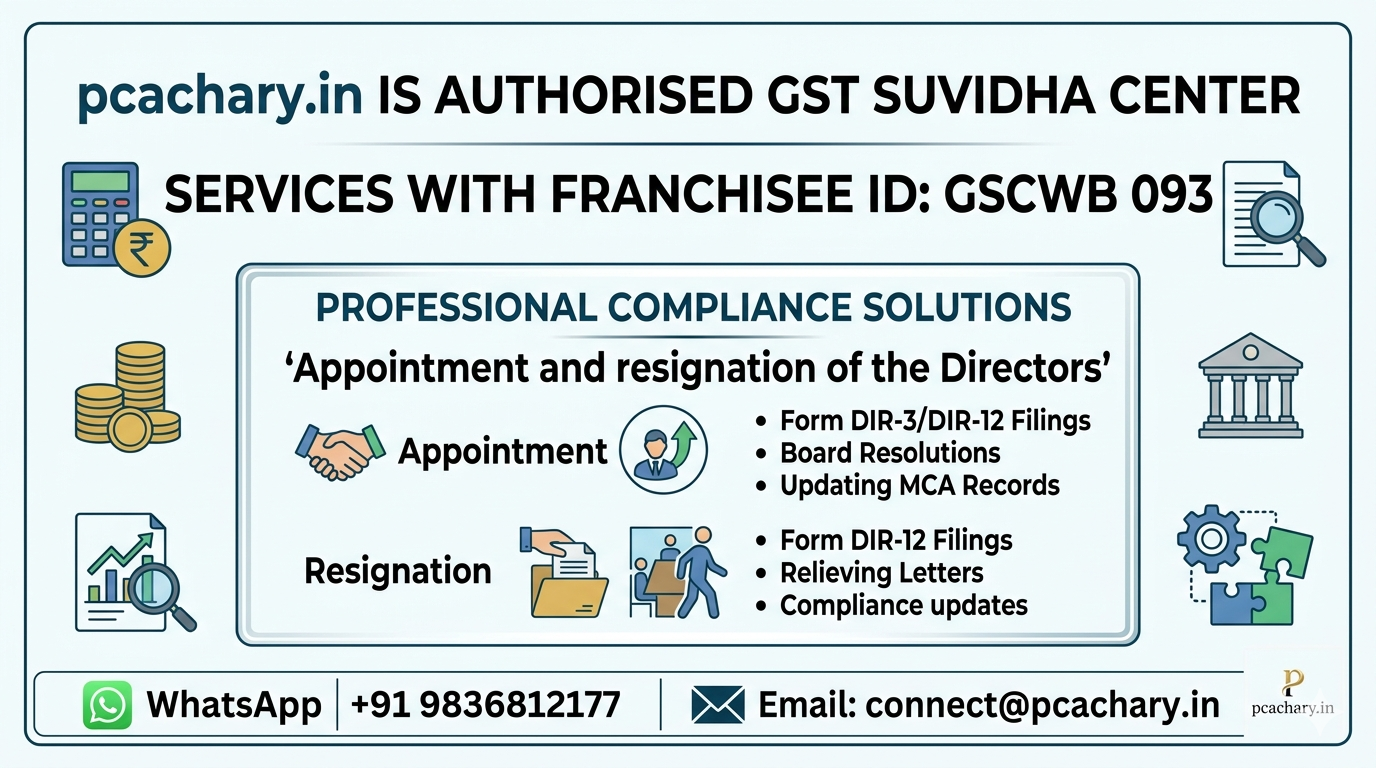

This comprehensive guide outlines the legal framework, procedural requirements, and compliance standards for the Appointment and Resignation of Directors under the Companies Act, 2013.
For expert assistance with corporate compliance, GST filings, or business registration, pcachary.in operates as an authorized GST Suvidha Center (Franchisee ID: GSC WB093). For direct inquiries, contact our support team via WhatsApp at +91 9836812177 or email at connect@pcachary.in.
1. Introduction to Corporate Governance
In the eyes of the law, a company is an artificial judicial person. While it has a legal identity, it cannot act on its own. It requires a human agency to direct its affairs, enter into contracts, and ensure statutory compliance. This agency is the Board of Directors.
The appointment and resignation of directors are not merely administrative tasks; they are significant legal events that alter the control and liability structure of a company. Under the Companies Act, 2013, these processes are strictly regulated to protect the interests of shareholders and creditors.
2. Eligibility and Prerequisites for Directors
Before any individual can be appointed as a director, they must meet specific legal criteria and possess certain digital credentials.
A. Director Identification Number (DIN)
Every individual intended to be appointed as a director must make an application for a DIN (Form DIR-3). A person can hold only one DIN in their lifetime, which acts as a permanent identification number for all corporate roles.
B. Digital Signature Certificate (DSC)
Since most filings with the Ministry of Corporate Affairs (MCA) are electronic, a director must possess a Class 3 DSC to sign statutory forms and declarations.
C. Statutory Disqualifications (Section 164)
A person cannot be appointed as a director if:
- They are of unsound mind.
- They are an undischarged insolvent.
- They have been convicted by a court for an offense involving moral turpitude and sentenced to imprisonment for at least six months.
- They have not paid calls on shares held in the company.
3. The Appointment of Directors
The appointment process varies depending on the type of director and the timing of the appointment.
I. First Directors
Typically named in the Articles of Association (AoA). If the AoA is silent, the subscribers to the Memorandum of Association (MoA) are deemed to be the first directors until others are duly appointed.
II. Appointment at General Meetings (Section 152)
Unless the Articles provide otherwise, directors of a public company are appointed by the shareholders in a General Meeting. At least two-thirds of the total number of directors in a public company must be persons whose period of office is liable to determination by retirement by rotation.
III. Board-Appointed Directors
The Board of Directors has the power to appoint certain individuals between two Annual General Meetings (AGMs):
- Additional Directors: Appointed to hold office up to the date of the next AGM.
- Alternate Directors: Appointed to act for a director during their absence from India for a period of not less than three months.
- Casual Vacancy: If a director’s office becomes vacant before their term expires (due to death or resignation), the Board can fill this vacancy.
IV. Independent Directors
Listed public companies and certain unlisted public companies must appoint Independent Directors. These individuals provide an unbiased perspective and ensure higher standards of corporate ethics.
4. Step-by-Step Procedure for Appointment
Step 1: Obtain DIN and DSC
The candidate must apply for a DSC, followed by a DIN application via Form DIR-3 if they do not already have one.
Step 2: Consent and Declaration
The proposed director must provide:
- Form DIR-2: Written consent to act as a director.
- Form DIR-8: A declaration that they are not disqualified under Section 164(2).
- MBP-1: Disclosure of interest in other entities.
Step 3: Board Meeting
The company must convene a Board Meeting to:
- Approve the appointment.
- Authorize a Company Secretary or Director to file necessary forms.
- Issue a notice for a General Meeting (if shareholder approval is required).
Step 4: Filing with the ROC
The company must file Form DIR-12 with the Registrar of Companies (ROC) within 30 days of the appointment. This form must be accompanied by the letter of appointment, DIR-2, and the Board Resolution.
5. Resignation of Directors (Section 168)
A director may resign from their office by giving notice in writing to the company.
A. The Process for the Director
- Submit a formal resignation letter to the Board of Directors.
- The director may also forward a copy of their resignation along with detailed reasons to the Registrar within 30 days using Form DIR-11. While DIR-11 is optional for some, it is highly recommended to protect the individual from liabilities arising after the resignation date.
B. The Process for the Company
- The Board must take note of the resignation in the next Board Meeting.
- The company must file Form DIR-12 with the ROC within 30 days.
- The resignation becomes effective from the date the company receives the notice or the date specified in the notice (whichever is later).
- The fact of the resignation must be mentioned in the Directors’ Report laid in the next General Meeting.
6. Liability After Resignation
A common misconception is that resignation absolves a director of all responsibility. However, a director remains liable for any offenses or acts of negligence that occurred during their tenure. Resignation only protects them from liabilities incurred by the company after their departure.
7. Special Cases and Removals
- Removal by Shareholders (Section 169): Shareholders can remove a director before the expiry of their term by passing an Ordinary Resolution, provided a “Special Notice” has been given.
- Vacation of Office (Section 167): An office becomes vacant automatically if the director absents themselves from all Board Meetings held during a period of twelve months, with or without leave of absence.
8. Compliance Checklist
To ensure a smooth transition, businesses should maintain a checklist:
- Check AoA for specific appointment/resignation clauses.
- Verify DIN status and KYC compliance of the director.
- Ensure Board/General Meeting minutes are accurately recorded.
- Update the Register of Directors and Key Managerial Personnel (KMP) at the registered office.
- Notify banks and statutory authorities (GST, Income Tax) regarding the change in authorized signatories.
9. How pcachary.in Can Help
Navigating the Ministry of Corporate Affairs (MCA) portal and ensuring adherence to the Companies Act can be daunting for business owners. Errors in filing DIR-12 or DIR-11 can lead to heavy penalties and legal complications.
At pcachary.in (GSC WB093), we provide end-to-end secretarial and compliance support, including:
- DIN and DSC applications.
- Drafting of Board Resolutions and Resignation Letters.
- ROC Filing (DIR-12, DIR-11, etc.).
- GST Registration and specialized GST Suvidha Center services.
Contact Information:
- Website: pcachary.in
- WhatsApp: +91 9836812177
- Email: connect@pcachary.in
10. Conclusion
The appointment and resignation of directors are pivotal moments in a company’s lifecycle. By following the prescribed legal steps, companies can ensure transparency, maintain good standing with the ROC, and uphold the principles of sound corporate governance. Whether you are expanding your board or restructuring your leadership, professional guidance is essential to avoid the pitfalls of non-compliance.


Reviews
There are no reviews yet.