

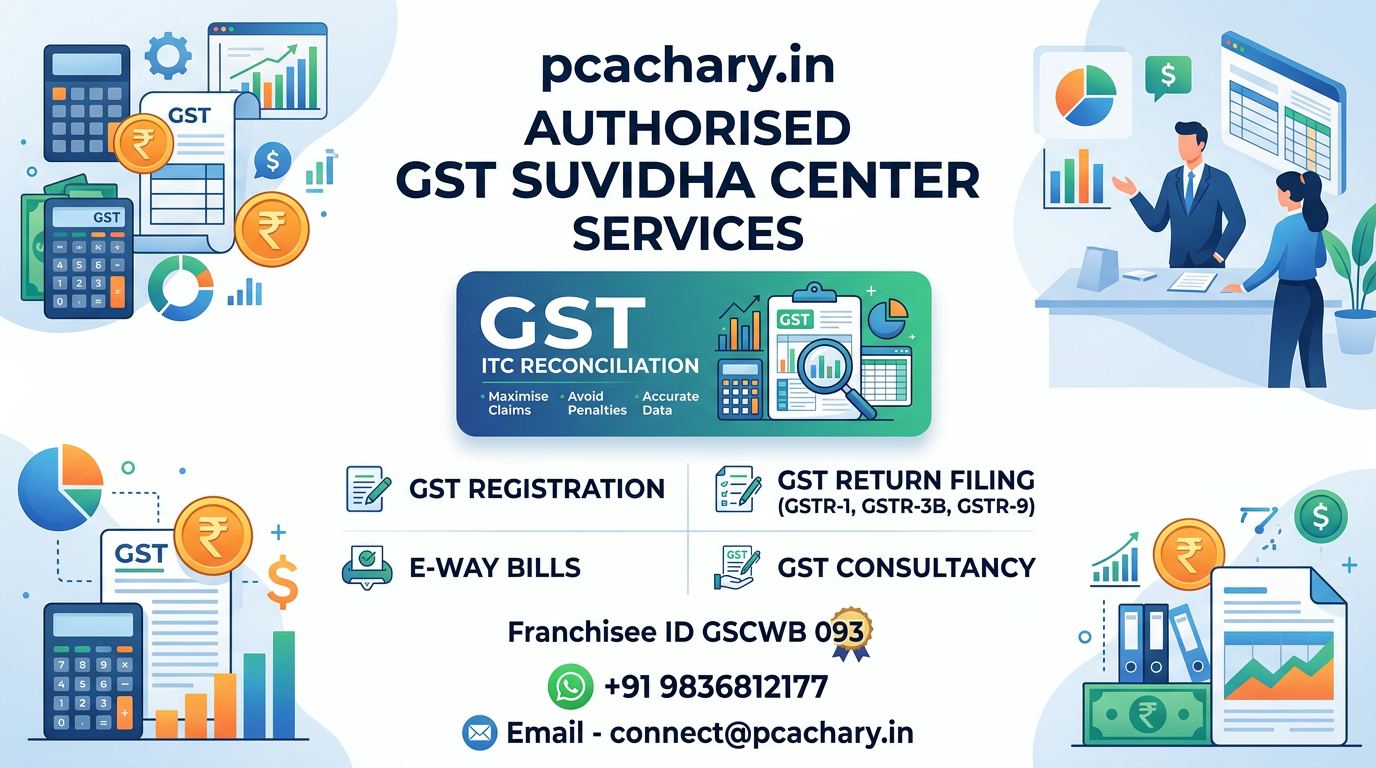

GST ITC Reconciliation: A Comprehensive Guide for pcachary.in (Franchisee ID GSC WB093)
In the modern Indian taxation landscape, the Goods and Services Tax (GST) has redefined how businesses operate, emphasizing transparency, digitalization, and compliance. Among the various pillars of GST, the Input Tax Credit (ITC) is perhaps the most critical for maintaining business liquidity. For pcachary.in, an authorized GST Suvidha Center (Franchisee ID: GSC WB093), providing expert ITC reconciliation services is not just a technical task—it is a vital financial safeguard for clients.
Navigating the complexities of ITC requires a deep understanding of the law, a meticulous eye for detail, and the right technological tools. Whether you are reaching out via WhatsApp at +91 9836812177 or emailing connect@pcachary.in, the goal remains the same: ensuring that every rupee of eligible credit is claimed while staying strictly within the boundaries of the law.
Understanding the Essence of Input Tax Credit (ITC)
Input Tax Credit is the backbone of the GST regime. It is the mechanism that prevents the “cascading effect” of taxes—essentially tax on tax. When a business buys goods or services for its operations, it pays GST to the supplier. This tax paid on “inputs” can be used to reduce the tax liability on “outputs” (sales).
However, ITC is not an absolute right; it is a conditional benefit. To claim it, the taxpayer must satisfy specific legal requirements under the CGST Act. This is where reconciliation becomes indispensable. Without a proper match between what your suppliers report and what you claim, the tax department may issue notices, demand reversals, or levy heavy penalties.
What is GST ITC Reconciliation?
ITC reconciliation is the process of matching the ITC claimed in your purchase register (books of accounts) with the ITC reflected in the GST portal, specifically through GSTR-2B and GSTR-2A.
- Internal Data: Your purchase ledger, which records all invoices received from suppliers.
- External Data: The data uploaded by your suppliers in their GSTR-1, which then flows into your auto-generated GSTR-2B statement.
The primary objective of reconciliation is to identify discrepancies. If a supplier fails to upload an invoice, or if there is a mismatch in the GSTIN, invoice number, or tax amount, the buyer cannot legally claim that credit. At pcachary.in, we bridge this gap by ensuring that your books and the portal speak the same language.
The Critical Importance of Reconciliation
For a business operating under Franchisee ID GSC WB093, we emphasize that reconciliation is not an annual year-end activity but a monthly necessity. Here is why:
1. Compliance with Section 16(2)(aa)
The GST law was amended to state that ITC can only be claimed if the supplier has reported the invoice in their GSTR-1 and it is communicated to the recipient in GSTR-2B. This makes reconciliation the “gatekeeper” of legal compliance.
2. Avoiding Interest and Penalties
If you claim ITC that is not reflected in GSTR-2B, it is considered an “ineligible claim.” If the tax department catches this, you will be required to reverse the credit and pay interest (currently 18% per annum) from the date the credit was wrongly utilized.
3. Cash Flow Management
Unclaimed ITC is essentially blocked capital. If your suppliers are negligent in filing their returns, your business pays more tax in cash than it should. Regular reconciliation identifies these “defaulting” suppliers, allowing you to follow up and recover your money.
4. Preparation for Annual Returns
Filing GSTR-9 (Annual Return) and GSTR-9C (Reconciliation Statement) becomes a nightmare if monthly reconciliations are ignored. By maintaining clean records throughout the year, the year-end process becomes a simple formality.
The Dynamic Nature of GSTR-2A vs. GSTR-2B
A common point of confusion for many taxpayers is the difference between these two forms. At pcachary.in, we simplify this for our clients:
- GSTR-2A is a dynamic, “live” document. It updates whenever a supplier files their return, even if they file late for a previous month. While useful for tracking, it is not the definitive basis for claiming ITC in a specific month.
- GSTR-2B is a static, “read-only” statement generated on the 14th of every month. It tells you exactly how much ITC is available for your current month’s GSTR-3B return. This is the “Bible” for reconciliation.
Our process involves cross-referencing your purchase register against the static GSTR-2B to ensure that your GSTR-3B filings are 100% accurate.
Step-by-Step Reconciliation Process at pcachary.in
As an authorized GST Suvidha Center, we follow a rigorous workflow to protect our clients’ interests:
Step 1: Data Collection and Cleaning
We begin by extracting the purchase register from the client’s accounting software (like Tally, SAP, or Zoho). We clean the data to ensure GSTINs are valid and invoice formats are consistent.
Step 2: Downloading Portal Data
We download the GSTR-2B and GSTR-2A JSON or Excel files directly from the GST portal for the relevant period.
Step 3: The Matching Logic
Using advanced tools, we compare the two datasets based on:
- Supplier’s GSTIN
- Invoice Number (handling variations like “001” vs “1”)
- Invoice Date
- Taxable Value
- Tax Amount (IGST, CGST, SGST)
Step 4: Categorizing Discrepancies
Mismatches generally fall into four buckets:
- Available in Books, Not in Portal: The supplier hasn’t filed their return.
- Available in Portal, Not in Books: You might have missed recording a purchase, or a supplier used your GSTIN by mistake.
- Amount Mismatch: The supplier reported a different value than what is on your physical invoice.
- GSTIN Errors: The invoice was uploaded against the wrong GSTIN.
Step 5: Actionable Reporting
We provide a detailed report to the client. For missing invoices, we help draft communication to suppliers. For amount errors, we advise on whether to claim the lower amount or seek an amendment from the vendor.
Common Challenges in ITC Reconciliation
Reconciliation is rarely straightforward. Several factors complicate the process:
- The “Invoice Number” Problem: A supplier might record an invoice as “INV/24/01,” while the buyer records it as “24-01.” Basic software fails to match these, requiring intelligent fuzzy-matching logic.
- Amendments: Suppliers often amend invoices in subsequent months. Tracking these changes back to the original entry is a manual challenge that pcachary.in handles professionally.
- RCM (Reverse Charge Mechanism): ITC on RCM must be paid in cash first and then claimed as credit. Ensuring this cycle is completed correctly is vital.
- Ineligible ITC: Not all taxes paid are claimable. Expenses like food and beverages, motor vehicles (with exceptions), and club memberships fall under “Blocked Credit” (Section 17(5)). We filter these out to prevent future litigation.
Why Choose pcachary.in for Your GST Needs?
Operating under the Franchisee ID GSC WB093, our center is part of a trusted network designed to bring professional-grade tax services to your doorstep. Our expertise in GST ITC Reconciliation offers several advantages:
Dedicated Support
You don’t have to deal with automated bots. You can reach us directly on WhatsApp at +91 9836812177. Whether you have a quick query about a specific invoice or need a full-year reconciliation, our team is responsive and ready to help.
Professional Accuracy
Mistakes in GST are expensive. By leveraging our services at connect@pcachary.in, you benefit from a “second pair of eyes” that catches errors before the tax department does.
Technology-Driven Solutions
As a GST Suvidha Center, we have access to streamlined tools that make reconciliation faster and more accurate than traditional manual methods. We handle bulk data with ease, making us a perfect partner for both SMEs and larger enterprises.
End-to-End Service
We don’t just stop at reconciliation. We help with GSTR-1 and GSTR-3B filing, E-way bill generation, GST registration, and responding to department notices.
Strategies for Effective Vendor Management
Reconciliation is easier when your vendors are compliant. We advise our clients on the following:
- Payment Withholding: Include a clause in your contracts stating that the GST component of a payment will only be released once the tax reflects in your GSTR-2B.
- Regular Communication: Use the monthly reconciliation reports provided by pcachary.in to send automated reminders to your vendors.
- Vendor Categorization: Identify “compliant” vs. “non-compliant” vendors. It may be safer to source from suppliers who consistently file on time, even if their prices are slightly higher, to avoid the cost of lost ITC.
Legal Deadlines and the “Last Chance” to Claim
It is important to remember that ITC cannot be claimed indefinitely. According to the GST law, the deadline to claim ITC for a particular financial year is the earlier of:
- The 30th of November following the end of the financial year.
- The date of filing the relevant Annual Return.
This makes the reconciliation for the months of September, October, and November particularly high-stakes. At pcachary.in, we conduct a “Mega Reconciliation” every October to ensure no credit is left behind before the window closes forever.
Conclusion
In the complex world of GST, Input Tax Credit is your most valuable asset, and Reconciliation is your most powerful shield. As an authorized GST Suvidha Center (Franchisee ID: GSC WB093), pcachary.in is committed to providing the precision and expertise you need to thrive.
Don’t let your hard-earned money vanish due to supplier negligence or accounting errors. Ensure your peace of mind by partnering with professionals who understand the nuances of the law.
For expert GST ITC reconciliation and all other GST-related services:
- WhatsApp us: +91 9836812177
- Email us: connect@pcachary.in
- Visit us: pcachary.in
Let us handle the numbers so you can focus on growing your business. High-quality compliance is just a message away.
Reviews
There are no reviews yet.