

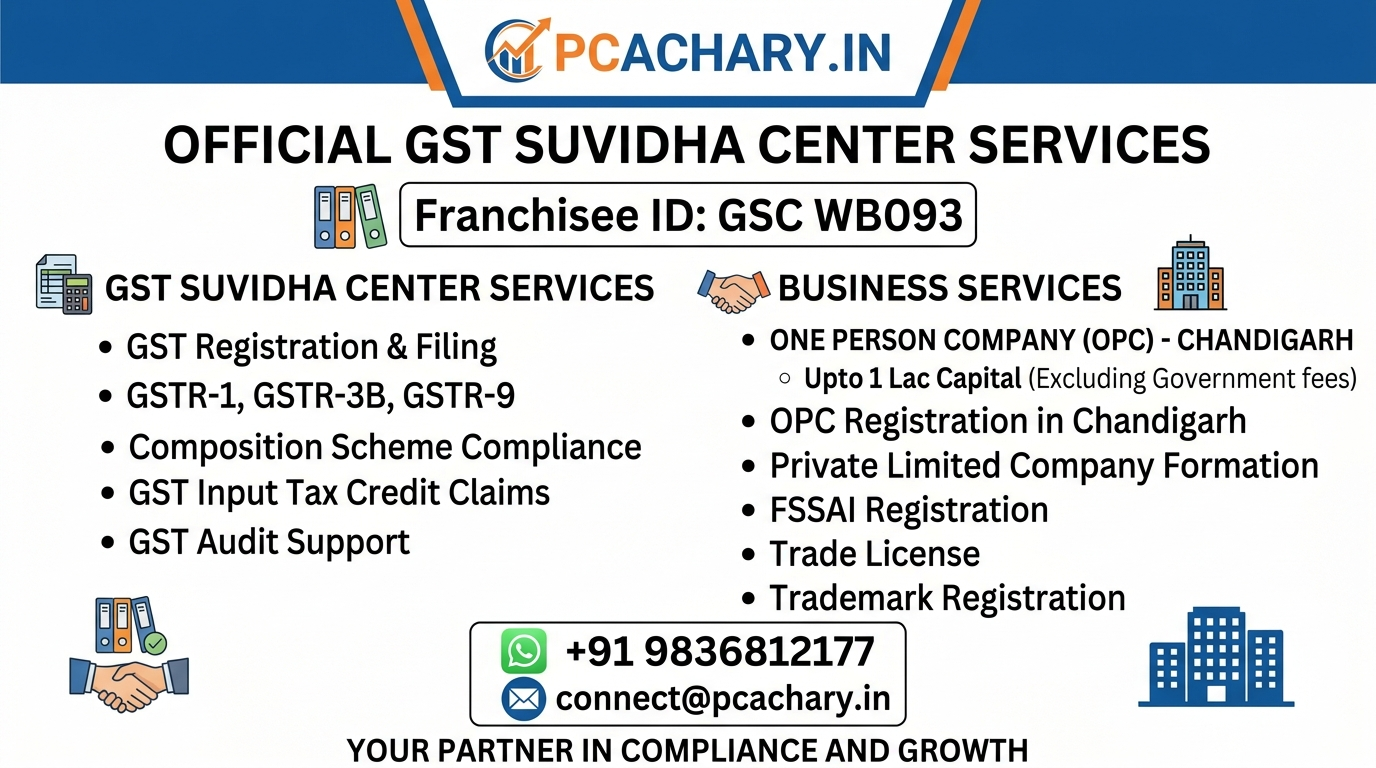

This comprehensive guide provides an in-depth exploration of the One Person Company (OPC) structure in India, specifically tailored for entrepreneurs in Chandigarh. Whether you are a solo founder or an aspiring business owner, this document outlines the legal framework, benefits, and procedural requirements for establishing an OPC with a capital of up to 1 Lac.
For professional assistance in navigating these regulatory waters, Pcachary.in serves as an authorized GST SUVIDHA CENTER (Franchisee ID: GSC WB093). For direct inquiries, you may reach out via WhatsApp at +91 9836812177 or via email at connect@pcachary.in.
1. Introduction to the One Person Company (OPC)
The concept of a One Person Company was introduced in India through the Companies Act, 2013. Before this landmark legislation, a single individual who wanted to start a business had to opt for a Sole Proprietorship. While easy to form, a proprietorship lacks a “separate legal entity” status, meaning the owner and the business are seen as one and the same in the eyes of the law. This carries significant personal financial risk.
An OPC allows a single promoter to enjoy the benefits of a private limited company, most notably Limited Liability. This means that if the business faces financial distress or legal claims, the owner’s personal assets—such as their home or savings—are generally protected.
Why Choose OPC in Chandigarh?
Chandigarh, as a Union Territory and a hub for the service and IT sectors, offers a fertile ground for startups. The OPC model is ideal for consultants, freelancers, and small-scale manufacturers who want the prestige of a corporate structure without the burden of finding a second director or shareholder.
2. Structural Requirements for an OPC
To register an OPC with a capital up to 1 Lac, certain statutory requirements must be met under the Ministry of Corporate Affairs (MCA) guidelines.
The Shareholder and Director
In an OPC, the single individual serves as both the sole shareholder and the director.
- Eligibility: The individual must be a natural person, an Indian citizen, and a resident in India.
- Restriction: One person can only incorporate one OPC or be a nominee in one OPC at any given time.
The Nominee
Because an OPC has only one member, the law requires the appointment of a Nominee. In the event of the death or incapacity of the original member, the nominee takes over the management of the company. This ensures “Perpetual Succession”—the company continues to exist even if the owner does not.
3. The Registration Process (Step-by-Step)
Registering a company involves several digital and legal hurdles. Below is the typical workflow managed by professional services like those found at Pcachary.in.
Step 1: Obtaining Digital Signature Certificates (DSC)
Since all filings with the MCA are electronic, the director must have a DSC. This is a secure digital key that validates the identity of the person signing the e-forms.
Step 2: Director Identification Number (DIN)
The next step is applying for a DIN for the sole director. This is a unique identification number assigned by the central government to any individual aspiring to be a director of a company.
Step 3: Name Approval
The name of an OPC must be unique and follow a specific format: (Name of Company) (OPC) Private Limited. You can apply for name reservation through the “RUN” (Reserve Unique Name) service or directly through the integrated SPICe+ form.
Step 4: Drafting MOA and AOA
The Memorandum of Association (MOA) defines the company’s objectives and the scope of its operations. The Articles of Association (AOA) layout the internal rules and regulations for governing the company. These must be drafted with precision to avoid future legal bottlenecks.
Step 5: SPICe+ Integrated Form
The SPICe+ form is a comprehensive application that allows for:
- Company Incorporation
- DIN Allotment
- PAN (Permanent Account Number) Application
- TAN (Tax Deduction Account Number) Application
- EPFO and ESIC Registration
- GSTIN Application (if applicable)
4. Financial Considerations: Capital and Fees
For an OPC with Upto 1 Lac Capital, the registration costs are significantly lower than for larger entities.
- Authorized Capital: This is the maximum amount of share capital that the company is authorized to issue to its shareholders. For this specific service, the cap is set at 1 Lac.
- Government Fees: It is important to note that professional service quotes usually exclude Government Fees. These fees vary based on the state (in this case, Chandigarh) and the amount of authorized capital. They include stamp duty and filing fees paid directly to the MCA portal.
5. Post-Incorporation Compliances
Once the Certificate of Incorporation (COI) is received, the work is not over. An OPC must adhere to several annual and periodic compliances to remain in “Active” status.
Statutory Audit
Even if the turnover is low, an OPC must have its accounts audited by a practicing Chartered Accountant. The audited financial statements must be filed with the Registrar of Companies (ROC).
Annual Filings
- Form AOC-4: For filing financial statements (Balance Sheet and Profit & Loss Account).
- Form MGT-7A: An abridged version of the Annual Return specifically designed for OPCs and small companies.
Income Tax
The company must file its Income Tax returns annually. As a separate legal entity, the OPC is taxed at corporate rates, which may differ from individual slab rates.
6. Advantages of an OPC over Proprietorship
- Limited Liability: As discussed, the owner’s liability is limited to the unpaid subscription money of their shares.
- Corporate Identity: Having “Private Limited” in the name enhances trust among vendors, banks, and clients.
- Easier Funding: While an OPC cannot issue shares to the public, it is much easier for a registered company to secure business loans from banks compared to a sole proprietor.
- Tax Planning: Companies can often claim more business expenses and deductions than individuals, potentially lowering the overall tax burden.
7. Why Use a GST Suvidha Center for Incorporation?
Navigating the MCA portal and ensuring that the MOA/AOA are legally sound can be daunting for a first-time founder. Utilizing a GST SUVIDHA CENTER provides a bridge between the entrepreneur and the complex digital infrastructure of the government.
By choosing the services of GSC WB093, you ensure that:
- Documentation is verified before submission to prevent rejections.
- The transition from incorporation to GST registration is seamless.
- You have a dedicated point of contact for Chandigarh-specific business queries.
Contact Information Summary:
- Website: Pcachary.in
- WhatsApp: +91 9836812177
- Email: connect@pcachary.in
8. Conclusion
Starting a One Person Company in Chandigarh is a strategic move for any solo entrepreneur looking to build a professional brand with the safety of limited liability. While the process is streamlined, attention to detail in the early stages—particularly regarding capital structure and nominee selection—is vital.
For those ready to take the next step in their business journey, Pcachary.in offers professional facilitation to ensure your OPC is registered correctly, allowing you to focus on growing your business.
Note: This document serves as an informational guide. For specific legal or financial advice, please consult with the professionals at GST SUVIDHA CENTER (Franchisee ID: GSC WB093).

Reviews
There are no reviews yet.