

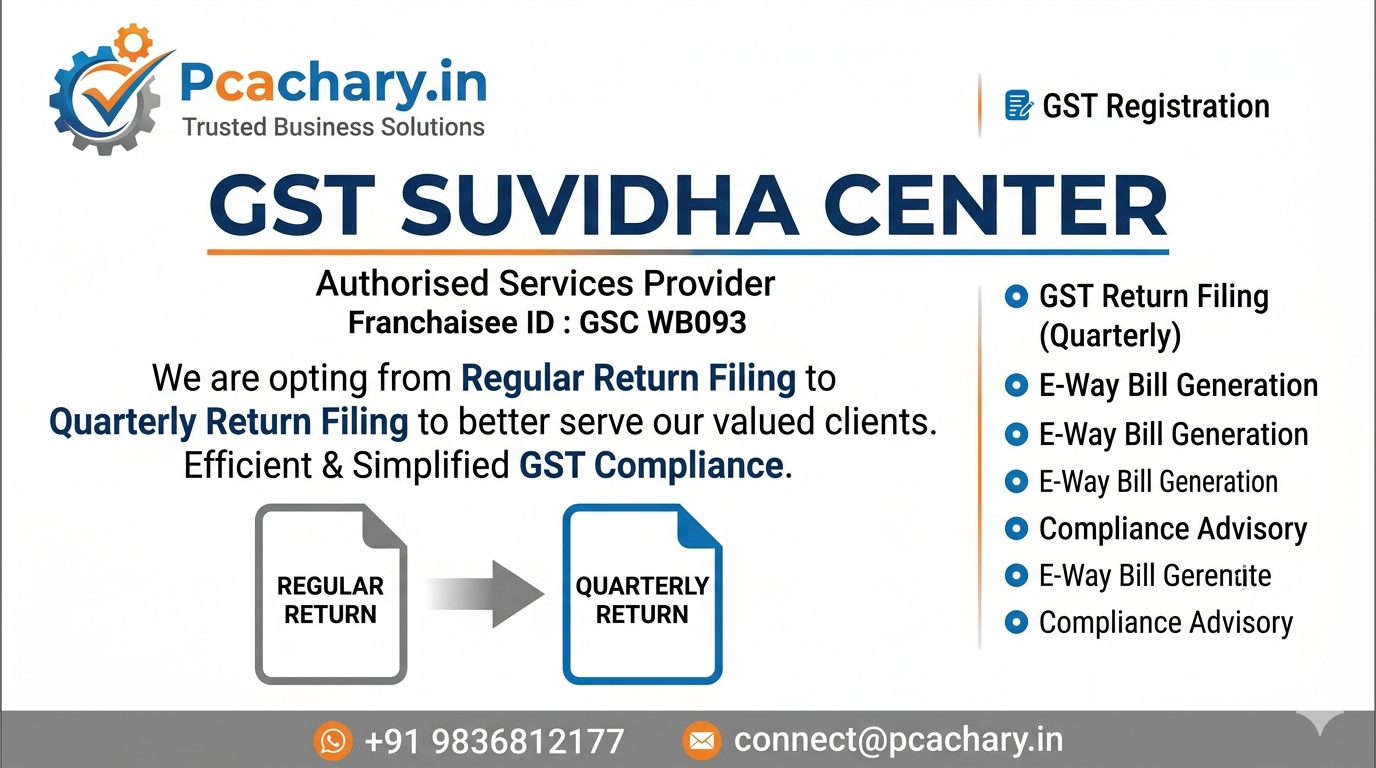

This comprehensive guide explores the nuances of the Goods and Services Tax (GST) regime in India, specifically focusing on the transition from Regular (Monthly) Return Filing to Quarterly Return Filing. If you are looking to streamline your tax compliance, Pcachary.in provides expert assistance as an authorized GST SUVIDHA CENTER (Franchaisee ID: GSC WB093). For direct inquiries, you can reach out via WhatsApp (+91 9836812177) or email connect@pcachary.in.
1. Introduction to GST Compliance and the Need for Flexibility
The implementation of the Goods and Services Tax (GST) in India marked a paradigm shift in the indirect tax landscape. Designed to create a “One Nation, One Tax” system, it integrated various central and state taxes into a single unified structure. However, for small and medium enterprises (SMEs), the initial requirement of filing monthly returns (GSTR-1 and GSTR-3B) often proved to be a heavy administrative and financial burden.
To address these challenges, the GST Council introduced schemes that allow taxpayers to move from a monthly filing cycle to a quarterly one. This transition is not merely a change in dates; it is a strategic decision that affects cash flow, bookkeeping, and vendor relationships.
2. Understanding the QRMP Scheme
The Quarterly Return Filing and Monthly Payment of Taxes (QRMP) scheme is a landmark initiative designed to simplify the compliance journey for small taxpayers. Under this scheme, eligible taxpayers can file their GSTR-1 and GSTR-3B returns once every three months, while continuing to pay their tax liability on a monthly basis through a simple challan.
Eligibility Criteria
To opt for the transition from Regular to Quarterly filing, a taxpayer must meet specific criteria:
- Aggregate Annual Turnover (AATO): The taxpayer’s aggregate turnover in the preceding financial year must be up to ₹5 Crores.
- Compliance Status: The taxpayer must have filed their last due GSTR-3B return before opting for the scheme.
3. The Benefits of Transitioning to Quarterly Returns
Opting for a quarterly return cycle offers several operational advantages for businesses:
Reduced Administrative Burden
Instead of preparing and filing 24 returns a year (12 GSTR-1s and 12 GSTR-3B), the taxpayer only needs to file 8 returns (4 of each). This significantly reduces the time spent on the GST portal and minimizes the risk of technical glitches during peak filing dates.
Cost Efficiency
Professional fees for tax consultants are often tied to the frequency of filing. By reducing the number of filings, businesses can often negotiate better compliance costs, allowing them to reinvest those savings into core operations.
Focus on Business Growth
For a small business owner, every hour spent on paperwork is an hour taken away from sales and customer service. Moving to a quarterly cycle allows for a more focused approach to business management.
4. The Monthly Payment Requirement (IFF and PMT-06)
A common misconception is that “Quarterly Return” means “Quarterly Payment.” This is not the case. The government still requires a steady flow of revenue.
The Invoice Furnishing Facility (IFF)
To ensure that the recipients (customers) of the quarterly filer can still claim Input Tax Credit (ITC) every month, the government introduced the IFF.
- This is an optional facility.
- It allows taxpayers to upload B2B invoices for the first two months of the quarter.
- The total value of invoices that can be uploaded per month is capped at ₹50 Lakhs.
Monthly Payment via PMT-06
Taxpayers must pay the tax due for the first two months of the quarter by the 25th of the succeeding month using form GST PMT-06. This can be done via two methods:
- Fixed Sum Method: A pre-filled challan for 35% of the tax paid in the previous quarter.
- Self-Assessment Method: Paying the actual tax due after considering the available ITC.
5. How to Opt-In: The Procedure
The window to opt for the QRMP scheme is available throughout the year, but the selection must be made within a specific timeframe for each quarter.
- Login: Access the GST Portal.
- Navigate: Go to Services > Returns > Opt-in for Quarterly Return.
- Selection: Choose the relevant Financial Year and Quarter.
- Declaration: Confirm that you meet the eligibility requirements.
At Pcachary.in, we handle this technical transition for you, ensuring that your profile is correctly updated without missing the statutory deadlines.
6. Challenges and Considerations
While the QRMP scheme is beneficial, it requires disciplined record-keeping. Because returns are filed every three months, a mistake in the first month might not be caught until much later.
Furthermore, if your customers are large corporations that file monthly, they may pressure you to use the IFF every month so they can reflect the ITC in their GSTR-2B. Managing these expectations requires a clear understanding of the GST ecosystem.
7. Why Choose a GST Suvidha Center?
A GST Suvidha Center (GSC) acts as an authorized gateway between the taxpayer and the GST Network (GSTN). Choosing Pcachary.in (ID: GSC WB093) ensures:
- Accuracy: Reducing the chances of receiving notices due to data mismatches.
- Security: Your financial data is handled through secure, authorized channels.
- Expertise: Deep knowledge of the latest notifications and amendments in GST law.
8. Conclusion
The move from Regular to Quarterly return filing is a significant step toward “Ease of Doing Business.” It balances the government’s need for monthly revenue with the taxpayer’s need for simplified compliance.
If you are ready to make the switch or need assistance with your monthly GST obligations, Pcachary.in is here to support your business journey.
Contact Information for GST Services:
- Website: Pcachary.in
- WhatsApp: +91 9836812177
- Email: connect@pcachary.in
- Franchaisee ID: GSC WB093
(Note: GST laws are subject to frequent changes. Always consult with a certified tax professional for the most current advice tailored to your specific business situation.)


Reviews
There are no reviews yet.