


This comprehensive guide provides an in-depth analysis of the PAN (Permanent Account Number) application process for non-individual entities in India. It explores the regulatory framework, the operational role of GST Suvidha Centers, and the specific documentation required for various organizational structures.
1. Introduction to PAN for Non-Individual Entities
In the Indian financial ecosystem, the Permanent Account Number (PAN) is more than just a tax identifier; it is a fundamental requirement for the legal existence and operational capability of any non-individual entity. While individuals often use PAN for personal banking and income tax filing, for businesses, trusts, and local authorities, it serves as the primary tool for transparency, compliance, and institutional credibility.
A PAN card for a non-individual entity is a unique ten-digit alphanumeric identifier issued by the Income Tax Department. Unlike individual PAN cards, which feature a photograph and signature of the holder, non-individual PAN cards display the name of the entity, its date of incorporation or formation, and the PAN itself.
The Importance of GST Suvidha Centers
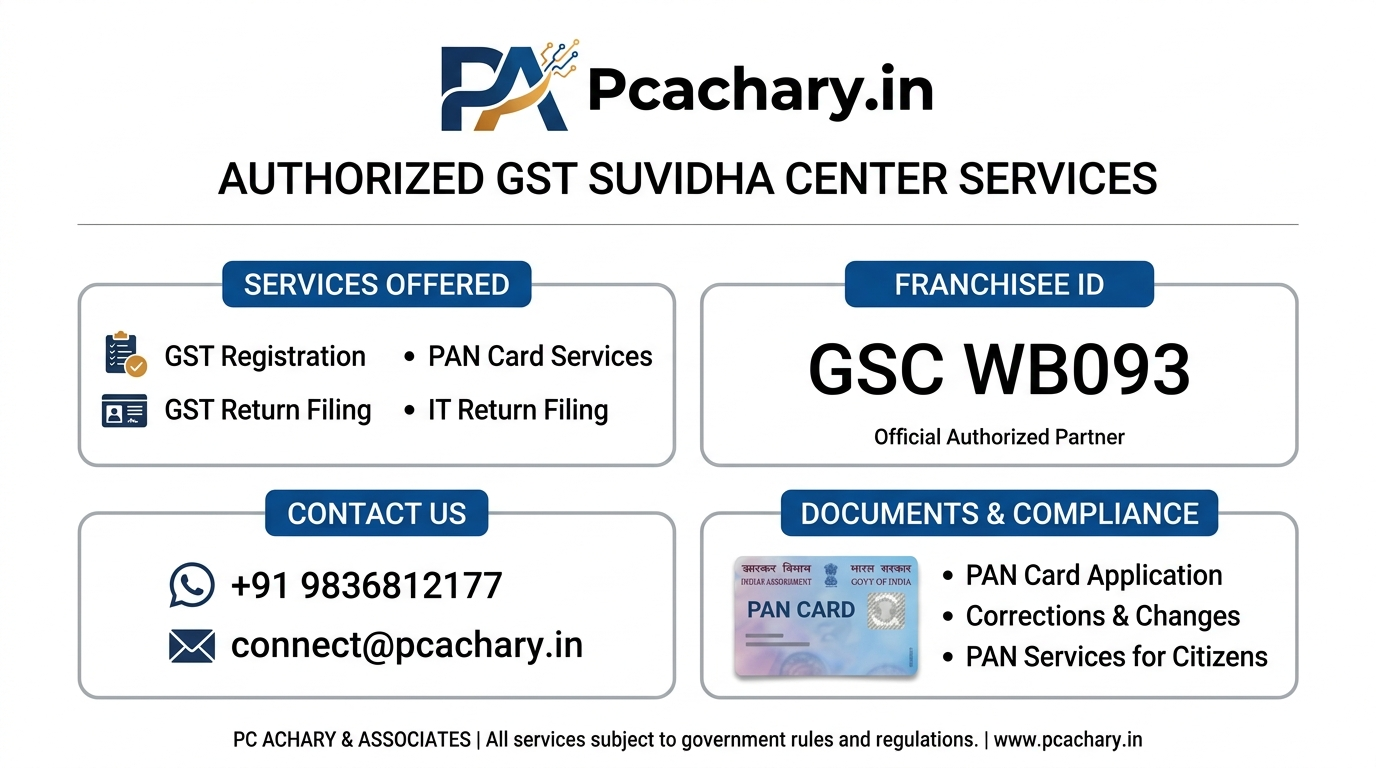
Navigating the complexities of government registrations can be daunting for small businesses and new organizations. This is where a GST Suvidha Center plays a pivotal role. These centers act as authorized facilitators, bridging the gap between the government’s digital portals and the end-user. By leveraging a Franchaisee ID GSC WB093, service providers ensure that applications are processed through legitimate channels, reducing the risk of errors and rejection.
For expert assistance with these registrations, you can visit Pcachary.in. For direct inquiries, professional support is available via email at connect@pcachary.in or through WhatsApp at +91 9836812177.
2. Defining “Other Than Individual” Services
The category “Other Than Individual” is broad and encompasses various legal structures. Each of these structures has specific tax implications and regulatory requirements. Understanding which category an entity falls into is the first step in a successful PAN application.
Companies
Whether a private limited company, a public limited company, or a one-person company (OPC), any corporate body registered under the Companies Act must have a PAN. It is mandatory for filing corporate tax returns and conducting high-value transactions.
Partnership Firms
Partnership firms, including Limited Liability Partnerships (LLPs), require a PAN to operate bank accounts and enter into legal contracts. The PAN for a firm is distinct from the personal PANs of the individual partners.
Association of Persons (AOP) and Body of Individuals (BOI)
AOPs and BOIs are formed when individuals or entities come together for a common purpose, often for a specific project or venture. These require a separate PAN to ensure that the income generated by the group is taxed appropriately.
Trusts and Foundations
Charitable trusts, religious institutions, and private foundations must obtain a PAN to claim tax exemptions under Sections 11 and 12 of the Income Tax Act. Without a PAN, these entities cannot receive a 12A or 80G certification.
Local Authorities and Government Agencies
Municipalities, port trusts, and other local authorities also fall under this category. They require a PAN for budgetary allocations and various administrative financial processes.
3. The Role of the GST Suvidha Center (GSC WB093)
The Pcachary.in platform, operating under Franchaisee ID GSC WB093, provides a streamlined environment for non-individual PAN applications. The benefits of using an authorized GST Suvidha Center include:
- Error Reduction: Non-individual applications are often rejected due to minor discrepancies in the name or date of incorporation. Professional review minimizes these risks.
- Document Verification: Ensuring that the Partnership Deed or Incorporation Certificate matches the application data.
- End-to-End Support: From the initial filing to the physical delivery of the PAN card.
For personalized guidance, contact the team at connect@pcachary.in or message via WhatsApp: +91 9836812177.
4. Detailed Breakdown of Documentation Requirements
The documentation for “Other Than Individual” PAN applications varies significantly depending on the legal status of the applicant.
For Companies
The primary document required is the Certificate of Incorporation issued by the Registrar of Companies (ROC). In addition to this:
- Copy of the Memorandum of Association (MOA).
- Copy of the Articles of Association (AOA).
- Board Resolution authorizing a specific director to apply for the PAN.
For Partnership Firms and LLPs
- Partnership Deed: A copy of the deed is mandatory. If the firm is registered, the registration certificate issued by the Registrar of Firms is also required.
- LLP Agreement: For LLPs, the incorporation document issued by the ROC is the standard proof.
For Trusts
- Trust Deed: A copy of the trust deed or the registration certificate issued by the Charity Commissioner.
- In the case of an unregistered trust, a formal affidavit or document evidencing the creation of the trust is needed.
For AOP/BOI and Local Authorities
- Agreement or Document of Formation.
- Certificate issued by the Registrar of Co-operative Societies or any other competent authority.
5. The Application Process: Step-by-Step
When applying through Pcachary.in, the process is designed to be user-friendly.
Step 1: Selection of Form 49A
For Indian entities, Form 49A is the standard application. It is crucial to select the correct “Category of Applicant” (e.g., Company, Firm, Trust) at the beginning of the process.
Step 2: Providing Accurate Information
The name of the entity must be written exactly as it appears on the incorporation document. Even a small difference in a comma or a suffix (like “PVT LTD” vs “PRIVATE LIMITED”) can lead to rejection.
Step 3: Digital and Physical Submission
Once the form is filled via Pcachary.in, the supporting documents must be uploaded. In many cases, physical copies with the entity’s official stamp and the authorized signatory’s signature must be sent to the processing centers.
Step 4: Tracking and Fulfillment
The GST Suvidha Center (GSC WB093) provides an acknowledgement number that allows the applicant to track the status of the PAN card.
6. Common Challenges in Non-Individual PAN Applications
Applying for a business PAN is more complex than an individual one. Common hurdles include:
- Authorized Signatory Issues: The person signing the form must have the legal authority to do so (e.g., a Managing Director, a Partner, or a Trustee).
- Name Mismatches: Discrepancies between the GST portal, the ROC, and the PAN application.
- Invalid Documents: Using expired or un-notarized deeds for partnership firms.
To avoid these pitfalls, it is highly recommended to consult with experts. Reach out to connect@pcachary.in or use WhatsApp at +91 9836812177 for a preliminary document audit.
7. Financial Implications of PAN for Businesses
Having a PAN is essential for several financial milestones:
- Opening a Current Account: No bank in India will open a business account without a valid PAN card.
- TDS (Tax Deducted at Source): If an entity does not provide its PAN to deductors, tax will be deducted at a much higher rate (usually 20%).
- GST Registration: PAN is a prerequisite for obtaining a Goods and Services Tax Identification Number (GSTIN).
- Import-Export Code (IEC): For businesses looking to trade internationally, PAN is mandatory for the IEC application.
8. Why Choose Pcachary.in?
In the digital age, speed and reliability are paramount. Pcachary.in, backed by the Franchaisee ID GSC WB093, ensures that your business stays compliant from day one.
- Professional Integrity: Handling sensitive business documents with the highest level of confidentiality.
- Accessibility: Whether you are a startup in a metro city or a local firm in a rural area, the digital service model is accessible to everyone.
- Expert Insight: Understanding the nuances of “Other Than Individual” categories to ensure the right tax headers are applied.
For any further assistance regarding PAN Card applications for companies, firms, or trusts, please contact:
Website: Pcachary.in
Email: connect@pcachary.in
WhatsApp: +91 9836812177
9. Conclusion
The PAN card is the cornerstone of an entity’s financial identity in India. While the process for individuals is relatively straightforward, the “Other Than Individual” service requires a deeper understanding of legal documents and corporate law. By utilizing the services of an authorized GST Suvidha Center like the one provided by Pcachary.in (ID: GSC WB093), organizations can ensure that their application is handled with precision.
Whether you are forming a new company, establishing a trust, or registering a partnership, securing your PAN is the first step toward a compliant and successful future. Reach out today via WhatsApp (+91 9836812177) or email (connect@pcachary.in) to begin your application process.
Reviews
There are no reviews yet.