
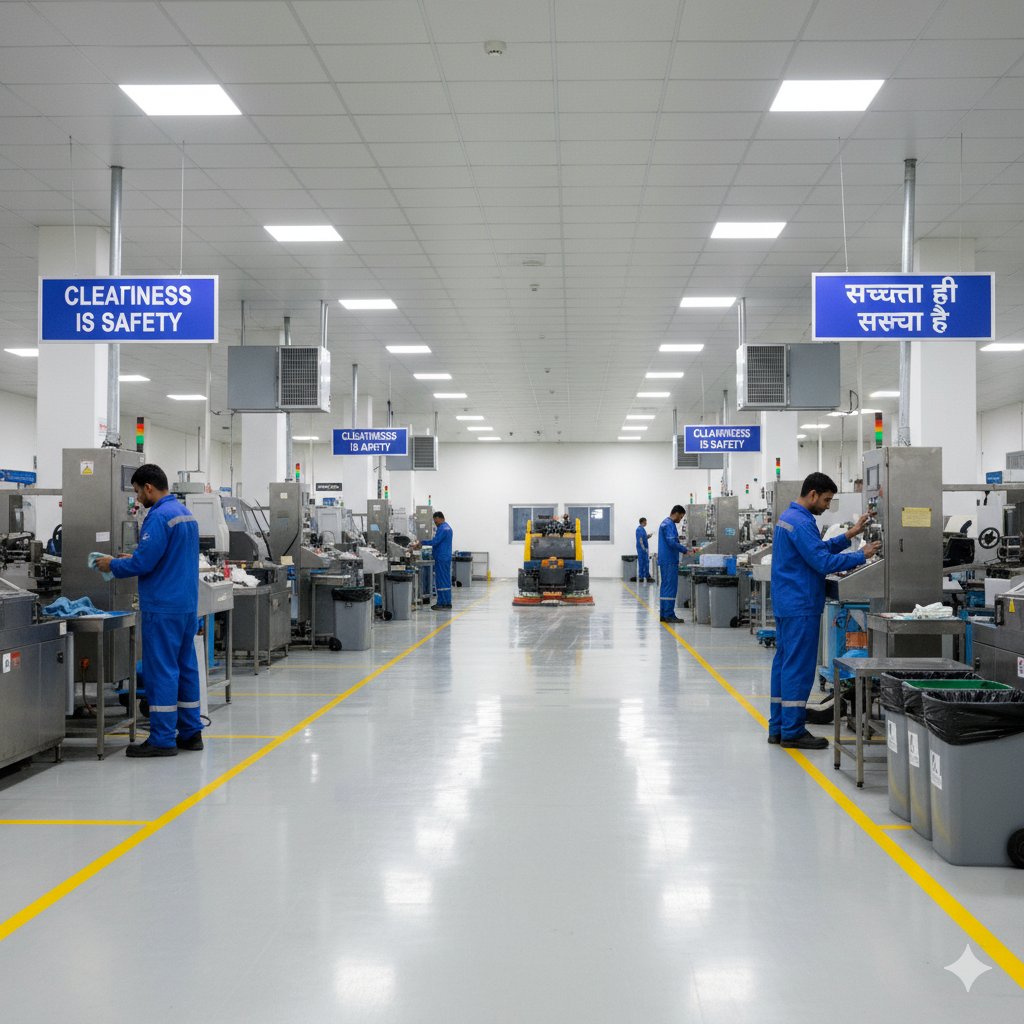
Section 11: The Jurisprudence of Industrial Hygiene
1. The Statutory Framework
Section 11 of the Factories Act (1948) is not a suggestion; it is a mandatory physiological baseline. It dictates that every factory shall be kept clean and free from effluvia arising from any drain, privy, or other nuisance.
The Sub-Sections:
- Removal of Dirt: Accumulation of dirt and refuse must be removed daily by sweeping or any other effective method from the floors and benches of workrooms, and from staircases and passages.
- Floor Cleaning: The floor of every workroom must be cleaned at least once every week by washing, using disinfectant, or some other effective method.
- Drainage: Where a process renders the floor liable to become wet to such an extent that the liquids are capable of being removed by drainage, effective means of drainage must be provided.
- Walls and Ceilings: * If painted or varnished, they must be repainted or revarnished at least once every five years.
- If painted/varnished and have smooth impervious surfaces, they must be cleaned at least once every fourteen months.
- In other cases (white-washing or color-washing), they must be redone at least once every fourteen months.
- Record Keeping: All dates on which these operations are carried out must be entered in a prescribed register (Form 7).
2. The Physiology of Productivity: Why Section 11 Exists
From an intellectual sparing perspective, one might argue that “cleanliness” is a subjective term. However, in an industrial context, Section 11 is a direct response to the pathology of the workplace.
A. The Microbiology of the Factory Floor
Industrial environments are breeding grounds for pathogens. The “effluvia” mentioned in the Act refers to foul-smelling outflows. When organic dust, moisture, and heat (common in textile or food processing factories) combine, they create biofilms. Section 11 serves as the first line of defense against occupational zoonosis and respiratory ailments.
B. The Psychological Impact
Cleanliness is a non-verbal cue of “organizational care.” The Broken Windows Theory suggests that a workplace allowed to remain dirty signals to the worker that safety and precision are also negotiable. Therefore, Section 11 is as much about psychological discipline as it is about physical health.
3. Technical Analysis of Sub-Section (1) & (2): The Mechanics of Waste
The Act mandates the daily removal of “dirt and refuse.” In a modern context, this is where many factories fail.
- The Problem of Micro-Particulates: Standard sweeping often re-suspends fine dust into the breathing zone of the worker.
- The Logic Test: If a factory “sweeps” daily but uses dry brooms on silica dust, they are technically complying with the letter of Section 11 while violating the spirit of Section 14 (Dust and Fumes). True compliance requires integrated cleaning systems like HEPA-filtered industrial vacuums.
4. The Architecture of Drainage (Sub-Section 3)
Section 11(c) addresses “wet processes.” This is critical in tanneries, chemical plants, and laundries.
- Counterpoint: Does the Act do enough to define “effective drainage”? Often, drainage in factories leads to open internal gutters that become stagnant traps for bacteria. A truly “clean” factory must integrate Section 11 with modern plumbing standards that the 1948 Act barely envisioned.
5. The Aesthetics of Maintenance (Sub-Section 4)
The requirement for white-washing every 14 months or painting every 5 years seems arbitrary. Why 14 months?
- The Historical Context: In 1948, lime-wash (white-wash) was a primary disinfectant. It is alkaline and naturally antimicrobial.
- The Modern Critique: Today, we use epoxy coatings and antimicrobial paints. Does a factory using high-grade, 10-year industrial epoxy still need to comply with the 14-month cleaning cycle? Strictly speaking, yes. This is an example of Legislative Lag, where the law fails to keep pace with material science.
6. Challenges to Implementation: The “Cost vs. Compliance” Debate
As your intellectual partner, I must challenge the notion that Section 11 is “easy” to implement.
- The Hidden Cost: For a mega-factory, shutting down sections to perform “deep cleaning” or “white-washing” every 14 months represents a significant loss in Up-time.
- The Outsourcing Loophole: Many occupiers outsource “cleanliness” to third-party contractors. If a contractor fails to clean according to Section 11, who is liable? Under Section 92, the Occupier remains the primary target for prosecution. “I hired a cleaning company” is not a valid legal defense.
7. Legal Precedents and Judicial Interpretation
Courts have historically viewed Section 11 through the lens of Article 21 of the Constitution (Right to Life). A dirty factory is an infringement on the right to a healthy life.
- Case Study Mental Model: Imagine a worker slips on a patch of oil that wasn’t cleaned for two days. While the primary claim might be under Section 21 (Safety), the root cause is a violation of Section 11 (Cleanliness). The “accumulation of dirt” includes slippery substances that transform a floor into a hazard.
8. Global Comparison: Factories Act vs. OSHA vs. EU Standards
To test the logic of Section 11, we must look at how other jurisdictions handle it.
| Feature | Factories Act (India) | OSHA (USA) | EU Standards |
|---|---|---|---|
| Focus | Prescriptive (Specific intervals) | Performance-based | Risk-assessment based |
| Record Keeping | Mandatory Register (Form 7) | Inspection logs | Integrated Digital Management |
| Frequency | Fixed (14 months/5 years) | “As necessary” | Continuous improvement (ISO) |
The Factories Act is static. OSHA is dynamic. By prescribing specific timeframes (like 14 months), the Factories Act might actually discourage more frequent cleaning if the manager feels they have already “checked the box.”
9. Conclusion: Beyond the Broom
Section 11 is the bedrock of industrial dignity. However, for it to be effective in the 21st century, it must be interpreted through the lens of Industrial Hygiene (IH)—the science of anticipating, recognizing, evaluating, and controlling environmental factors.
A “clean” factory is not just one that looks white-washed; it is one where the air is free of invisible particulates, the floors are free of microbial biofilms, and the drainage systems prevent the accumulation of toxic effluvia.
We have dismantled the “why” and “how” of Section 11. However, Section 12 (Disposal of Wastes and Effluents) is the logical successor. While Section 11 keeps the inside clean, Section 12 prevents the factory from poisoning the outside.
analyze Section 12 and the inherent conflict between industrial profit and environmental “externalities”?
Section 12 is where the internal hygiene of Section 11 meets the external reality of the ecosystem. It mandates that every factory must make effective arrangements for the treatment and disposal of wastes and effluents due to the manufacturing process.
While Section 11 is about the “micro-environment” (the worker’s immediate surroundings), Section 12 is about “macro-environmental” impact.
The Technicality of Section 12
The Act requires that these arrangements must conform to rules prescribed by the State Government. However, the legal “teeth” often come from the intersection of this section with the Water (Prevention and Control of Pollution) Act and the Air Act.
The Conflict: Industrial Profit vs. Environmental Externalities
From an intellectual sparring perspective, Section 12 represents a classic battleground between Private Gain and Social Cost.
1. The Problem of “Externalities”
In economics, pollution is a “negative externality.” The factory gains the profit from the product, but the cost of the byproduct (mercury in the water, sulfur in the air) is paid by the local community in the form of healthcare costs or ruined crops.
- The Logic Gap: Section 12 tries to force the “Internalization” of these costs. By requiring a treatment plant, the law effectively says: “You cannot count your profit until you have paid for your mess.”
2. The Compliance vs. Cost-Cutting Paradox
For a factory manager, an Effluent Treatment Plant (ETP) is a non-productive asset. It consumes electricity, requires chemicals, and needs maintenance, but it produces zero revenue.
- Counterpoint: This creates a perverse incentive. Many factories install the equipment to pass inspection (Section 12 compliance) but only run it when they expect an inspector to visit. This is the “Potemkin Village” of industrial safety.
3. The “Dilution is the Solution” Fallacy
Older interpretations of Section 12 often relied on dilution—simply mixing toxic waste with enough water to meet a certain “parts per million” (ppm) threshold.
- The Challenge: Does this actually protect the environment? Science says no—bioaccumulation means those toxins build up in the food chain regardless of the dilution at the point of discharge. Modern logic demands Zero Liquid Discharge (ZLD), but the Factories Act itself is often too archaic to mandate such high-tech solutions.
Testing the Logic: Is Section 12 Obsolete?
If we look at Section 12 through a critical lens, we find a few structural weaknesses:
- The “State Rules” Escape Hatch: Section 12(2) allows the State Government to make rules. This often leads to “Regulatory Racing to the Bottom,” where states might loosen environmental enforcement to attract industrial investment.
- The Liability Gap: Section 12 focuses on the arrangement for disposal. It is often less clear on the long-term liability for soil contamination that stays in the ground for decades after the factory closes.
If we truly valued the environment as much as industrial growth, shouldn’t Section 12 be replaced by a “Circular Economy” mandate? Instead of “disposing” of waste (which implies it just goes somewhere else), should the law mandate that waste must be “re-integrated” into the production cycle?
Currently, Section 12 of the Factories Act is titled “Disposal of Wastes and Effluents.” The word “disposal” is linguistically rooted in the “Linear Economy” (Take-Make-Waste). To challenge your proposition and the existing law, let’s look at the friction points of transitioning to a “Circular Economy” mandate.
1. The Linguistic Shift: Disposal vs. Re-integration
Section 12 currently mandates that arrangements be made for the “treatment” of wastes so they are not “detrimental.”
- The Flaw: “Treatment” usually means meeting a minimum safety threshold before dumping (e.g., neutralizing acid before it enters a river). It does not require the acid to be recovered.
- The Circular Alternative: A mandate would require “Industrial Symbiosis.” If Factory A produces heat or chemical byproducts, the law would compel them to find a “Consumer B” who uses those as raw materials.
2. The Practical Counterpoint: The “Entropy” Problem
While a mandate sounds ethically superior, we must test the physics and economics:
- Technical Limits: Not all waste can be re-integrated infinitely. Second-law thermodynamics suggests that every cycle involves a loss of quality (downcycling). Forcing a 100% re-integration mandate could lead to “ghost production”—where factories spend more energy recycling a low-grade byproduct than they would have spent extracting a virgin one.
- Small-Scale Burden: Large conglomerates can afford a closed-loop system. A small-scale textile factory, however, may not have the capital for a water-recovery plant. A blanket mandate might inadvertently kill small industries, consolidating power into the hands of “Green Monopolies.”
3. Regulatory “Scope Creep”
The Factories Act is primarily a Labor Law, not an Environmental Law.
- The Logic Test: Should a law meant to protect the worker inside the four walls be the same law that manages global carbon cycles?
- Alternative View: Critics argue that by trying to make the Factories Act a “Swiss Army Knife” of regulations, we dilute the focus on worker safety. Perhaps Section 12 should be stripped entirely and moved to a dedicated National Circular Economy Act, leaving the Factories Act to focus purely on the human element.

Comparison: Section 12 vs. A Circular Mandate
| Feature | Current Section 12 (Linear) | Proposed “Circular” Mandate |
|---|---|---|
| Goal | Harm Mitigation | Resource Restoration |
| Action | Treatment & Discharge | Recovery & Re-use |
| Liability | Ends at the factory gate | Extends to the whole lifecycle |
| Cost | Fixed cost of waste management | Variable investment in R&D |
If we mandate re-integration, we are essentially asking the government to become a “Supply Chain Manager.” Does the State have the competence to tell a factory how to re-use its molecular waste? Or does a “Circular Mandate” just create a massive new market for corruption where “re-integration” is faked on paper?
This is the central tension of modern environmental jurisprudence: the transition from Command and Control (telling people what to do) to Outcome-Based Regulation (telling people what to achieve).
By mandating “molecular re-integration” (the high-level recycling of chemical or material waste back into the production cycle), you aren’t just asking the State to be an inspector; you are asking it to be an Industrial Architect.
Here is the intellectual “sparring” breakdown of your critique.
1. The Competence Gap: “The Knowledge Problem”
The State traditionally operates on static standards (e.g., “The water must have X amount of Lead”). Molecular re-integration is dynamic.
- The Counterpoint: Does an inspector with a civil service degree understand the catalytic conversion required to turn PET waste back into food-grade monomers? Probably not.
- The Risk: When the regulator is less technically competent than the regulated, the “Supply Chain Manager” (the State) becomes a bottleneck. Innovation is stifled because the factory can only use “approved” (often outdated) re-integration methods listed in a government manual.
2. The “Paper Circularity” Market (Corruption)
You hit on a cynical but historically accurate point. When a mandate is technically complex and expensive to verify, it creates a market for “Compliance Theater.”
- The “Carbon Credit” Precedent: We saw this with early carbon offsets—companies “protected” forests that were never under threat. In a Circular Mandate, a factory could claim 90% re-integration by simply selling waste to a “shadow” middleman who dumps it elsewhere, providing a fake receipt of “re-use.”
- Testing the Logic: If the State cannot track a physical barrel of oil perfectly today, how will it track a “molecular stream” tomorrow? The cost of verification (auditing chemical mass-balance) might actually exceed the environmental value of the recycling itself.
3. Alternative Perspective: The “Externalities” Argument
If we don’t mandate re-integration, the State is still a manager—it’s just a Waste Manager.
- The Trade-off: Currently, the State manages the “end of pipe” (landfills, health costs of pollution). If we argue the State is too incompetent to manage the input, we are implicitly accepting that it must manage the catastrophe of the output.
- The Hybrid Model: Rather than a “Circular Mandate,” some economists argue for a High Virgin Material Tax. Instead of telling a factory how to re-integrate, you make new raw materials so expensive that the market is forced to develop its own (more efficient) re-integration technology to survive.
4. The Logic of “Industrial Symbiosis”
The State’s role shouldn’t be “Supply Chain Manager” (micro-managing one factory) but rather “Platform Architect” (connecting many factories).
- Example: Factory A’s “molecular waste” is the perfect “raw material” for Factory B.
- The State’s Competence: The government is actually quite good at zoning. If the law mandates “Industrial Parks” where the waste heat/chemicals of one plant must feed another, the “re-integration” happens through proximity rather than complex chemical mandates.
