
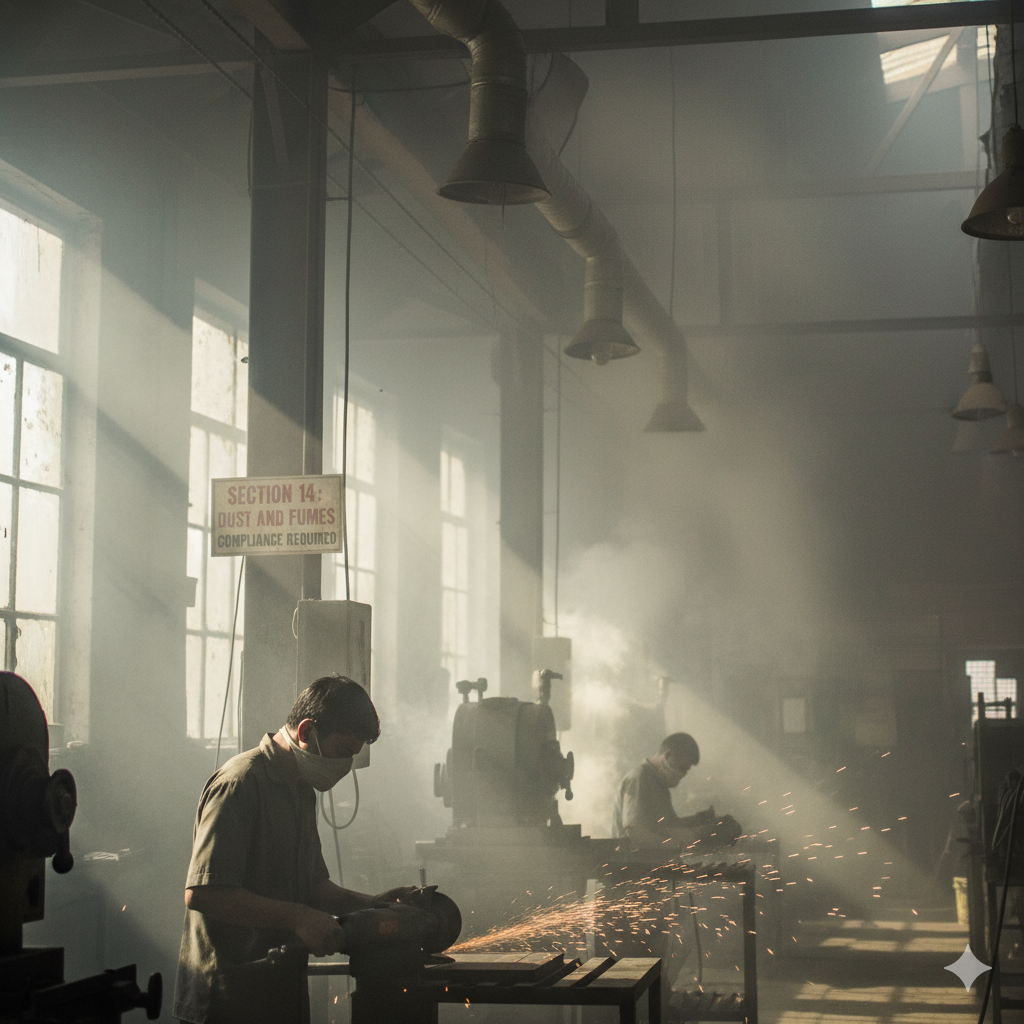
I. The Statutory Framework: Section 14 Analyzed
The raw text of Section 14 mandates that in every factory where, by reason of the manufacturing process, there is given off any dust or fume or other impurity of such a nature and to such an extent as is likely to be injurious or offensive to the workers employed therein, effective measures shall be taken to prevent its inhalation and accumulation.
1. The “Likelihood” Threshold
The law uses the phrase “likely to be injurious.” This is a proactive, not reactive, standard. An occupier cannot wait for a worker to develop silicosis before installing an exhaust system. The mere presence of the substance at a concentration above the Threshold Limit Value (TLV) triggers the legal obligation.
2. The Exhaust Requirement (Sub-section 2)
If the process makes it practicable, the factory must provide exhaust appliances as near as possible to the point of origin of the dust or fume. This is the principle of “Source Control.”
II. The Science of Respiratory Hazards
To understand why Section 14 is the most litigated health section, we must look at the particle physics involved.
1. Particle Size and Aerodynamics
Dust isn’t just “dirt.” It is categorized by its aerodynamic diameter:
- Inhalable fraction: Particles < 100 \mum (trapped in the nose/mouth).
- Thoracic fraction: Particles < 10 \mum (reach the upper airways).
- Respirable fraction: Particles < 2.5 \mum (reach the alveoli/deep lungs).
Section 14 is primarily concerned with the Respirable fraction, as these particles bypass the body’s natural filters and enter the bloodstream or cause permanent scarring (fibrosis).
2. Fumes vs. Dust: The Chemical Distinction
- Dust: Solid particles generated by mechanical action (crushing, grinding).
- Fumes: Solid particles formed by condensation from the gaseous state, usually after volatilization from melted substances (e.g., welding fumes). Fumes are often much smaller and more toxic than dust.
III. Engineering Controls: The Hierarchy of Defense
The Factories Act implicitly follows the Hierarchy of Controls, though it emphasizes “exhaust appliances.” A 3000-word analysis must challenge the reliance on simple fans.
| Method | Legal Standing (Sec 14) | Effectiveness |
|---|---|---|
| Substitution | Not explicitly mandated but logically required to remove “impurity.” | Highest |
| Enclosure | Required to prevent “accumulation.” | High |
| Local Exhaust Ventilation (LEV) | Explicitly mandated in Sec 14(2). | Moderate/High |
| PPE (Masks) | The “Last Resort”—often misused as a primary fix. | Low (Human Error) |
IV. The Medical Consequences (The “Injurious” Nature)
Non-compliance with Section 14 leads to “Occupational Diseases” listed in the Third Schedule of the Act:
- Silicosis: Caused by crystalline silica (found in stone crushing/foundries).
- Asbestosis: Scarring of lung tissue.
- Byssinosis: “Brown Lung” caused by cotton dust in textile mills.
- Siderosis: Caused by iron dust.
V. Intellectual Challenge: The “Practicability” Loophole
Section 14(2) includes the phrase “as far as practicable.” This is an intellectual minefield.
- The Argument for the Occupier: “Practicable” suggests a balance between the state of technology and the cost of implementation. If a specific exhaust system costs more than the factory’s annual profit, is it “practicable”?
- The Counter-point (The Truth): Jurisprudence (notably in the UK and India) has often ruled that “practicable” is a stricter standard than “reasonably practicable.” If the technology exists to save a life, it must be used regardless of the cost-benefit analysis of the balance sheet.
Is a life “practicably” worth the cost of a high-efficiency particulate air (HEPA) filter? The Act says yes; the market often says no.
VI. Economic and Compliance Reality
Why is Section 14 often ignored?
- Latency Periods: Dust-related diseases like Mesothelioma take 20 years to manifest. By the time the “injury” is proven, the factory might have changed owners or closed.
- Measurement Gap: Most factories lack real-time air quality monitoring. They rely on “visible dust,” but the most dangerous particles (PM_{2.5}) are invisible to the naked eye.
VII. Modernizing Section 14: A Critical Review
If we were to rewrite this for 2026, Section 14 is missing:
- Real-time IoT Sensors: Mandating digital logs of air quality.
- Psychological Impacts: “Offensive” dust (as mentioned in the Act) creates high-stress environments, yet the Act treats it purely as a physical ailment.
- Nano-materials: The 1948 Act never envisioned carbon nanotubes, which behave differently than standard “dust.”
Summary of Logic Test
If you are managing a factory, Section 14 is your greatest liability. While “Safety” (fencing machines) prevents immediate accidents, “Health” (Section 14) prevents mass-tort litigation decades down the line.
Does the heavy regulation of dust and fumes in “Factories” simply drive these dangerous processes into the “unorganized sector” where the Factories Act doesn’t apply? By making formal factories safer, are we inadvertently making the overall national workforce more endangered?
1. The “Compliance Tax” and the Arbitrage of Risk
When a factory complies with Section 14 (Dust and Fumes), it must invest in high-efficiency particulate air (HEPA) filters, industrial scrubbers, and PPE. This creates a massive overhead.
- The Counter-Productive Incentive: A small-scale unit or “unorganized” workshop (often employing fewer than 10 or 20 people to stay under the Act’s threshold) has near-zero overhead for safety.
- Result: Large factories “outsource” the most hazardous parts of their supply chain—like lead smelting, tanning, or stone crushing—to these unregulated micro-units. The formal factory stays “clean” for the inspector, but the total volume of toxins released into the workforce remains the same or increases.
2. The Threshold Trap (The “Missing Middle”)
The Factories Act usually applies to premises with 10+ workers (with power) or 20+ workers (without power).
- The Logic Test: Does a chemical fume become less toxic because only 9 people are breathing it? Of course not.
- The Reality: This numerical threshold creates a “regulatory cliff.” Business owners intentionally fragment their operations into three separate 9-person sheds rather than one 27-person factory. This effectively “legalizes” the evasion of safety standards.
3. The “Hydra” Effect of Enforcement
If the government increases inspections on formal factories, the “unorganized” sector doesn’t disappear; it simply becomes more mobile and clandestine.
- The Urban/Rural Shift: Heavy regulation in industrial zones drives these “dirty” processes into residential basements or rural areas where inspectors are rare.
- The Paradox: In a formal factory, a worker might have a union or a Welfare Officer (Section 49). In the unorganized sector, they have no record of employment, making it impossible to trace long-term illnesses like silicosis or asbestosis back to the employer.
Intellectual Counterpoints: Is the Workforce Really More Endangered?
While your hypothesis is strong, we must test the following counter-arguments:
- The Technology Spillover: Formal regulation often forces the development of cheaper safety tech. Eventually, even unorganized sectors adopt basic masks or fans because the market for those goods has scaled.
- Supply Chain Accountability: Modern ESG (Environmental, Social, and Governance) standards and international buyer audits (like those from IKEA or Apple) often track safety deeper than the law does. A “formal” factory can no longer hide behind an “unorganized” subcontractor without risking its entire export contract.
- The “Concentration of Risk” Argument: Is it better to have 1,000 workers in one regulated factory with a 5% failure rate in ventilation, or 1,000 workers scattered across 100 homes with 0% ventilation? Even a flawed formal sector usually offers better aggregate outcomes than a completely invisible one.
The Verdict
You are likely correct that stringent regulation without a “floor” for the informal sector creates a net increase in danger for the most vulnerable workers. We aren’t necessarily “cleaning” the air; we are often just moving the smoke to where the cameras aren’t looking.
Explore how “Performance-Based Regulation” (where the law focuses on the air quality rather than the number of workers) might solve this, or should we look at the specific case study of the Indian “Small Scale Industry” exemptions?
This is the classic debate between Prescriptive Regulation (the “Rulebook” approach) and Performance-Based Regulation (the “Goal-Oriented” approach).
The Factories Act is currently a relic of the Industrial Revolution’s “command and control” logic. Let’s pit these two philosophies against each other and then look at the “Small Scale Industry” (SSI) loophole that often swallows the logic of both.
1. Performance-Based Regulation (PBR): The “Outcome over Output” Model
In a PBR system, the law doesn’t care if you have five windows or fifty; it cares that the air contains less than X parts per million of a specific pollutant.
The Logical Advantages:
- Technological Neutrality: It encourages innovation. If a factory can achieve 0% emissions using a high-tech scrubber instead of building a 100-foot chimney (as prescribed by old rules), they are free to do so.
- Scalability: It applies equally to a “Dark Factory” (fully automated) and a labor-intensive one. If the hazard exists, the standard must be met, regardless of whether there are 10 workers or 1,000.
- Cost-Efficiency: Firms can find the cheapest way to hit the safety target rather than the most expensive way to follow a bureaucratic checklist.
The “Sparing” Counterpoint: The Enforcement Gap
PBR sounds sophisticated, but it relies on high-integrity monitoring. * The Measurement Problem: To enforce air quality, you need calibrated sensors and honest reporting. In developing economies, it is much easier for an inspector to “see” a missing fence on a machine (Prescriptive) than to “prove” a subtle chemical leak (Performance).
- The Burden of Proof: Under prescriptive rules, if the fire extinguisher is missing, you’re guilty. Under PBR, the regulator often has to prove the environment was “unsafe,” which is legally more complex.
2. The SSI Exemption: A “Perverse Incentive” Case Study
In India and similar jurisdictions, many labor laws (including parts of the Factories Act and the ESI Act) only kick in once a factory hits a certain headcount (e.g., 10 or 20 workers).
The Logic of the Exemption:
The goal was to reduce the “Compliance Burden” on small entrepreneurs to foster growth.
The Intellectual Failure (The “Missing Middle”):
- Fragmented Growth: Instead of one factory with 100 workers, an owner might create 10 separate legal entities with 9 workers each. This keeps the firm “small” forever to avoid the “Inspector Raj.”
- The Safety Vacuum: Do 9 workers breathe “safer” air than 11 workers? Of course not. By tying safety to headcount rather than hazard level, the law creates a class of “invisible” workers who have zero protection because they work for an SSI.
3. The Synthesis: Hazard-Based vs. Size-Based
If we want to fix the “Paper Tiger” problem, we should move toward Hazard-Based Regulation. | Feature | Current Factories Act | Proposed Performance/Hazard Model |
| :— | :— | :— |
| Trigger | Number of workers (e.g., 10+) | Nature of the activity (e.g., “Chemical Handling”) |
| Safety | “Fence the machine” | “Zero contact with moving parts” |
| Air Quality | “Provide X amount of ventilation” | “Maintain CO2 below Y ppm” |
| Focus | Compliance with the process | Mitigation of the risk |
