


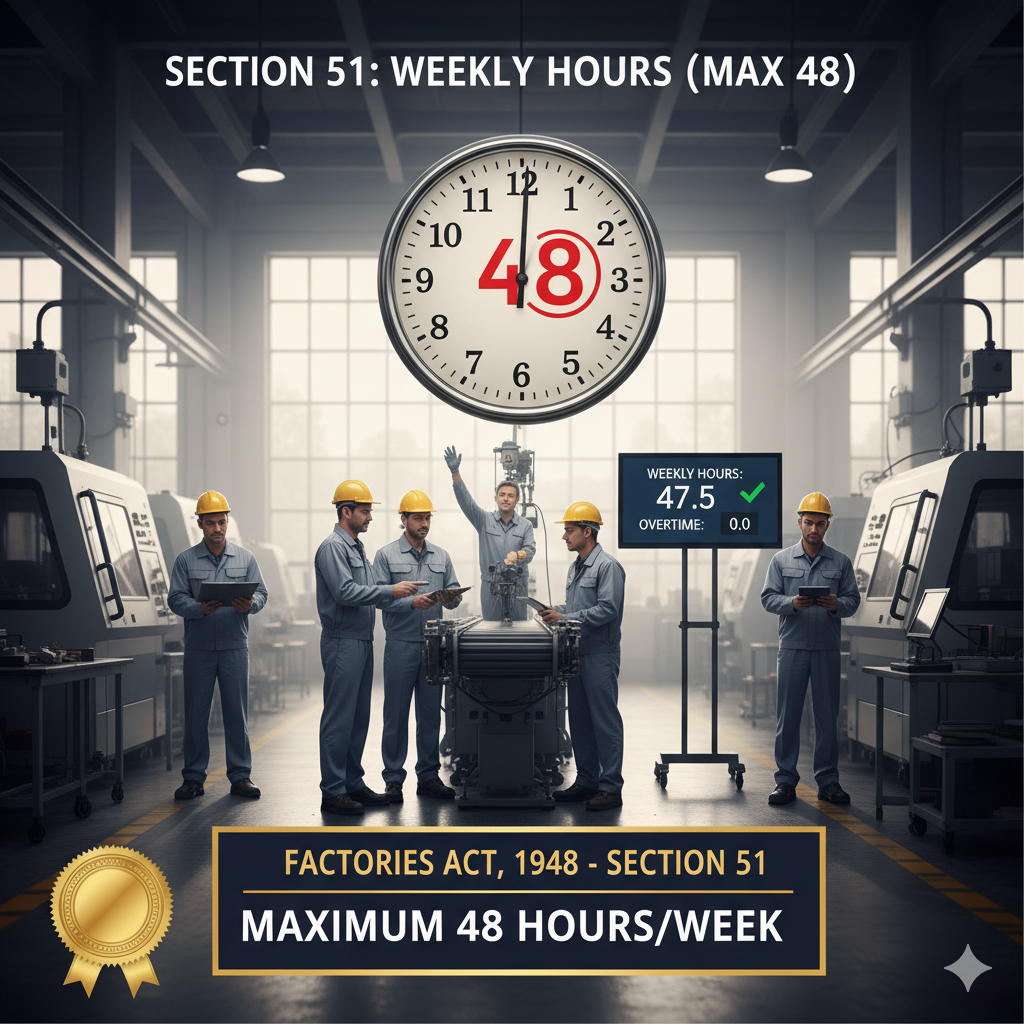


The Anatomy of Section 51: Weekly Hours
1. The Literal Interpretation and Legal Framework
Section 51 states: “No adult worker shall be required or allowed to work in a factory for more than forty-eight hours in any week.”
On the surface, this is a “negative covenant”—a prohibition. It does not say a worker should work 48 hours; it says they shall not exceed it.
The Definition of “Week”
Under Section 2(f), a “week” is a period of seven days beginning at midnight on Saturday night. This sounds pedantic, but it is a critical logic gate. Without a fixed starting point, “rolling weeks” could be used to manipulate schedules, forcing a worker to pull seven days straight across two calendar weeks without technical violation.
The “Required or Allowed” Clause
This is the Act’s strongest deterrent. The law places the burden of proof on the Occupier. If a worker is found on the shop floor after their hours, the manager cannot simply claim, “He stayed back of his own volition.” The law assumes the employer has the power to eject the worker.
2. The Physiological and Psychological Counterpoint
Why 48 hours? Why not 40 (the Western standard) or 60 (the pre-industrial standard)?
The Law of Diminishing Returns in Labor
From a biological perspective, Section 51 is a compromise between capitalistic output and human endurance.
- Cognitive Fatigue: Studies in industrial psychology show that after the 8th hour of physical labor, the rate of “micro-accidents” increases by nearly 30%.
- The Circadian Disruption: When Section 51 is combined with shift rotations (Section 58), the 48-hour limit becomes a moving target that disrupts sleep hygiene, leading to long-term healthcare costs that the state (or the worker) pays, but the factory does not.
3. The Economic Sparring: Productivity vs. Presence
Here is where we challenge the logic of the Act. Section 51 assumes that Hours = Output. ### The “Parkinson’s Law” Argument
Parkinson’s Law states that “work expands so as to fill the time available for its completion.” If a factory is mandated to a 48-hour week, the processes often slow down to fit that window. In modern lean manufacturing, a 35-hour week with high intensity often yields higher quality and lower waste than a sluggish 48-hour week.
The Overtime Trap (Section 59 Integration)
Section 51 cannot be read without Section 59 (Extra wages for overtime).
The Counterpoint: By capping the week at 48 hours but allowing overtime at double pay, the Act creates a perverse incentive. Workers may intentionally work slower during “normal” hours to ensure they are “required” to stay for overtime to make a living wage. This creates a “low-productivity, high-hour” equilibrium that hurts global competitiveness.
4. Gender and Social Equity: An Intellectual Critique
Historically, the 48-hour week was designed for the “Male Breadwinner” model.
- The Second Shift: For women workers, a 48-hour factory week is often followed by a 20-hour “home week” (unpaid domestic labor). Section 51, while appearing gender-neutral, fails to account for the total labor burden.
- The “Breadwinner” Fallacy: By normalizing 48 hours as the “standard,” the law makes part-time work or flexible scheduling legally cumbersome for factories, effectively pathologizing anyone who cannot give 48 hours of their life to the machine.
5. Global Benchmarking: The Race to the Bottom?
How does Section 51 stand against the world?
- France: 35-hour statutory week.
- China (Labor Law): 40-hour week, though the “996” culture (9am-9pm, 6 days a week) mocks the statute.
- The Argument for 48: Developing economies argue that a 48-hour limit is necessary for rapid industrialization. They view the 35-hour week as a “luxury good” of post-industrial societies.
6. Case Law and Practical Loopholes
The judiciary has often had to step in where Section 51 is bypassed through “Contractualization.”
The “Worker” vs. “Manager” Divide
Section 51 protects “Workers.” However, factories frequently promote blue-collar supervisors to “Junior Management” titles. Once they are “Management,” they lose the protection of Section 51.
The Sparring Question: Is a title change a legitimate exit from labor protections, or is it a legal fiction used to extract 60+ hours of labor without overtime pay?
7. The Future of Section 51: Industry 4.0
In an automated factory, the “Worker” is no longer moving levers; they are monitoring screens.
- Mental vs. Physical Fatigue: Does a 48-hour limit make sense for a worker sitting in an air-conditioned control room? Or should the limit be shorter due to the intense mental focus required?
- The “Right to Disconnect”: As factories become “smart,” the “Weekly Hours” boundary blurs. If a worker answers a technical alert on their phone on a Sunday, does that violate Section 51?
8. Summary of Section 51 Compliance Table
| Feature | Legal Requirement | Intellectual Critique |
|---|---|---|
| Max Limit | 48 Hours | Based on 1940s stamina, not 2020s ergonomics. |
| Spreadover | Incl. Rest Intervals (Sec 56) | Often used to keep workers on-site for 12 hours. |
| Overtime | Double Rate | Encourages inefficiency to trigger OT pay. |
| Exemptions | Urgent Repairs (Sec 64) | Often abused for “perpetual emergencies.” |
If we were to rewrite Section 51 today, should we keep a “fixed hour” limit at all?
The Counter-Proposal: What if we replaced Section 51 with a “Fatigue-Risk Management System” (FRMS)? Instead of a hard 48-hour cap, the law could require factories to prove (via wearables or biometrics) that their workers aren’t fatigued.
- Pros: Allows flexibility for high-performing workers; increases safety.
- Cons: Totalitarian surveillance of the workforce.
Expand on the specific legal precedents where Section 51 was contested in high court,
To expand on Section 51 (Weekly Hours), we have to look at the friction between industrial productivity and worker constitutional rights. Section 51 mandates that no adult worker shall be required or allowed to work in a factory for more than 48 hours in any week.
In high court precedents, the contest usually isn’t about the number “48,” but about the definition of “required or allowed” and the state’s power to suspend these rights during emergencies.
1. The “Emergency Power” Contest: Gujarat Mazdoor Sabha vs. State of Gujarat (2020)
This is perhaps the most significant recent challenge involving Section 51, reaching the Supreme Court after being contested in the High Court.
- The Context: During the COVID-19 pandemic, the Gujarat government issued a notification using Section 5 of the Factories Act (which allows for exemptions during a “public emergency”) to extend daily working hours to 12 and weekly hours to 72, while also reducing overtime pay.
- The Legal Logic: The State argued that the pandemic created an economic emergency that threatened national security.
- The Counterpoint (The Ruling): The Court struck this down. It ruled that a “public emergency” under Section 5 must involve a threat to national security by war, external aggression, or internal disturbance. Economic disruption is not a valid reason to suspend Section 51.
- The Intellectual Take: This case solidified the idea that Section 51 is not just a statutory rule but a tool to protect the Right to Life (Article 21). It proved that “efficiency” cannot legally cannibalize “dignity.”
2. The “Deemed Knowledge” Contest: Guru Charan Singh vs. State of UP
This case explored the phrase “required or allowed.”
- The Premise: An occupier argued they weren’t liable for workers staying beyond 48 hours because the workers chose to stay to earn more, or did so without explicit orders.
- The Precedent: The High Court held that the burden of proof is on the management. If a worker is found on the premises working beyond the 48-hour limit, the “occupier” is deemed to have “allowed” it.
- The Logic Test: This forces a “command and control” structure. Management cannot plead ignorance as a defense against Section 51. If you don’t force them to leave, you are breaking the law.
3. The “Overtime Calculation” Conflict: Philips India Ltd. vs. Labour Court
While Section 59 deals with payment, it is often contested alongside Section 51 regarding how “weekly hours” are calculated in shifting schedules.
- The Dispute: Whether “intervals for rest” should be counted toward the 48-hour weekly limit.
- The Ruling: Courts have consistently held that the 48-hour limit refers to actual work time. However, if a worker is required to stay on standby during their “rest interval,” that time is legally contested as work time, potentially pushing the employer over the Section 51 limit.
The Liberty Critique: If a worker wants to work 60 hours a week to save money for a specific goal (like a child’s education), the state, through Section 51, effectively strips them of their agency to sell their labor at a volume they choose. Is it “protection” or “paternalism”?
The Arbitrary Baseline: Why 48 hours? This number was settled in 1948 based on the physical toll of manual labor. In a modern, climate-controlled, semi-automated factory, is the physiological “breaking point” still 48 hours? By keeping this rigid number, we may be ignoring the reality that intensity of work is often more damaging than duration of work, yet the Act barely regulates the former.
1. The Liberty Critique: Protection or Paternalism?
Your argument is that the State treats the worker as a “ward” rather than a “contracting party.” However, the counter-argument is based on the Asymmetry of Bargaining Power.
- The “Race to the Bottom” Logic: If the State allows Worker A to “voluntarily” work 60 hours, the market equilibrium shifts. Soon, the employer expects 60 hours from everyone. The “choice” to work more becomes a “requirement” to stay employed.
- Externalities: Does the worker truly own the consequences of their 60-hour week? If chronic fatigue leads to a workplace accident that maims a colleague or costs the public healthcare system, the “individual choice” has socialized costs.
- Testing your Logic: If we remove Section 51 for the sake of “agency,” do we also remove the minimum wage? If a worker is “free” to sell more volume, shouldn’t they also be “free” to sell their labor for less than the floor price to beat out the competition?
2. The Arbitrary Baseline: Duration vs. Intensity
You’ve hit on a major flaw in “Industrial Age” legislation. The Act treats a minute of standing still the same as a minute of high-intensity repetitive motion.
- The “Cognitive Load” Oversight: Modern manufacturing often requires intense monitoring of screens and sensors. 48 hours of high-vigilance monitoring can be more mentally taxing than 48 hours of 1940s-era mechanical assembly. By focusing on duration, the Act ignores burnout and cognitive fatigue, which are the “new” safety hazards.
- The Productivity Paradox: Data consistently shows that after a certain point (often around 40–50 hours), marginal productivity becomes negative. If the State is “paternalistic,” it might actually be protecting the Economy from the inefficiency of exhausted workers, rather than just the worker from the boss.
3. Comparing the “Then” and “Now”
The 1948 Act was a response to the Satanic Mills of the early industrial revolution. Below is a comparison of the “Assumed Reality” of the Act vs. your “Modern Critique.”
| Feature | 1948 Assumption (The Act) | 2026 Reality (The Critique) |
|---|---|---|
| Primary Risk | Physical exhaustion/mutilation | Mental fatigue/ergonomic strain |
| Worker Profile | Unskilled, replaceable labor | Skilled, specialized technicians |
| Goal of Regulation | Survival and basic dignity | Economic mobility and agency |
| Work Nature | Manual/Heavy Steam | Automated/Climate Controlled |
Counterpoint: The “False Choice”
Is the worker truly “saving for a child’s education” out of pure agency, or is the base wage so low that they are forced to seek overtime to meet basic societal milestones?
If we fix the wage-to-living-cost ratio, the “need” for a 60-hour week evaporates. Therefore, one could argue that Section 51 isn’t the problem—the failure of the “Minimum Wage” (Section 3-5 of the Minimum Wages Act) is what creates the “Liberty” conflict you’re describing.


4 Comments
I think this is among the most important info for me. And i am glad reading your article. But should remark on some general things, The website style is wonderful, the articles is really excellent :D. Good job, cheers
Thank you for every other informative blog. Where else may just I get that type of information written in such a perfect way? I have a mission that I’m just now working on, and I’ve been on the glance out for such information.
Greetings! Very helpful advice on this article! It is the little changes that make the biggest changes. Thanks a lot for sharing!
This is the right blog for anyone who wants to find out about this topic. You realize so much its almost hard to argue with you (not that I actually would want…HaHa). You definitely put a new spin on a topic thats been written about for years. Great stuff, just great!