


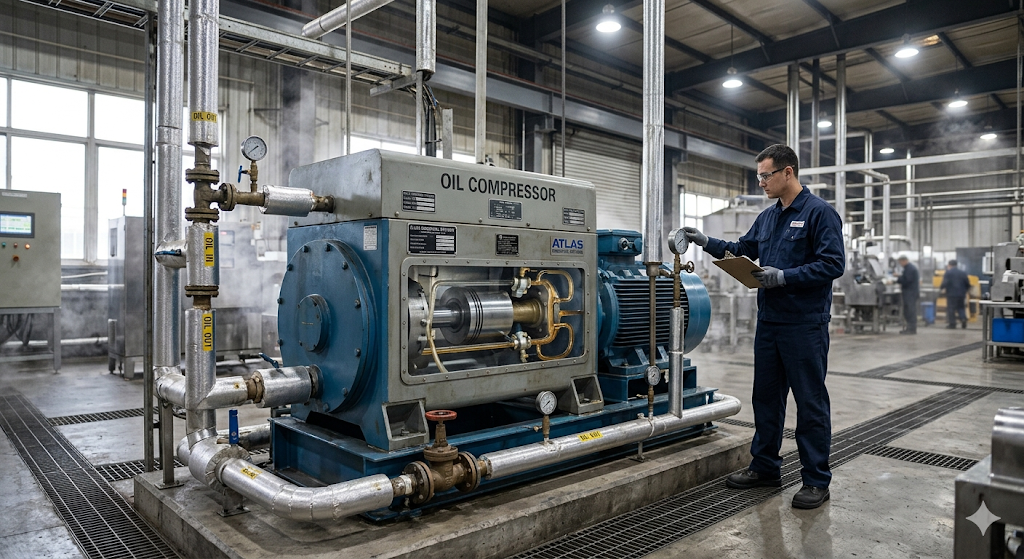


An “oil compressor” typically refers to an oil-injected rotary screw compressor. Unlike a standard reciprocating air compressor that might use oil only for splash lubrication of the crankcase, an oil-injected system uses oil as a vital component of the compression cycle itself.
How it Works
In a rotary screw compressor, two interlocking helical rotors (male and female) spin in opposite directions. As they rotate, they draw in ambient air.
- Injection: During the compression process, oil is injected into the compression chamber.
- Sealing: The oil creates a thin film between the rotors and the cylinder walls, acting as a “liquid seal” that prevents air from leaking back toward the intake.
- Cooling: Compression naturally generates heat (PV = nRT). The oil absorbs this heat immediately, allowing for a near-isothermal compression process.
- Separation: After compression, the air-oil mixture exits the rotors. It then passes through a Separator Tank, where centrifugal force and high-efficiency filters remove the oil from the air stream.
- Recirculation: The oil is cooled via a heat exchanger and filtered before being sent back into the rotors.
Example: Imagine a bicycle pump. If you pump it quickly, the barrel gets hot, and the air leaks past the rubber seal if it’s dry. Now, imagine filling that pump with a viscous fluid. The fluid would seal the gaps perfectly, and because the fluid absorbs the heat of the friction and the compressed air, the pump stays cool even under high pressure.
2. Industrial Categories & Applications
Oil-injected compressors are the workhorses of heavy industry because they can run 24/7 at 100% duty cycles.
A. General Manufacturing and Assembly Lines
In automotive or appliance manufacturing, pneumatic tools (impact wrenches, robotic arms, and conveyors) require consistent pressure. Oil-injected systems are preferred here because the trace amounts of oil that remain in the air (measured in parts per million) actually help lubricate the internal components of the pneumatic tools, extending their lifespan.
B. Construction and Mining
In harsh environments, compressors are exposed to dust and extreme temperatures. Oil-injected portable compressors are used to power jackhammers, rock drills, and sandblasting equipment. The oil acts as a barrier against contaminants that might otherwise score the internal metal surfaces of the compressor.
C. Oil and Gas (Upstream and Midstream)
Oil compressors are used for Gas Reinjection and Gas Lift operations. In these cases, the “oil” used in the compressor is often a specialized synthetic fluid designed to handle the chemical footprint of natural gas without breaking down.
D. HVAC and Refrigeration
Large-scale industrial chillers use screw compressors where the refrigerant and oil mix. The oil is essential for cooling the refrigerant during the high-pressure phase of the cycle.
3. Why Oil Compressor instead of Air (Oil-Free) Compressor?
The choice between oil-injected and oil-free (often mistakenly called “air compressors” in a general sense) comes down to Efficiency vs. Purity.
| Feature | Oil-Injected Compressor | Oil-Free Compressor |
|---|---|---|
| Initial Cost | Lower | Significantly Higher |
| Maintenance | Regular oil/filter changes | High (teflon coatings wear out) |
| Heat Management | Excellent (Oil absorbs heat) | Poor (Requires multi-stage cooling) |
| Noise Level | Lower (Oil dampens sound) | Higher |
| Longevity | 20+ years with maintenance | 7–10 years (Rotor wear) |
The “Why”:
- Thermal Efficiency: Because oil absorbs heat during compression, the air stays cooler. Cooler air is denser and easier to compress, meaning the motor does less work to achieve the same pressure.
- Durability: Metal-on-metal contact is the enemy of machinery. In an oil-injected system, the rotors never actually touch; they “ride” on a film of oil. In oil-free systems, the rotors rely on special coatings (like Teflon) which eventually flake off, requiring a total “air-end” replacement.
- Pressure Ratios: Oil-injected screws can reach much higher pressures in a single stage than oil-free units because the cooling allows for tighter tolerances.
4. Preventing “Oil Compressor Blasts” (Explosion Hazards)


While rare, an oil compressor can explode (often termed a “dieseling effect”). This happens when the oil mist within the system reaches its flashpoint and ignites, or when high-pressure vessels fail.
Precautions to Prevent Blasts:
1. Temperature Monitoring (The Critical Line)
The most common cause of a “blast” is overheating. If the cooling system fails and the oil temperature exceeds 110°C (230°F), the oil can begin to carbonize. These carbon deposits can glow like embers. If the temperature continues to rise to the oil’s auto-ignition point, an internal explosion occurs.
- Action: Install redundant high-temperature shut-off switches.
2. Oil-Separator Maintenance
The separator tank contains a high concentration of pressurized air and oil mist. If the separator element is not changed, it can become clogged, increasing internal pressure. Furthermore, static electricity can build up on the separator.
- Action: Ensure the separator is properly grounded to prevent static sparks and change filters every 2,000–4,000 hours.
3. Lubricant Selection
Never use automotive oil in an industrial compressor. Use only high-flashpoint synthetic lubricants (like PAO or Ester-based oils). Synthetic oils have higher thermal stability and are less likely to form the carbon “varnish” that leads to fires.
4. Pressure Relief Valves (PRVs)
A “blast” can also be a mechanical failure of the tank.
- Action: PRVs must be tested annually. They should be set to 10% above the maximum operating pressure to vent excess air before the vessel reaches its burst point.
5. Proper Ventilation
Compressors generate massive amounts of heat. If they are kept in a small, unventilated room, the ambient air intake temperature rises, which in turn raises the discharge temperature.
- Action: Ensure ducting pulls in cool, outside air and exhausts hot air away from the machine.
5. Summary of Necessity
Using an oil compressor is a necessity in heavy industry because it provides a self-lubricating, self-cooling, and cost-effective method of power. While oil-free compressors are required for “clean” industries like Food/Beverage or Pharmaceuticals, the oil-injected variety remains the standard for 90% of global manufacturing due to its sheer reliability.
By adhering to strict thermal monitoring and lubricant management, the risks of “oil blasts” are virtually eliminated, making it one of the safest and most efficient tools in the modern industrial arsenal.
The Critical Role of Compressed Air in Pharma
In pharmaceutical manufacturing, compressed air is often referred to as the “fourth utility” after electricity, water, and gas. It is not merely a power source for pneumatic tools; it is a direct ingredient or a process medium. It comes into contact with products during:
- Tablet Coating: Spraying coating material onto pills.
- Product Drying: Removing moisture from sensitive chemical compounds.
- Pneumatic Conveying: Moving powders and granules through tubes.
- Packaging: Cleaning bottles and sealing blister packs.
Because the air touches the medicine, its quality is governed by strict international standards, primarily ISO 8573-1:2010, which classifies air based on particles, water, and oil content.
2. Defining the Contender: The “Oil Compressor”
When we speak of an “oil compressor” in pharma, we are usually referring to Oil-Injected Rotary Screw Compressors equipped with a sophisticated Downstream Filtration Train.
In these machines, oil serves three vital functions:
- Lubrication: Reducing friction between the rotors.
- Sealing: Filling the gaps between rotors to prevent air backflow, ensuring high volumetric efficiency.
- Cooling: Absorbing the heat of compression, which allows the machine to run continuously without overheating.
3. Why Oil Compressors are “Most Used” (The Practical Reality)
While “Oil-Free” compressors are marketed as the gold standard for purity, oil-injected compressors remain the workhorses of the industry for several pragmatic reasons.
A. Mechanical Longevity and Reliability
Oil-free compressors run at much higher temperatures because they lack the cooling medium (oil) within the compression chamber. This heat leads to higher thermal stress on components. Oil-injected compressors, by contrast, run “cool,” leading to a significantly longer lifecycle for the internal rotors and bearings. In a 24/7 pharma production environment, downtime is more expensive than the risk of oil carryover.
B. Energy Efficiency
Oil acts as a sealant. In an oil-free compressor, there is a minute gap between the rotors to prevent them from touching (since there is no lubricant). This allows “blow-by” or air leakage, which reduces efficiency. An oil-injected compressor seals this gap perfectly, requiring less electricity to produce the same Cubic Feet per Minute (CFM) of air.
C. Cost of Acquisition (CAPEX)
Oil-free compressors are precision-engineered marvels, often costing 40% to 100% more than their oil-injected counterparts. For many medium-sized pharmaceutical firms or those focused on non-sterile topical products, the massive upfront investment in oil-free technology is difficult to justify when high-end filtration can achieve the same air quality class.
4. The “Why Not” Factor: Why Standard Air Compressors are Not Preferred
When you ask why they “do not prefer air compressors,” it is important to distinguish between a standard industrial air compressor and a medical-grade air system. The pharmaceutical industry rejects “standard” air compressors for the following reasons:
A. The “Oil Vapor” Crisis
A standard shop compressor allows significant amounts of liquid oil and oil vapor to pass into the lines. In pharma, oil is a contaminant. If oil vapor hits a batch of tablets:
- It alters the chemical composition.
- It prevents coatings from adhering.
- It creates “fisheyes” or spots on the product.
B. Microbial Growth
Standard compressors often lack integrated dryers. Compressed air is naturally humid. When air cools in the pipes, water precipitates. This moisture, combined with the warmth of the compressor, creates a breeding ground for bacteria and fungi. Pharma requires Class 1 or 2 pressure dew points (down to -40°C) to ensure the air is too dry for life to exist.
C. Particle Contamination
Standard compressors use basic intake filters. Pharma requires the removal of particles down to 0.01 microns. A standard compressor’s wear-and-tear shed metal micro-particles into the air stream, which is an automatic “failed batch” in a regulated environment.
5. The Solution: The Filtration Train
The reason pharma can use oil compressors is the Filtration Train. To make an oil-injected compressor “Pharma-Safe,” it must pass through:
- Water Separators: To remove bulk liquid.
- Coalescing Filters: To turn oil mist into droplets and drain them.
- Activated Carbon Towers: To adsorb oil vapors (smell and microscopic gas).
- Sterile Filters: To ensure the air is biologically pure.
6. Challenging the Assumption: Is Oil-Free Actually Better?
There is a common logic that “Oil-Free = Zero Risk.” As an intellectual partner, I must challenge this.
- The Ambient Air Trap: Even an “Oil-Free” compressor sucks in ambient air. If the factory is near a highway or a parking lot, the intake air contains hydrocarbon vapors from car exhausts.
- The False Sense of Security: Users of oil-free compressors often neglect downstream filtration, thinking the air is “pure.” However, they still face risks from dust, pipe scale, and atmospheric oil.
Alternative Perspective: An oil-injected compressor with a monitored carbon tower is often safer than an unmonitored oil-free compressor because the filtration system is designed to be a “fail-safe” barrier.
7. Comparison Table: Oil-Injected vs. Oil-Free in Pharma
| Feature | Oil-Injected (with Filtration) | Oil-Free |
|---|---|---|
| Initial Cost | Lower | Very High |
| Maintenance | Regular (Filters/Oil changes) | Expensive (Rotor replacements) |
| Energy Usage | Highly Efficient | Less Efficient (Heat loss) |
| Risk Profile | Risk of filter failure | Risk of ambient contamination |
| Noise Level | Generally quieter | Generally louder |
Summary of Logic
The pharmaceutical industry uses oil compressors not because they want oil, but because the mechanical stability and cost-efficiency of the oil-injected screw are unmatched. They mitigate the “oil problem” through rigorous, multi-stage purification.
They do not prefer “standard” air compressors because the lack of control over moisture, oil, and microbes would lead to catastrophic regulatory failures (FDA/EMA) and the loss of millions of dollars in spoiled product.
Why Compressors are Vital to Pharma
In pharmaceutical manufacturing, compressed air is often treated as a “fourth utility” alongside electricity, water, and gas. It comes into direct or indirect contact with the product in several ways:
- Pneumatic Conveying: Moving powders or tablets through the production line using air pressure.
- Product Drying: Removing moisture from pills or capsules.
- Packaging and Bottling: Using air to actuate valves, sort products, or clean containers before filling.
- Fermentation: Providing oxygen to bacteria or cell cultures in bioreactors.
The Debate: Oil-Lubricated vs. Oil-Free
While your query focuses on “Oil Compressors,” it is essential to clarify a major industry standard: The pharmaceutical industry actually strives to avoid oil-injected compressors in favor of oil-free models.
Why Oil-Injected (Oil) Compressors are Used
Despite the risks, oil-lubricated compressors are sometimes found in peripheral pharmaceutical operations (like plant maintenance or non-cleanroom tool power) for the following reasons:
- Lower Initial Cost: Oil-lubricated machines are generally cheaper to purchase than high-end oil-free “Class 0” compressors.
- Durability: Oil acts as a coolant and sealant, often leading to a longer lifespan for the internal moving parts under heavy friction.
- Heat Management: The oil absorbs the heat of compression, making the machine run cooler than a dry-running equivalent.
The Shift to Oil-Free
Most modern pharma plants use Oil-Free Compressors to meet ISO 8573-1 Class 0 standards. If an oil-lubricated compressor is used for direct product contact, the risk of “oil carryover” (microscopic oil vapors leaking into the air stream) is extremely high. Even with advanced filtration, a single filter failure could contaminate an entire multi-million dollar batch of medicine.
The Catastrophe: Understanding a Compressor Blast
A “compressor blast” or “receiver tank explosion” is a high-energy event that can be compared to a small bomb detonating within a facility. Because air is compressible, a tank under 100-150 PSI stores a massive amount of potential energy.
Primary Causes of Explosion
- Internal Combustion (Diesel Effect): In oil-lubricated compressors, if the discharge temperature rises too high, the lubricating oil can vaporize and mix with the compressed oxygen. This creates a combustible mixture that can ignite, leading to an internal explosion.
- Corrosion: Moisture is a byproduct of compression. If a steel receiver tank isn’t drained regularly, it rusts from the inside out, thinning the walls until they can no longer contain the pressure.
- Pressure Switch Failure: If the “cutoff” switch fails and the safety relief valve is stuck or clogged, the compressor will continue to pump air until the tank’s physical yield strength is exceeded.
The Results of a Compressor Blast
When a compressor fails catastrophically, the consequences are categorized into three main areas:
1. Physical and Structural Damage
The immediate release of pressure creates a shockwave.
- Shrapnel: The metal casing of the tank or the compressor head can shatter, sending high-velocity metal fragments through walls and machinery.
- Structural Collapse: The blast can knock out supporting pillars or damage HVAC systems, which are critical for maintaining cleanroom pressures.
2. Personnel Safety
The human cost is the most severe result.
- Trauma: Workers near the unit face a high risk of fatal injury from shrapnel or the pressure wave itself.
- Hearing Loss: The decibel level of a tank rupture can cause permanent eardrum damage to anyone in the vicinity.
3. Pharma-Specific Fallout: Contamination and Compliance
In a pharmaceutical context, the blast creates unique “invisible” disasters:
- Loss of Sterility: A blast usually compromises the “Negative/Positive Pressure” balance of a cleanroom. Dust, unfiltered air, and debris are sucked into sterile environments, immediately halting production.
- Regulatory Scrutiny: An explosion triggers mandatory reporting to bodies like the FDA or EMA. If investigators find the cause was “poor maintenance” or “improper equipment choice,” the facility may lose its license to manufacture.
- Financial Ruin: Beyond the cost of the machine, the loss of a “batch” in progress can range from hundreds of thousands to millions of dollars.
Mitigation and Best Practices
To prevent such disasters, pharmaceutical facilities must adhere to strict maintenance protocols:
- Daily Draining: Ensuring no water accumulates in the tank to prevent corrosion.
- Annual Hydrostatic Testing: Testing the tank’s integrity by filling it with water and pressurizing it.
- Vibration Monitoring: Using sensors to detect internal wear before a mechanical failure occurs.
- Class 0 Certification: Using oil-free air to eliminate the risk of oil-vapor combustion.
Summary Table: Oil vs. Oil-Free in Pharma
| Feature | Oil-Lubricated | Oil-Free (Class 0) |
|---|---|---|
| Initial Cost | Lower | Higher |
| Risk of Contamination | High (Oil carryover) | Zero |
| Explosion Risk | Higher (Oil combustion) | Lower (Mechanical/Pressure only) |
| Maintenance | Frequent filter changes | High-end component checks |
| Pharma Suitability | Non-critical tasks only | Direct product contact |
While oil-lubricated compressors are workhorses of the industrial world, the pharmaceutical industry’s “Quality by Design” philosophy increasingly views them as an unnecessary risk. A single blast or a single drop of oil in a vial of medicine is a price far higher than the cost of a safer, oil-free system.


