


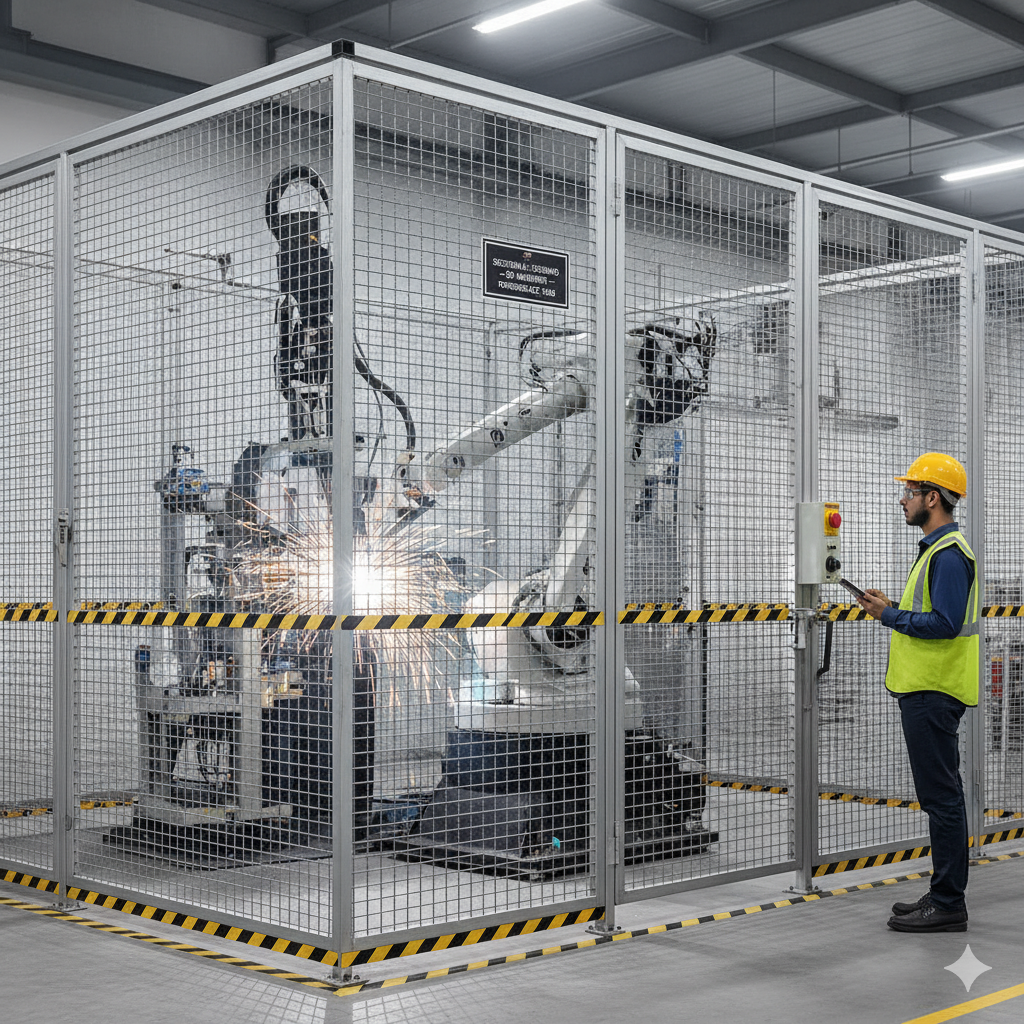


Section 21 is the “Iron Rule” of industrial safety. While other sections deal with comfort (ventilation, lighting), Section 21 deals with life and limb. It is one of the few sections where the liability of the “Occupier” is almost absolute.
I. The Statutory Mandate: The “Shall” vs. “May”
The primary text of Section 21 mandates that in every factory, certain dangerous parts of machinery “shall be securely fenced by safeguards of substantial construction.”
The word “shall” is the pivot of the entire section. In legal hermeneutics, this creates an absolute liability. It is not a suggestion; it is a command. It does not matter if the machine is brand new or a hundred-year-old heirloom; if it is “dangerous,” it must be fenced.
The Categories of Machinery Requiring Fencing:
- Prime Movers: Every moving part of a generator, motor, or rotary converter.
- Transmission Machinery: Every shaft, wheel, drum, pulley, system of fast and loose pulleys, coupling, clutch, driving belt, or other device by which the motion of a prime mover is transmitted.
- Dangerous Parts of Other Machinery: This is the “catch-all” clause that leads to the most litigation. What constitutes “dangerous”?
II. Defining “Dangerous”: The Foreseeability Test
Intellectually, we must challenge the definition of “dangerous.” The law does not define it by the machine’s inherent nature, but by the probability of contact.
The Legal Counterpoint: The “Careless Worker” Argument
A common defense used by factory occupiers is: “The machine wasn’t dangerous; the worker was being negligent/stupid.” However, judicial precedents (notably in cases like Mitchell v. North British Rubber Co.) have established that a part is dangerous if it is a reasonably foreseeable cause of injury to anybody acting in a way a human being may be reasonably expected to act in circumstances that may be reasonably expected to occur.
This includes acts of inadvertence, laziness, or even minor disobedience. The law assumes that humans are fallible. Therefore, the fence is not there to protect the “perfect” worker; it is there to protect the tired, distracted, or clumsy worker.
III. The “Securely Fenced” Doctrine
Section 21 doesn’t just ask for a fence; it asks for it to be “securely fenced.” ### 1. Substantial Construction
A piece of cardboard or a flimsy plastic sheet does not satisfy Section 21. The material must withstand the force of a breaking belt or a flying component.
2. Maintenance and Position
The fencing must be kept in position while the parts are in motion or use. This is where most industrial accidents happen. Maintenance crews often remove guards to “get the job done faster” and forget to replace them. Under Section 21, the moment that machine moves without the guard, the Occupier has committed a criminal offense, regardless of whether an accident occurs.
IV. The Philosophical Conflict: Safety vs. Productivity
Here is where I challenge the logic of the Act. Section 21 is a prohibitive safety standard.
The Productivity Tax
If a machine requires constant adjustment (like a circular saw or a milling machine), a “secure fence” often slows down production.
- The Paradox: If the law demands 100% fencing, but 100% fencing makes the machine 0% usable, the law creates a culture of “Compliance Theatre.”
- The Result: Managers install guards for the Inspector’s visit and remove them for the night shift. This “double life” of machinery is the direct result of a rigid legal framework that doesn’t always account for ergonomic realities.
The Technology Gap
Section 21 was written in 1948. It envisions physical metal barriers. Today, we have Light Curtains, Laser Scanners, and Pressure Mats. * The Sparing Point: Does a “Light Curtain” constitute a “fence of substantial construction”? In many jurisdictions, the law has had to be stretched by “deeming” these electronic barriers as fences. However, a strict reading of Section 21 might suggest that an electronic beam isn’t “substantial” in the physical sense.
V. Judicial Interpretations and Absolute Liability
In the eyes of the court, Section 21 is Strict Liability.
If a worker climbs over a 7-foot fence to clear a jam and gets injured, the employer is often still held liable. Why? Because the law suggests that if a worker can climb over it, the fence wasn’t “secure” enough for the foreseeable (albeit foolish) actions of the employee.
The Case of “Indirect Contact”
What if the machine doesn’t touch the worker, but the machine throws a piece of wood (ejecta) at the worker?
- The Debate: Historically, some courts argued Section 21 only protects against contact with the machine. Modern interpretations, however, argue that if the “dangerous part” is capable of throwing objects, the fencing must account for that.
VI. Critical Analysis: Why Section 21 Fails in Practice
Despite the 3,000-word potential of this section’s legal nuances, the reality on the factory floor is often grim.
- The Small-Scale Problem: In “Micro” factories, Section 21 is almost entirely ignored. The cost of bespoke fencing for an old lathe might exceed the value of the lathe itself.
- The Inspector’s Discretion: Because “dangerous” is subjective, Section 21 becomes a tool for rent-seeking (bribery). An inspector can find a “dangerous part” on almost any moving object if they look hard enough.
- The Training Gap: We fence the machine, but we don’t “fence” the mind. A worker who doesn’t understand why the guard exists will always find a way to bypass it.
VII. Conclusion: Is Section 21 Still Relevant?
As an intellectual partner, I argue that Section 21 is a relic of the Mechanical Age struggling to survive in the Digital Age. While its intent—the preservation of human life—is timeless, its focus on “substantial construction” (physical barriers) is becoming obsolete.
The future of industrial safety isn’t in better fences; it’s in Inherent Safe Design. A machine that cannot operate while a human limb is in the vicinity—via sensors and AI—is far safer than a machine behind a rusted iron cage.




1 Comment
Very interesting info !Perfect just what I was looking for! “I live in company with a body, a silent companion, exacting and eternal.” by Eugene Delacroix.