


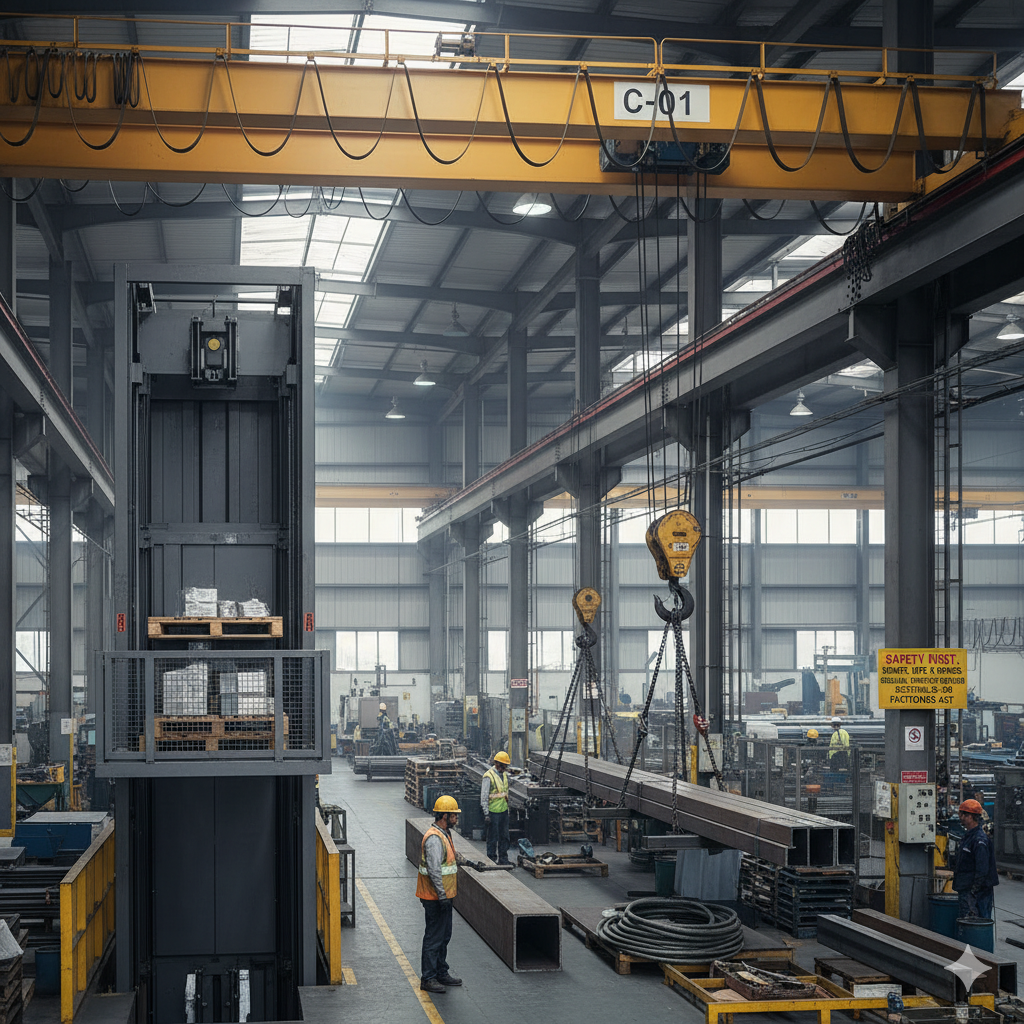


Section 28: Hoists and Lifts
Section 28 is the legislative response to the fact that vertical transport is essentially a controlled fall. The Act treats a hoist not as a convenience, but as a “dangerous machine” by default.
1. The Requirement of “Good Mechanical Construction”
The Act mandates that every hoist and lift shall be of “good mechanical construction, sound material, and adequate strength.”
- The Counterpoint: What defines “good”? In 1948, this was subjective. Today, we rely on IS (Indian Standards) or ISO codes. However, the Act remains vague, giving inspectors immense discretionary power. This “vagueness” is a double-edged sword: it allows for evolution in technology, but it also creates a breeding ground for rent-seeking behavior during inspections.
2. The Six-Month Rule (The Examination Fetish)
Section 28(1)(b) requires a thorough examination by a Competent Person at least once every six months.
- The Logic Test: Why six months? Why not 500 hours of operation? A lift in a textile mill running 24/7 undergoes vastly different stress than a lift in a seasonal sugar factory. The Act prioritizes chronological time over operational cycles, which is a fundamental flaw in predictive maintenance logic.
3. The Enclosure and Gate Mandate
The Act requires hoists to be sufficiently protected by an enclosure fitted with gates. These gates must be “interlocked”—meaning the lift cannot move unless the gate is shut, and the gate cannot open unless the lift is at that landing.
- The “Human Factor” Failure: Almost all industrial accidents involving lifts occur because of “gate bypassing.” Workers often wedge gates open for speed. While the law mandates the hardware (the interlock), it is notoriously silent on the “Software” (the safety culture and behavioral monitoring).
II. Section 29: Lifting Machines, Chains, Ropes, and Lifting Tackle
While Section 28 deals with fixed verticality, Section 29 deals with horizontal and vertical movement—Cranes, Derricks, Crab-winches, and the “Tackle” (slings, rings, hooks) that connect them.
1. The Definition of “Tackle”
The law extends its reach to the smallest link in the chain. This is where the “Weakest Link” theory becomes codified law. If a $50,000 crane drops a load because a $10 uncertified S-hook failed, the Occupier is liable for the entire failure.
2. The Safe Working Load (SWL)
Section 29(1)(b) states that no lifting machine or tackle shall be loaded beyond the Safe Working Load.
- The Intellectual Challenge: The SWL is a static number stamped on a plate. However, dynamic loading (sudden braking or “jerking” a load) can increase the effective force by 2\times or 3\times the static weight. The Act treats the SWL as a binary “Safe/Unsafe” line, whereas engineering treats it as a probability curve. A machine operated at 90% SWL in high winds is often more dangerous than one at 110% in a controlled vacuum.
3. The “Competent Person” Paradox
Both sections rely on the “Competent Person” to certify safety.
- The Conflict of Interest: In many jurisdictions, the Competent Person is a private consultant paid by the Factory Occupier. This creates a fundamental “Principal-Agent” problem. Does the inspector risk losing a recurring client by red-flagging a critical but expensive-to-repair crane? The Act provides the framework for safety but fails to insulate the inspector from the economic pressure of the employer.
- Table of Annealing Schedules: Section 29 requires chains to be “annealed” (heat-treated to remove brittleness).
- The Physics of the “Free Lift”: Why the law prohibits “overhead traveling cranes” from passing over certain areas.
- The Register of Examinations (Form 9/10): The administrative burden that often leads to “paper compliance”—where the logs look perfect but the cables are fraying.
The Real-World Critique:
The Factories Act (Sec 28-29) is Hardware-Centric. It assumes that if the machine is strong and the gate is closed, the worker is safe.
Modern Counter-Argument: Modern safety science (like the Swiss Cheese Model) suggests that accidents happen due to a “linear alignment of holes” in multiple layers of defense.
- The Act focuses on the Physical Layer (The Machine).
- It largely ignores the Cognitive Layer (Operator fatigue, “normalization of deviance”).
- It ignores the Environmental Layer (Lighting, noise, vibration affecting the crane operator’s judgment).
IV. Comparative Analysis: Section 28 vs. 29
| Feature | Section 28 (Hoists/Lifts) | Section 29 (Cranes/Tackle) |
|---|---|---|
| Primary Motion | Vertical/Fixed Path | Multi-directional/Variable |
| Inspection Frequency | Every 6 Months | Every 12 Months (for machines) |
| Critical Failure | Free Fall / Crushing at Gate | Tip-over / Snap / Load Drop |
| Key Safety Device | Interlocking Gates | Limit Switches / SWL Indicators |
Sections 28 and 29 are masterclasses in Victorian-era engineering safety. They are brilliant for preventing catastrophic mechanical failure of metal and rope. However, they are woefully inadequate for the Human-Machine Interface (HMI).




2 Comments
Hey there! Do you use Twitter? I’d like to follow you if that would be okay. I’m definitely enjoying your blog and look forward to new posts.
Thank you for any other magnificent post. The place else may just anyone get that type of information in such an ideal way of writing? I’ve a presentation next week, and I’m on the look for such information.