















.jpg?w=218&resize=218,150&ssl=1 "UNESCO Zollverein Coal Mine Industrial Complex & Other Things to do in Essen, Germany | My Travelogue")











Odisha and the Swadeshi Movement: A Surge for Self-Reliance (1905-1911)
The Swadeshi Movement (1905-1911), ignited by the partition of Bengal, was a pivotal moment in India’s struggle for independence. It transcended geographical boundaries, stirring nationalist sentiments and fostering a spirit of self-reliance across the nation. Odisha, then a politically fragmented region under British rule, actively participated in this movement, demonstrating its commitment to the cause of Swaraj (self-rule) and the revival of indigenous industries. This comprehensive article explores Odisha’s significant contribution to the Swadeshi Movement, detailing its key aspects, prominent figures, and lasting impact.
Disclaimer
This article provides a historical overview of Odisha’s participation in the Swadeshi Movement based on available historical records and scholarly interpretations. While every effort has been made to ensure accuracy, historical events can be subject to varying perspectives. The information presented herein is intended for educational and informational purposes.
The Socio-Political Landscape of Odisha Pre-Swadeshi
At the dawn of the 20th century, Odisha was not a unified political entity. Parts of it were under the direct administration of the Bengal Presidency (including districts like Balasore, Cuttack, and Puri), while other portions were under the Central Provinces and Madras Presidency, and numerous princely states existed. Despite this fragmentation, a sense of Odia identity and a desire for unification were gradually taking root, fueled by linguistic and cultural commonalities.
The economic situation in Odisha was largely agrarian, with a significant dependence on agriculture. Indigenous industries, particularly textiles and handicrafts, were facing stiff competition from cheaper, machine-made foreign goods flooding the market due to British trade policies. This economic vulnerability created fertile ground for the Swadeshi message of promoting local products.
The intellectual awakening spearheaded by figures like Madhusudan Das, who championed Odia language and the unification of Odia-speaking tracts, laid a crucial foundation for the nationalist fervor that the Swadeshi Movement would amplify. The Utkal Sammilani (Utkal Union Conference), formed in 1903, aimed to unite Odia-speaking regions and played a significant role in propagating nationalist ideas.
Odisha’s Response to the Swadeshi Call
The partition of Bengal in 1905 acted as a catalyst, galvanizing nationalist sentiments in Odisha. The call to boycott foreign goods and promote Swadeshi (indigenous) products resonated deeply with various sections of Odia society, including students, intellectuals, lawyers, merchants, and ordinary citizens.
Key Aspects of Odisha’s Participation
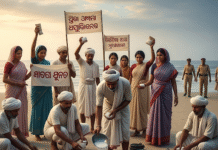
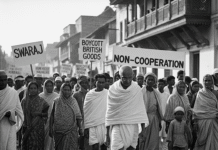
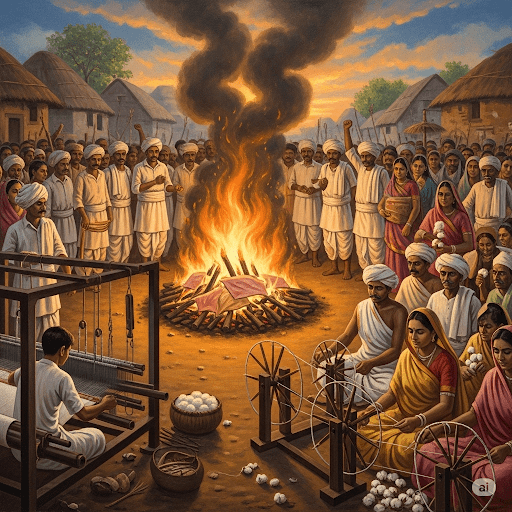
- Boycott of Foreign Goods: The most visible aspect of Odisha’s involvement was the widespread boycott of foreign-made goods, particularly textiles, sugar, and salt. Public meetings were organized where people took pledges to use only Swadeshi products. Bonfires of foreign clothes became a common sight in towns and villages, symbolizing the rejection of colonial economic exploitation.
- Promotion of Indigenous Industries: The movement spurred efforts to revive and promote local industries. Emphasis was placed on using handloom textiles produced by Odia weavers. The Utkal Sammilani actively encouraged the establishment of indigenous enterprises and provided support to local artisans. There was a renewed appreciation for traditional Odia crafts and products.
- Educational Initiatives: The Swadeshi spirit also influenced the education sector. Calls were made for establishing national schools that would impart education rooted in Indian culture and values, free from colonial influence. While the establishment of formal national schools on a large scale was limited in Odisha during this period, the underlying principle of promoting indigenous education gained traction.
- Use of Media and Public Discourse: Nationalist newspapers and journals played a vital role in disseminating the message of Swadeshi. Publications like “The Oriya” and “Samaj” carried articles and editorials advocating for the boycott of foreign goods and the adoption of Swadeshi. Public meetings, lectures, and patriotic songs became important tools for mobilizing public opinion.
- Role of Women: Women in Odisha actively participated in the Swadeshi Movement. They organized meetings, promoted the use of homespun cloth (Khadi), and encouraged their families to boycott foreign goods. Their involvement added significant momentum to the movement at the grassroots level.
Prominent Figures in Odisha’s Swadeshi Movement
Several key individuals played crucial roles in leading and popularizing the Swadeshi Movement in Odisha:
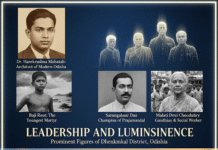
- Madhusudan Das (1848-1934): A towering figure in Odisha’s socio-political landscape, Madhusudan Das was a strong advocate for Swadeshi. He emphasized the economic empowerment of Odias through the promotion of indigenous industries, particularly the tanning industry. His efforts to establish indigenous enterprises and his powerful speeches inspired many to embrace Swadeshi.
- Gopabandhu Das (1877-1928): A prominent nationalist leader and social reformer, Gopabandhu Das played a pivotal role in propagating the ideals of Swadeshi among the masses. Through his writings in “Samaj” and his public speeches, he passionately advocated for the boycott of foreign goods and the adoption of Swadeshi principles in all aspects of life. He also emphasized social reform as an integral part of national awakening.
- Harekrushna Mahtab (1899-1987): Although he rose to prominence later in the independence movement, Harekrushna Mahtab was actively involved in the Swadeshi Movement as a student. He participated in boycotts and promoted the use of Swadeshi goods in his local area, reflecting the movement’s appeal to the younger generation.
- Godabarish Mishra (1886-1956): An educationist and nationalist leader, Godabarish Mishra was a strong supporter of Swadeshi education. He believed in the importance of imparting education that instilled a sense of national pride and self-reliance among students.
Impact and Limitations
The Swadeshi Movement in Odisha, though not as large-scale as in Bengal, had a significant impact on the socio-political consciousness of the region:
- Rise in Nationalist Sentiment: It played a crucial role in fostering a stronger sense of Odia identity and integrating it with the broader Indian nationalist movement. The participation of diverse sections of society underscored the growing desire for self-rule.
- Economic Awakening: The movement encouraged the consumption and production of indigenous goods, providing a boost to local artisans and small-scale industries, albeit temporarily. It highlighted the economic consequences of colonial rule and the need for self-sufficiency.
- Social Mobilization: It brought people from different backgrounds together under a common cause, breaking down some social barriers and fostering a sense of unity.
- Foundation for Future Movements: The experiences and lessons learned during the Swadeshi Movement laid the groundwork for future nationalist agitations in Odisha, including the Non-Cooperation Movement and the Civil Disobedience Movement.
However, the movement in Odisha also faced certain limitations:
- Fragmented Political Landscape: The lack of a unified political structure in Odisha at the time hindered the movement’s ability to achieve a more cohesive and widespread impact.
- Economic Constraints: The local industries were often not equipped to meet the demand for all goods, leading to continued reliance on some foreign products.
- Limited Reach: The movement was largely concentrated in urban and semi-urban areas, with a less pronounced impact in the more remote rural regions.
Conclusion
Odisha’s participation in the Swadeshi Movement was a significant chapter in its journey towards independence. Despite the regional fragmentation and economic challenges, the spirit of self-reliance and the commitment to boycotting foreign rule were clearly evident. Led by prominent figures like Madhusudan Das and Gopabandhu Das, and embraced by students, women, and ordinary citizens, the Swadeshi Movement in Odisha not only promoted indigenous industries and fostered nationalist sentiments but also laid a crucial foundation for the larger freedom struggle that would follow. It stands as a testament to the enduring spirit of resistance and the yearning for self-determination among the people of Odisha.
Here are some videos about the Swadeshi Movement, including Odisha’s participation:
- Partition of Bengal 1905 (Swadeshi and Boycott Movement) – A video from the channel Bookstawa, discussing the overall movement. (https://www.youtube.com/watch?v=SQAf0tEwdCM)
- Swadeshi Movement in India 1905-1908 | The boycott movement – This video from ORYLL hub for virtual studies gives an overview of the movement. (https://www.youtube.com/watch?v=3-s71uvoang)
- OAS 2021 | Swadeshi Movement 1905 Boycott Movement | Modern India | GK Possible OPSC[Lecture – 5] – A lecture from GK Possible OPSC that specifically mentions the movement in the context of the Odisha Civil Services exam. (https://www.youtube.com/watch?v=XCxBh8cj7fw)
- Swadeshi Movement | Modern History | UPSC CSE – A video from Target GS covering the topic for the UPSC Civil Services Examination. (https://www.youtube.com/watch?v=wSs7l_dLShk)
- SWADESHI MOVEMENT II Indian National Movement ll Modern History ll Odia Guru ll Yajanika/LTR – Another video from Odia Guru on the Swadeshi Movement. (https://www.youtube.com/watch?v=ofiaoFpAg3U)