



















.jpg?w=218&resize=218,150&ssl=1 "UNESCO Zollverein Coal Mine Industrial Complex & Other Things to do in Essen, Germany | My Travelogue")











In the hyper-competitive landscape of 2025, the traditional concept of the “monolithic corporation”—where every function from janitorial services to software development is housed under one roof—has become a relic of the past. Today’s most agile and successful enterprises operate more like ecosystems than fortresses. At the heart of this shift lies Business Process Outsourcing (BPO): the strategic practice of contracting specific business functions to third-party providers.
While often simplified as a “cost-cutting measure,” modern BPO has evolved into a sophisticated engine for innovation, scalability, and global expansion.
What is Business Process Outsourcing?
At its core, BPO is the delegation of one or more IT-intensive business processes to an external provider that, in turn, owns, administrates, and manages the selected processes based on defined and measurable performance metrics.
It is generally categorized into two main functional areas:
- Back-Office BPO: This involves internal business functions such as finance and accounting, human resources (HR), data entry, and quality assurance. These are the “engines” of the company that the customer never sees but are vital for survival.
- Front-Office BPO: These are customer-facing services, including technical support, telemarketing, customer service, and sales. These providers represent the “face” of your brand to the public.
The Evolution: From “Lift and Shift” to Strategic Partnership
The BPO industry did not emerge overnight; it has undergone three distinct “waves” of evolution:
- The 1980s-90s (Cost Arbitrage): The early days were defined by “labor arbitrage.” Companies moved simple, repetitive tasks (like payroll or data entry) to regions with lower labor costs, such as India or the Philippines. The goal was purely financial: do the same work for less money.
- The 2000s-2010s (Operational Excellence): As technology improved, the focus shifted to efficiency. BPO providers began to specialize, offering better technology and more streamlined processes than the hiring companies could maintain in-house. This era saw the rise of Knowledge Process Outsourcing (KPO) and Legal Process Outsourcing (LPO).
- The 2020s and Beyond (Digital Transformation): Today, BPO is a partnership for innovation. Providers are no longer just “extra hands”; they are “extra brains.” They bring Artificial Intelligence (AI), Robotic Process Automation (RPA), and specialized data analytics to the table, helping companies transform how they work rather than just doing the work for them.
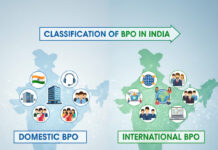
Geographical Classifications
The “where” of BPO is just as important as the “what.” Businesses choose their partners based on a balance of cost, culture, and convenience:
| Type | Location | Primary Advantages |
| Offshore | A distant country (e.g., U.S. company outsourcing to the Philippines). | Maximum cost savings and 24/7 “follow-the-sun” coverage. |
| Nearshore | A neighboring country (e.g., U.K. company outsourcing to Poland). | Similar time zones and cultural alignment. |
| Onshore | Within the same country (e.g., New York company outsourcing to Ohio). | Zero language barriers and easier regulatory compliance. |
Why Outsource? The Strategic Rationales
The decision to outsource is rarely based on a single factor. Instead, it is a weighted decision involving several key drivers:
- Focus on Core Competencies: Every hour a CEO spends worrying about payroll processing is an hour not spent on product innovation or market strategy. BPO allows leadership to “keep the main thing the main thing.”
- Access to Global Talent: Small startups can now access the same high-level specialized expertise (in areas like cybersecurity or complex tax law) that was previously reserved for Fortune 500 giants.
- Scalability and Agility: If a retail company experiences a 500% surge in customer inquiries during the holiday season, BPO allows them to scale their support team up instantly and scale back down in January without the mess of mass hiring and firing.
- Technological Superiority: BPO providers are tech-first companies. By outsourcing, a business effectively “subscribes” to the latest AI and automation tools without having to build or maintain the infrastructure themselves.
To truly understand BPO, we must test the logic of its widespread adoption.
1. The Myth of “Pure” Cost Savings
While labor costs may be lower, the Total Cost of Engagement (TCE) often includes hidden expenses: transition costs, vendor management overhead, and the price of cultural misalignment. If a company saves 30% on labor but loses 10% in productivity due to communication lags, the “win” is much smaller than it appears on a spreadsheet.
2. The Risk of Institutional Memory Loss
When you outsource a process, you are also outsourcing the learning associated with that process. If a company outsources its customer service entirely, it risks losing the direct “pulse” of its customer base. The provider owns the data and the insights; the parent company becomes a “black box” operation, potentially losing the ability to innovate based on raw customer feedback.
3. The Security Paradox
In an era of “Zero-Trust” security, BPO creates a massive paradox. You are extending your internal network and data to a third party. While providers often have better security than the hiring company, the complexity of the supply chain increases. One breach at a BPO provider can compromise dozens of global brands simultaneously.
Future Trends (2025-2030)
As we look toward the next decade, three trends are redefining the industry:
- Hyper-Personalization via AI: Chatbots are evolving from “frustrating scripts” to empathetic, AI-driven agents that can solve complex problems in seconds.
- Impact Sourcing: A growing focus on ESG (Environmental, Social, and Governance) goals. Companies are intentionally outsourcing to providers that employ marginalized communities, turning a business necessity into a social good.
- The Rise of the “Specialist”: Generalist BPOs are struggling. The market is moving toward “Micro-BPOs” that do only one thing (e.g., medical coding for oncology or AI-model training for autonomous vehicles) exceptionally well.
Conclusion
Business Process Outsourcing is no longer a peripheral tactic for the budget-conscious; it is a foundational pillar of modern global commerce. When executed with a focus on strategic partnership rather than just cost reduction, BPO enables companies to be more resilient, more innovative, and more focused on their ultimate mission.
However, the “truth over agreement” remains: BPO is a double-edged sword. Its success depends entirely on a company’s ability to maintain its own identity and security while delegating the “how” to those who do it best.