




1. Material Analysis: Benefits & Characteristics
The sole of a shoe is typically divided into the Outsole (the part that touches the ground) and the Midsole (the cushioning layer). Different materials serve different functions within these layers.
Rubber (Natural and Synthetic)
Rubber is the “gold standard” for outsoles due to its incredible resilience and grip.
- Benefits: High slip resistance, extreme durability, and excellent protection against sharp objects. It is naturally waterproof and can withstand high friction without wearing down quickly.
- Usage: Best for hiking boots, work boots, and the bottom layer of athletic shoes.
EVA (Ethylene Vinyl Acetate)
EVA is a plastic-based foam that is essentially “air-filled.”
- Benefits: It is ultra-lightweight and provides superior initial cushioning. It acts as an excellent shock absorber, reducing the immediate impact on joints during walking or running.
- Usage: Predominantly used in the midsoles of running shoes and casual sneakers.
PVC (Polyvinyl Chloride)
PVC is a synthetic plastic polymer often used in budget-friendly footwear.
- Benefits: Exceptional insulation (keeping feet warm/cool), highly resistant to water and chemicals, and very cheap to produce.
- Usage: Common in rain boots (wellies) and low-cost fashion sandals.
TPR (Thermoplastic Rubber)
TPR combines the processability of plastics with the performance of rubber.
- Benefits: It is lighter than traditional rubber but offers better grip than PVC. it is recyclable and has good “rebound” (bouncing back after a step).
- Usage: Widely used in mid-range casual shoes and soles for children’s footwear.
PU (Polyurethane)
PU is a high-density organic polymer.
- Benefits: It is the most “stable” of the foam materials. Unlike EVA, it does not compress easily over time. It provides excellent arch support and has a long “functional life.”
- Usage: Found in high-quality walking shoes, “comfort” brands (like Birkenstock or Dansko), and safety footwear.
2. Classification: Which is Best for the Human Leg?
When we talk about “benefits for the human leg,” we must look at Biomechanics. The human leg needs two conflicting things: Cushioning (to absorb shock) and Stability (to prevent the foot from rolling and causing injury).
The Winner: PU (Polyurethane) & Rubber Hybrid
For long-term leg health, a PU midsole with a Rubber outsole is scientifically superior.
Why?
- Shock Distribution: While EVA is softer, it “bottoms out” (flattens) after a few months. PU maintains its shape for years, ensuring your alignment stays correct.
- Knee & Hip Protection: A material that is too soft (like cheap EVA) causes the foot to wobble, forcing the knee and hip to work harder to stabilize the body. PU provides a firm foundation that reduces this “micro-wobble.”
- Example: Professional nursing clogs or high-end hiking boots often use PU because these professionals spend 12+ hours on their feet. The PU prevents the “sinking” feeling that leads to leg fatigue.
3. Risks of Long-Term Use: Material-Specific Diseases
Using the wrong material for an extended period can lead to chronic musculoskeletal issues.
Material | Long-Term Health Risks / Diseases |
|---|---|
EVA | Plantar Fasciitis: Because EVA flattens over time, it loses arch support, causing the ligament under the foot to tear and inflame. |
PVC | Contact Dermatitis & Hyperhidrosis: PVC is non-breathable. It traps sweat, leading to fungal infections (Athlete’s foot) and skin rashes from chemical off-gassing. |
TPR | Metatarsalgia: TPR can be quite thin in cheap shoes. Long-term use on hard surfaces leads to pain in the ball of the foot (the metatarsals). |
Rubber | Joint Fatigue: Pure rubber is heavy. Wearing heavy rubber soles for years without a foam midsole can lead to “Heavy Leg Syndrome” and early-onset osteoarthritis in the knees due to weight-strain. |
Leather | Stress Fractures: Traditional hard leather soles have zero shock absorption. The “jarring” of every step travels directly into the shin bones and knees. |
4. The “Best for Long-Lasting” Leg Health: Final Analysis
If you want your legs to remain healthy into old age, your footwear should follow the 3-Point Rule:
- Stability (PU): Ensure the midsole is firm enough that you cannot twist the shoe like a towel. This protects your tendons.
- Traction (Rubber): A rubber outsole prevents slips, which are the leading cause of acute ankle and hip injuries.
- Natural Upper (Leather/Mesh): While leather soles are bad for impact, leather uppers are excellent because they breathe and mold to your foot shape, preventing bunions and corns.
Summary of Recommendation
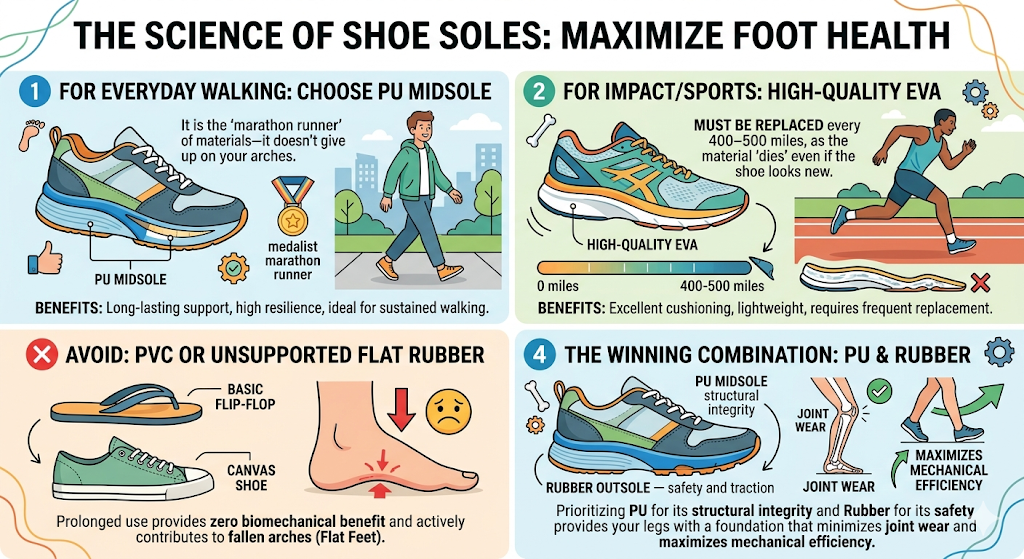
- For Everyday Walking: Choose a shoe with a PU midsole. It is the “marathon runner” of materials—it doesn’t give up on your arches.
- For Impact/Sports: High-quality EVA is acceptable but must be replaced every 400–500 miles, as the material “dies” even if the shoe looks new.
- Avoid: Prolonged use of PVC or unsupported flat Rubber soles (like basic flip-flops), as these provide zero biomechanical benefit and actively contribute to fallen arches (Flat Feet).
By prioritizing PU for its structural integrity and Rubber for its safety, you provide your legs with a foundation that minimizes joint wear and maximizes mechanical efficiency.


