
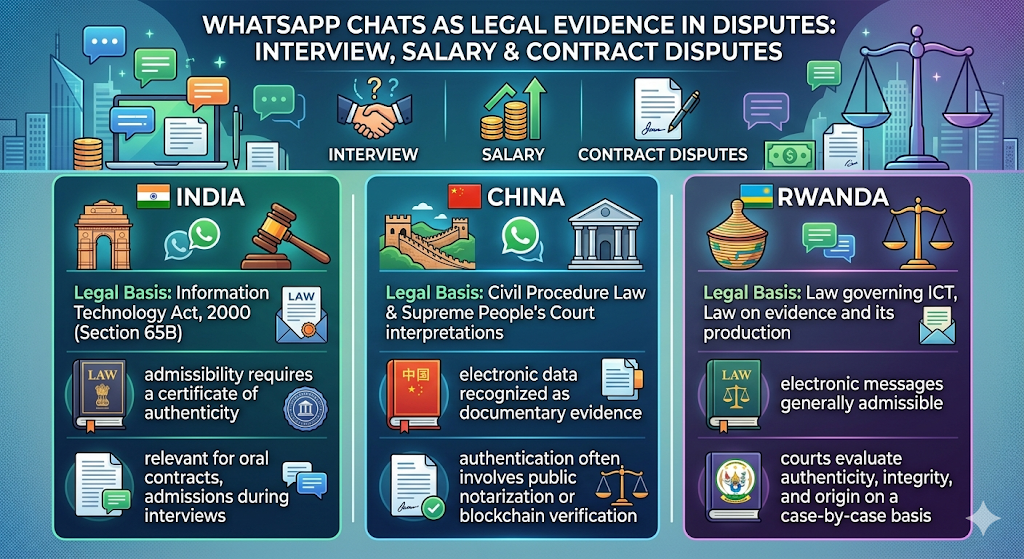
The moment a dispute arises (e.g., a “ghosted” job offer),
🇮🇳 INDIA
Legal Framework
WhatsApp messages are considered electronic records under Indian law. Their admissibility is governed mainly by the Bharatiya Sakshya Adhiniyam (BSA), 2023, which replaced the earlier Indian Evidence Act, 1872. These laws allow electronic records such as emails, digital files, and WhatsApp chats to be presented as evidence in court if they meet the required legal conditions. (Barristery)
The Critical Requirement: Section 63 Certificate (formerly Section 65B)
Under the present law, electronic records must ordinarily be accompanied by a proper certificate under Section 63 of the Bharatiya Sakshya Adhiniyam (earlier Section 65B of the Evidence Act) for admissibility. Without this certificate, the opposing party may object to the admissibility of the chats at the stage of evidence. WhatsApp conversations cannot be read as evidence without this mandatory certificate. (Livelaw India)
Employment & Salary Disputes Specifically
Employers and employees have relied on WhatsApp messages to prove resignations, misconduct, or policy violations. Courts have also used chat records to support claims in business negotiations and contract formation. (The Edu Law)
In commercial disputes, the Supreme Court affirmed that WhatsApp messages are admissible but must be proven like any other electronic record — by authenticating the sender, recipient, and content. The court also clarified that blue ticks alone do not prove a contract was accepted. (Legal Whizz)
Important Landmark Cases
The Supreme Court of India (July 14, 2021) ruled that WhatsApp messages have no evidentiary value and that the source cannot be identified — particularly in commercial matters — unless accompanied by a proper Section 65B certificate. A bench stated: “Anything can be created and deleted on social media these days. We don’t attach any value to the WhatsApp messages” without certification. (Lexology)
In Dell International India Private Limited v. Adeel Feroze (2024), the Delhi High Court held that WhatsApp messages would be inadmissible unless accompanied by a proper certificate under Section 65B of the Indian Evidence Act. (DLCO)
Practical Checklist for India
To properly produce WhatsApp chats as evidence in Indian courts: preserve evidence early once a dispute arises; prefer exporting the full chat over screenshots where possible; avoid editing or cropping messages; file the complete thread with proper certification under Section 63 of the BSA; and use contemporaneous corroborative evidence. (Livelaw India)
🇨🇳 CHINA
Legal Framework
China’s Civil Procedure Law stipulates that electronic data such as email, electronic data exchange, mobile phone text messages, and online chat records can be used as legal evidence. This means messages sent through WhatsApp, WeChat, Messenger, email, or SMS can be submitted as evidence to Chinese courts. (Chinajusticeobserver)
In 2012, the Chinese legislature added electronic data (电子数据) as a formally recognised category of admissible evidence, officially opening the door for applying electronic records in legal proceedings. (Lexology)
How to Present the Evidence
If the other party does not deny the authenticity of a conversation screenshot in court, then the screenshot can be used as evidence. China’s Civil Code also stipulates that electronic chat messages can be used as the carrier of written contracts — parties may conclude a written contract by means of electronic data exchange, email, or chat.
Employment Disputes & Privacy Considerations
Beijing courts have ruled that deleted WeChat records of an employee on a company computer cannot be admitted if recovered without the employee’s consent. The trial court pointed out that regardless of the content, deleted WeChat records from a company computer constitute the employee’s personal information and should have been recovered only after the employee provided consent. (Morgan Lewis)
In labour dispute cases, courts review an employer’s personal information processing activities based on their legality, legitimacy, and reasonableness — informed consent is a fundamental factor when evaluating admissibility. (Morgan Lewis)
Authenticity Challenges
A 2022 Shanghai High Court decision in a labour dispute invalidated informal WeChat exchanges due to ambiguity in terms and absence of digital seals (电子签章), which are recommended for enforceability under China’s Electronic Signature Law.
Under China’s Several Provisions on Evidence in Civil Procedures (2020), the following satisfy the “original copy” requirement for electronic data: (1) a copy made by the producer consistent with the original; (2) a printout; or (3) any other output directly derived from the electronic data that can be displayed or identified.
Note on WhatsApp Specifically in China
WhatsApp is blocked in mainland China under the “Great Firewall,” so WeChat is the dominant equivalent. However, WhatsApp messages and emails are all admissible as evidence in mainland Chinese courts (South China Morning Post) for international business matters. For domestic employment disputes, WeChat records are the practical equivalent.
🇷🇼 RWANDAThe Digital Hub of East Africa
Legal Framework
Rwanda is positioning itself as the “Singapore of Africa.” Its legal framework for digital evidence is remarkably modern, primarily governed by Law No. 18/2010 and the 2021 Data Protection Law.
- The Principle of Non-Discrimination: Rwandan law states that information shall not be denied legal effect, validity, or enforceability solely on the grounds that it is in the form of an electronic message.
- Functional Equivalence: If the law requires a contract to be “in writing,” a WhatsApp chat satisfies this requirement provided the information is accessible so as to be usable for subsequent reference.
3.2 Admissibility and Integrity
In Rwandan litigation, the focus is on Integrity.
- Article 11 (Law 18/2010): When assessing the evidentiary weight of a WhatsApp chat, the judge looks at:
- The reliability of the manner in which the message was generated, stored, or communicated.
- The reliability of the manner in which the integrity of the information was maintained.
- The manner in which its originator was identified.
3.3 Salary Disputes and Oral vs. Digital Evidence
In Rwanda, labor contracts for a duration exceeding six months must be in writing. However, the Supreme Court of Rwanda has often leaned toward protecting the weaker party (the employee). If a WhatsApp conversation clearly outlines a salary of 1,000,000 RWF, but the paper contract says 500,000 RWF, the court may look at the “pre-contractual” WhatsApp negotiations to determine the true intent of the parties.
Template – Certificate of Electronic Integrity (Rwanda)
Unlike India, Rwanda’s requirement is more flexible but requires a clear statement of technical reliability. Use this template to accompany any WhatsApp evidence in a Rwandan Labor or Commercial Court.
IN THE [INSERT COURT NAME, e.g., NYARUGENGE PRIMARY COURT]
CASE NO: ……………………. OF 2026
BETWEEN:
[YOUR NAME] ……………………………………………………………… APPLICANT/PLAINTIFF
AND
[OPPOSING PARTY NAME] ……………………………………………….. RESPONDENT/DEFENDANT
CERTIFICATE OF AUTHENTICITY AND INTEGRITY OF ELECTRONIC EVIDENCE
(Prepared pursuant to Law No. 18/2010 and Law No. 22/2016)
I, [Full Name], holder of National ID No: [ID Number], residing at [Address], do hereby solemnly state as follows:
- IDENTIFICATION OF DEVICE: I am the owner/authorized user of the mobile communication device described as:
- Make/Model: [e.g., iPhone 15 / Samsung S24]
- Operating System: [e.g., iOS 18.2 / Android 14]
- Associated Phone Number: +250 [Your Number]
- NATURE OF THE ELECTRONIC RECORD: Attached to this certificate are printed transcripts and screenshots of a WhatsApp conversation between myself and [Opposing Party Name/Phone Number] occurring between the dates of [Start Date] and [End Date].
- INTEGRITY OF THE DATA (Law 18/2010): I certify that the electronic messages were generated and stored in the ordinary course of my professional/personal communication. The device was in good working condition during the relevant period, and the messages have not been altered, edited, or tampered with in any way.
- METHOD OF EXTRACTION:
- [ ] The messages were exported using the “Export Chat” feature of WhatsApp.
- [ ] The screenshots were taken directly from the device screen without modification.
- [ ] The messages are corroborated by a cloud backup on [Google Drive/iCloud] dated [Date].
- DECLARATION: I provide this certificate to assist the Court in recognizing the electronic records as credible evidence of [e.g., Salary Negotiation / Employment Terms] as per the principles of Functional Equivalence under Rwandan Law.
DATED this ……… day of ……………………. 2026.
SIGNED: ……………………………………………………
[Your Name]
How to structure your request and the laws to cite to convince the High Court.
In Rwanda, the legal system has transitioned to recognize electronic communication, but “Great Weight” is only given when you prove the authenticity and integrity of the data. If the Labor Inspector or Intermediate Court overlooked your WhatsApp chats, your appeal to the High Court must focus on “Manifest Error in Evidence Evaluation.”
Here is how to structure your request and the laws to cite to convince the High Court.
1. Legal Basis for Your Request
You must cite these specific Rwandan laws to prove that WhatsApp messages are legally binding:
- Law Nº 022/2018 of 29/04/2018 (Civil, Commercial, Labour and Administrative Procedure): Specifically Article 12, which places the “Burden of Proof” on the claimant. You must argue that the lower court failed its obligation under Article 9 to properly adjudicate based on all submitted evidence.
- Law № 24/2010 of 26/05/2010 (Electronic Messages, Electronic Signatures, and Electronic Transactions): This is your strongest tool. It states that information shall not be denied legal effect, validity, or enforceability solely on the grounds that it is in the form of an electronic message.
- Law No. 66/2018 of 30/08/2018 (Regulating Labour in Rwanda): Use this to show that the “terms of the contract” (Article 14) or “salary agreements” were modified or confirmed via these chats, creating a verbal/electronic contract which is valid under Rwandan Law.
2. How to Convince the High Court
To make the High Court take the chats seriously, do not just show screenshots. You must prove they are real:
A. Prove Authenticity (Who sent it?)
- Metadata: Don’t just show the name “Boss.” Show the phone number associated with the contact and prove it belongs to the employer (e.g., via the official company contact list or previous MoM/contracts).
- Response Logic: Highlight that the employer acted upon the instructions in the chat, which proves they acknowledged the conversation.
B. Prove Integrity (Has it been changed?)
- Export Chat History: Instead of screenshots, provide the .txt export of the chat from WhatsApp. This shows the timestamps and sequence more reliably.
- Notarization: Take your phone to a Public Notary in Rwanda. Have them view the live chat on your phone and sign a document confirming that the printed screenshots match the live digital conversation. This carries massive weight in the High Court.
C. The “Manifest Error” Argument
In your appeal memo, state:
”The Intermediate Court committed a manifest error of law by disregarding material evidence (the WhatsApp communications) which constitutes an ‘Electronic Record’ under Law № 24/2010. These messages contain the ‘meeting of minds’ regarding salary and job terms that are not reflected in the incomplete written paper contract.”
3. Summary Table for Your Appeal
| Argument | Law to Cite | Evidence to Attach |
|---|---|---|
| Admissibility | Law № 24/2010 (Electronic Transactions) | Notarized screenshots of the chat. |
| Contract Validity | Law № 66/2018 (Labour Law), Art. 11 | The specific messages where salary was promised. |
| Procedural Error | Law № 022/2018 (Procedure), Art. 9 | The previous court judgment showing the chat was ignored. |
This video explains how digital communications like WhatsApp are increasingly used in courtrooms to prove intent and hold parties accountable in legal disputes.
⚖️ Comparative Summary Table
| Feature | 🇮🇳 India | 🇨🇳 China | 🇷🇼 Rwanda |
| Is WhatsApp chat admissible? | Yes, with conditions | Yes, with conditions | Yes, under electronic message laws |
| Key law | Bharatiya Sakshya Adhiniyam 2023 / IEA 1872 | Civil Procedure Law 2012+; Civil Code | Law No. 18/2010; Law 22/2016 |
| Certificate required? | Yes — Section 63 BSA certificate mandatory | No formal certificate, but authenticity must be established | Authentication & integrity must be demonstrated |
| Screenshots accepted? | Risky without certification | Yes, if opponent does not deny authenticity | Yes, if authentic and unaltered |
| Employment interviews via WhatsApp | Can form binding evidence of offer/acceptance | Can constitute a written contract under Civil Code | Admissible as electronic message evidence |
| Salary discussed via WhatsApp | Admissible as part of contract evidence if certified | Admissible; chat records treated as contract terms | Admissible if integrity provable |
| Privacy protection | Right to privacy; but courts may allow if relevant | Employer cannot retrieve employee chats without consent | Constitution protects communications; warrant needed for interception |
| Biggest risk | Evidence rejected without Section 63 certificate | Evidence rejected if obtained without employee consent | Evidence rejected if source/integrity cannot be proven |
🔑 Key Takeaways for All Three Countries
Always preserve the original device — Courts in all three countries give more weight to original data than screenshots.
Don’t alter or crop chats — Any tampering can destroy the evidentiary value entirely.
Employment offers made via WhatsApp can be legally binding — But you need to prove who sent what and when.
Salary and contract terms discussed via WhatsApp carry legal weight, especially when the other party does not deny their authenticity in court.
Privacy laws matter — Especially in China and Rwanda, obtaining someone else’s WhatsApp chats without consent can backfire and make the evidence inadmissible.
Conclusion: The Future of the “WhatsApp Contract”
As we look toward 2026 and beyond, the “WhatsApp Contract” is no longer a legal myth; it is a daily reality.
- In India, the transition to BSA 2023 will likely lead to a surge in specialized “Evidence Consultants” who help HR departments stay compliant.
- In China, the integration of AI in courts will allow judges to instantly verify if a chat screenshot has been “photoshopped.”
- In Rwanda, the continued push for a paperless government will make digital chat the default evidence in nearly all civil matters.
⚠️ This is legal information for general guidance only. Always consult a qualified lawyer in the relevant jurisdiction for specific legal advice.
