
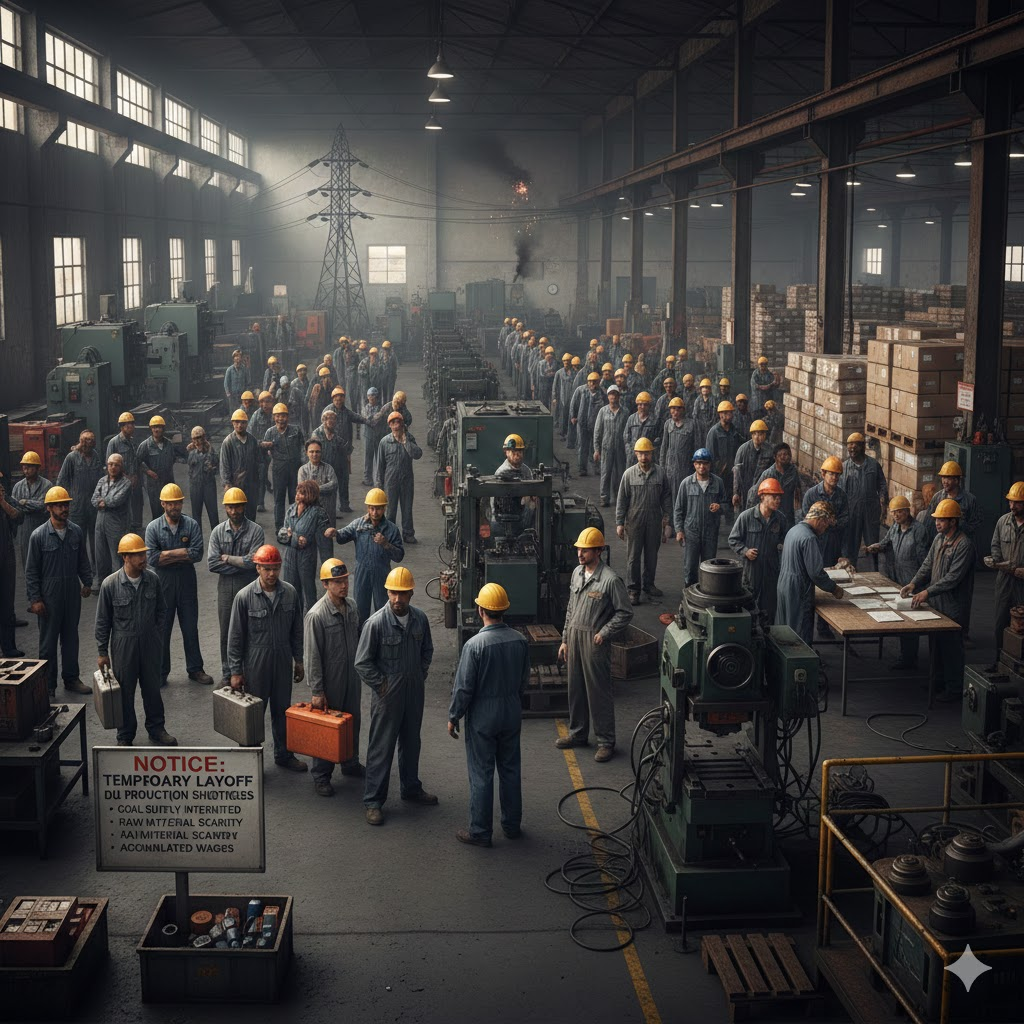
At its core, a lay-off is a situation where an employer wants to give work to a person, but cannot due to external circumstances.
Imagine a factory as a giant biological organism. For it to function, it needs “food” (raw materials), “energy” (power/coal), and “health” (working machinery). If any of these fail, the organism stops moving. The workers are still part of the organism, but they have nothing to do.
The Five Essential Criteria
For an event to qualify as a “lay-off” under this definition, five boxes must be checked:
- The Failure/Refusal/Inability: The employer must be unable to provide work.
- Specific Causes: This inability must stem from shortage of resources (coal, power, raw materials), stock accumulation, machinery breakdown, or natural calamities.
- The “Muster Roll” Requirement: The worker’s name must be on the official employment list.
- Not Retrenched: The worker has not been permanently terminated (fired).
- The Intention to Resume: There is an implicit understanding that once the problem (e.g., the power comes back on) is fixed, the relationship continues.
2. Breaking Down the Causes (The “Why”)
The definition provides a specific list of reasons. Let’s look at them through a “Normal Human View”:
A. Shortage of Coal, Power, or Raw Materials
Think of a bakery. If there is a national flour shortage, the baker cannot bake bread. It’s not the baker’s fault, and it’s not the workers’ fault. There is simply no “input” to process.
- The Intellectual Counterpoint: One might argue that a “smart” employer should have a backup supply. However, the law recognizes that some shortages (like a regional power grid failure) are beyond reasonable management control.
B. Accumulation of Stocks
This is a classic economic trap. A factory makes 10,000 chairs, but nobody is buying them. The warehouse is full to the ceiling. If they keep making chairs, they will go bankrupt paying for storage and materials for products that aren’t moving. They “lay off” the workers until the sales team clears the warehouse.
C. Breakdown of Machinery
If the main boiler in a textile mill explodes, the looms won’t run. You cannot ask a weaver to weave without a machine. Until the parts arrive from overseas and the engineers fix it, the staff is laid off.
D. Natural Calamity or “Connected Reasons”
This is the “Catch-all” phrase. A flood, an earthquake, or even a pandemic-induced lockdown fits here. “Connected reasons” is the most debated part—it keeps the definition flexible enough to cover modern crises that weren’t invented when the law was written.
3. The “Muster Roll” and the “Retrenchment” Distinction
This is where the logic gets tested.
- The Muster Roll: If your name isn’t on the “Muster Roll” (the official attendance/payroll register), you aren’t “laid off”—you simply don’t exist to the company. This protects the employer from temporary contractors or “gig” workers claiming lay-off benefits.
- Lay-off vs. Retrenchment: This is the most common point of confusion.
- Retrenchment is a permanent goodbye. The job is gone. The relationship is severed.
- Lay-off is a “see you later.” The job is still there; it’s just currently “empty.”
The Socratic Challenge: Is a lay-off actually a “refusal” to give work? The definition uses the word “refusal.” This implies that even if an employer could find something else for the worker to do (like sweeping the floors while the machines are broken), if they choose not to, it still counts as a lay-off.
4. A Practical Example: “The Steel Mill Scenario”
Let’s look at IronWorks Corp, a mid-sized steel plant.
- The Event: A massive storm knocks out the high-voltage power lines leading to the plant. The furnaces go cold.
- The Status: 500 workers show up at 8:00 AM. The manager says, “The power won’t be back for two weeks. We can’t melt steel. Go home.”
- The Classification: This is a Lay-Off.
- The workers are on the Muster Roll.
- The cause is Power Shortage/Natural Calamity.
- They are not retrenched; the manager expects them back in 14 days.
5. Challenging the Logic: The Employer’s “Inability”
As your intellectual sparring partner, I must challenge the “Inability” clause.
Is a lay-off ever a hidden strategy?
Sometimes, an employer might claim a “shortage of raw materials” because they actually want to avoid paying full wages during a slow month. By declaring a lay-off, they often only have to pay 50% of the basic wages (depending on local labor laws).
The Counter-Perspective: If we didn’t have this legal definition, an employer facing a machinery breakdown might just fire everyone (retrenchment) to save money. The “Lay-off” framework actually protects the worker by keeping their name on the books and ensuring they have a job to return to once the lights come back on.
6. Grammatical Variations and Legal Cognates
The term “lay-off” functions as both a noun and a verb, but in a legal context, its “cognate expressions” (related words) matter:
- “Laid-off”: The state of the workman.
- “Laying off”: The act performed by the employer.
- “Right to compensation”: The shadow that follows the definition. Usually, you cannot define a lay-off without discussing the compensation that follows it.
7. Summary Table: Lay-off vs. Termination
| Feature | Lay-Off | Retrenchment (Termination) |
| Duration | Temporary | Permanent |
| Reason | External (Materials, Power, etc.) | Internal (Downsizing, Redundancy) |
| Relationship | Suspended but active | Severed |
| Muster Roll | Name stays on the roll | Name is removed |
| Intent | To restart work | To end the position |
The Final Verdict
A lay-off is a temporary inability to provide work for specific technical or economic reasons. It is a middle ground—a state of “industrial suspended animation”—designed to prevent permanent job loss during temporary crises.
It assumes that the “shortage” or “breakdown” is a temporary hurdle, not a terminal illness for the company.
2nd Scienario
To understand the legal definition of a lay-off, we have to strip away the complex jargon and look at it as a temporary “pause button” pressed by an employer. In the eyes of the law, a lay-off isn’t a permanent firing; it is a situation where an employer wants to give work but cannot due to specific external hurdles.
1. The Core Definition: Why Does a Lay-Off Happen?

A lay-off occurs when a workman’s name is on the muster rolls (the official attendance register), they are ready to work, but the employer says “no” for one of these five specific reasons:
- Shortage of fuel/power: No electricity to run the machines.
- Shortage of raw materials: No ingredients to make the product.
- Accumulation of stocks: The warehouse is full, and nobody is buying.
- Breakdown of machinery: The heart of the factory has stopped beating.
- Natural calamity/Other reasons: Floods, earthquakes, or related disruptions.
The Footwear Industry Example
Imagine a large shoe factory. 500 workers arrive at 8:00 AM. However, the leather shipment from the tannery is stuck at a flooded border. The employer cannot make shoes without leather. Even though the workers are there, the employer lays them off because of a shortage of raw materials.
The Chemical Industry Example
In a chemical processing plant, a massive cooling tower malfunctions. Without cooling, the volatile chemicals could explode. The employer must shut down the line. The workers are laid-off because of a breakdown of machinery.
2. The “Two-Hour” Rule (The Turning Point)
The law is very specific about when a lay-off officially begins. It isn’t the moment you walk through the gate; it’s a race against the clock.
- The Rule: If you show up on time and the employer doesn’t give you work within two hours, you are considered “laid-off” for that day.
Challenge to Logic: Why two hours? This protects the worker’s time. It prevents an employer from keeping a worker “on standby” all day for free. If the employer can’t find a task for you by 10:00 AM (for an 8:00 AM shift), they must officially declare it a lay-off day, which triggers the worker’s right to compensation.
3. The “Second Half” Shift Nuance
The law allows for a “split” scenario. If an employer tells a worker at the start of the day, “We have no work now, but come back after lunch for the second half of the shift,” two things can happen:
Scenario A: Work is found
In our Footwear Industry example, if the leather truck arrives at noon and the workers start their machines for the afternoon, they are only “laid-off” for the first half of the day. They get paid for the work done in the second half, plus lay-off compensation for the first half.
Scenario B: Work is NOT found (The Penalty)
This is where the law gets strict. If the employer asks the worker to come back for the second half, but still fails to provide work, the worker is treated differently.
- They are NOT “laid-off” for that second half.
- Instead, they are entitled to full basic wages and dearness allowance for that second half.
The Counterpoint: You might ask, “Why full wages if they didn’t work?” It’s a penalty for the employer. By asking the worker to return, the employer took up the worker’s entire day, preventing them from finding odd jobs or tending to their personal lives. Therefore, the employer pays the price for the bad logistics.
4. Lay-Off vs. Retrenchment (The Critical Distinction)
To be “laid-off,” you must not have been retrenched.
- Retrenchment is a permanent “breakup.” The contract is over.
- Lay-off is a “temporary break.” The employer expects to bring you back once the power is on or the chemicals arrive.
In the Chemical Industry, if a plant closes a specific wing permanently because a pesticide is banned, those workers are retrenched. If the plant stops for a week because of a pipe leak, they are laid-off.
5. Summary Table for Quick Reference
| Situation | Legal Status | Payment Implication |
| Work given within 2 hours | Normal Work | Full Day’s Wage |
| No work given within 2 hours | Laid-off | Lay-off Compensation (usually 50%) |
| Asked to come back at noon, work given | Half Lay-off | 50% for morning, 100% for afternoon |
| Asked to come back at noon, NO work given | Penalty State | 50% for morning, 100% for afternoon |
Testing the Logic: An Alternative Perspective
Consider this: Is a lay-off “fair” to the employer? From a business standpoint, if a natural disaster (like a flood) stops production, the employer is losing money too. The lay-off provision acts as a social compromise. It prevents the employer from having to fire everyone (retrenchment) while ensuring the worker doesn’t go home entirely empty-handed. It maintains the “muster roll” connection so that when the sun comes out and the machines start, the workforce is still there, ready to go.
How “Lay-off Compensation” is calculated, or perhaps explore the specific legal “Muster Roll” requirements for these industries?
1. Calculating Lay-off Compensation: The 50% Rule
The core logic of lay-off compensation is shared pain. The law assumes that since the employer didn’t want the machine to break or the chemicals to run out, they shouldn’t pay 100%. However, since the worker is still “attached” to the company and cannot take another full-time job, they shouldn’t get 0%.
The Formula
Under standard labor laws (specifically the Industrial Disputes Act in many jurisdictions), a workman is entitled to:
50% of the total of the Basic Wages and Dearness Allowance (DA) that would have been payable to him had he not been laid off.
Footwear Industry Example: The Stitching Department
Imagine a worker, “Aman,” who stitches soles in a shoe factory.
- Basic Wage: 400 per day
- Dearness Allowance (DA): 200 per day
- Total Daily Wage: 600
If the factory runs out of specialized adhesive (Raw Material) and lays Aman off for 10 days:
- We calculate 50% of his total daily rate ($600 \div 2 = 300$).
- Aman receives 300 per day for those 10 days.
- Total Compensation: 3,000.
The “45-Day” Ceiling (The Counterpoint)
Here is a point where I challenge the assumption of “infinite” protection: In many jurisdictions, an employer is only required to pay this 50% compensation for a maximum of 45 days in any period of 12 months.
- The Logic: If the lay-off lasts longer than 45 days, it signals that the business is failing, not just “paused.” At that point, the employer may choose to retrench (permanently fire) the worker, paying a different, higher terminal compensation.
2. The “Muster Roll”: The “Black Box” of Evidence
The definition you provided earlier mentions that a worker’s name must be “borne on the muster rolls.” Think of the muster roll as the “ledger of truth.” If your name isn’t there, you legally don’t exist for the purpose of a lay-off.
Legal Requirements for the Muster Roll
In the Chemical and Footwear industries, the employer is legally obligated to maintain this register. It must include:
- Attendance: Time of arrival and departure.
- Category: Whether the worker is skilled, semi-skilled, or unskilled.
- The “Two-Hour” Timestamp: The roll must prove whether a worker presented themselves at the appointed time.
Why this matters in the Chemical Industry
Chemical plants often run on continuous shifts. If a boiler explodes at 2:00 AM, the “Night Shift” muster roll becomes the primary evidence. If the employer claims they gave work but the worker refused, the muster roll (which requires a signature or thumbprint for refusal) is the only thing that stands in court.
3. When is Compensation NOT Payable? (The Traps)
Even if a worker is laid off, the employer can legally refuse to pay a single penny if certain conditions aren’t met. Let’s test the logic of these “disqualifiers”:
- Refusal of Alternative Work: If the shoe factory is out of leather, but the manager says, “We need you to help paint the warehouse walls today instead,” and the worker says, “No, I’m a stitcher, not a painter,” the worker loses all compensation. * Requirement: The alternative work must be in the same establishment (or nearby) and must not require special skill or cause undue hardship.
- Failure to Report: If the worker is laid off but doesn’t show up at the factory at the “appointed time” during the lay-off period to check if work has resumed, they lose compensation for that day.
- Strike/Slowing Down: If the lay-off is caused because other workers in another part of the factory are on strike, the employer often doesn’t have to pay.
4. Industry-Specific Comparisons
| Feature | Footwear Industry (Labor Intensive) | Chemical Industry (Capital Intensive) |
| Common Lay-off Trigger | Lack of leather, soles, or seasonal demand drop. | Power failure, safety shut-down, or hazardous leak. |
| Muster Roll Complexity | High volume of names; high turnover. | Strict shift timings; often automated/biometric. |
| Alternative Work | Easier to find (e.g., packing, cleaning). | Harder to find (requires specific safety training/gear). |
5. Intellectual Challenge: The “Ghost” Workman
Consider this scenario: An employer in a chemical plant knows they have no raw materials for the next three days. To avoid paying 50% compensation, they simply “forget” to mark the workers as present on the muster roll, or they tell workers over the phone “don’t bother coming in.”
The Truth: If the worker does not physically show up and ensure their presence is recorded on the Muster Roll, they have no legal leg to stand on. The “Two-Hour Rule” mentioned in your definition is the worker’s best friend. They must present themselves to “trigger” the lay-off status. If they stay home because the boss told them to via WhatsApp, they are technically “absent,” not “laid-off.”
Retrenchment (the permanent version) to see how it differs in cost for the employer, or perhaps the legal penalties an employer faces if they maintain a “fake” muster roll?
To understand the shift from a Lay-off to Retrenchment, we must shift our perspective from “temporary pause” to “permanent termination.” While a lay-off is an employer saying, “I can’t give you work today,” retrenchment is the employer saying, “I don’t need your position anymore.”
1. The Cost Difference: Lay-off vs. Retrenchment
In the Footwear Industry, if a sudden change in fashion makes “high-top sneakers” obsolete and the factory only has machines for those, the employer might decide to shut that division forever. This is retrenchment.
The Financial Math
The cost of retrenchment is significantly higher because it is a terminal benefit. Here is how the costs stack up:
| Feature | Lay-off Cost | Retrenchment Cost |
| Daily Payment | 50% of Basic + DA | N/A (One-time payment) |
| Notice Period | None required (it’s day-to-day) | 1 Month’s notice (or wages in lieu) |
| Service Weightage | None | 15 days’ average pay for every completed year of service |
| Max Duration | Usually capped (e.g., 45 days) | Permanent |
Example: The Chemical Plant Supervisor
Suppose a supervisor in a chemical plant has worked for 10 years. His monthly salary (Basic + DA) is 40,000.
- If Laid-off for 1 month: The employer pays 20,000 (50%). He is still an employee.
- If Retrenched:
- Notice Pay: 40,000 (1 month)
- Retrenchment Compensation: 15 days x 10 years = 150 days of pay. (Approx. 5 months of salary = 200,000).
- Total Cost: 240,000 plus gratuity and leave encashment.
The Counterpoint: Employers often try to disguise retrenchment as a “long-term lay-off” to avoid that massive 240,000 upfront payment. This is why the 45-day rule exists; it forces the employer to either bring the worker back or pay the full retrenchment price.
2. The “Last Come, First Go” Rule (LIFO)
In a lay-off, an employer can often choose which department to pause. In Retrenchment, the law dictates a very strict “Fairness Logic” called LIFO (Last In, First Out).
If a footwear factory needs to reduce its workforce by 20%, it must retrench the person most recently hired in that category.
- The Challenge: An employer might want to keep a young, fast worker and fire an older, slower worker who has been there 20 years. The Law says NO. To keep the younger worker, the employer must prove “extraordinary skill” or have a specific agreement; otherwise, seniority wins.
3. The “Fake” Muster Roll: Legal Penalties & Risks
The Muster Roll is the legal DNA of the factory. If an employer manipulates it (e.g., marking a worker “Absent” when they actually showed up and were denied work), they are committing a serious offense.
The “Ghost” Worker Penalty
In the Chemical Industry, where safety audits are frequent, a fake muster roll is a double-edged sword. If an accident occurs and the “official” roll says only 5 people were on-site, but 20 were actually there being “informally” laid-off, the employer faces criminal negligence charges.
Specific Penalties often include:
- Recovery of Wages: The Labor Court can order the employer to pay the full wages (not just 50%) for the period they tried to hide.
- Fines: Statutory fines per worker per day.
- Imprisonment: In many jurisdictions, repeated “willful” violation of the Industrial Disputes Act or Factories Act can lead to jail time for the “Occupier” (the person in charge of the factory).
4. Why the Industry Matters
In the Footwear Industry:
Since this is a labor-intensive sector, retrenchment is a massive logistical nightmare. If a factory closes, paying 2,000 workers “15 days’ pay per year of service” can bankrupt the company before they even shut the doors. This leads to many employers attempting “illegal lockouts” instead of legal retrenchment.
In the Chemical Industry:
Because these plants are capital-intensive (expensive machines, fewer people), retrenchment is less frequent but more legally complex. The workers are often highly specialized. If a plant retrenches a “Safety Officer” and later tries to hire a new one at a lower salary, the law gives the retrenched worker the “Right of Re-employment.” The employer must offer the job to the old worker first before hiring someone new.
The “Voluntary” Trap
An employer might say: “I’m not laying you off, and I’m not retrenching you. But if you sign this ‘Voluntary Resignation,’ I’ll give you two months’ extra pay.”
The Alternative Perspective:I would warn that this is often a trick to bypass the “15 days per year” rule. For a 20-year veteran, two months of pay is a terrible deal compared to the 10 months of pay they are legally owed via retrenchment.
Specific steps an employer must take to legally close a whole “Industrial Establishment” (Closure vs. Retrenchment)? or “Right of Re-employment”—how a worker can reclaim their job if the factory starts hiring again?
A “Closure” is not just a big “Retrenchment.”
In the eyes of the law, retrenchment is pruning the branches of a tree to keep it alive. A closure is cutting the tree down at the roots. For a worker in the Footwear or Chemical industry, the difference determines whether they have a job to come back to or if they are fighting for the scraps of a liquidated company.
Here is the deep dive into the mechanics of Closure versus Retrenchment, and the powerful “Right of Re-employment” that acts as a legal tether between a worker and their former factory.
1. Closure: The “Death” of the Establishment
A Closure is the permanent closing down of a place of employment or part thereof. It is not a “pause” like a lay-off. It is final.
The Procedural Gauntlet (The Steps)
If a Footwear factory with 500 workers decides that leather prices are too high and they can no longer compete, they cannot just lock the gates on Monday morning. They must follow a strict legal “Flight Plan”:
- The 60/90 Day Notice: In most jurisdictions (like India under the Industrial Disputes Act), an employer must serve notice to the Government. If the factory has more than a certain number of workers (often 100 or 1000 depending on the state), they need prior permission from the government to close.
- The “Good Faith” Test: The government can refuse permission if they believe the closure is “unfair” or just a trick to bust a labor union.
- The Compensation Check: Every worker must be paid closure compensation, which is exactly the same as retrenchment compensation: 15 days’ average pay for every completed year of service.
Footwear Industry Example: The “Style Shift”
Imagine “Step-Right Footwear Ltd.” They make leather formal shoes. Suddenly, the world shifts to 3D-printed sneakers. The factory is obsolete.
- The Action: They apply for closure.
- The Cost: If they have 1,000 workers with an average of 10 years of service, they must pay out 150 days of wages per worker simultaneously. For many shoe factories, the “Cost of Closing” is higher than the “Cost of Staying Open,” which leads to “Sick Units” that linger in debt.
2. Retrenchment: The “Survival” Pruning
Retrenchment happens when the establishment continues to exist, but the surplus labor is removed.
The “LIFO” Logic (Last In, First Out)
As we discussed, the employer must fire the newest person first. But here is the intellectual counterpoint: What if the newest person is the only one who knows how to run the new computerized chemical mixer?
- The Legal Exception: The employer can deviate from LIFO if they record the reasons in writing. In the Chemical Industry, specialized technical skill is often a valid reason to skip a senior worker and keep a junior one. However, the burden of proof is on the employer.
Chemical Industry Example: The “Automation” Cut
“Chem-Flow Corp” installs a new automated bottling line. They used to need 50 workers; now they need 10. They retrench 40 workers.
- Difference from Closure: Chem-Flow Corp is still making money and operating. The 40 workers are out, but the factory gate is still open for the remaining 10.
3. The “Right of Re-employment”: The Legal Ghost
This is one of the most powerful rights a workman has, yet many forget it exists. If you are retrenched, you are not “gone”—you are “on standby” in a legal sense.
How it Works (Section 25-H Logic)
Where any workmen are retrenched, and the employer proposes to take into his employ any persons, he shall:
- Give an opportunity to the retrenched workmen to offer themselves for re-employment.
- Give preference to these retrenched workmen over new applicants.
The “Muster Roll” Connection
Remember our discussion on the Muster Roll? When a worker is retrenched, their name moves from the “Active Muster” to a “Retrenched Register.”
- If the Footwear Factory gets a huge order for boots six months later and needs 100 new workers, they cannot place an ad in the paper until they have sent notices to the workers they retrenched six months ago.
The Sparring Point: Does the worker get their old salary?
No. The law says they have a right to the job, but it doesn’t strictly mandate they get their old salary. They are treated as new hires, but they get the first seat at the table.
- The Alternative View: Is this fair? An employer might retrench a senior worker making $50/hour and then “re-hire” them a year later at $20/hour. While legal in some regions, labor courts often view this as “unfair labor practice” if the intent was clearly to lower the wage bill.
4. Comparing the “Exit” Strategies
| Feature | Closure | Retrenchment |
| Existence of Business | Ends completely. | Continues. |
| Permission | Usually requires Gov. approval. | Often requires only notice (for smaller units). |
| Re-employment Right | Does not exist (the company is gone). | Crucial Right (the company still exists). |
| Muster Roll | Closed and archived. | Active workers + Retrenched list. |
5. Industrial Scenarios: A Deep Dive
The Chemical Industry “Safety Closure”
Chemical plants are often closed by Government Order due to pollution or safety violations (think of the aftermath of environmental leaks).
- The Legal Twist: If a plant is closed because it was polluting, the employer still has to pay closure compensation. They cannot claim “Act of God” or “Natural Calamity” because the pollution was their fault.
- Testing the Logic: If the employer closes the plant because the government banned the specific chemical they make (e.g., a ban on a certain pesticide), is that a “Closure” or “Retrenchment”? It’s a Closure. The business model is dead.
The Footwear Industry “Seasonal Retrenchment”
Footwear is often seasonal (school shoes in summer, boots in winter).
- Some employers try to use “Fixed Term Employment” to avoid retrenchment laws. If a contract says “You are hired for 3 months,” and the contract ends, it is not retrenchment.
- The Counter-point: If the employer keeps renewing that 3-month contract 10 times in a row, the court will treat the worker as a permanent employee. This is called “Continuous Service,” and the worker becomes eligible for all the protections we’ve discussed.
6. Penalties for “Bad Faith” Exits
If a Chemical Plant owner pretends to “Close” the factory, pays the minimum compensation, and then opens the same factory under a different name (a “Phoenix Company”) two months later to hire cheaper labor:
- Lifting the Corporate Veil: The court can “look through” the new company name. If the machinery is the same, the location is the same, and the owner is the same, the court will rule it was a Sham Closure.
- Reinstatement with Back Wages: The workers can be ordered back to work, and the employer must pay them for all the months the factory was “closed.”
Summary of Your Rights and Risks
- As a Worker: Your best defense is ensuring your name is correctly spelled and recorded on the Muster Roll with the correct Date of Joining. This date determines your 15-days-per-year payout.
- As an Employer: The biggest risk is failing to follow the Notice Period. A single procedural mistake can turn a legal “Closure” into an “Illegal Lockout,” leading to years of litigation.
Eplore the “Section 25-N” special protections? This applies to large factories (100+ or 1000+ workers) where the employer cannot retrench even one person without prior government permission. It’s the “Final Boss” of labor law.
To truly understand Section 25-N of the Industrial Disputes Act (or its equivalents in various global labor codes), you have to stop thinking like a manager and start thinking like a Sovereign.
In the previous sections, we discussed Lay-offs and Retrenchment as private disputes between a boss and a worker. But once a factory crosses a certain size threshold—typically 100 or more workmen (though this varies by state and country, often reaching 1,000)—the government steps in as a third party. Under Section 25-N, the employer loses the “Right to Fire.” They can only “request” the government for permission to retrench.
As your intellectual sparring partner, I will challenge the logic of this “Final Boss” of labor law. While it is designed to protect workers, does it actually paralyze the Chemical and Footwear industries, or does it ensure social stability? Let’s dive in.
1. The Threshold: Why “100” or “1000”?
The law creates a distinction between “Small/Medium Enterprises” and “Industrial Establishments.”
- Under the Threshold: You follow Section 25-F (Notice + Compensation). It’s a simple transaction.
- Above the Threshold (The Chapter V-B Territory): You enter Section 25-N. Here, the “Management Prerogative” is suspended.
Footwear Industry Example: The Scale Problem
Imagine a handmade leather sandal workshop with 20 people. If sales drop, the owner lets 5 people go. It’s sad, but legal. Now imagine “Mega-Stride International,” a footwear giant with 1,200 workers in a single massive plant. If Mega-Stride fires 300 people at once, it creates a local economic depression. The government claims an interest in preventing this shock, which is why Section 25-N exists.
2. The Procedural Gauntlet of Section 25-N
To legally retrench a single worker in a large factory, the employer must survive three brutal stages:
Stage 1: The Application for Permission
The employer cannot just send a notice to the worker. They must send a formal application to the “Appropriate Government” (the Labor Department).
- They must state the specific reasons for the proposed retrenchment.
- A copy of this application must be served to the Workmen/Union simultaneously.
Stage 2: The Government Enquiry
The government doesn’t just read the letter; they hold a hearing. They act like a judge.
- The Logic Test: Is the retrenchment “genuine and adequate”?
- The Social Test: Is it in the interest of the general public?
- The “Sparring” Point: In a Chemical Industry case, an employer might argue, “We must retrench 150 people because this specific chemical process is now automated and the old manual way is dangerous.” The Union might counter, “The employer is just trying to increase profits by replacing humans with sensors.” The Government decides who is right.
Stage 3: The Order (The 90-Day Clock)
The government must grant or refuse permission within 60 days. If they don’t respond, permission is “deemed” to be granted.
- If Refused: The retrenchment is illegal. If the employer fires them anyway, the workers are entitled to full wages as if they were never fired.
- If Granted: The employer can proceed, but they must still pay the 15 days’ wages per year of service.
3. Section 25-N in the Chemical Industry: The “Safety” Argument
The Chemical industry is unique because it is “Capital Intensive” and “High Risk.”
The Scenario: A large petrochemical plant wants to shut down a hazardous chlorine-processing unit. They want to retrench 120 specialized workers.
- Employer Assumption: “It’s my factory; if a unit is dangerous or obsolete, I should be able to close it and let the workers go.”
- Section 25-N Reality: The government might say, “No. You are a wealthy chemical corporation. You have the resources to retrain these 120 workers to work in your new Green Hydrogen wing. Permission Denied.”
The Intellectual Challenge: This forces the employer to keep workers they don’t need. Does this lead to “Zombie Factories” where people are paid to do nothing? Yes, often. But the law prioritizes “Right to Life/Livelihood” over “Right to Profit.”
4. Section 25-N in the Footwear Industry: The “Export” Trap
Footwear is a “Labor Intensive” industry. Profit margins are thin.
The Scenario: A footwear exporter loses a massive contract from a European brand because a competitor in Vietnam is 10% cheaper. They need to downsize their 2,000-person factory by 500 people to survive.
- The Conflict: If the government delays permission under 25-N for six months, the factory might go bankrupt entirely.
- The Outcome: Instead of losing 500 jobs, the delay causes the factory to collapse, losing all 2,000 jobs.
Critical Sparring Point: Critics of Section 25-N argue that it actually hurts workers in the long run. Because it is so hard to fire people in large factories, footwear owners choose to keep their factories small (99 workers) or use “Contract Labor” (third-party agencies) to stay below the 100-worker threshold. This is called “Threshold Jumping.”
5. Comparing Section 25-F (Normal) vs. Section 25-N (Special)
| Feature | Section 25-F (Small Units) | Section 25-N (Large Units) |
| Notice to Govt. | Informational (Post-facto) | Prior Permission Required |
| Union’s Role | Can challenge in court later | Can block the process during the hearing |
| Standard of Proof | Business necessity | “Public Interest” + Necessity |
| Penalty for Violation | Compensation + Reinstatement | Criminal Prosecution + Jail Time |
6. The “Fake” Muster Roll under 25-N
In a large factory, the Muster Roll is the primary weapon. If a factory has 105 workers, the employer might try to “hide” 6 workers by not putting them on the muster roll, keeping the official count at 99.
Why is this a massive risk?
If a labor inspector finds those 6 “invisible” workers, the factory instantly shifts from the “Easy” 25-F rules to the “Final Boss” 25-N rules. If the employer had retrenched anyone while pretending to be a small unit, that retrenchment becomes void ab initio (legally dead from the start). The employer would have to pay back-wages to everyone they fired, potentially totaling millions.
7. The Final Boss: The Government’s Power to Review
Even if the government gives permission to retrench, Section 25-N allows the government (or the workers) to ask for a Review of that decision, or refer it to a Tribunal.
- The Loop: A large Chemical factory could spend 2 years in court just trying to retrench 10 surplus security guards.
- The Alternative View: This creates a system where “No one is ever fired.” In exchange, the workers are often less productive because the threat of termination is non-existent.
Conclusion & Summary
Section 25-N is the ultimate expression of the “Socialist” roots of labor law. It treats a large factory not as a private machine, but as a social institution.
- In the Chemical Industry: It forces high-tech retraining over layoffs.
- In the Footwear Industry: It often discourages growth, as owners fear the “100-worker trap.”
- On the Muster Roll: It makes every single name a high-stakes legal liability.
Explore “Unfair Labor Practices”—the specific dirty tricks employers use to bypass 25-N (and the penalties they face)?
Or shall we look at “Strike and Lockout”—what happens when the 25-N process fails and the workers/management go to war?
Since we are deep in the “Final Boss” territory of Section 25-N, it is only fitting that we explore the “Shadow Moves”—the Unfair Labor Practices (ULPs).
When a large factory in the Chemical or Footwear industry feels suffocated by the legal requirement for government permission to retrench, they often resort to tactics that range from “creative accounting” to “psychological warfare.” As your intellectual sparring partner, I’ll deconstruct these “dirty tricks” and the legal “counter-spells” used to stop them.
1. The “Shadow” Tactics: Bypassing Section 25-N
When an employer wants to downsize but knows the Government will deny a Section 25-N application, they often use these three common ULPs:
Trick A: The “Forced” Voluntary Retirement Scheme (VRS)
Legally, a VRS is a “golden handshake.” However, it becomes an Unfair Labor Practice when it is forced.
- The Footwear Industry Example: A manager at a shoe factory calls senior workers into a room and says, “Sign this resignation and take $5,000, or we will transfer you to a warehouse 1,000 miles away where you don’t know the language.” * The Legal Reality: This is “Constructive Discharge.” The law views this not as a choice, but as an illegal retrenchment disguised as a resignation to bypass Section 25-N.
Trick B: Victimization via “Transfer”
In the Chemical Industry, specialized skills are everything.
- The Dirty Trick: An employer wants to get rid of a troublesome Union leader. They “transfer” this specialized Chemical Lab Technician to the “Loading Dock” to carry heavy sacks.
- The Goal: To make the worker so miserable they quit on their own.
- The Sparring Point: The employer will argue “Administrative Necessity.” But if the worker can prove the transfer was intended to break their spirit or clear the way for a headcount reduction without permission, it is a ULP.
Trick C: The “Artificial” Breakdown
Since a lay-off due to “breakdown of machinery” is easier to justify than a permanent retrenchment, some employers purposefully neglect maintenance.
- The Scenario: A footwear factory owner stops buying spare parts for the stitching machines. The machines fail. The owner “lays off” the workers indefinitely.
- The Truth: This is an “Illegal Lockout” in disguise. They are trying to starve the workers into quitting so the owner can sell the land for real estate.
2. Defining Unfair Labor Practices (The Legal List)
Most labor codes (like the 5th Schedule of the Industrial Disputes Act) explicitly list what counts as a “Dirty Trick.”
| For the Employer | For the Workmen/Unions |
| To establish “Employer-sponsored” unions (Puppet Unions). | To advise or indulge in a “Gherao” (physically surrounding a manager). |
| To discharge workers for “Union Activity.” | To indulge in “Go-Slow” tactics (deliberately working slowly). |
| To replace regular workers with “Contract Labor” for permanent jobs. | To use violence or intimidation against “Scabs” (strike-breakers). |
| To refuse to bargain in good faith with a recognized Union. | To stage “Wildcat Strikes” (strikes without notice). |
3. The Penalties: When the Law Strikes Back
The penalties for ULPs are designed to be “Stingers”—they hurt the pocket and the reputation.
- Cease and Desist Orders: The Labor Court can order the employer to immediately stop the practice (e.g., “Stop transferring these 50 workers”).
- Affirmative Action (The “Reverse” Move): The court can order Reinstatement with Full Back-Wages. If a Footwear factory illegally “forced” 100 people to quit, the court can force the factory to take them all back and pay them for the 2 years they were gone.
- Imprisonment: In many jurisdictions, committing an Unfair Labor Practice carries a prison sentence of up to 6 months for the “Occupier” or Director of the company.
4. Strike vs. Lockout: The “Nuclear” Option
When the 25-N process fails—meaning the government denies the employer’s request to fire, and the union refuses to budge—the relationship enters a state of war.
The Strike (Worker’s Weapon)
In the Chemical Industry, a strike is terrifying for management. Why? Because chemical processes often cannot be stopped instantly. If workers walk out while a reactor is mid-cycle, it could lead to an explosion or a massive loss of “Work in Progress” (WIP) material.
- Sparring Logic: This gives Chemical workers massive “Leverage,” but it also makes their strike “Illegal” if they don’t provide a Minimum Notice Period (usually 14 days for public utilities/essential services).
The Lockout (Employer’s Weapon)
A lockout is the “Employer’s Strike.” It’s when the employer shuts the gate and says, “No one gets in and no one gets paid until you agree to my new terms.”
- The 25-N Connection: An employer cannot use a lockout as a “permanent” solution to bypass retrenchment permission. If a court finds the lockout was just a way to shut the factory forever without paying closure compensation, the lockout is declared Illegal.
5. Intellectual Challenge: The “Go-Slow” Dilemma
As your sparring partner, I want to test your logic on a subtle ULP: the “Go-Slow.”
In the Footwear Industry, if workers are angry about a 25-N application, they might not strike. Instead of stitching 100 shoes an hour, they stitch 10. They are still at their desks, so the employer can’t “lay them off” for absence.
The Counter-point: The courts have ruled that “Go-Slow” is not a legitimate form of protest; it is a “Serious Misconduct.” An employer in a large footwear factory can actually dismiss workers for a Go-Slow without 25-N permission, because dismissal for “Misconduct” follows different rules than “Retrenchment.”
The “Dirty Trick” Loophole: This is why employers often “fabricate” misconduct charges (e.g., “The worker was rude to a supervisor”) to get rid of someone they actually wanted to retrench.
6. Summary: The Final Stakes
In the Chemical and Footwear industries, the battle over Section 25-N is a game of “Legal Chess”:
- The Employer tries to move workers into “Contractor” or “Managerial” roles (where labor laws don’t apply).
- The Union tries to prove that “Contractors” are actually “Regular Workers” (to keep the headcount above 100 and stay in 25-N territory).
- The Government acts as the referee, trying to prevent the factory from closing while keeping the workers from starving.
Case Study (real or hypothetical) of a Chemical Plant that tried to “disappear” its workforce through a fake transfer? “Muster Roll Audit”—how a labor inspector actually “catches” an employer using these dirty tricks?
“Muster Roll Audit”—the forensic investigation that brings the whole house of cards down.
Part 1: Case Study — The “Solvent-X” Chemical Disappearance
The Setup: “Solvent-X Industries” is a massive chemical plant with 140 permanent workmen. Because they have more than 100 workers, they are trapped under the “Final Boss” of Section 25-N. They want to modernize the plant, which would require only 60 workers. They know the government will deny permission to retrench 80 people because the company is still profitable.
The “Dirty Trick” (The Forced Transfer): Instead of applying for retrenchment, Solvent-X creates a “ghost subsidiary”—a tiny, shell-company warehouse in a remote, mountainous region 1,500 miles away.
- They issue transfer orders to 80 of the most senior (and expensive) workers.
- The transfer orders state: “Your skills are required for the setup of our new logistics wing.”
- The goal is simple: The employer knows these workers, who have families and homes near the main plant, will refuse to move.
- When the workers refuse, the employer marks them as “Absent/Desertion of Duty” and strikes their names from the Muster Roll.
The Assumption: The employer thinks, “I haven’t retrenched anyone! They ‘voluntarily’ refused to work at the new location. Now I’m back down to 60 workers, and I didn’t pay a dime in compensation.”
Part 2: The “Muster Roll Audit” — The Forensic Counter-Strike
A Labor Inspector (let’s call them the “Auditor”) arrives for a surprise inspection after the Union files a complaint of Unfair Labor Practice. Here is how the Auditor catches them using the “Muster Roll” as a crime scene.
Step 1: The “Attendance Gap” Analysis
The Auditor looks at the Muster Rolls from six months ago vs. today.
- The Finding: 80 names have vanished.
- The Employer’s Excuse: “They were transferred and then deserted their posts.”
- The Auditor’s Counter: The Auditor demands the “Transfer Register” and the “Dispatch Log.” If the 80 workers were transferred to a warehouse that doesn’t actually have the electricity or permits to handle chemicals, the “Administrative Necessity” is proven to be a lie.
Step 2: Cross-Referencing the “Gate Logs”
This is the “gotcha” moment. In the Chemical Industry, safety protocols require a Gate Pass/Entry Log separate from the Muster Roll for insurance and fire safety.
- The Audit: The Auditor compares the Muster Roll (which says the workers are “Absent”) with the Gate Logs or Canteen Records.
- The Catch: If the Gate Log shows the workers showed up at 8:00 AM but were turned away by security, the Muster Roll marking of “Absent” is officially falsified. Under the definition we started with, these workers were Laid-off, not absent.
Step 3: The “Production Output” vs. “Labor Hours” Logic
In the Footwear Industry, this is even easier to catch.
- The Audit: The Auditor looks at the number of shoes produced.
- The Logic: If the factory claims they only have 60 workers (having “disappeared” 80), but they are still producing the same 5,000 pairs of shoes a day as they did with 140 workers, something is wrong.
- The Catch: The Auditor looks for “Hidden Muster Rolls”—temporary or contract workers being paid “off the books” to do the jobs of the 80 transferred permanent workers.
Part 3: The “Smoking Gun” — Payroll and Social Security
The ultimate tool of the Auditor is the Statutory Returns (Provident Fund/Social Security payments).
- If the employer stopped paying Social Security for 80 people but didn’t file a “Termination of Service” or “Retrenchment Notice” with the government, they have created a Legal Vacuum.
- Under Section 25-N, since no “Prior Permission” was sought, the Auditor rules that the workers are “Deemed to be in Continuous Service.”
The “Sparring” Conclusion: Who Wins?
The Penalty for Solvent-X:
- Reinstatement: All 80 workers must be brought back to the original plant.
- Full Back-Wages: Solvent-X must pay 100% of the wages for the months the workers were “disappeared”—potentially millions of dollars.
- Criminal Charges: The Manager can be prosecuted for falsifying a Statutory Document (The Muster Roll).
The Intellectual Lesson: The “Muster Roll” is more than a list of names; it is a Contract of Presence. Whether in a high-tech Chemical plant or a labor-intensive Footwear factory, an employer can try to use “geography” (transfers) or “silence” (omission from the roll) to bypass the law, but the physical reality of the factory (Gate logs, production numbers, and safety audits) almost always leaves a trail.
Final Wrap-Up
We’ve traveled from the basic definition of a Lay-off (the 2-hour rule), through the math of Compensation, the permanence of Retrenchment, the “Final Boss” of Section 25-N, and finally into the “Shadow World” of Unfair Labor Practices.
Draft a “Notice of Retrenchment” or a “Lay-off Announcement” that would actually stand up to such a rigorous Labor Audit, or have we fully tested the logic of these industrial disputes?
To pass a rigorous Labor Audit, a notice must be more than just a polite letter; it must be a statutory shield. If the auditor from our previous scenario looks at this document, they should find every legal requirement of Section 25-F or 25-N satisfied on the face of the record.
Below is a draft for a Notice of Retrenchment tailored for a large-scale establishment (e.g., a Footwear or Chemical factory) where the “Final Boss” rules apply.
1. Statutory Notice of Retrenchment
Establishment Name: [e.g., Vulcan-Chem Processing Ltd.]
Date of Issue: March 3, 2026
Notice No: RED/2026/089
TO: THE APPROPRIATE GOVERNMENT AUTHORITY
(Copy to: The Union Secretary and the Individual Workman)
Subject: Notice of Retrenchment under Section [25-F / 25-N] of the Industrial Disputes Act.
1. Nature of the Action: This is to formally notify that the management of [Vulcan-Chem Processing Ltd.] intends to retrench [Number] workmen from the [e.g., Solvent Distillation Department] effective from [Date].
2. Reasons for Retrenchment (The Logic Test): (Note: As your sparring partner, I advise that “Profit Maximization” is a weak reason. Use “Obsolescence” or “Raw Material Ban” instead.) * Reason: Permanent closure of the Mercury-based processing line due to updated Environmental Safety Standards (Regulation 2025/B).
- Evidence: Annexure A contains the government order banning the chemical process, rendering the specific manual labor surplus.
3. Seniority and LIFO Compliance: In accordance with the principle of “Last In, First Out” (LIFO), the attached Annexure B provides the seniority list for the category of “[Chemical Operators]”.
- Deviation Note: If any junior worker is being retained over a senior, the specific technical certifications (e.g., Hazardous Waste Handling Level 4) are detailed in Annexure C.
4. Compensation and Dues: Each workman listed will be paid:
- One month’s wages in lieu of notice.
- Retrenchment Compensation: Calculated at 15 days’ average pay for every completed year of continuous service or part thereof in excess of six months.
- Gratuity and Leave Encashment: As per the Payment of Gratuity Act and Factory Rules.
5. Right of Re-employment Acknowledgement: The management hereby records that should the establishment resume operations in this category within the next 12 months, preference shall be given to the retrenched workmen as per the Right of Re-employment provisions.
Authorized Signatory, (Occupier/Manager)
2. Why this stands up to an Audit: The Intellectual “Checks”
As your sparring partner, let’s test the logic of this draft against the “dirty tricks” we discussed:
- The “No-Ambiguity” Rule: By citing a specific government regulation (the chemical ban), the employer prevents the Union from claiming the retrenchment is “Victimization.”
- The LIFO Transparency: By attaching the Seniority List (Annexure B) with the notice, the employer shows they aren’t hiding a “Favorite” younger worker. An auditor loves a pre-emptive paper trail.
- The “Two-Hour” Trap Prevention: The notice is dated and timed. If a worker claims they were “Laid-off” without notice, this document—stamped by the Labor Department—proves the legal status was Retrenchment from day one.
3. Final Comparison: Lay-off vs. Retrenchment Notices
| Feature | Lay-off Announcement | Retrenchment Notice |
| Tone | “We hope to see you back soon.” | “The relationship is ending.” |
| Duration | Day-to-day or weekly. | Permanent. |
| Key Attachment | Power/Raw Material shortage proof. | Seniority List (Muster Roll extract). |
| Government Role | Informational (usually). | Prior Permission Required (under 25-N). |
Conclusion of our Sparring Session
We have now fully tested the logic of industrial disputes from the initial clock-in at 8:00 AM (the two-hour rule) to the final exit via Section 25-N.
We’ve seen that:
- The Muster Roll is the employer’s greatest defense and their greatest liability.
- Chemical Industries are bound by safety-logic, while Footwear Industries are bound by labor-volume logic.
- The Law acts as a buffer to ensure that “Efficiency” for the boss does not mean “Starvation” for the worker.
