
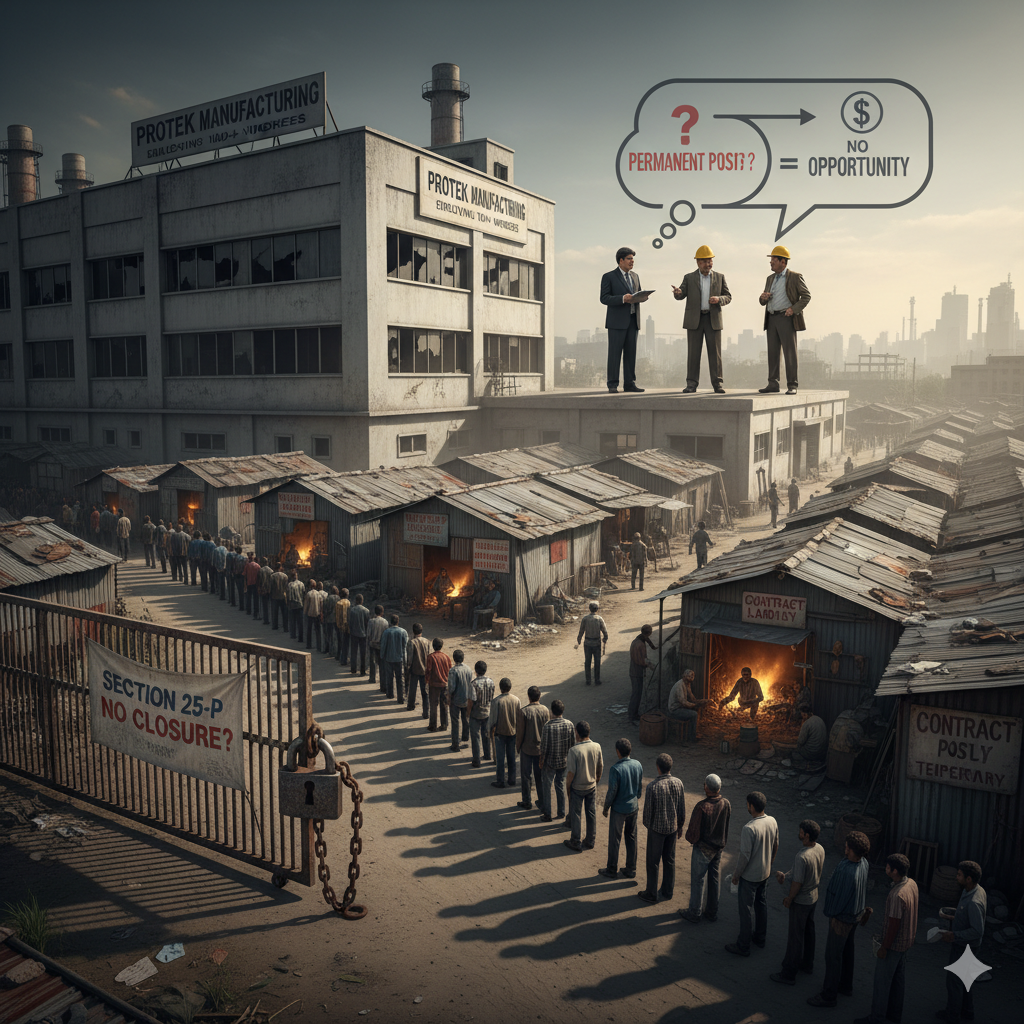
Section 25P of the Industrial Disputes Act, 1947
1. The Legislative Intent: Why does Section 25P exist?
In a socialist-leaning republic like India (post-independence), the closure of an industry wasn’t viewed as a private business decision; it was viewed as a social catastrophe.
- Mass Unemployment: A sudden closure of a large plant (100+ workers) leads to local economic collapse.
- Production Loss: Essential goods (cloth, steel, food) might stop reaching the market.
- The “Illegal Closure” Shield: Section 25P was inserted to ensure that employers didn’t simply “walk away” from their obligations by locking the gates and declaring bankruptcy to avoid paying retrenchment compensation.
2. The Structural Mechanics of Section 25P
The section operates under a specific sequence of triggers and conditions:
A. The Triggering Conditions
The Appropriate Government can only invoke Section 25P under two specific scenarios:
- Illegal Closure: The undertaking was closed down without obtaining prior permission under Section 25O(1).
- Public Interest: Even if the closure was legal or the application is pending, the government believes that restarting the industry is “necessary in the public interest.” This is a broad, subjective “grey area” often challenged in High Courts.
B. The Process of the Order
- The “Show Cause” Requirement: The government cannot simply send a letter. It must give the employer a “reasonable opportunity of being heard.” This aligns with the Principles of Natural Justice.
- The Directives: The government issues a written order directing the employer to restart the undertaking within a specified period (usually 30–60 days).
3. Constitutional Validity: The Battle with Article 19(1)(g)
This is where the “intellectual sparring” begins. The Indian Constitution guarantees the Right to carry on any occupation, trade, or business.
- The Argument for the Employer: If I have the right to start a business, I must logically have the right to close it. Forcing me to run a loss-making factory is “Industrial Serfdom.”
- The Supreme Court View (Excel Wear v. Union of India): The Court famously held that the right to close a business is not absolute but can be restricted by “reasonable restrictions” in the interest of the general public. However, if the business is genuinely bankrupt and cannot pay wages, Section 25P cannot be used to force a dead horse to run.
4. Practical Hurdles: Can you actually force a restart?
In reality, Section 25P is rarely successful for the following reasons:
- Financial Paralysis: If a company has no cash for raw materials or electricity bills, a government order doesn’t magically create capital.
- Managerial Vacuum: If the owners have fled or are insolvent, who manages the restart? Often, the government has to appoint a “Receiver” or hand it over to a Workers’ Cooperative.
- Judicial Stay: Most 25P orders are immediately challenged in High Courts via Writ Petitions, leading to years of litigation while the machinery rusts.
5. The “Public Interest” Paradox
Section 25P mentions “Public Interest” but doesn’t define it.
- Is it in the public interest to keep 500 people employed in a factory that produces obsolete technology?
- Is it in the public interest to drain the state exchequer to provide subsidies to keep a “sick unit” alive?
The Intellectual Sparing: Logic Test
Let’s test the logic of Section 25P against your preference for truth over agreement:
The Counter-Point: Section 25P is arguably a zombie provision. By threatening employers with a forced restart, it creates a “Fear of Entry.”
If an investor knows that once they hire 100 people, the Government can legally force them to keep the factory open even if they are losing millions, that investor will simply never build the factory.
Does Section 25P actually protect workers, or does it ensure that modern, high-growth industries avoid India’s manufacturing sector in favor of automated services where these laws are harder to apply?
This is a fundamental debate in Indian labor economics. To address whether Section 25P (the power of the government to order the restart of an undertaking) is a protective shield or a structural deterrent, we have to look at the gap between legislative intent and economic reality.
The Case for Protection: Social Security as a State Duty
Section 25P is built on the philosophy that an industrial unit is not just private property; it is a social asset.
- Preventing “Artificial” Closures: It prevents owners from closing a viable plant simply to bust a union or to siphon off assets while leaving workers destitute.
- The “Livelihood” Argument: Under Article 21 of the Constitution (Right to Life), Indian courts have often viewed the right to livelihood as paramount. Section 25P acts as a last-resort “CPR” for an industry that the state deems essential for the local economy.
The Counter-Point: The “Hotel California” Effect
Critics argue that Section 25P creates a “Hotel California” labor market: you can check in, but you can never leave.
- Capital Flight to Services: Modern, high-growth industries (SaaS, FinTech, Consulting) are “asset-light.” Because they don’t rely on massive factories or “workmen” as defined under Section 2(s), they largely bypass Chapter VB. This has led to a “Missing Middle” in India—we have tiny informal shops and giant service firms, but very few mid-sized manufacturing plants.
- The Automation Incentive: If Section 25P makes it legally impossible to exit a business when market conditions change, a rational investor will choose Capital over Labour.
- Logic: You don’t need government permission to turn off a robot or cancel a software subscription. You do need it to lay off 100 people.
- The “Zombie” Firm Problem: By forcing a restart, the government may keep “zombie” firms alive—companies that are economically dead but legally forced to breathe. This prevents “Creative Destruction,” where capital and labor from failing industries move to more productive, modern sectors.
Testing the Logic: Does it actually work?
In practice, Section 25P is rarely invoked effectively. If a company is truly bankrupt, a government order to “restart” cannot conjure money out of thin air to pay wages or electricity bills.
- Assumption: The law assumes the government knows better than the entrepreneur whether a business is viable.
- Counter-point: If the government forces a restart and the company fails again, who pays the workers? Usually, the dispute just ends up in a decade-long litigation cycle, leaving workers with “legal rights” but no actual “paychecks.”
The Modern Shift: The Industrial Relations Code (2020)
The Indian government acknowledged these frictions by introducing the Industrial Relations Code, 2020 (though implementation has been staggered). It proposes raising the threshold for these “Special Provisions” from 100 to 300 workers, specifically to encourage manufacturing firms to grow larger without fearing the “trap” of Sections 25K–25S.
f we abolished Section 25P tomorrow, would we see a massive boom in manufacturing, or would we simply see a race to the bottom where workers are discarded the moment a quarterly profit dip occurs? Is the problem the law itself, or the lack of a robust social safety net (like unemployment insurance) that would make such laws unnecessary?
Abolishing Section 25P (which allows the Government to force a closed undertaking to restart) would be a radical shift. However, Section 25P is rarely used in isolation; it’s the “enforcement arm” of the broader Chapter VB restrictions.
To address your dilemma, we have to weigh the Economic Efficiency of capital movement against the Social Cost of labor displacement.
1. The Case for the “Manufacturing Boom”
Proponents of abolition argue that Section 25P and its siblings (25N, 25O) create a “Zombie Firm” ecosystem.
- Capital Stagnation: When a factory is forced to stay open or restart despite being unviable, it traps capital, land, and electricity in an unproductive venture. Abolition would allow “creative destruction”—letting inefficient firms die so resources can flow to more competitive ones.
- Risk Mitigation for Investors: Foreign Direct Investment (FDI) often shies away from Indian manufacturing because of “exit barriers.” Investors fear that if a venture fails, they will be legally tethered to a loss-making entity forever. Removing 25P signals a mature, market-driven economy.
2. The Case for the “Race to the Bottom”
Critics argue that in a country with a massive labor surplus like India, the “market” does not value human life.
- Asymmetric Power: Without these protections, employers might use a “temporary closure” as a tactical weapon to break unions or force wage concessions, knowing the state can no longer compel them to resume operations.
- Social Destabilization: In Western economies, a factory closure is a personal crisis; in a developing nation without a safety net, a mass layoff can destabilize an entire regional economy, leading to a rise in crime and poverty that the state eventually has to pay for anyway.
3. The “Missing Middle”: Social Safety Nets
You hit the nail on the head regarding the Social Safety Net. The reason India has such rigid labor laws (like Section 25P) is that the law is being used as a surrogate for welfare.
The Current Trade-off
| Feature | Rigidity Model (Current India) | Flexibility Model (e.g., Denmark/Nordic) |
|---|---|---|
| Hiring/Firing | Extremely difficult (Section 25N/O/P) | Very easy |
| Unemployment Benefit | Virtually non-existent for private sector | High (up to 90% of previous salary) |
| Skill Retraining | Minimal/State-dependent | Robust and mandatory |
| Primary Goal | Job Security (Keep the same job) | Employment Security (Find a new job) |
The Counter-point: If we abolish Section 25P without first building a “Flexicurity” model (Unemployment insurance + aggressive retraining), we aren’t creating a manufacturing boom; we are creating a humanitarian crisis.
However, if we keep Section 25P, we continue to see the “informalization” of the workforce. To avoid these laws, 90% of Indian workers are hired as “contractual” or “informal” labor where they have zero protections anyway.
Is a law Section 25P truly “protective” if it is so strict that employers spend all their energy finding ways to bypass it entirely?
This is the central paradox of Indian labor law. Section 25P—which empowers the government to order a closed undertaking to restart—is often cited as the ultimate “pro-worker” shield. However, in practice, its extreme rigidity frequently triggers a “cobra effect,” where the protection itself creates a more precarious environment for the very people it aims to save.
Let’s dismantle the logic of Section 25P as a “protective” measure by looking at the unintended consequences of such a high barrier to exit.
1. The “Ghost Factory” Phenomenon
Section 25P assumes that a government mandate can revive an economically dead entity.
- The Flaw: If an employer is forced to restart a business that is no longer viable (due to technology shifts, loss of markets, or debt), the result isn’t “employment”—it’s a Ghost Factory.
- The Outcome: Management may “restart” on paper to avoid jail time under Section 25R, but they stop paying electricity, raw materials, and eventually, wages. The worker stays “employed” but receives no paycheck, trapped in a legal limbo where they cannot even claim retrenchment compensation because the unit is technically “open.”
2. The Shift to “Informalization”
When Section 25P (and the surrounding Chapter VB) makes the “divorce” between employer and employee impossible, employers stop “marrying” them in the first place.
- The Bypass: Instead of hiring permanent “workmen” who fall under the Industrial Disputes Act, firms pivot to Fixed-Term Employment (FTE) or Third-Party Contracting.
- The Irony: By trying to protect 100% of a worker’s job security, the law has pushed millions of workers into the informal sector where they have 0% security.
3. Capital Flight and “Sickness”
Strict exit laws like 25P encourage a “wait-until-it-dies” approach.
- Strategic Sickness: Rather than closing a unit early while there is still money left to pay workers their dues, employers often let the company become “sick” (insolvent).
- The Logic: It is easier to deal with the Insolvency and Bankruptcy Code (IBC) than it is to navigate the Appropriate Government’s refusal of closure under the ID Act. In the IBC process, workers often end up at the bottom of the priority list for payouts.
The Intellectual Counter-Argument
To play the role of the Sparing Partner, we must ask: What is the alternative?
If Section 25P were abolished, would we see a “race to the bottom” where employers shut down profitable plants just to break unions or move to cheaper states?
- The “Veto” Power: The government argues that Section 25P is a necessary check against predatory closures. Without it, a company could theoretically shut a factory on a whim, devastating a local economy.
- Social Stability: In a country without a robust social safety net (unemployment insurance), the employer is effectively forced to act as the “social security provider.”
A Comparative Perspective
Many modern economies use a “Flexicurity” model (easy to fire, but with high government-funded unemployment benefits) instead of the “Job-for-Life” model (impossible to fire, but no safety net if the company fails).
The Hard Truth: Section 25P is “protective” only in a static economy. In a dynamic, globalized economy, it often acts as a cage. It protects the position, but it may actually destroy the livelihood by scaring away the very capital needed to create jobs.

5 Comments
I’m so happy to read this. This is the type of manual that needs to be given and not the random misinformation that’s at the other blogs. Appreciate your sharing this best doc.
Excellent read, I just passed this onto a friend who was doing a little research on that. And he actually bought me lunch as I found it for him smile Therefore let me rephrase that: Thanks for lunch! “It is impossible to underrate human intelligence–beginning with one’s own.” by Henry Adams.
I’ll immediately grasp your rss as I can not in finding your e-mail subscription hyperlink or newsletter service. Do you have any? Please let me recognise so that I may subscribe. Thanks.
v579mu
Its wonderful as your other blog posts : D, appreciate it for posting. “Even Albert Einstein reportedly needed help on his 1040 form.” by Ronald Reagan.