
The Comprehensive Guide to Chapter VC & Section 25U
1. Historical Evolution: Why Chapter VC Exists
The Industrial Disputes Act was originally designed as a framework for dispute resolution. However, it lacked a specific mechanism to prevent “victimization” or “bad faith” actions by employers or unions before a full-blown dispute erupted.
Following the recommendations of the National Commission on Labour (1969) and drawing inspiration from the Maharashtra Recognition of Trade Unions and Prevention of Unfair Labour Practices (MRTU & PULP) Act, 1971, the Central Government introduced Chapter VC (Sections 25T and 25U) via an amendment in 1982 (effective from 1984).
The objective was simple: To codify ethical behavior in industrial relations.
2. The Legal Framework: Section 25T and 25U
Section 25T: Prohibition of Unfair Labour Practices
“No employer or workman or a trade union, whether registered under the Trade Unions Act, 1926 or not, shall commit any unfair labour practice.”
Key Analysis:
- Universal Application: Notice that the prohibition is not just on employers. It is a tripartite obligation binding the management, the individual worker, and the union.
- Registration Irrelevant: Even an unregistered union can be held liable. This prevents “shadow groups” from disrupting industrial peace without accountability.
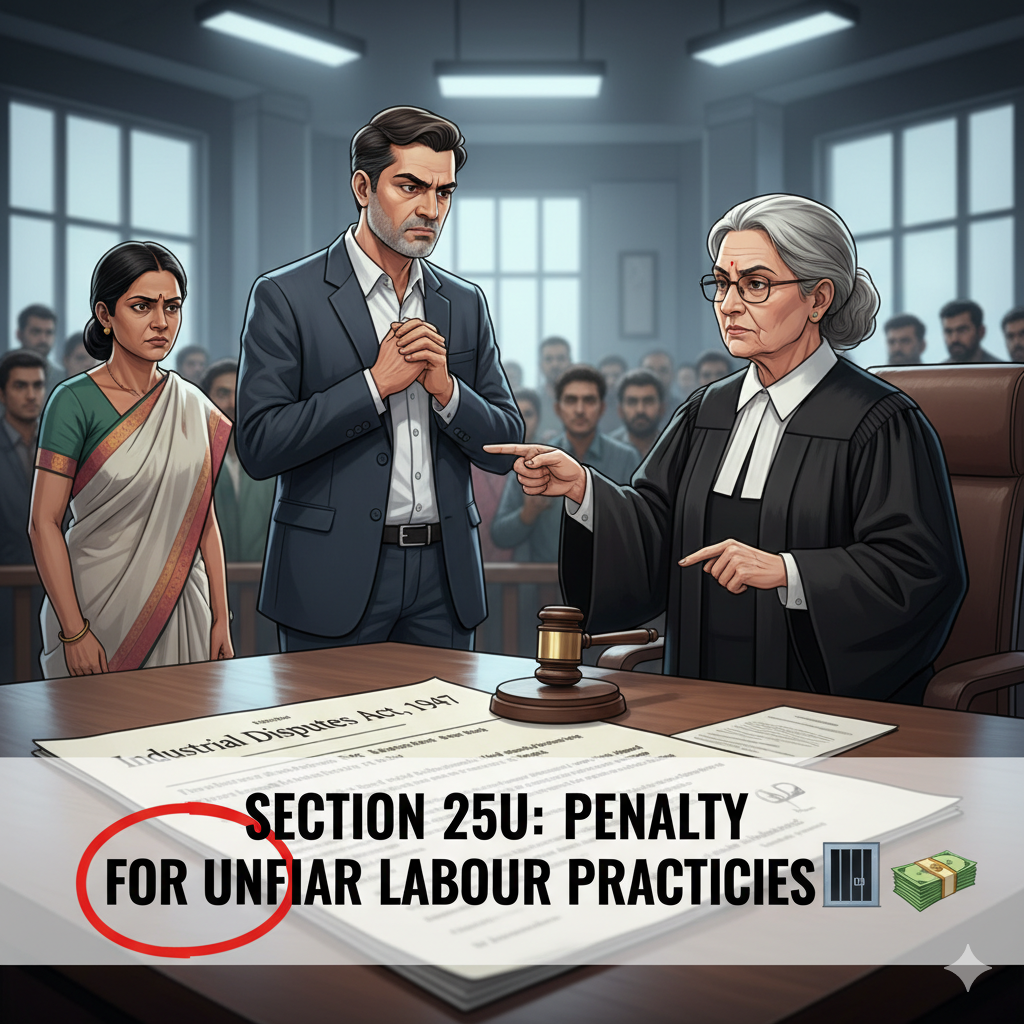
Section 25U: Penalty for Committing Unfair Labour Practices
This is the “teeth” of the chapter.
“Any person who commits any unfair labour practice shall be punishable with imprisonment for a term which may extend to six months or with fine which may extend to one thousand rupees or with both.”
Critique of the Penalty: From an intellectual sparring perspective, a ₹1,000 fine in the year 2026 is mathematically negligible for a multi-million dollar corporation. This raises the question: Is Section 25U a deterrent or merely a “cost of doing business”? The real sting lies in the imprisonment (criminal record) and the potential for a Labour Court to order “status quo ante” (restoring things to how they were).
3. The Fifth Schedule: The “Dictionary” of ULPs
Section 2(ra) of the Act defines an Unfair Labour Practice as any practice specified in the Fifth Schedule. To understand 25U, you must understand the Fifth Schedule.
Part I: ULPs on the part of Employers
There are 15 distinct categories. They generally fall into:
- Interference with Unionization: To threaten workmen with discharge or dismissal if they join a union; to grant wage increases at specific times to undermine union efforts.
- Victimization: To discharge a workman because he gave evidence in a previous case or because he is a union leader.
- Establishing “Employer-Sponsored” Unions: Creating “puppet” unions to divide the workforce.
- Bad Faith Bargaining: Refusing to bargain collectively in good faith with a recognized union.
- Artificial Breaks in Service: Employing workmen as “badlis” or casuals for years to deny them the status of “permanent” employees (a very common violation in India).
- Recruiting Scabs: Hiring new workers during a legal strike.
Part II: ULPs on the part of Workmen and Trade Unions
There are 7 distinct categories:
- Coercion: Using physical force or intimidation against non-striking workmen.
- Wildcat Strikes: To advise or instigate an illegal strike.
- “Go-Slow”: Deliberately reducing production output (this is often harder to prove than a strike).
- Gherao: Physical blockade of managerial staff.
- Intimidation: Using abusive language or staging demonstrations at the residence of management members.
4. Procedural Depth: How is Section 25U Triggered?
The process of penalizing someone under Section 25U is not automatic. It follows a specific legal trajectory:
- Complaint: An aggrieved party (worker or employer) files a complaint before the Labour Court or Industrial Tribunal.
- Investigation: The court must determine if the act complained of falls strictly within the Fifth Schedule.
- The Burden of Proof: In cases of “Victimization,” the burden often shifts. If an employer fires a union leader, they must prove it was for a valid disciplinary reason and not because of his union activities.
- Criminal Prosecution: Since 25U involves imprisonment, the proceedings are quasi-criminal.
5. Judicial Interpretations (The “Living” Law)
The courts have expanded the scope of Section 25U through landmark judgments:
- Regional Manager, SBI vs. Mahatma Gandhi (2006): The Supreme Court clarified that engaging workers on a temporary basis for years to avoid permanent benefits is a “perennial” unfair labour practice.
- General Labour Union (Red Flag) vs. B.V. Chavan: Established that “Lock-outs” declared under the guise of “security threats” when no such threat exists is a ULP.
6. The Socratic Challenge: The Paradox of “Unfairness”
As your sparring partner, I must challenge the logic of Chapter VC:
A. The Definition Trap:
The Fifth Schedule is exhaustive. If a practice is “unfair” but not listed in the Schedule, can it be penalized under 25U? Legally, no. This creates a loophole where innovative forms of harassment (like digital surveillance or social isolation in the workplace) might not technically be “Unfair Labour Practices” because they weren’t imagined in 1982.
B. The Power Imbalance:
Section 25U penalizes “any person.” However, the resources of a Trade Union to prosecute a company are vastly inferior to the company’s ability to defend itself. Does 25U create an “illusion of equality” while maintaining a structural hierarchy?
C. The Efficiency Argument:
By criminalizing labor relations (imprisonment), does Section 25U destroy the possibility of future reconciliation? In most modern jurisdictions, labor disputes are kept strictly civil to allow the business to survive. India’s approach is uniquely punitive.
Summary Table: Chapter VC at a Glance
| Section | Content | Key Implication |
|---|---|---|
| 25T | Prohibition | Makes ULP a statutory offense for all parties. |
| 25U | Penalty | 6 months jail / ₹1,000 fine. The “deterrent” clause. |
| Schedule V | The List | The 22 “sins” of industrial relations. |

6 Comments
Hi, I think your site might be having browser compatibility issues. When I look at your website in Safari, it looks fine but when opening in Internet Explorer, it has some overlapping. I just wanted to give you a quick heads up! Other then that, fantastic blog!
Write more, thats all I have to say. Literally, it seems as though you relied on the video to make your point. You definitely know what youre talking about, why waste your intelligence on just posting videos to your site when you could be giving us something informative to read?
This really answered my problem, thank you!
8hcxlm
Pretty section of content. I just stumbled upon your blog and in accession capital to claim that I get actually loved account your weblog posts. Any way I will be subscribing for your feeds or even I success you get right of entry to constantly quickly.
Hey very cool web site!! Guy .. Excellent .. Wonderful .. I’ll bookmark your blog and take the feeds additionally?KI’m satisfied to search out a lot of useful information here within the publish, we’d like develop extra techniques in this regard, thank you for sharing. . . . . .