
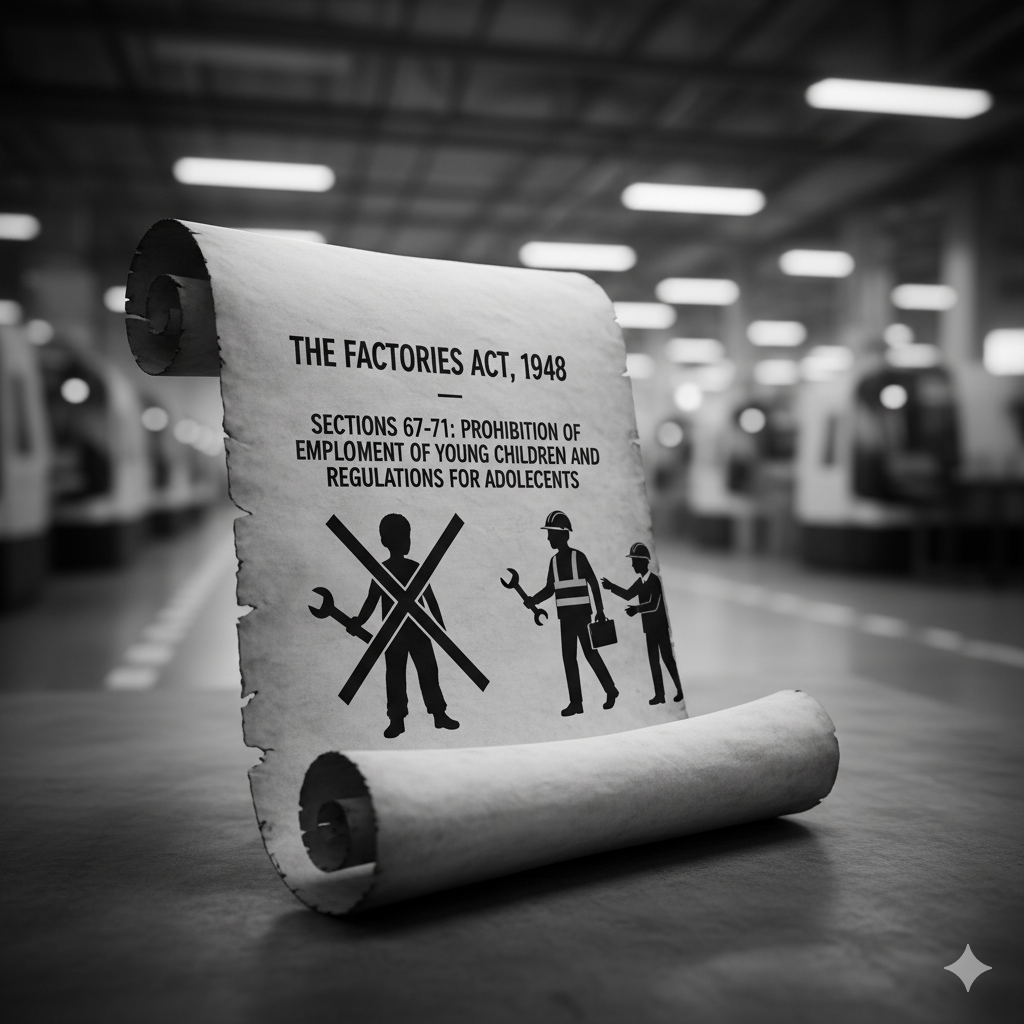
Detailed Analysis: Employment of Young Persons (Sections 67-71)
I. The Statutory Framework: Definitions and Thresholds
Before dissecting the specific sections, we must establish the legal taxonomy used by the Act. The law does not see “minors” as a monolith. It divides them into:
- Child: A person who has not completed their 15th year.
- Adolescent: A person who has completed 15 years but not 18 years.
- Young Person: A category encompassing both children and adolescents.
II. Section 67: Prohibition of Employment of Young Children
The Letter of the Law: “No child who has not completed his fourteenth year shall be required or allowed to work in any factory.”
1. The Absolute Nature of the Ban
Section 67 is a “strict liability” provision. It does not matter if the child’s parents consented, if the child lied about their age, or if the employer acted in good faith. If a child under 14 is found working, the “Occupier” and “Manager” are liable.
2. The Intellectual Counterpoint: The “Unintended Vacuum”
While Section 67 aligns with Article 24 of many Constitutions (Prohibition of Child Labor), it creates an economic vacuum. If a 13-year-old is barred from a factory that provides a regulated environment, but the family remains below the poverty line, the child often migrates to the “informal sector” (rag-picking, street vending, or illicit firework assembly) where the Factories Act has no jurisdiction.
Logic Test: Does Section 67 solve “Child Labor,” or does it merely solve “Child Labor in Factories”?
III. Section 68: Non-adult Workers to Carry Tokens
The Letter of the Law: A child who has completed 14 years or an adolescent shall not be allowed to work unless:
- A Certificate of Fitness granted under Section 69 is in the custody of the manager.
- The worker carries a token giving a reference to such certificate while at work.
1. The “Token” System as Surveillance
The requirement of a physical token is a vestige of early 20th-century industrialism. It serves as an immediate visual identifier for inspectors. If an inspector sees a young face without a gleaming brass token, the burden of proof shifts immediately to the employer.
2. Practical Critique
In a modern high-speed manufacturing plant, is a physical “token” a safety hazard? If a worker is operating a lathe or a conveyor, a dangling token could lead to entanglement. Modern compliance suggests digital databases, yet the Act remains anchored in physical “tokens.”
IV. Section 69: Certificate of Fitness
This is the most critical procedural section. It moves the authority from the “Employer” to a “Certifying Surgeon.”
1. The Process
- Application: Must be made by the young person or their parent, or the manager of the factory.
- Examination: The Certifying Surgeon must examine the person to see if they are fit for “full day’s work” in a factory.
- Validity: The certificate is valid for only 12 months.
2. The Surgeon’s Discretion
The Surgeon can grant a certificate as:
- A Child, if they are fit for the limited hours allowed for children.
- An Adult, if the adolescent (15+) has reached a physical standard that allows them to work a full adult shift.
3. Testing the Logic of “Fitness”
The Act assumes “fitness” is a purely biological metric. It ignores psychological maturity. An adolescent might be physically “fit” to carry loads but mentally incapable of maintaining the sustained attention required to avoid a high-voltage hazard.
V. Section 70: Effect of Certificate of Fitness Granted to Adolescents
This section bridges the gap between childhood and adulthood.
1. Working as an Adult
If an adolescent (15-18) has a certificate stating they are fit for a full day’s work, they are treated as an “adult” for the purposes of Chapters VI and VIII (Working Hours and Leave).
2. The Caveat: No Night Work
Even if an adolescent is certified as an “adult,” they are strictly prohibited from working between 10 PM and 6 AM.
3. Challenging the Assumption
Why is the “night” more dangerous for a 17-year-old certified as an “adult” than for an 18-year-old? If the biological development is nearly identical, this restriction is purely social/paternalistic. Is it designed to protect the worker, or to ensure they are available for “education/socialization” during non-work hours?
VI. Section 71: Working Hours for Children
For those aged 14-15 who are permitted to work, the restrictions are severe:
- Limited Hours: No more than 4.5 hours in any day.
- No Night Work: Prohibited between 10 PM and 6 AM.
- The “Double Employment” Ban: A child cannot work in two different factories on the same day.
- Spread-over: The period of work must be limited to one shift not exceeding 5 hours.
1. The “Half-Shift” Philosophy
The 4.5-hour limit is designed to allow the child time for schooling. However, in reality, most factories do not find it economically viable to hire someone for only 4.5 hours.
Sparring Point: This section effectively functions as a “Soft Ban.” By making the regulations so cumbersome and the hours so short, the Act forces employers to simply not hire anyone under 18, regardless of the legality of hiring a 15-year-old.
VII. Comparative Analysis & Contemporary Critique
1. The Conflict with Modern Education Laws
In many jurisdictions, “Right to Education” acts mandate schooling until 14. The Factories Act allows work at 14. This creates a “transition year” (the 14th year) where a child is legally allowed to work but also legally mandated to be in school. The Act fails to harmonize these two realities.
2. The Gender Dimension
Historically, these sections were even more restrictive for “female children.” While modern amendments aim for neutrality, the “Protective Discrimination” inherent in these sections often leads to women being excluded from high-paying industrial roles because they are seen as “compliance risks” until they are 18.
3. The Enforcement Gap
- The Register of Child Workers (Section 73): Even if Sections 67-71 are followed, the lack of a proper Register under Section 73 makes the previous sections unenforceable.
- The “Age Guessing” Problem: Without robust birth registration (a common issue in rural industrial hubs), the “Certifying Surgeon” becomes a subjective judge, often influenced by the factory owner’s “donations.”
VIII. Conclusion: The Evolutionary Necessity
Sections 67-71 were written for a world of chimneys and coal. In the modern context:
- The 14-year-old floor is too low for a world requiring high-skill labor.
- The Token system is an archaic method of tracking.
- The 4.5-hour limit is a bureaucratic barrier that promotes “hidden” child labor rather than “regulated” child labor.
The true “truth” of the Factories Act is that it seeks to make child labor unprofitable, rather than just illegal. By raising the “compliance cost” of hiring a young person (surgeons, tokens, registers, limited hours), the law uses economics to enforce morality.

9 Comments
hey there and thanks in your information – I have certainly picked up something new from right here. I did alternatively experience a few technical points the use of this site, as I skilled to reload the web site a lot of instances previous to I may just get it to load properly. I were wondering if your hosting is OK? No longer that I’m complaining, however sluggish loading instances times will sometimes impact your placement in google and could damage your high quality ranking if advertising and ***********|advertising|advertising|advertising and *********** with Adwords. Anyway I am adding this RSS to my email and could look out for a lot extra of your respective intriguing content. Ensure that you replace this once more very soon..
of course like your website but you have to take a look at the spelling on quite a few of your posts. Many of them are rife with spelling problems and I find it very bothersome to inform the truth however I’ll certainly come again again.
fantastic points altogether, you just gained a new reader. What would you suggest about your post that you made a few days ago? Any positive?
Only a smiling visitant here to share the love (:, btw outstanding pattern.
I’m no longer certain the place you are getting your information, however good topic. I must spend a while learning much more or understanding more. Thank you for fantastic info I used to be on the lookout for this info for my mission.
As a Newbie, I am always exploring online for articles that can aid me. Thank you
I have recently started a blog, the info you provide on this website has helped me tremendously. Thank you for all of your time & work. “Men must be taught as if you taught them not, And things unknown proposed as things forgot.” by Alexander Pope.
Just what I was looking for, thanks for posting.
Hey there are using WordPress for your site platform? I’m new to the blog world but I’m trying to get started and create my own. Do you need any coding knowledge to make your own blog? Any help would be really appreciated!