
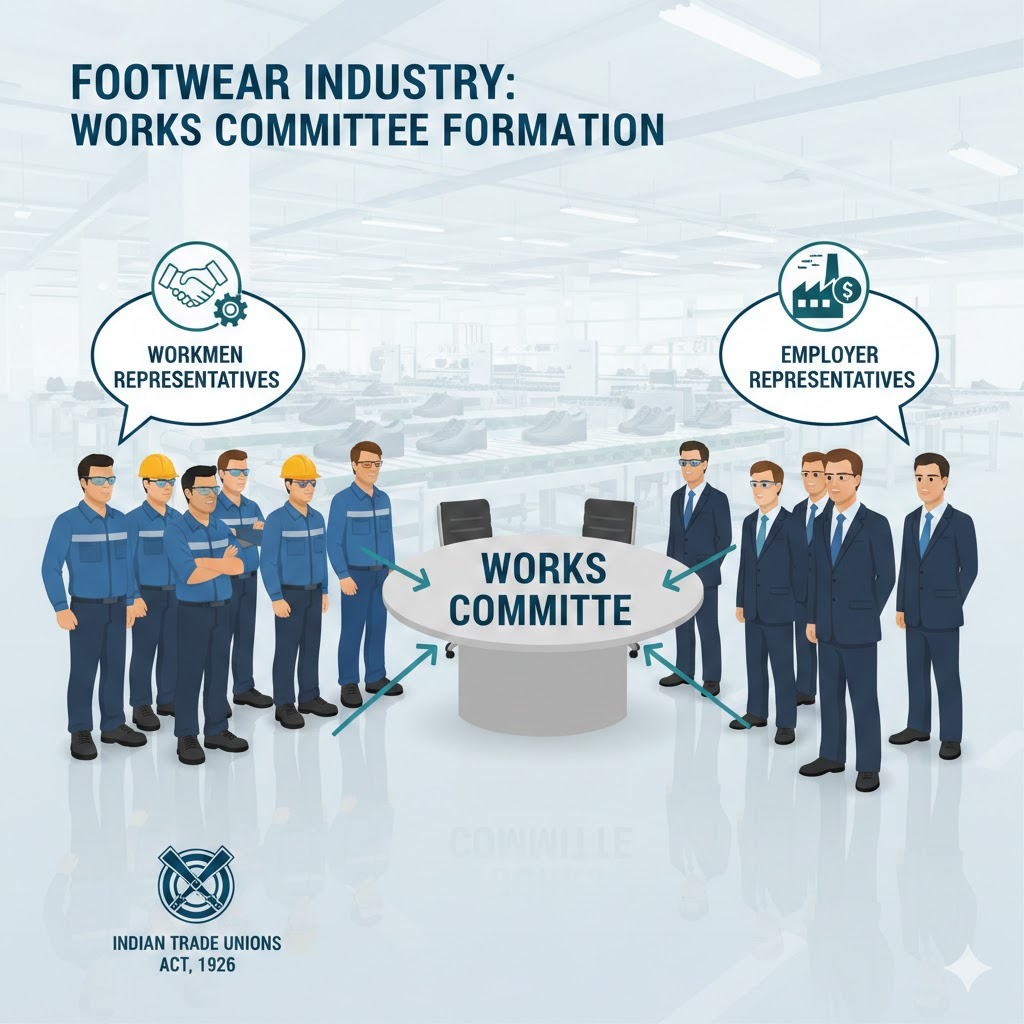
1. The Statutory Threshold: When Does a Footwear Factory Need a Committee?
The law mandates a Works Committee for any industrial establishment with 100 or more workmen.
In the footwear industry—which ranges from boutique leather workshops to massive synthetic sneaker assembly lines—this threshold is easily met. A standard assembly line for lasting, sole-attachment, and finishing often requires 150–300 workers per shift.
The “100 Workmen” Trap
- The Assumption: 100 workers is the “tipping point” for organized industrial friction.
- The Counterpoint: In the footwear sector, many employers intentionally fragment their units into smaller entities of 80–90 workers to bypass this and other labor laws (like the Industrial Employment Standing Orders Act). This leads to “informalization” of a formal industry.
2. Composition and Democratic Friction
The Act requires the number of workmen representatives to be no less than the employer representatives.
Selection Dynamics in Footwear
In a footwear factory, “workmen” aren’t a monolith. You have:
- Skilled Artisans: Pattern cutters and clicking room operators.
- Semi-skilled Labor: Stitching machine operators.
- Unskilled Labor: Helpers, packers, and chemical cleaners.
The Logic Test: If the representatives are chosen only from the most vocal group (often the senior stitchers), the interests of the chemical-handling workers or packers may be ignored. The law requires consultation with registered Trade Unions, but if a factory has multiple competing unions, the “prescribed manner” of choosing representatives often becomes a political battleground rather than a collaborative effort.
3. The Mandate: Amity vs. Collective Bargaining
Section 3(2) defines the duty: to promote amity and good relations.
Crucial Distinction: What a Works Committee is NOT
It is vital to distinguish the Works Committee from a Trade Union.
- Works Committee: Focuses on day-to-day welfare (ventilation, lighting, water, safety gear).
- Trade Union: Focuses on “Interest Disputes” (wages, bonus, hours of work).
Alternative Perspective: Employers often attempt to use Works Committees to bypass Unions. By discussing “common interests” in the committee, they may try to pacify workers on minor issues to avoid addressing larger wage hikes. However, legally, a Works Committee cannot negotiate collective bargaining agreements.
4. Industry-Specific Examples: The Footwear Context
How does a Works Committee operate on the floor of a shoe factory? Let’s look at three “Material Differences of Opinion”:
A. The “Vapor and Ventilation” Dispute
Footwear manufacturing involves heavy use of adhesives (toluene-based) and primers.
- The Issue: Workers complain of dizziness in the lasting department.
- Committee Action: The workmen representatives propose an upgraded exhaust system. The employer representatives argue it’s too costly.
- The Outcome: The Committee “endeavours to compose” the difference by suggesting a rotational shift for that department or improved Personal Protective Equipment (PPE) as a middle ground.
B. The “Production Quota” Tension
- The Issue: Management increases the “pairs per hour” target for the stitching line.
- The Counterpoint: Workers argue the leather quality is tougher this month, making the target impossible.
- The Role: The Works Committee discusses the feasibility of the quota to prevent a flash strike, focusing on the “good relations” aspect rather than the legal contract of employment.
C. Safety in the Press Room
- The Issue: Sole-pressing machines are high-risk for finger injuries.
- Committee Action: Regular review of safety guards and “near-miss” reporting. This is a classic “Common Interest” matter where both parties benefit from zero accidents.
5. Critical Analysis: Why Works Committees Often Fail
While the law looks good on paper, the footwear industry faces specific hurdles that render these committees “paper tigers.”
1. The Power Asymmetry
In many export-oriented footwear units, workers are often on short-term contracts. A contract worker is technically a “workman,” but they are unlikely to challenge an employer in a committee meeting for fear of their contract not being renewed.
2. Overlapping Jurisdictions
With the advent of the Health, Safety and Working Conditions Code (which aims to replace older acts), the role of the Works Committee is often confused with “Safety Committees.” If a factory has five different committees, the Works Committee loses its “amity-building” focus and becomes a redundant bureaucratic layer.
3. Lack of Finality
The Works Committee’s decisions are not legally binding. They are “recommendatory.”
- The Logic Gap: If the employer can simply ignore a unanimous recommendation of the committee, the “amity” intended by the Act quickly turns into “cynicism” among the workforce.
6. Summary Table: Works Committee vs. Trade Union
| Feature | Works Committee (Section 3) | Trade Union (TU Act, 1926) |
| Primary Goal | Internal peace and day-to-day welfare. | Collective bargaining and wage protection. |
| Participation | Mandatory if ordered by Govt (100+ workers). | Voluntary association. |
| Legal Status | Internal consultative body. | External legal entity/body corporate. |
| Conflict Role | Prevent minor sparks from becoming fires. | Fight the “fire” (strikes/litigation). |
7. The Intellectual Challenge: Is “Amity” Possible?
The statute assumes that employers and employees have “common interests.”
The Counter-Argument: In a hyper-competitive global footwear market, the employer’s interest is cost-minimization (lower overheads, faster throughput), while the workman’s interest is effort-minimization and wage-maximization.
Can a committee truly “compose differences” when the fundamental goals are diametrically opposed? The Works Committee works best not as a tool for “truth,” but as a ventilation valve. It allows small grievances (bad food in the canteen, lack of fans) to be resolved before they ferment into a full-scale industrial strike that halts the entire production line.

4 Comments
Good day! This is kind of off topic but I need some advice from an established blog. Is it difficult to set up your own blog? I’m not very techincal but I can figure things out pretty quick. I’m thinking about creating my own but I’m not sure where to begin. Do you have any tips or suggestions? Thank you
Hey there this is kinda of off topic but I was wondering if blogs use WYSIWYG editors or if you have to manually code with HTML. I’m starting a blog soon but have no coding knowledge so I wanted to get advice from someone with experience. Any help would be enormously appreciated!
This is a very good tips especially to those new to blogosphere, brief and accurate information… Thanks for sharing this one. A must read article.
Some really nice stuff on this internet site, I enjoy it.