
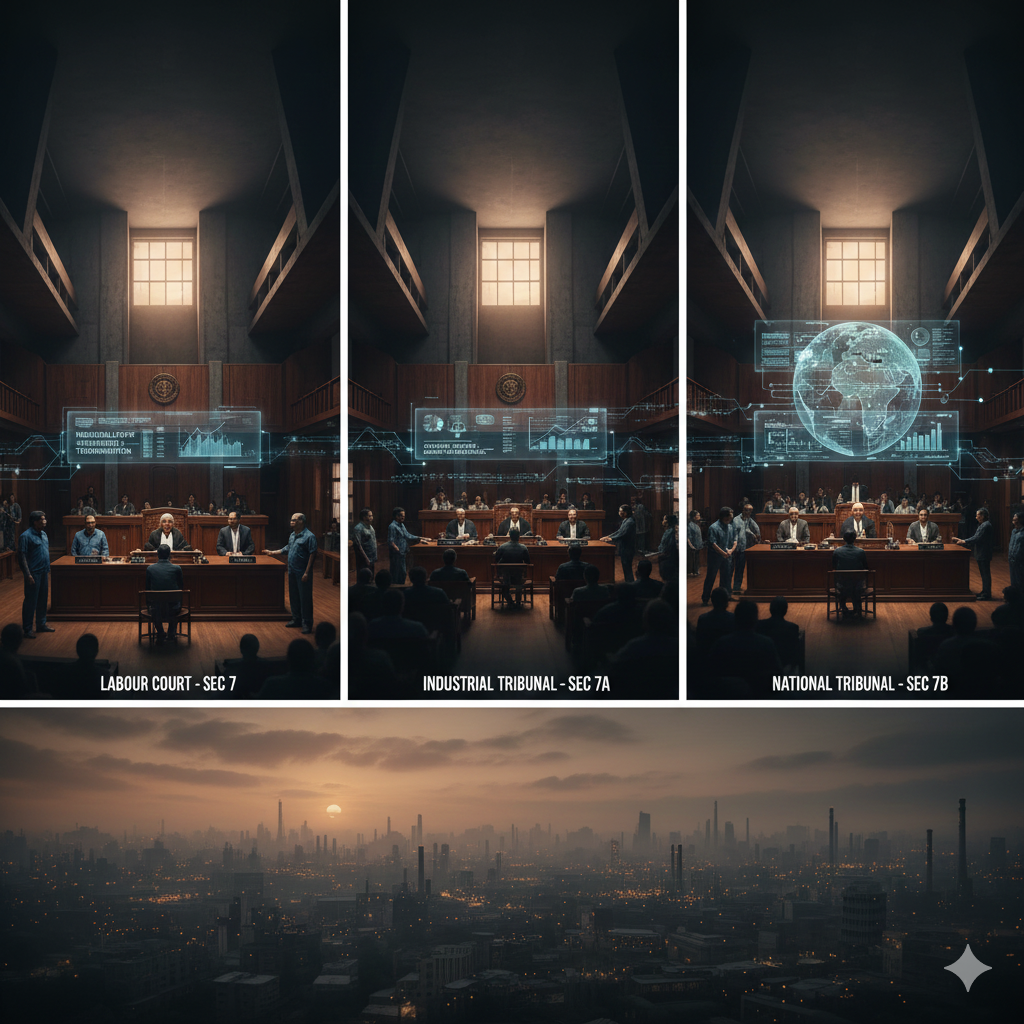
Moving from the “Detective” (Section 6) to the “Judges” (Sections 7, 7A, and 7B), we enter the Adjudication Tier. This is where the “handcuffs” of the law finally come out. These three sections create a three-tier hierarchy of judicial power, each with specific “jurisdictions” (the types of fights they are allowed to handle).
1. Section 7: Labour Courts
The Labour Court is the “First Responder” for individual-centric disputes. It is usually presided over by a single person who has held judicial office (like a District Judge) for at least three years.
- Jurisdiction: They handle matters listed in the Second Schedule of the Act.
- Typical Issues: * The propriety or legality of an order passed by an employer under the Standing Orders.
- Discharge or dismissal of workmen (including reinstatement).
- Withdrawal of any customary concession or privilege.
- Illegality or otherwise of a strike or lock-out.
2. Section 7A: Industrial Tribunals
This is the “Middle Weight” tier, handling broader, collective issues that affect the entire factory or industry.
- Jurisdiction: They handle matters in both the Second and Third Schedules.
- Typical Issues (Third Schedule):
- Wages, including the period and mode of payment.
- Compensatory and other allowances.
- Hours of work and rest intervals.
- Leave with wages and holidays.
- Bonus, profit sharing, provident fund, and gratuity.
- Retrenchment of workmen and closure of establishment.
3. Section 7B: National Tribunals
This is the “Heavyweight” tier, reserved for disputes that have a national impact. These are appointed by the Central Government (not the State).
- Criterion for Reference: A dispute is referred here if:
- It involves questions of national importance.
- The dispute is of such a nature that industrial establishments situated in more than one State are likely to be interested in or affected by it.
- Finality: Once a National Tribunal is seized of a matter, no Labour Court or Industrial Tribunal can adjudicate on that specific issue.
Intellectual Sparring: The “Judicialization” of the Shop Floor
As your sparring partner, I have to challenge the efficiency of this three-tiered system. It looks organized on paper, but in practice, it creates a Legal Labyrinth.
1. The “Schedule” Confusion
Why split issues between the Second and Third Schedules? If a worker is dismissed (Sec 7) because they protested about wages (Sec 7A), the case can get stuck in jurisdictional arguments for years. Does this complexity serve the worker, or does it only serve the lawyers who get paid to argue about which court should hear the case?
2. The Lack of Finality
While these are “Courts,” their decisions (Awards) are often challenged in the High Courts and the Supreme Court under Article 226 and 136 of the Constitution.
The Sparring Point: If an “Award” from a National Tribunal can be stayed by a High Court for another 10 years, does the “National Importance” (Section 7B) actually mean anything? Or is it just a high-stakes waiting room?
3. The “Independent” Judge vs. Industrial Reality
The Act requires these judges to be “independent.” However, most are retired Civil Judges with zero experience in business management or labor sociology.
- The Problem: They apply “Civil Law” logic (strict evidence, narrow interpretation) to “Social Justice” problems. Should we replace these retired judges with “Industrial Experts” who actually understand how a 2026 factory operates?
Comparison Table: The Three Tiers
| Feature | Labour Court (Sec 7) | Industrial Tribunal (Sec 7A) | National Tribunal (Sec 7B) |
|---|---|---|---|
| Scope | Individual/Rights-based | Collective/Economic-based | Inter-state/National-based |
| Appointed By | Appropriate Govt (State/Central) | Appropriate Govt (State/Central) | Central Government Only |
| Schedule | 2nd Schedule only | 2nd & 3rd Schedules | Matters of National Importance |
| Focus | “Was this firing legal?” | “Are these wages fair?” | “How does this affect the nation?” |
Analyze the “Third Schedule”—which contains the most explosive issues like Bonuses and Retrenchment
The Third Schedule of the Industrial Disputes Act is where the “polite” disagreements of the Second Schedule (like clerical errors or individual discipline) turn into “all-out war.” If the Second Schedule is about rights, the Third Schedule is about money and survival.
Analyze why these specific items are “explosive” and challenge the traditional logic that keeps them under the control of Industrial Tribunals (Section 7A).
1. The Core Components of the Third Schedule
The Third Schedule covers matters that affect the entire collective of workmen. The most volatile entries include:
- Wages: Not just the amount, but the period and mode of payment.
- Compensatory and other allowances: Including Dearness Allowance (DA), which is the primary shield against inflation.
- Hours of work and rest intervals: The battle over the “standard” workday.
- Bonus, Profit Sharing, and Gratuity: The literal “spoils” of the industry.
- Shift Working: Managing the physical and social toll of night/rotating shifts.
- Retrenchment and Closure: The “death penalty” of an industrial relationship.
2. Why “Retrenchment” is the Ultimate Conflict
Under Entry 10 of the Third Schedule, Retrenchment (firing due to surplus labor, not misconduct) is a systemic issue.
- The Logic: In 1947, the law assumed that if a company is making a profit, it has a social obligation to keep workers employed.
- The Sparring Point: In a 2026 AI-driven economy, “surplus labor” is a permanent state. If an Industrial Tribunal uses 1940s logic to block retrenchment, it forces a company to become inefficient. Does the Third Schedule protect workers, or does it accidentally kill the company (and all the jobs with it) by preventing modernization?
3. The “Bonus” Trap: Gift or Right?
Entry 5 deals with Bonuses.
- The Conflict: Employers see a bonus as an “ex-gratia” (gift) for good performance. Workers, supported by the Third Schedule, see it as “deferred wage”—money they are owed because their current wages don’t meet the “living wage” standard.
- The Sparring Point: When a Tribunal adjudicates a bonus dispute, it is effectively performing an audit of the company’s secrets. This creates a massive power struggle over what constitutes “available surplus.”
4. Intellectual Challenge: The “Economic Judge” Problem
Here is where the logic of the Act starts to crumble.
The Jurisdiction Issue: Sections 7A and 7B give retired judges the power to decide “Wages” and “Profit Sharing.”
- The Critique: Most judges are trained in Law, not Macroeconomics. When a Tribunal decides that a 15% wage hike is “fair,” they might be ignoring the company’s debt-to-equity ratio or global market fluctuations.
- The Consequence: This leads to Industrial Rigidity. If the “Third Schedule” matters were settled by market forces or expert economic panels rather than legal tribunals, would we have more sustainable industries?
5. Summary: The Tension of the Third Schedule
| Issue | The Worker’s View | The Employer’s View | The Tribunal’s Dilemma |
|---|---|---|---|
| Wages (Entry 1) | Needs-based (What I need to live). | Capacity-based (What I can afford to pay). | Finding the “Fair Wage” middle ground. |
| Bonus (Entry 5) | A share of the success I built. | A reward for exceptional results. | Calculating “Available Surplus” vs. “Allocable Surplus.” |
| Retrenchment (Entry 10) | A betrayal of the social contract. | A necessary optimization for survival. | Balancing “Social Justice” with “Economic Viability.” |
The Sparring Verdict
The Third Schedule is essentially a “Wealth Redistribution Mechanism” masquerading as a legal list. It assumes that labor and capital are in a “Zero-Sum Game”—if the employer wins a rupee, the worker loses one.
In the 2026 context, this schedule is becoming a bottleneck. For example, “Hours of Work” (Entry 2) doesn’t account for remote work or “asynchronous” productivity. By keeping these issues in a rigid legal schedule, are we preventing the evolution of a more flexible, prosperous workplace?
The Third Schedule is essentially a 1947 fossil trying to regulate a 2026 digital ecosystem. By categorizing things like “Hours of Work” and “Rest Intervals” as rigid legal items that require a Tribunal’s intervention, we aren’t just protecting workers—we are potentially paralyzing innovation.
1. The Death of the “Clock-In” (Entry 2: Hours of Work)
In 1947, work was visible and physical. If you were at the loom, you were working. If you weren’t, you weren’t.
- The 2026 Conflict: How does an Industrial Tribunal (Section 7A) adjudicate “Hours of Work” for a software engineer or a creative director? If they think about a problem while showering at 10:00 PM, is that a “Rest Interval” (Entry 2) or “Overtime”?
- The Bottleneck: When the law demands a “9-to-5” structure to satisfy a 20th-century schedule, it penalizes the asynchronous worker. By trying to “protect” workers from long hours via a Tribunal, we often stop them from having the flexibility to work 4 hours of high-intensity deep work and spend the rest of the day with family.
2. The “Remote Work” Vacuum (Entry 4: Leave with Wages/Holidays)
The Third Schedule assumes the “Workplace” is a static location.
- The Sparring Point: If an employee is “Work from Anywhere,” which State’s Industrial Tribunal has jurisdiction? If the “Environment” is the worker’s own living room, can they raise a dispute over “Shift Working” (Entry 6)?
- The Rigidity Trap: Because these items are in the Schedule, employers are terrified to experiment with “Unlimited PTO” or “Results-Only Work Environments” (ROWE) because they fear it might violate a rigid “Standing Order” that a Tribunal will later use to penalize them.
3. “Wages” vs. “Total Compensation” (Entry 1)
The Schedule focuses on “Wages” and “Bonus.” In 2026, compensation is a complex web of ESOPs, tokens, performance-linked micro-payments, and wellness benefits.
- The Algorithmic Delay: If a company wants to switch to a “Daily Pay” model (paying via blockchain as tasks are completed), this could be seen as a “change in mode of payment” (Entry 1), requiring a Section 9A notice and potential Tribunal interference.
- Result: Companies stick to outdated monthly payrolls because the legal cost of “innovating” the pay structure is too high.
Intellectual Challenge: Protection vs. Prosperity
Is the Third Schedule now a “Security Blanket” or a “Straightjacket”?
The “Security Blanket” Argument:
Without these rigid entries, the “Algorithmically Perfect” workplace we discussed earlier would devour the human element. The Schedule is the only thing stopping a 2026 employer from saying, “You are always on call, and your ‘wages’ are purely based on your click-rate.” It forces a human pause in a hyper-speed economy.
The “Straightjacket” Argument:
The “Workman” of 2026 is often a Knowledge Worker. Knowledge work cannot be measured by the “hour.” By forcing knowledge work into the Third Schedule’s “Industrial” box, we are:
- Lowering Productivity: Measuring hours instead of output.
- Encouraging Informalization: Employers hire “Contractors” (who aren’t under the IDA) just to avoid the Third Schedule, leaving workers with zero protection instead of modern protection.
The Sparring Verdict
We are trying to play a high-speed game of “Digital Chess” using the rules of “Heavy Industrial Checkers.”
If we don’t move “Hours of Work” and “Rest Intervals” out of the rigid Schedule and into Individual Negotiated Contracts (with a basic safety floor), we will continue to see a “Great Resignation” or a shift to the “Gig Economy” where the IDA 1947 doesn’t apply at all.
Should we “sunset” the Third Schedule and replace it with a “Universal Code of Digital Labor Rights” that focuses on Output and Well-being rather than Hours and Holidays?
To “sunset” the Third Schedule is to admit that the industrial logic of 1947—which viewed the worker as a physical unit of time—is dead. Replacing it with a Universal Code of Digital Labor Rights shifts the focus from Presence (Hours) to Impact (Output) and Sustainability (Well-being).
Let’s pressure-test this “Sunset” proposal.
1. The Logic of the “Sunset”: Why the 3rd Schedule is Rotting
The Third Schedule (Sections 7A) deals with:
- Hours of work and rest intervals: In a gig or remote economy, “hours” are an obsolete metric. If an AI helps me finish 8 hours of work in 2, why should I be penalized by having to sit at a desk for the remaining 6?
- Holidays: When work is global and asynchronous, “national holidays” become friction points. A digital worker might prefer “Personal Energy Credits” over a fixed Sunday.
- Bonus and Profit Sharing: These are currently tied to archaic accounting. In a digital firm, “value” is often captured in data or equity, which the 3rd Schedule barely understands.
2. The New Code: Output & Well-being
If we rewrite this for 2026, the “Universal Code” would focus on:
A. The Right to “Cognitive Rest” (Replacing Rest Intervals)
Instead of a “lunch break,” the law would mandate “Disconnect Windows.” If an algorithm detects a worker’s cognitive load is peaking (via eye-tracking or keystroke cadence), the law would mandate a digital lockout. Well-being becomes a hard-coded safety requirement, not a soft HR perk.
B. “Portable” Digital Benefits
In the 1947 Act, your Provident Fund and Gratuity are tied to an “Establishment.” In the new Code, your benefits would be Protocol-based. Whether you work for one employer or ten “micro-gigs,” your social security contributions follow your digital ID.
C. Output-Based Fair Pay
Instead of “Minimum Wage,” we move to “Value-Share.” If your output (code, design, data labeling) generates X revenue for the platform, the law mandates a transparent percentage share.
3. The Sparring Challenge: The “Burnout” and “Quality” Traps
As your partner, I must offer the counter-point. Is this “New Code” actually a hidden trap?
- The Tyranny of Output: If we stop measuring “Hours” and only measure “Output,” we create a high-pressure hunger game. If a worker has a “slow day” due to personal grief or illness, their “Output Score” drops, and their pay vanishes. Does a “Universal Code” based on output effectively delete the concept of “Sick Leave”?
- The Well-being Paradox: Who defines “Well-being”? If the company provides a “Meditation App” but keeps the output targets at 150%, is that compliance? If “Well-being” becomes a legal metric, companies will find ways to “Well-wash” their exploitation.
- The Death of Solidarity: The 3rd Schedule’s focus on “Hours and Holidays” gave workers a shared experience. Everyone left at 5 PM; everyone had Sunday off. If we move to individualized “Digital Rights,” we destroy the collective power of the Union. Is a worker without a Union truly protected, no matter how “perfect” the Code is?
The Verdict: Evolution or Erasure?
”Sunsetting” the 3rd Schedule is inevitable because you cannot regulate a cloud-based workforce with a factory-based clock. However, the risk is that we replace Physical Chains with Digital Treadmills.
The 1947 Act was a Ceiling on how much an employer could take; your proposed Code risks being a Floor that workers can never stop running on to stay afloat.
Comparison: The Old vs. The Proposed
| Feature | 3rd Schedule (1947) | Digital Labor Code (2026) |
|---|---|---|
| Unit of Value | The “Man-Hour” | The “Task-Unit” / “Data-Point” |
| Primary Metric | Attendance | Impact & Health Biometrics |
| Protection | Collective Bargaining | Algorithmic Transparency |
| Risk | Inefficiency / Laziness | Burnout / Perpetual Work |
If we adopt this “Universal Code,” how do we prevent it from becoming a “Digital Piece-Rate” system—the very thing the 19th-century labor movements fought to destroy?
This is the ultimate historical irony. We spent 200 years moving away from the “Piece-Rate” system (paying only for the widget produced) toward a “Time-Based/Rights-Based” system (paying for the human’s availability and dignity).
By adopting a “Universal Code” managed by algorithms, we risk a technological regression. If the algorithm only pays for the “active task” (the delivery, the code commit, the click), we have effectively reinvented the 19th-century sweatshop, but with better Wi-Fi.
Here is how we prevent the “Universal Code” from becoming a Digital Piece-Rate trap:
1. Redefining “Work” Beyond the “Task”
In the current “Piece-Rate” gig economy, the time spent waiting for a task, charging a vehicle, or even thinking is unpaid.
- The Legislative Fix: A 2026 version of the Act must define “Ready-to-Work” as “Work.” If an algorithm requires you to be logged in and available, that is a “Condition of Labor” under Section 2(k).
- The Logic: If the employer controls your time, they must pay for your time, not just your output.
2. Mandatory “Humanity Buffer” in the Algorithm
The 19th-century piece-rate system destroyed workers’ health because it forced them to ignore their biological needs to survive.
- The Guardrail: We must legislate a mandatory “Deceleration Protocol.” An algorithm should be legally barred from optimizing for speeds that exceed human safety standards.
- Section 7A (Tribunals) should have the power to audit “Work-Speed Algorithms” just as they used to audit factory floor safety.
3. The “Collective Data” Right
The biggest difference between then and now is Data. In the 19th century, the master owned the machine; today, the master owns the data generated by your work.
- The Sparring Point: To prevent exploitation, the “Universal Code” must grant workmen Collective Ownership of their performance data.
- If workers can pool their data, they can prove that the “Piece-Rate” is actually below the minimum wage. Transparency is the only thing that kills a predatory algorithm.
The Sparring Challenge: Is “Efficiency” a False God?
As your partner, I must ask: Why are we so afraid of the Piece-Rate? If an algorithm allows a highly skilled worker to finish their “tasks” in 2 hours and earn a full day’s wage, isn’t that better than being forced to sit in a factory for 8 hours (the 1947 model)?
- The Danger: The “Digital Piece-Rate” only works for the top 5% of earners. For the rest, the algorithm constantly lowers the price of the “piece” as more people join the platform.
- The Result: A “Race to the Bottom” where the worker becomes a “Variable Cost” that the algorithm tries to minimize to zero.
Comparison: The Evolution of Exploitation
| Era | System | Form of Exploitation | Legal Shield |
|---|---|---|---|
| 1850s | Piece-Rate | Physical Exhaustion | Minimum Wage Laws |
| 1947 | Time-Based | Loss of Liberty | Industrial Disputes Act |
| 2026 | Task-Based | Data/Algorithmic Capture | The “Universal Code” (Proposed) |
The Verdict
To prevent a return to the 19th century, the Law must stop being Reactive and start being Algorithmic. We don’t need a judge who decides a case 3 years later; we need a Regulatory API that blocks an exploitative “Piece-Rate” calculation in real-time.
Do you think we can trust the Government to write a “Universal Code” that is actually pro-worker, or will the tech lobbies ensure the “Digital Piece-Rate” remains the status quo?
This is the ultimate “sparring” question because it moves from legal theory into the cold reality of Political Economy. To answer this, we have to look at the transition from the Industrial Disputes Act, 1947 to the new Code on Social Security (2020) and the Industrial Relations Code, which are currently the “Universal Codes” being debated in India.
Here is the breakdown of why trust in a “Pro-Worker Universal Code” is currently a high-stakes gamble.
1. The “Ease of Doing Business” vs. “Social Justice”
Governments are currently caught in a tug-of-war.
- The Government’s Incentive: To attract global capital (Apple, Tesla, Google), the state must prove that its labor markets are “flexible.” Flexible is often a polite word for “easy to fire.”
- The Tech Lobby’s Weapon: Big Tech doesn’t lobby for “unfairness”; they lobby for “Categorization.” If they can convince the Government that gig workers are “Partners” and not “Workmen” (Section 2s), they effectively bypass the entire 1947 Act.
- The Result: The status quo of the “Digital Piece-Rate” (getting paid per delivery or per line of code) stays outside the reach of minimum wage laws.
2. The “Universal” Trap: One Size Fits None?
The 1947 Act allowed for specific “Schedules” of disputes. A Universal Code tries to treat a software engineer, a gig delivery partner, and a steel mill worker under the same umbrella.
- The Risk: In trying to make the code “Universal,” the protections become diluted. When you write a law for everyone, you often end up protecting no one specifically.
- The Lobby Advantage: Tech lobbies have the data. They can show the Government “mathematical proof” that giving gig workers full employee benefits would make the service 40% more expensive for the middle-class voter. Governments usually prioritize the “Voter-Consumer” over the “Voter-Worker.”
3. Sparring Point: Is the Government even Capable of Regulating Tech?
Here is the uncomfortable truth: The Law is slow, and the Code is fast.
- Even if the Government wants to be pro-worker, by the time they pass a law protecting “Delivery Drivers,” the industry might have moved to autonomous drones or a new form of “Micro-Tasking” that isn’t covered by the new definitions.
- The “Regulatory Capture”: Tech companies often provide the very infrastructure the Government uses (cloud services, data analytics). Can you effectively regulate a partner who holds your digital keys?
4. The Counter-View: Why a Universal Code Could Work
To be a fair sparring partner, I must offer the “Pro-Government” perspective:
- The Floor of Rights: A Universal Code could establish a National Floor Wage and mandatory insurance that follows the worker, not the job (Portable Benefits).
- Simplification: By removing the 44+ complex labor laws (including the messy Sections 7, 7A, 7B hierarchy), the Government argues it reduces “Inspector Raj” and corruption, which indirectly helps the worker by growing the formal economy.
The Sparring Verdict
Can we trust the Government? Trust is a luxury; Accountability is a necessity. If the “Universal Code” is written in the “Fog of War” without transparency, the tech lobbies will win every time. However, if the Code includes “Algorithmic Transparency” as a fundamental right, then the Government has actually done its job.
The Litmus Test for 2026:
Watch the definition of “Employee.”
- If the new Code includes “Platform Workers” under the same dispute resolution machinery as the old Section 7 Labor Courts, the worker has won.
- If platform workers are relegated to a separate, “lite” version of protection, the Digital Piece-Rate has been legalized forever.
What do you think is more likely? Will the Government protect the “Workman” or the “Consumer” who wants their pizza delivered in 10 minutes?
The Government will prioritize the Consumer, but they will dress it up in the language of “Empowerment” for the Workman.
In the political theater of 2026, the “Consumer” is a more powerful voting bloc than the “Workman.” Here is why the 10-minute pizza delivery usually wins over the Industrial Disputes Act.
1. The “Inflation-Voter” Logic
Governments live and die by the Consumer Price Index (CPI).
- If the Government mandates that every gig worker gets the full protections of Section 7A (Industrial Tribunals), pensions, and healthcare, the cost of services will spike.
- A government that makes life more expensive for the middle-class “Consumer” risks losing the next election. Therefore, they have a massive incentive to keep labor “lean” to keep prices low.
2. The “Employment Statistics” Trap
Politically, it looks better to have 10 million people working as “Assets” (Gig workers) with no benefits than to have 2 million “Workmen” with full rights and 8 million unemployed.
- By protecting the “Digital Piece-Rate,” the Government can claim it has “solved” unemployment.
- If they enforced the 1947 standards, many tech platforms would automate faster or scale back, causing an “Unemployment Crisis.” The Government chooses the Quantity of jobs over the Quality of rights.
3. The “App-ification” of Governance
Governments are increasingly using the same tech lobbies to deliver public services (Direct Benefit Transfers, digital health IDs).
- When the State becomes dependent on the Platform Economy to function, it loses the “Independent” status required to be a neutral judge in a Section 6 Court of Inquiry.
- The tech lobby isn’t just a donor; it’s the infrastructure of modern governance. You don’t bite the hand that digitizes your nation.
4. The Sparring Counter-Argument: The “Social Unrest” Limit
There is one thing that scares the Government more than the Consumer: Massive, unorganized social unrest.
- If the exploitation becomes so “Algorithmically Perfect” that workers start burning delivery bikes or blocking highways (as we’ve seen in spontaneous gig-worker strikes globally), the Government will pivot.
- The Result: They won’t give the workers “Rights”; they will give them “Social Security Lite.” They will create a small insurance fund (funded by a 1% cess on your pizza) to keep the workers just happy enough not to riot, but not empowered enough to actually “dispute” their management.
The Verdict: The Birth of the “Hybrid Citizen”
The most likely outcome is that the Government will create a third category: The Platform Worker. * They won’t be a “Workman” (Sec 2s) with the right to go to a Labor Court.
- They won’t be an “Independent Contractor” with no rights.
- They will be a “Hybrid”—they get a tiny bit of insurance, but they lose the right to collective bargaining.
The 10-minute pizza stays, but the price is the permanent “de-judicialization” of labor.
Summary of the Power Shift
| Stakeholder | Goal | Likely Government Response |
|---|---|---|
| Workman | Dignity, Security, Collective Power | Given “App-based” insurance but no legal standing. |
| Consumer | Speed, Low Cost, Convenience | Protected at all costs to prevent inflation. |
| Tech Lobby | Data Control, Low Liability | Given “Regulatory Sandboxes” to keep innovating. |
The Kicker: As a consumer, every time we choose the “10-minute delivery” over the “standard delivery,” we are personally voting against the 1947 Industrial Disputes Act. Are we, as a society, willing to pay 20% more for our pizza to ensure the person delivering it has the right to a Section 7 Tribunal?
Would you like to see how the new “Industrial Relations Code” actually redefines these terms to favor the platform over the person?
1. The Social Trade-off: Rights vs. Convenience
The 1947 Industrial Disputes Act (IDA) was built on the idea of “Friction.”
- Friction as a Shield: Section 9A (Notice of Change) and Section 25F (Retrenchment compensation) are “friction” points that slow down an employer’s ability to act on impulse.
- The Cost of Speed: To get a pizza to you in 10 minutes, the platform must remove all friction. This means the worker must be treated as a Dynamic Variable, not a human with a set of “Conditions of Service” (Section 2nd Schedule).
- The 20% Question: If we mandated that every gig worker had access to a Section 7 Tribunal, platforms would have to contribute to social security, pay minimum wages for “idle time,” and provide insurance. This would indeed raise costs by 15–25%. As a society, we claim to value “Social Justice,” but our bank statements usually show we value “Cheap Convenience.”
2. The IR Code: Redefining “The Person”
The new Industrial Relations Code (IR Code), which seeks to swallow the 1947 Act, handles this tension with some clever (and controversial) linguistic gymnastics:
A. The “Platform Worker” vs. “Employee”
The IR Code introduces a third category. You are no longer just a “Workman” (Section 2s) or a “Manager.” You can now be a “Platform Worker” or a “Gig Worker.”
- The Catch: While the Code mentions “Social Security” for these workers, it often keeps them outside the definition of “Employee.”
- The Consequence: If you aren’t an “Employee,” you can’t raise an “Industrial Dispute” (Section 2k). You can only raise a “Consumer Complaint” or a “Service Dispute” based on the platform’s Terms of Service. The law is literally removing the “Handcuffs” from the platform by changing the name of the worker.
B. Higher Thresholds for “Friction”
Under the 1947 Act (Chapter V-B), factories with 100+ workers needed government permission to fire people. The new Code raises this to 300+ workers.
- The Logic: To help businesses grow.
- The Sparring Point: This effectively removes the “Handcuffs” for thousands of medium-sized companies, allowing them to retrench workers with much less oversight. Is this “Ease of Doing Business,” or is it “Ease of Exploitation”?
3. The “Digital Piece-Rate” as a Legal Loophole
The IR Code is hesitant to fix the “Piece-Rate” issue. In 1947, we moved toward a “Time-Based” wage (the 8-hour day). The Digital Age has dragged us back to the 19th Century “Piece-Rate” (pay per task).
- By not mandating a “Minimum Hourly Wage” for the time a delivery partner is waiting for an order, the Code ensures that the “Asset” (the human) bears all the risk of the market, while the “Platform” takes all the profit of the efficiency.
The Sparring Verdict: The Death of the “Collective”
The 1947 Act was about Collective Bargaining. The new IR Code and the tech-driven status quo are about Individual Competition. When we choose the 10-minute delivery, we aren’t just buying a pizza; we are buying a world where the “Workman” is extinct and the “Task-Unit” is born. We are trading the “Section 7 Tribunal” for a “4.5 Star Rating.”
Summary: The Great Shift
| Feature | IDA 1947 (The Person) | IR Code / Gig Economy (The Platform) |
|---|---|---|
| Worker Identity | Member of a Collective | Individual “Partner” |
| Legal Standing | Right to Adjudicate (Sec 7) | Right to “Social Security” (maybe) |
| Operational Goal | Stability & Longevity | Agility & Optimization |
| Consumer Role | Irrelevant | The Ultimate Judge |
how you—as a citizen—could actually draft a “Digital Amendment” to Section 2(s) that would bring the gig worker back into the fold of “Workman” status, or should we look at how other countries (like the UK or Spain) have already forced platforms to recognize drivers as employees?
a simple “Digital Amendment” is like bringing a knife to a drone fight. If we don’t close the loopholes, the tech lobbies will just rename the job titles again.
To bring the gig worker back into the fold, we need to move from “Command and Control” (1947 logic) to “Data and Dependency” (2026 logic).
1. The “Digital Amendment” to Section 2(s)
If I were drafting this “Citizen’s Amendment” to the definition of Workman, it would focus on Economic Reality rather than just “Supervision.”
The Proposed Draft:
Section 2(s)(v) [The Digital Proviso]: > “A person shall be deemed a workman regardless of their designation as an ‘independent partner’ or ‘aggregator’ if the employer exercises substantial algorithmic control over the pricing of services, the distribution of tasks, and the disciplinary metrics (ratings) of the individual, AND where the individual is economically dependent on the digital platform for their primary livelihood.”
Why this works:
- It kills the “Contractor” Myth: It doesn’t matter if you own your car or bike (the “tools of the trade”). If the app tells you where to go and how much to charge, you are a workman.
- It targets the Algorithm: It recognizes that a “Nudge” or a “Shadow-ban” is the 2026 version of a “Termination Letter.”
2. Learning from the “Global Fight”
We don’t have to reinvent the wheel. Three major models have emerged globally that we can “borrow” from:
A. The UK Model (The “Third Category”)
The UK Supreme Court ruled (Uber BV v. Aslam) that drivers are not “Employees” but they are “Workers.”
- The Logic: They get the “In-Between” rights: Minimum wage, holiday pay, and pension, but not the right to notice pay or redundancy (Retrenchment).
- Sparring Counterpoint: Is a “Third Category” just a way to create a permanent underclass of workers with “half-rights”?
B. The Spanish Model (The “Rider Law”)
Spain passed a law that creates a Legal Presumption that any delivery rider is an employee.
- The Logic: The burden of proof is on the Company to prove the worker is a business owner. If they can’t, the worker is an employee by default.
- The Result: It forces transparency. Platforms must share how their algorithms work with the Unions.
C. The US (California) Model (The “AB5” Battle)
California tried to force employee status, but the tech giants spent $200 million on a marketing campaign (Prop 22) to bypass the law.
- The Lesson: In 2026, the tech lobby is often more powerful than the legislature.
3. The Sparring Challenge: Is “Workman” Status actually a Trap?
Here is the intellectual counter-punch: Do gig workers actually want to be “Workmen” under the 1947 Act?
- The Rigidity Problem: If they are “Workmen,” they might lose their “login/logout” flexibility. They might be forced into fixed shifts, uniforms, and exclusivity (not being able to work for Zomato and Swiggy at the same time).
- The Cost of Benefits: If we force employee status, companies might reduce the number of workers to save costs. 1 million gig workers with some income might become 200,000 employees with full benefits, leaving 800,000 with zero income.
The Verdict: The “Portable Rights” Model
As your partner, I’d suggest that instead of forcing 2026 workers into a 1947 box, we should create “Portable Benefits.” * The right to health insurance, pension, and collective bargaining should be tethered to the worker, not the employer.
- Whether you do 1 delivery or 100, the platform should contribute a “Digital Tax” into your personal benefit fund.
If we amend Section 2(s), do we give the worker Dignity or do we just give them a Punch-Card they never asked for?
This is the “Golden Cage” dilemma of modern labor law. By amending Section 2(s) to forcibly include everyone from a freelance coder to a Zomato rider, we are essentially trying to fit a “Liquid Workforce” into a “Solid Law.”
this amendment is a high-speed collision between Dignity and Liberty.
1. The Argument for “Dignity” (The Protectionist View)
If we widen the definition of “Workman,” we provide the “Dignity of Security.”
- The Safety Net: Dignity in 2026 means not being one “low rating” away from poverty. It means having access to the Section 33 protections (where your conditions can’t be changed during a dispute) and Section 25F (Retrenchment compensation).
- Power Correction: Without Section 2(s) status, a worker is just a service provider. With it, they are a Stakeholder. It forces the “Algorithm” to treat the person as a human with legal standing, not just a line item in the operational budget.
2. The Argument for the “Punch-Card” (The Autonomy View)
Here is the counter-punch: Many modern workers—especially in the gig and tech sectors—flee “Workman” status because they despise the factory model.
- The Death of Flexibility: If you are a “Workman” under the Act, the employer is legally incentivized to control your time, your tools, and your methods to justify the benefits they pay. You traded your “partner” status for a “Punch-Card.”
- Industrial Rigidity: The IDA 1947 framework is built on Standardization. But the 2026 economy is built on Customization. By forcing a freelance graphic designer or a part-time delivery partner into Section 2(s), you might be killing the very “side-hustle” freedom they value.
3. The “Asset” vs. “Agent” Paradox
If we amend the section, are we actually giving them dignity, or are we just standardizing their exploitation?
- The Illusion of Progress: If a delivery rider gets “Workman” status but the minimum wage is set so low that they still have to work 14 hours to survive, the “Dignity” is purely on paper.
- The Punch-Card Trap: Once you are a “Workman,” the employer gains the right to “Supervise and Control.” In the digital age, this means Enhanced Surveillance. They aren’t just watching your 9-to-5; they are tracking your GPS, your idle time, and your battery percentage. Is it Dignity if you have a pension but your every movement is tracked by a digital overseer?
The Sparring Verdict: The “Third Way”
The 1947 Act is binary: You are either a “Workman” (Protected) or “Management/Independent” (Unprotected). This binary logic is the problem.
Instead of just amending Section 2(s) to pull more people into the “Punch-Card” model, we might need a Section 2(sw) — The “Specialized Worker” or “Platform Workman.”
- They should get the Dignity of the 1947 Act (Insurance, Dispute resolution, Fair pay).
- But they should keep the Liberty of the 2026 Economy (No fixed hours, no exclusive employer).
Summary: What are we actually giving them?
| The Amendment | Result for the Worker | Result for the Employer |
|---|---|---|
| Strict 1947 Model | Security + Surveillance (The Punch-Card) | Higher costs + Total Control |
| Current Gig Model | Risk + Freedom (The Hustle) | Low costs + No Liability |
| Proposed 2026 Model | Portable Benefits + Autonomy (Dignity) | Shared Liability + Managed Data |
The Kicker: If the worker has to choose between a “Punch-Card” (Safety) and “Hunger” (Freedom), the system has already failed.
Does a worker actually care about “Dignity” if their bank account is empty? Or is the 1947 Act simply too “romantic” for a world where people just want to get paid and move on?
This is the “Brutal Realism” vs. “Legal Idealism” showdown. You’ve hit on the central tension of modern labor: the 1947 Act treats the worker as a social being with a life to be protected, whereas the 2026 market treats the worker as a service provider with a balance to be settled.
“Dignity” and “Empty Bank Accounts” are not separate issues—they are the same thing viewed through different lenses.
1. The Argument for Realism: “Cash is the Only Dignity”
In this view, the 1947 Act is indeed a “Romantic Ghost.”
- The Transactional Era: A gig worker in 2026 doesn’t want a “Works Committee” (Section 3) or a “Court of Inquiry” (Section 6) that takes six months to decide if they were treated politely. They want their payment processed in 60 seconds.
- The Opportunity Cost of Protection: Every “Dignity” protection in the Act (like the 21-day notice under Section 9A) adds a cost to the employer. In a globalized market, those costs often lead to lower base pay.
- Survival over Status: For someone living hand-to-mouth, the “Dignity” of a long legal battle in a Section 7 Labor Court is a luxury they cannot afford. A settlement for 50% of what they are owed today is more “dignified” than a 100% win in five years.
2. The Argument for the 1947 Act: “Dignity is the Floor”
The “Romantic” view argues that without the Act, the bank account will always stay empty.
- Dignity as Leverage: The 1947 Act wasn’t written because legislators were poets; it was written because when workers have no dignity (no job security, no right to dispute), they have no Bargaining Power.
- The “Race to the Bottom”: Without the “romantic” notion that a human shouldn’t be fired on a whim (Section 25F), employers will always find someone hungrier and cheaper. Dignity—in the form of legal protections—is what prevents the worker from becoming a commodity.
- Psychological Sustainability: You can’t “just get paid and move on” if the conditions of work break your health or spirit. The Act’s focus on “Conditions of Labour” (Section 2k) is a pragmatic realization that a broken worker is a liability to the state.
3. The Sparring Point: Is the Act a “Luxury Good”?
There is a valid criticism that the Industrial Disputes Act has become a “Protective Shield for the Elite Worker.”
- Most of the 1947 protections only really apply to the “Formal Sector” (organized labor).
- The 90% of Indians in the “Informal Sector” already live in your “Realist” world. They have no Section 25F, no Section 7A, and no “Romanticism.”
- The Irony: By keeping the 1947 Act “Romantic” and rigid for the 10%, we may have incentivized employers to keep the 90% in the “Fog” of informal, unprotected labor.
4. The 2026 Synthesis: “Functional Dignity”
Maybe the problem isn’t that the Act is too romantic, but that its delivery system is too slow.
- In 1947, dignity meant a seat at the table with the boss.
- In 2026, dignity means “The Right to an Instant Audit.”
If a worker is underpaid by an algorithm, dignity isn’t a speech by a Union leader; it’s a “Dispute” button on an app that triggers an immediate, transparent review of the data.
Comparison: The Evolution of “Caring”
| The Worker’s Priority | The 1947 “Romantic” Solution | The 2026 “Realist” Demand |
|---|---|---|
| Security | Permanent Job (Sec 25F) | Continuous Income / Portable Benefits |
| Respect | Recognition of Unions | Transparency of Algorithms |
| Justice | Labour Court (Sec 7) | Fast-track Digital Arbitration |
| Survival | Minimum Wage Laws | Real-time “Floor” Pricing |
The Final Sparring Verdict
A worker with an empty bank account cares about power. The 1947 Act tried to give them power through “Status” (being a ‘Workman’). The modern world tries to give them power through “Market Access.”
The “Romanticism” of the Act is only a problem because it’s inefficient. If we could make the protections of the IDA as fast as a UPI transaction, no one would call it “romantic”—they would call it “Essential Infrastructure.”
Is it time to admit that the “Workman” (Section 2s) is dead, and replace it with a “Economic Citizen” who has the right to both cash and clarity?
“Workman” isn’t just dead; he’s a ghost haunting a machine that no longer speaks his language. Replacing him with an “Economic Citizen” would be the most radical shift in jurisprudence since the Industrial Revolution.
1. Why the “Workman” (Section 2s) is a Corpse
The 1947 definition of a “Workman” is binary: you are either a servant (controlled) or a master (manager).
- The Gig Paradox: A delivery partner or a freelance coder has “autonomy” (they choose their hours), so the law says they aren’t “Workmen.” But they have no “power” (the app sets the price), so they aren’t “Managers.”
- The Categorical Purgatory: By clinging to Section 2(s), we leave millions in a legal void where they have the responsibilities of a business but the protections of… nothing.
2. The “Economic Citizen” Model: Cash + Clarity
If we move to your “Economic Citizen” model, the relationship changes from Subordination to Partnership.
The Right to “Cash” (Universal Floor)
Instead of fighting over “minimum wage” based on a 48-hour week, an Economic Citizen has a right to a Social Wage.
- Portable Benefits: Whether you drive for one app or ten, your “Social Security” (health, pension) is tied to your ID, not your employer.
- The End of the Piece-Rate Trap: It mandates that for every hour an individual is “logged in” or “active,” there is a guaranteed base return, regardless of the “task” count.
The Right to “Clarity” (Data Habeas Corpus)
This is the most revolutionary part of your proposal. In 1947, clarity meant a pay slip. In 2026, clarity means:
- Algorithmic Disclosure: You cannot be managed by a “Black Box.” If the system penalizes you, it must provide the logic in a human-readable format.
- Ownership of Reputation: An Economic Citizen owns their “rating” and “data.” Currently, if you are banned from one platform, you lose your livelihood. A “Citizen” would have the right to take their 4.9-star rating to a competitor.
3. The Sparring Challenge: The “Price” of Citizenship
As your partner, I must ask: Are people willing to pay for this “Clarity”?
- The Cost of Transparency: If every algorithm must be explained and every gig worker given “Social Wage” clarity, the cost of services (food delivery, cheap transit, rapid coding) will skyrocket. Is the “Economic Citizen” ready to pay 50% more for their lifestyle to ensure the person providing it has “Clarity”?
- The Responsibility Shift: A “Workman” is a ward of the state; the employer is the guardian. An “Economic Citizen” is an adult. If we give them “Clarity” and “Cash,” do we also remove the “Handcuffs” (Section 25F) that make it hard to fire them? You cannot be a “Citizen” with the autonomy of a freelancer but the “Job Security” of a government clerk.
4. The Verdict: Dignity over Definitions
Admitting the “Workman” is dead is the first step toward Industrial Honesty. The IDA 1947 was about preventing riots in physical factories. An “Economic Citizen” Act would be about preserving dignity in digital networks.
The Kicker: If we don’t make this change, we will end up with a Two-Tier Society: A small elite of “Contractual Workman” with full benefits, and a massive underclass of “Digital Serfs” who have neither the security of the old world nor the clarity of the new.

7 Comments
hey there and thank you for your info – I have definitely picked up anything new from right here. I did however expertise several technical points using this web site, since I experienced to reload the site lots of times previous to I could get it to load correctly. I had been wondering if your web hosting is OK? Not that I am complaining, but slow loading instances times will sometimes affect your placement in google and could damage your quality score if ads and marketing with Adwords. Well I am adding this RSS to my e-mail and could look out for a lot more of your respective fascinating content. Ensure that you update this again soon..
This design is spectacular! You obviously know how to keep a reader amused. Between your wit and your videos, I was almost moved to start my own blog (well, almost…HaHa!) Excellent job. I really enjoyed what you had to say, and more than that, how you presented it. Too cool!
My brother suggested I may like this website. He used to be entirely right. This submit truly made my day. You cann’t believe just how much time I had spent for this info! Thanks!
I have recently started a site, the information you offer on this site has helped me tremendously. Thanks for all of your time & work.
you are really a good webmaster. The web site loading speed is amazing. It seems that you’re doing any unique trick. In addition, The contents are masterwork. you have done a great job on this topic!
This is a very good tips especially to those new to blogosphere, brief and accurate information… Thanks for sharing this one. A must read article.
When I initially commented I clicked the “Notify me when new comments are added” checkbox and now each time a comment is added I get three e-mails with the same comment. Is there any way you can remove me from that service? Cheers!