
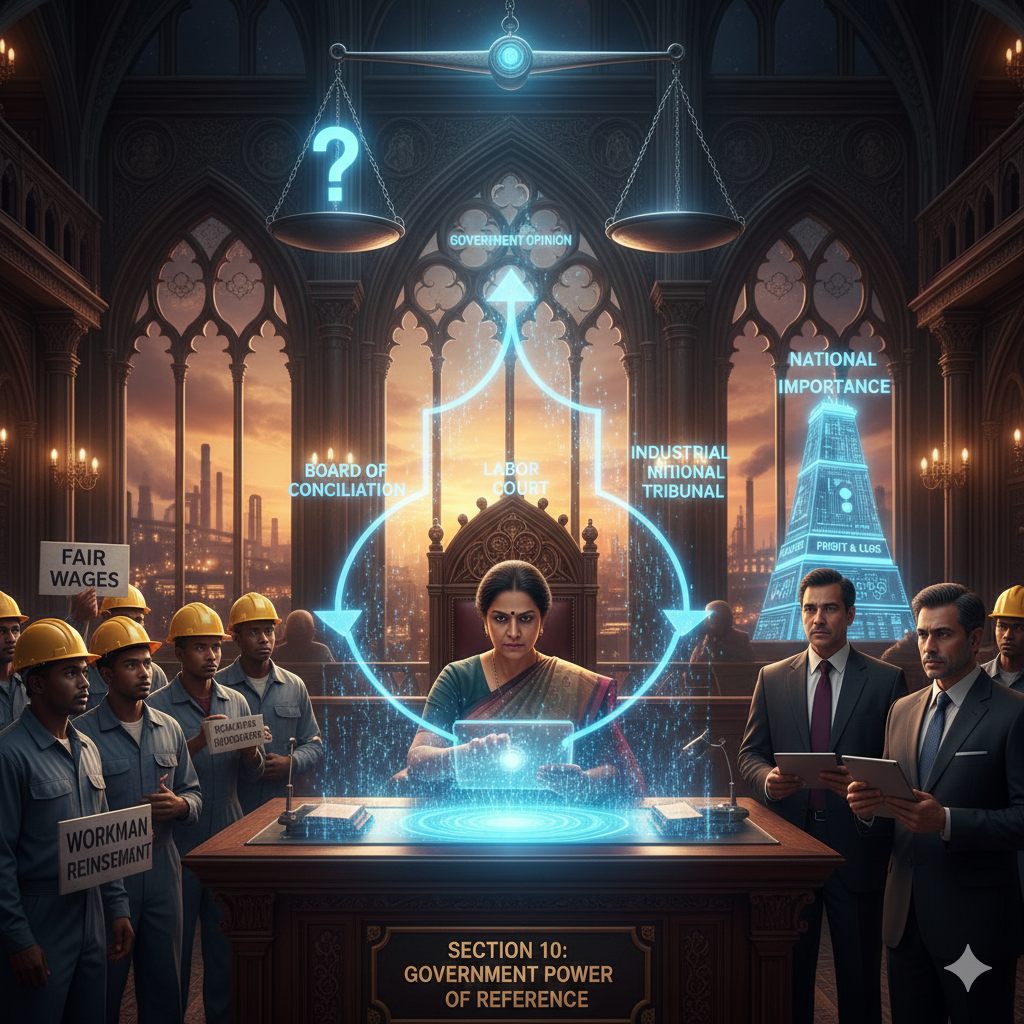
Section 10 is the “Gatekeeper” of the Industrial Disputes Act. It represents the precise moment where a private disagreement between an employer and a employee becomes a matter of State concern.
We will dissect this section through its four dimensions: the Administrative Power, the Types of Reference, the Limitations of the Government, and the Judicial Sparring regarding its potential for abuse.
The Core Philosophy: “The Power of Reference”
Under Section 10, the “Appropriate Government” (Central or State) has the discretionary power to refer an industrial dispute to a Board, Court, or Tribunal.
The key phrase in Section 10(1) is: “Where the appropriate Government is of opinion that any industrial dispute exists or is apprehended…”
Notice the word “Apprehended.” The Government doesn’t have to wait for a strike to happen. They can intervene based on a “feeling” or “intelligence” that a dispute might happen. Is this a proactive peace-keeping tool, or is it a “Big Brother” mechanism that allows the State to interfere in private business contracts prematurely?
The Four Channels of Reference
Section 10(1) allows the Government to refer the dispute to four different authorities, depending on the nature and severity of the conflict:
- To a Board of Conciliation (Sec 5): For promoting a settlement. (Rarely used).
- To a Court of Inquiry (Sec 6): For investigating any matter relevant to the dispute.
- To a Labour Court (Sec 7): If the matter relates to the Second Schedule (Individual rights, dismissals, etc.).
- To an Industrial Tribunal (Sec 7A): If the matter relates to the Second or Third Schedule (Wages, bonuses, retrenchment).
The Power Dynamics of Section 10(1)
This section is a “Double-Edged Sword” because it is an Administrative Act, not a Judicial one.
- No Duty to Hear: The Government is not required to hear the parties before making a reference. They can just “decide” to refer it.
- The “Prima Facie” Test: The Government only needs to see if a dispute exists. They are not supposed to decide who is right or wrong—that is the job of the Tribunal.
- Refusal to Refer: If the Government decides not to refer a dispute, it must record and communicate the reasons to the parties (Section 12(5)).
Section 10(3): The “Ceasefire” Clause
This is perhaps the most powerful part of the section. Once a dispute has been referred to a Court or Tribunal, the Government may issue an order prohibiting the continuance of any strike or lock-out which may be in existence.
- Example: 5,000 workers at an Oxygen Plant go on strike. The Government refers the dispute to a National Tribunal under Section 10(1A) and simultaneously uses Section 10(3) to order the workers back to work. If they refuse, the strike becomes illegal under Section 24.
Section 10A: Voluntary Reference to Arbitration
While Section 10 is “forced” by the Government, Section 10A allows the Employer and Workmen to agree voluntarily to refer their dispute to an Arbitrator.
- This agreement must be in writing.
- The Arbitrator’s award has the same legal force as a Tribunal’s award.
Extensive Example: The “Bonus War” at Zenith Tech
- The Dispute: Zenith Tech (an AI firm) refuses to pay the 20% bonus workers were expecting, citing “reinvestment in R&D.” The Union threatens a total digital blackout (strike).
- The Conciliation Failure: The Conciliation Officer (Sec 4) tries to mediate but the CEO refuses to budge. The Officer sends a Failure Report to the Government.
- The Reference (Section 10): The State Labor Department reviews the report. They realize that if Zenith Tech shuts down, the city’s transport app (which they manage) will crash.
- The Action: The Government issues an order: “We refer the dispute regarding ‘Bonus for the Year 2025-26’ to the Industrial Tribunal. Under Section 10(3), we hereby prohibit the proposed strike.”
- The Result: The Union must stop the strike. The “Handcuffs” of the Tribunal now take over the “Fog of War.”
Intellectual Sparring: The “Political Gatekeeper” Problem
As your sparring partner, I want to challenge the integrity of Section 10. In a truly fair system, wouldn’t parties have an automatic right to go to court? Why do they need the Government’s “permission” (a reference)?
1. The Political Filter
If a Union is affiliated with the Opposition Party, the Government might refuse to refer their dispute, effectively “starving” them of justice. Conversely, if a “Friendly” Employer is in trouble, the Government might refer the dispute just to use Section 10(3) to stop a legitimate strike. Is Section 10 a bridge to justice, or a political toll-booth?
2. The Delay Tactic
The Government often takes 6 to 12 months just to decide whether to refer a case. By then, the workman might have already run out of savings. The Supreme Court in State of Madras vs. C.P. Sarathy held that the Government’s power is very wide, but “Justice Delayed is Justice Denied.”
3. The “Appropriate Government” Confusion
In 2026, many companies operate entirely in the “Cloud.” If a server is in Mumbai, the headquarters is in Bangalore, and the workmen are in Delhi, which “Appropriate Government” gets the power under Section 10? This jurisdictional mess often leads to years of litigation before the actual dispute is even discussed.
The “2026 Rewrite” Challenge
If we were to update Section 10 for the modern age, we should consider:
- Automatic Reference: If Conciliation fails, the case should automatically move to a Tribunal within 48 hours, removing the Government’s “Opinion” (and political bias) from the equation.
- Digital Tribunals: Mandating that Section 10 references for “Digital/Gig Work” must be resolved within 30 days via online hearings.
The Sparring Verdict
Section 10 is the “Hand on the Valve.” The Government controls the flow of conflict into the legal system. While this prevents the Courts from being overwhelmed with frivolous cases, it gives the State an enormous, often unchecked, power over the livelihoods of millions.
Is it time to “Uber-ize” Section 10?
The Current Bottleneck: Section 10’s “Opinion”
Under the current Section 10, the Government may refer a dispute to a Tribunal if it is of the “opinion” that an industrial dispute exists.
- The Problem: This “opinion” is a black box. It allows for political favoritism, bribery, and endless administrative delay. If the Government doesn’t want to upset a powerful industrialist, they simply sit on the file, and the workman has no “Handcuffs” (Section 7) to use.
- The Proposed Solution: A Smart Contract on a blockchain.
- Input A: Conciliation Failure Report (Section 12(4)) uploaded by the Officer.
- Input B: Expiry of a 14-day mandatory “cooling-off” period.
- Outcome: Automatic, immutable reference to the Industrial Tribunal. No minister, no bureaucrat, no “opinion.”
2. The Argument FOR: “Justice at the Speed of Code”
- Neutrality: A smart contract doesn’t have a political party. It treats a trillion-dollar tech giant and a lone delivery partner with the same algorithmic indifference.
- Elimination of Rent-Seeking: You can’t bribe an if-then-else statement. It eliminates the “middleman” who profits from delaying the reference.
- Certainty: Both parties know exactly when the “hot war” (litigation) begins. This encourages Good Faith Bargaining during conciliation because the parties know they can’t hide behind a slow-moving government.
3. The Sparring Counter-Point: The “Unintended Explosion”
Here is where I challenge your “Uber-ization.” The Government’s “Opinion” in Section 10 acts as a Stabilizer.
A. The Floodgate Problem
If every failed mediation automatically triggered a Tribunal case, the judicial system would collapse under the weight of millions of trivial disputes. The Government currently “filters” out frivolous cases to keep the Tribunals functional. Can a smart contract distinguish between a “genuine struggle for rights” and a “nuisance lawsuit” designed to extort a settlement?
B. The Loss of Political Compromise
Sometimes, a dispute shouldn’t go to court. A court produces a Winner and a Loser. The Government’s delay is often a tactic to force the parties back to the table to find a Win-Win.
The Sparring Point: If a smart contract automatically triggers a trial in a sensitive industry (like the Power Grid or Healthcare), it might lock the parties into an adversarial battle when the nation needs a diplomatic solution. Is “Automatic Justice” worth the risk of “Automatic Instability”?
C. The “Garbage In, Garbage Out” Risk
A smart contract is only as good as its data source. If the Conciliation Officer (a human) is biased, they can simply delay uploading the “Failure Report.” You’ve moved the corruption from the Minister’s office to the Data Entry clerk’s desk.
4. The “Hybrid” 2026 Model
Perhaps we don’t need a total replacement, but an “Algorithmic Nudge.” * The Rule: If the Government does not form an “opinion” within 45 days of a failure report, the Smart Contract triggers an Automatic Deemed Reference. * The Result: The Government keeps its “Diplomatic Tier” power for a limited window, but if they fail to act, the “Handcuffs” of the Tribunal are applied automatically.
The Sparring Verdict
”Uber-izing” Section 10 would be a victory for Rule of Law but a nightmare for Industrial Peace. The Government uses Section 10 as a “muffler” to keep the noise of class conflict from deafening the economy. If you remove the muffler, the engine might run more efficiently, but the noise might start a riot.
The real question: In 2026, do we trust the “Wisdom of the Bureaucrat” or the “Efficiency of the Code”? If the Code makes a mistake, who do we protest against? You can’t march to the gates of a Smart Contract with a placard.
Describe
This is the “Black Box” paradox of modern governance. If we replace the “Wisdom of the Bureaucrat” with the “Efficiency of the Code,” we aren’t just changing how we make decisions—we are changing the nature of Political Accountability.
The Death of the “Placard”
In 1947, if a labor commissioner refused to refer your case, you could gather 500 workers, march to their office, and demand a meeting. This is a Human-to-Human Pressure Loop.
- The Smart Contract Wall: A line of code doesn’t feel shame, fear, or political pressure. If a smart contract denies your referral because of a logic error or a missing data point (an “Oracle” failure), there is no gate to march to. You can’t shout at a blockchain.
- The “Nobody’s Fault” Defense: In 2026, we are seeing the rise of “Distributed Liability.” The developer says it’s a data error; the data provider (Oracle) says it’s a network error; the Government says it’s the “system’s” error. When everyone is responsible, no one is.
2. The Trap of “Algorithmic Finality”
The current Section 10 is messy, but its messiness allows for Mercy.
- The Bureaucrat’s Wisdom: A human official might say, “Technically, this isn’t a dispute, but if I don’t refer it, this town’s economy will collapse from a wildcat strike.” They can override the rules for the sake of the Social Fabric.
- The Code’s Rigidity: A smart contract is binary. If you don’t meet the is_workman criteria by 0.01%, the contract terminates your claim. It eliminates Equity (fairness) in favor of Consistency (logic).
3. Who Do We Protest Against?
If the “Universal Code” of 2026 fails, the protest shifts from the Street to the Audit.
- The “Right to an Explanation”: Protests will no longer be about “Higher Wages” but about “Data Transparency.” We will see “Strike by Data”—where workers withhold their data inputs to blind the company’s AI.
- The Rise of “Techno-Unions”: Unions of the future will need more Coders than Orators. Their job will be to “audit” the Government’s smart contracts for bias.
- Vicarious Liability (The Human-in-the-Loop): International law in 2026 (like the EU AI Act and emerging Indian standards) is moving toward the “Precautionary Principle.” This mandates that for every automated decision, there must be a Named Human Official who is legally liable for the code’s “mistake.”
4. Sparring Point: Is the Bureaucrat actually “Wise”?
Let’s be honest: The “Wisdom of the Bureaucrat” has often been the “Silence of the Bribe.”
- The reason we want the Code is because we are tired of the Corruption and Uncertainty of human judgment.
- The Trade-off: Are you willing to accept a system that is 100% “Fairly Cold” (the Code) to escape a system that is “Warmly Corrupt” (the Bureaucrat)?
The Sparring Verdict
We should never trust the Code to be “Pro-Worker,” just as we never trusted the Bureaucrat to be “Pro-Justice.” Both are tools of power.
In 2026, the real Industrial Dispute won’t be between “Labour and Capital,” but between “Humans and Hyper-Efficiency.” If we march with placards, they should say: “GIVE US THE KEY TO THE CODE.”
Summary: The Accountability Shift
| Era | Target of Protest | Method of Protest | Nature of “Truth” |
|---|---|---|---|
| 1947 (IDA) | The Supervisor / Minister | Strikes & Processions | Subjective/Negotiable |
| 2026 (Algorithmic) | The Developer / Data Set | Audits & “Data Sabotage” | Objective/Mathematical |
The Kicker: If the Smart Contract makes a mistake that leads to a mass layoff, the only way to “protest” is to have a “Kill Switch” built into the law.
How the new Industrial Relations Code (2020) has already tried to “speed up” this process,
The Industrial Relations Code (2020)—which essentially “upgrades” the 1947 Act—is the government’s attempt to trade in a slow, manual gearbox for a semi-automatic transmission. It tries to address the exact “bottleneck” problem of Section 10 by introducing statutory timelines and removing some of the government’s discretionary “Gatekeeper” powers.
Here is how the new Code attempts to “speed up” the process and where it stops short of your “Smart Contract” ideal.
1. The “Direct Access” Upgrade (Removing the Gatekeeper)
Under the 1947 Act, an individual worker often needed the government to “refer” their case to a court.
- The New Rule: In cases of discharge, dismissal, or termination, an individual worker can now approach the Tribunal directly after 45 days of applying for conciliation.
- The “Speed” Factor: You no longer have to wait for a bureaucrat to form an “opinion” (Section 10). If the clock hits day 46 and the dispute isn’t settled, the worker has a “Direct Pass” to the judge.
2. Mandatory “Statutory Timelines”
The Code injects a stopwatch into every stage of the dispute:
- Grievance Redressal Committee (GRC): Must resolve internal complaints within 30 days.
- Conciliation Officer: Must submit their report within 45 days (compared to the often-ignored “14 days” in the old Act).
- Tribunal Adjudication: The Code sets a goal for the Tribunal to decide cases within one year.
3. The “Two-Member” Tribunal (Specialization)
The 1947 Act’s Tribunals (Section 7A) usually had one judge. The 2020 Code introduces two-member Tribunals (one Judicial and one Administrative).
- The Logic: By including an “Administrative Member” (usually a senior government official), the court doesn’t just look at the law; it looks at the economic and industrial reality. This is intended to prevent “legalistic” delays and ensure decisions are grounded in the speed of business.
4. Universal Strike Notice (The “Cooling-Off” Expansion)
In the 1947 Act, only “Public Utility Services” (like water or electricity) needed to give a 14-day notice.
- The 2020 Change: ALL industrial establishments now require a 14-day notice before a strike.
- The Sparring Point: The government argues this “speeds up” resolution by forcing parties to talk before production stops. Critics argue this is just an “Algorithmic Delay” that gives employers 14 days to prepare for or break the strike.
Intellectual Sparring: Is this “Speed” or just “Shifted Paperwork”?
As your sparring partner, I have to ask: Does a 90-day deadline matter if there are no consequences for missing it?
- The “Goal” vs. the “Requirement”: The 1-year limit for Tribunals is a “goal,” not a “mandatory cut-off.” Without a penalty (like the smart-contract “automatic judgment” we discussed), judges can and will continue to grant adjournments.
- The Case Overload: By giving individual workers “Direct Access,” the number of cases in the Tribunal might triple. If we don’t triple the number of judges, “Direct Access” just means you get to wait in a faster line to reach a slower room.
- The “Deemed Reference” Myth: While the Code makes it easier to bypass the government for termination cases, collective disputes (like wage hikes or bonuses) still largely require government intervention. The “Opinion” bottleneck remains for the biggest fights.
Comparison: 1947 Act vs. 2020 Code
| Feature | Industrial Disputes Act, 1947 | Industrial Relations Code, 2020 |
|---|---|---|
| Referral Power | Government is the absolute Gatekeeper. | Individual workers get “Direct Access” for termination. |
| Strike Notice | Only for Public Utility Services. | Mandatory for all industries. |
| Conciliation Time | 14 days (rarely followed). | Strict 45-day reporting limit. |
| Tribunal Structure | Single Judicial Member. | Dual Members (Judicial + Admin). |
The 2020 Code is “Section 10 Lite.” It removes the government’s power for individual dismissals but keeps the “Opinion” trap for collective bargaining. It’s a step toward your “Smart Contract” vision, but it still keeps a human hand on the override switch.
The Kicker: If the government truly wanted to “speed up” the process, they would have implemented Mandatory Arbitration centers instead of just “renaming” the old Tribunals.

7 Comments
you have a great blog here! would you like to make some invite posts on my blog?
I haven’t checked in here for some time because I thought it was getting boring, but the last several posts are great quality so I guess I will add you back to my daily bloglist. You deserve it my friend 🙂
0um3dd
Nice post. I learn something more challenging on different blogs everyday. It will always be stimulating to read content from other writers and practice a little something from their store. I’d prefer to use some with the content on my blog whether you don’t mind. Natually I’ll give you a link on your web blog. Thanks for sharing.
WONDERFUL Post.thanks for share..more wait .. …
I would like to show my appreciation to this writer just for bailing me out of this problem. Just after scouting throughout the the web and getting recommendations which are not beneficial, I figured my life was done. Existing devoid of the strategies to the issues you have solved all through your entire report is a serious case, and those that would have in a negative way affected my career if I hadn’t encountered the website. Your personal knowledge and kindness in touching all areas was helpful. I’m not sure what I would’ve done if I hadn’t come across such a stuff like this. I can also at this time look forward to my future. Thank you very much for this professional and results-oriented guide. I won’t hesitate to recommend the sites to any individual who desires counselling on this subject.
After all, what a great site and informative posts, I will upload inbound link – bookmark this web site? Regards, Reader.