
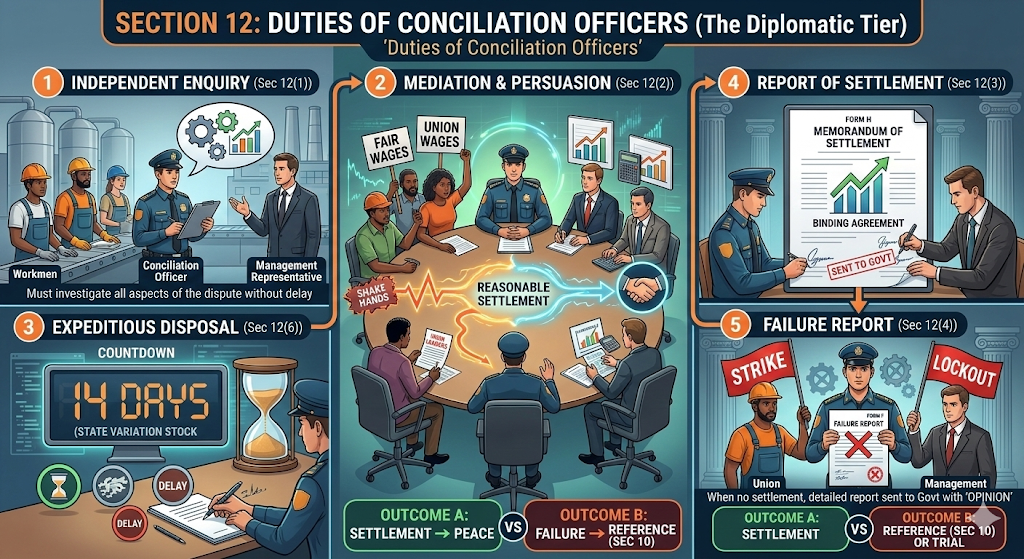
When we established the authorities under the Act (Sections 4 and 5) as the “Diplomatic Tier,” Section 12 became the indispensable operating manual for that diplomacy.
This section does not just list duties; it is a meticulously constructed procedural blueprint designed to force the two most adversarial parties in capitalism—Capital (Management) and Labor (Workers)—to sit in the same room and find a rational path to peace.
1. Introduction: The “Mediator’s Mandate”
Section 12 is arguably the most dynamic section in the entire Industrial Disputes Act. While the Tribunals (Section 7) wait for the fight to come to them, the Conciliation Officer (appointed under Section 4) is legally required to actively seek out and “disarm” the conflict.
The overarching philosophy is simple: A bad settlement reached through Section 12 is always better for the industry than a good award from a Tribunal. Why? Because the parties chose the settlement, whereas the award is forced upon them. Section 12 is the statutory machinery that forces choice.
2. Statutory Framework: The Five Sequential Phases
Section 12 is divided into subsections that represent a strict chronological progression. A standard conciliation proceeding is a five-phase journey.
Phase 1: The Mandate (Subsection 1)
“Where any industrial dispute exists or is apprehended, the Conciliation Officer shall, where the dispute relates to a public utility service and a notice of strike or lock-out under section 22 has been given, and may, in any other case, hold conciliation proceedings in the prescribed manner.”
The Duty to Intervene:
This subsection establishes the primary “gatekeeping” function. It draws a clear line between Mandatory and Discretionary intervention.
- Mandatory Intervention (Public Utility Services): If the industry is a public utility (e.g., electricity, water, railways—Item 1 of the First Schedule) and a formal Section 22 Notice of strike or lockout has been given, the officer HAS no choice. They must intervene.
- Discretionary Intervention (Other Cases): If it’s a standard private industry (like a textile mill), and there is an apprehended dispute, the word used is “MAY.” This is the ultimate Administrative Prerogative. The officer can decide whether the conflict is “worthy” of formal state-sponsored mediation.
The Prescribed Manner:
Proceedings are not a “free-for-all.” They are governed by the Rules of the respective State or Central Government.
- Example of Phase 1: A private hospital (a public utility in some states) receives a 14-day strike notice from its nurses demanding higher overtime pay. The Conciliation Officer must immediately register the case and schedule the first hearing, overriding any personal schedule or lack of “apprehension.”
Phase 2: The Investigation and Persuasion (Subsection 2)
“The Conciliation Officer shall, for the purpose of bringing about a settlement of the dispute, without delay, investigate the dispute and all matters affecting the merits and the right settlement thereof and may do all such things as he thinks fit for the purpose of inducing the parties to come to a fair and amicable settlement of the dispute.”
The Dual Duty:
This subsection is the core of the officer’s work. It merges two often conflicting roles: the Investigator and the Diplomat.
- The Duty to Investigate: The officer cannot simply listen. They must actively “investigate.” This means:
- Reading the Charter of Demands (the “Why”).
- Reading the Management’s formal reply (the “Why Not”).
- Visually inspecting the workplace if needed.
- Reviewing payroll data or financial balance sheets.
- The Power to Induce (The Diplomat): The words “may do all such things as he thinks fit” give the officer extraordinary leeway. This is the “Persuasion Paradox.” How does a “Public Servant” (without penal power) “induce” two powerful, stubborn parties?
The Persuasion Methods:
- “Shuttle Diplomacy”: Meeting separately in two different rooms ( caucus ) to allow each side to vent without escalating the tension.
- “Reality Checking”: Explaining to the Union the probability of loss at a Tribunal, or explaining to the Employer the daily cost of a 100% lockout.
- “The Golden Bridge”: Suggesting creative compromises that the parties hadn’t thought of, allowing them both to “save face.”
- Capital needs predictability.
- Section 18(3): A 12(3) settlement is legally binding on all workmen of the industry, including those who were not present or who did not vote for it, and even those who join the company later. It is a Collective Contract enforced by the state.
- Strike/Lockout Prohibition: For the entire duration of the settlement (usually 3 years), the workmen are legally prohibited from going on a strike regarding any issue covered by the agreement.
- A list of all meetings held.
- A summary of the demands made.
- A summary of the arguments presented by both sides.
- Crucially: The Officer’s “Opinion” on the failure.
- “In my opinion, the Union is being completely unreasonable in light of the company’s clear bankruptcy.” (Hint to Govt: Do NOT refer this to a Tribunal).
- “In my opinion, the Management is clearly hiding its true profits and refused to disclose essential data during the proceeding.” (Hint to Govt: Must refer to Tribunal).

6 Comments
good post.Ne’er knew this, regards for letting me know.
hey there and thank you for your information – I have certainly picked up something new from right here. I did however expertise some technical points using this website, since I experienced to reload the site a lot of times previous to I could get it to load properly. I had been wondering if your web hosting is OK? Not that I am complaining, but slow loading instances times will often affect your placement in google and could damage your quality score if ads and marketing with Adwords. Well I am adding this RSS to my e-mail and could look out for much more of your respective fascinating content. Make sure you update this again soon..
I’m still learning from you, but I’m trying to achieve my goals. I absolutely love reading all that is posted on your site.Keep the stories coming. I loved it!
It’s truly a great and useful piece of information. I’m happy that you just shared this helpful info with us. Please stay us up to date like this. Thank you for sharing.
I’ve been surfing online greater than 3 hours today, but I by no means found any attention-grabbing article like yours. It’s lovely price enough for me. Personally, if all site owners and bloggers made excellent content as you did, the internet will likely be much more useful than ever before. “No nation was ever ruined by trade.” by Benjamin Franklin.
Enjoyed reading this, very good stuff, thankyou. “A man does not die of love or his liver or even of old age he dies of being a man.” by Percival Arland Ussher.