
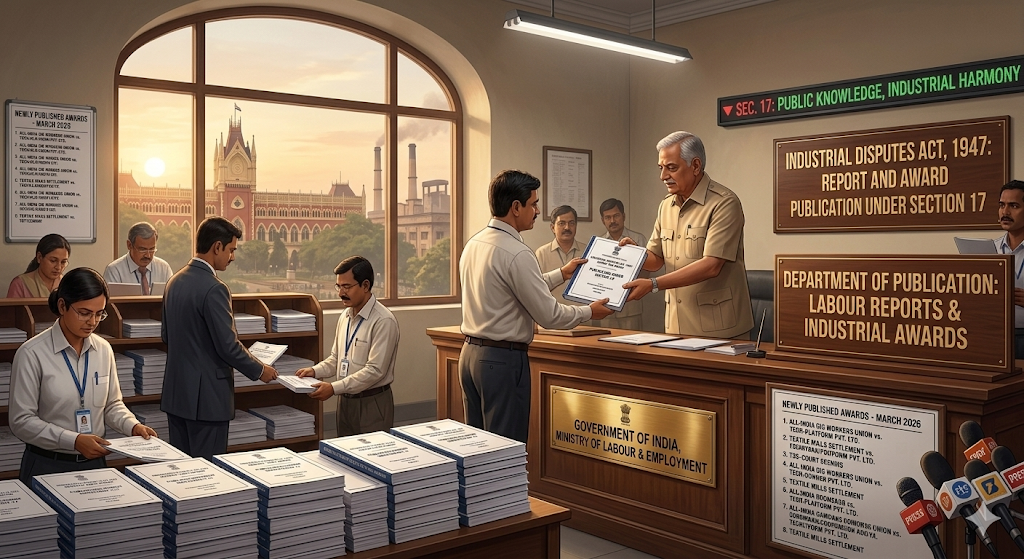
The Statutory Mandate: Moving from “Private Award” to “Public Law”
Section 17(1) of the Industrial Disputes Act is deceptively simple. It states that:
- The Subject: Every report of a Board or Court, and every award of a Labour Court, Tribunal, or National Tribunal.
- The Timeframe: Must, within a period of thirty days from the date of its receipt by the Appropriate Government,
- The Action: Be published by that Government in such manner as it thinks fit.
The Philosophy of Section 17
Before publication, an “Award” is merely a piece of paper lying on a judge’s desk. It has no more legal power than a strongly worded letter. The act of “Publication” is the state’s official “Fiat” (Let it be done). It is the moment a private dispute resolution becomes part of the public legal record of the country.
The Sparring Point: In a world of digital governance, is “30 days” a reasonable timeframe? If an algorithm in 2026 decides a dispute (via a “Smart Tribunal”), should publication not be instantaneous? Why give the Government 30 days to sit on a decision?
2. The Timeline of Finality (Section 17A)
This is where the law gets gritty. Section 17 must be read alongside Section 17A, which dictates when the Award actually becomes “Enforceable.”
- T + 0: The Award is signed by the Judge/Tribunal.
- T + 7 (Estimated): The Appropriate Government “receives” the physical copy of the award.
- T + 37 (Maximum): The Government must publish the Award (Section 17).
- T + 67: Thirty days after the publication, the Award becomes “Enforceable”.
The “Voidable” Period
This 30-day window after publication is critical. It is the period during which the affected parties (Employer or Union) decide whether to comply or to challenge the award in a higher court (High Court or Supreme Court). If no challenge is made by Day 67, the Award has the full force of a civil decree.
3. The “State Emergency” Escape Valve (Section 17A[1])
This is one of the most controversial elements of the Industrial Disputes Act. The Appropriate Government (Central or State) can intercept and suspend the enforceability of an award before the 30-day “Finality” period expires.
The Conditions for Interception
The Government can only exercise this power if they believe the enforceability of the award:
- Would be inexpedient on public grounds affecting the national economy.
- Would negatively affect social justice. (The State can use this to stop an award that gives too much to workers if they believe it would bankrupt the industry).
The Procedure for Rejection
If the Government intercepts the award, they must:
- Make an order rejecting or modifying the award.
- On the first available opportunity, lay the rejected/modified award before the Legislature (State Assembly or Parliament).
The Result: The Award only becomes enforceable if the Legislature passes a resolution approving it. This transforms a judicial decision into a political one.
4. The Sparring Challenge: Is Section 17 “Final”? (The “New War” Argument)
We often mistake “Publication” for “Resolution.” As your sparring partner, I want to challenge this illusion. In 2026, Section 17 is rarely the end of the dispute; it is usually just the Formal Declaration of War.
A. The “Writ” Loophole
The Industrial Disputes Act (Section 17[2]) states that an award is “final and shall not be called in question by any Court in any manner whatsoever.”
The Real Truth: This clause is practically meaningless. While a lower court can’t question it, the parties almost always file a Writ Petition under Article 226 of the Constitution in the High Court. They argue the Tribunal made an “Error of Law” or violated “Natural Justice.” The moment the High Court issues a “Stay Order”, the “Final” Award (published under Sec 17) is suspended for years. Does a system of “Finality” that can be instantly stayed by a superior court actually provide “Justice,” or does it just provide another administrative hurdle?
B. The Enforcement Crisis (Section 33C)
Even if an Award is published and becomes final, the Government (which published it) rarely helps enforce it.
- Example: If a Tribunal awards workers ₹10 Crores in back-wages, the Employer might simply refuse to pay.
- The Worker’s Nightmare: The worker then has to file a new case under Section 33C (Recovery of Money) to calculate the exact amount and then go to a Civil Court to attach the company’s assets. Is an Award “Final” if the worker has to start a whole new litigation process just to get paid?
C. The 2026 Algorithmic Problem
If a “Tribunal” in 2026 is an AI system using machine learning to parse data, what does “Publication” (Section 17) even mean? Do you publish the AI’s final sentence, or do you have to publish its entire logical proof? If the logic (the neural network’s weights) is proprietary, you can’t publish it, meaning the “Award” fails the test of Transparency required by Section 17.
5. Extensive Example: The Case of “Quantum Logistics”
Imagine a massive strike at “Quantum Logistics,” the backbone of an e-commerce giant.
- The Case: The National Tribunal (Section 7B) gives an Award in favor of the workers, granting them “Workman” status (Sec 2s) and 40% wage hikes.
- T+0 (June 1st): The Award is signed. It is a “Secret” decision.
- T+30 (July 1st): The Central Government receives the Award.
- The State Intervention: The Tech Industry lobbies the Government, claiming that publishing this award will crash the digital economy (the “Public Grounds” exception).
- T+60 (July 31st): The Government does not publish the award. Instead, they issue an order rejecting it under Section 17A(1). They present the rejected award to Parliament.
- The Outcome: If Parliament approves the rejection, the “Final” judicial decision is nullified. If Parliament does nothing, the original Award automatically becomes enforceable 90 days from the rejection date. The workers are left waiting in a political “limbo.”
Comparison of Finality Mechanisms
| Mechanism | Section 17 Publication | Writ Petition (Art 226) | Execution (Sec 33C) |
|---|---|---|---|
| Action | Govt “Notifies” | Party “Challenges” | Party “Recovers” |
| Logic | State Authorization | Superior Review | Financial Coercion |
| Result | Triggers 30-Day Countdown | Pauses/Stays the Award | Collects the Debt |
| Finality? | Theoretical | Procedural | Substantive |
Section 17 is the “Seal of Sovereign Approval.” Without it, an award is just an opinion. But it is also the mechanism that gives the State a final, dangerous “Kill Switch” (Section 17A).
In 2026, we must decide: Do we trust the “State” to publish and enforce awards blindly, or should we replace the Government’s role with an Immutable Blockchain? If an “Algorithmic Tribunal” (as discussed in earlier sections) signs an award, it should automatically be published to a decentralized, un-hackable public ledger, completely bypassing the “Appropriate Government” and its 30-day “Political Fog.”

3 Comments
Youre so cool! I dont suppose Ive read anything like this before. So nice to find someone with some original ideas on this subject. realy thanks for starting this up. this website is one thing that’s needed on the internet, somebody with a little originality. useful job for bringing one thing new to the web!
I’ve been absent for a while, but now I remember why I used to love this website. Thanks, I’ll try and check back more frequently. How frequently you update your web site?
Hey there, I think your website might be having browser compatibility issues. When I look at your website in Opera, it looks fine but when opening in Internet Explorer, it has some overlapping. I just wanted to give you a quick heads up! Other then that, terrific blog!