
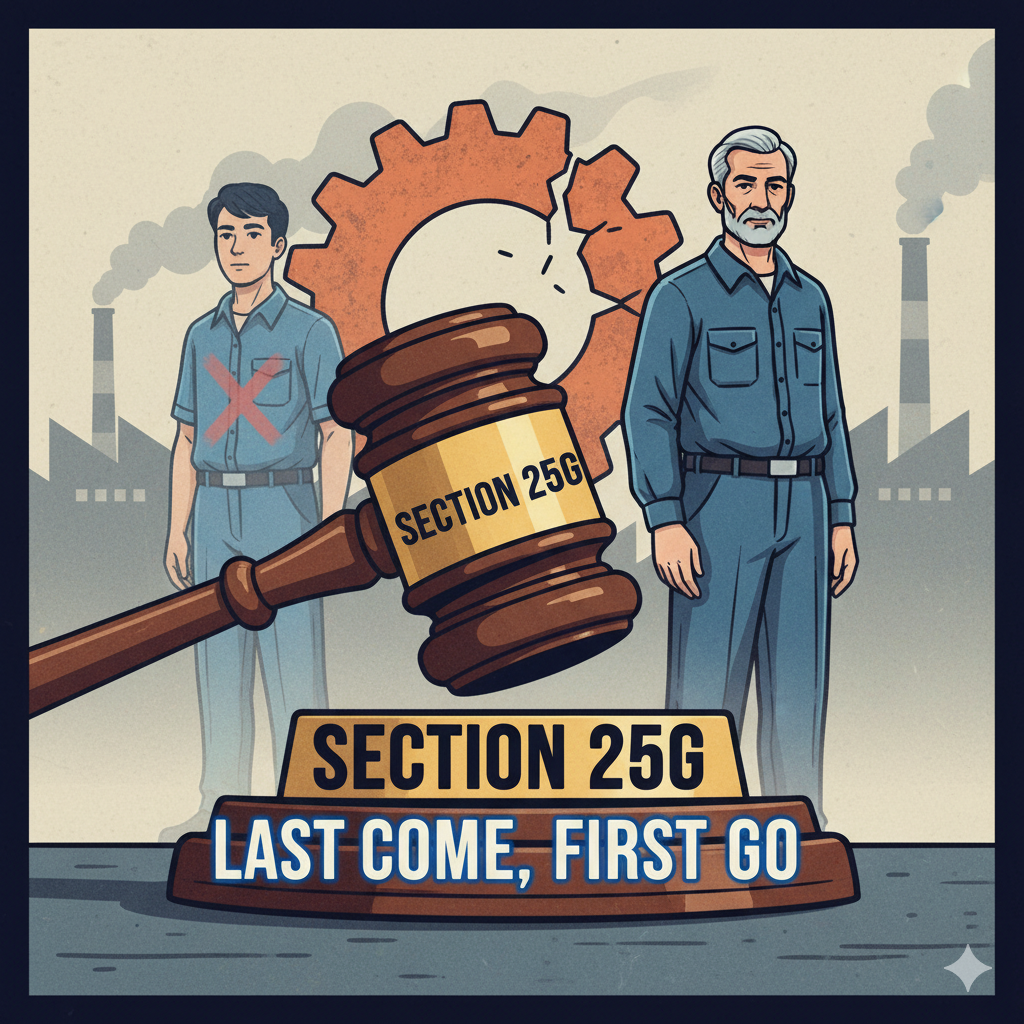
Section 25G of the Industrial Disputes Act, 1947, we must look beyond the simple “Last Come, First Go” (LCFG) slogan. This section represents a critical intersection of management prerogative, social justice, and statutory rigidity.
Below is an exhaustive analytical breakdown of Section 25G, covering its mechanics, judicial interpretations, exceptions, and the inherent logical tensions it creates in a modern economy.
Section 25G: The Anatomy of “Last Come, First Go”
1. The Statutory Language
Section 25G states:
“Where any workman in an industrial establishment, who is a citizen of India, is to be retrenched and he belongs to a particular category of workmen in that establishment, the employer shall ordinarily retrench the workman who was the last person to be employed in that category, unless for reasons to be recorded the employer retrenches any other workman.”
Key Components of the Definition:
- Industrial Establishment: The rule applies specifically to a defined unit or undertaking.
- Category Specificity: Retrenchment is not across the whole company, but within a “particular category” (e.g., all Welders, all Typists).
- The “Ordinarily” Caveat: It is not an absolute rule; it is a default rule that can be bypassed if reasons are documented.
- Citizenship: Interestingly, the protection specifically mentions “citizens of India.”
2. The Philosophy of LCFG: Social Justice vs. Meritocracy
The primary objective of Section 25G is to prevent victimization and nepotism. Without this rule, an employer facing a downturn might be tempted to fire a senior employee who earns a higher wage or is active in a trade union, while keeping a junior, more “compliant” worker.
The Logic of Seniority:
- The Reward for Loyalty: Longer service equates to a deeper vested interest in the industry.
- Objective Benchmark: Seniority is a mathematical fact, whereas “performance” is often a subjective management assessment.
- Ease of Re-employment: A junior worker is statistically more likely to find new employment than a veteran who has spent 20 years specializing in a single machine.
3. Essential Conditions for Application
For a workman to invoke Section 25G during a dispute, four conditions must be satisfied:
A. The “Workman” Status
The person must fall under the definition of Section 2(s). If the person is in a purely managerial or administrative role, Section 25G does not apply.
B. The Same “Industrial Establishment”
If a company has a branch in Mumbai and a branch in Delhi, they are generally treated as separate establishments unless there is “functional integrality” (shared accounts, inter-transferability of staff, etc.). A junior in Mumbai cannot be fired to save a senior in Delhi unless the units are legally seen as one.
C. The “Category” Rule
This is the most litigated aspect. The employer must prepare a Seniority List for each specific category.
- Example: If an employer needs to cut two clerks, they must look at the list of all clerks. They cannot fire a senior clerk and keep a junior peon just because they like the peon better.
D. The Seniority List (Rule 77)
Under the Industrial Disputes (Central) Rules, 1957, the employer is mandated to publish a seniority list at least seven days before the date of retrenchment. Failure to do so often leads courts to set aside the retrenchment as “mala fide.”
4. Exceptions: When “Last Come, First Go” Fails
The word “ordinarily” in the statute is a safety valve for employers. An employer can deviate from LCFG if:
- Efficiency/Special Skill: If a junior workman possesses a unique technical skill that the senior lacks, and that skill is essential for the survival of the remaining business, the senior may be retrenched first.
- Reliability and Conduct: If a senior workman has a record of chronic indiscipline or poor physical health (documented and proven), the employer may justify their departure over a junior.
- Agreement to the Contrary: If there is a specific contract or settlement with the Union that dictates a different order of retrenchment, that may supersede the general rule.
Crucial Requirement: The reasons for deviation must be recorded in writing at the time of retrenchment. Post-hoc justifications in court usually fail.
5. Consequences of Non-Compliance
If an employer violates Section 25G (e.g., keeps a junior and fires a senior without valid, recorded reasons), the retrenchment is considered void ab initio (invalid from the start).
- Reinstatement: The court will typically order the workman to be taken back.
- Back Wages: The employer may be liable to pay full back wages from the date of illegal retrenchment to the date of reinstatement.
- Continuity of Service: The workman is treated as if they never left, maintaining their seniority for future benefits.
6. The Intellectual Sparing Match: Challenging the Assumption of LCFG
As your intellectual sparring partner, I must challenge the “truth” that LCFG is the most “just” system. Let’s test the logic of Section 25G against modern economic realities.
Counterpoint 1: The “Mediocrity Trap”
Section 25G treats labor as a commodity rather than human capital. By forcing an employer to keep the most senior person, the law effectively punishes the “Rising Star”—the highly efficient, innovative junior worker—in favor of the “Steady Laggard.” Does this not incentivize mediocrity in the Indian industrial workforce?
Counterpoint 2: The Stifling of Modernization
If an industry wants to pivot from manual labor to automation, the senior staff (who may be resistant to or incapable of learning new software) are protected, while the tech-savvy juniors are purged. This creates a “technological debt” that can lead to the entire establishment becoming uncompetitive and eventually closing down—resulting in everyone losing their jobs.
Counterpoint 3: Discrimination against Youth
While the Act seeks to protect the vulnerable, it creates a structural barrier for the youth. In a country with a massive “youth bulge,” a law that mandates firing the youngest first ensures that the newest entrants to the job market bear the entire brunt of economic volatility.
7. Judicial Trends: The Shift in Interpretation
In the early decades (1950s–1980s), the Supreme Court of India was strictly pro-worker, often viewing any deviation from 25G with extreme suspicion. However, in the post-liberalization era (1991–Present), there has been a subtle shift.
- The “Loss of Confidence” Doctrine: Courts have occasionally allowed employers to bypass seniority if they can prove a total loss of confidence in a senior employee, even if it falls short of a full disciplinary inquiry.
- Substantial Compliance: If an employer makes a minor clerical error in the seniority list but follows the spirit of LCFG, courts are now less likely to grant “automatic reinstatement with full back wages,” sometimes opting for “compensation in lieu of reinstatement.”
8. Comparison: Section 25G vs. Section 25N
It is vital to distinguish between the “General Provisions” and “Special Provisions”:
- Section 25G: Applies to smaller establishments (Chapters VA).
- Section 25N: Applies to large establishments (100+ or 300+ workmen depending on the state). Under 25N, you don’t just follow LCFG; you need prior permission from the government.
Summary Table: The LCFG Checklist
| Feature | Requirement |
|---|---|
| Applicability | To all industrial establishments (unless specific exemptions apply). |
| Scope | Within the “same category” of workmen. |
| Prerequisite | Publication of a Seniority List (Rule 77). |
| Default Action | Retrench the person with the shortest length of service. |
| Deviation | Permissible only if reasons are recorded in writing. |
| Burden of Proof | On the employer to justify why a senior was let go. |
Conclusion: The Double-Edged Sword
Section 25G is a shield against the “hire and fire” culture that can lead to exploitation. However, its rigidity often acts as a weight on industrial efficiency. For the employer, the “recorded reasons” for deviation must be airtight, evidentiary, and objective. For the workman, 25G remains the most potent tool to ensure that their years of loyalty aren’t discarded the moment a cheaper, younger alternative arrives.
Analyze a specific court case (like Harjinder Singh v. Punjab State Warehousing Corp) to show how these rules are applied in real-time disputes? Section 25G: Procedure for retrenchment (Last Come, First Go).
To understand how the theory of the Industrial Disputes Act (IDA) translates into the harsh reality of employment termination, the case of Harjinder Singh v. Punjab State Warehousing Corp (2010) is a landmark study. It specifically highlights the strict application of Section 25G.
The Case Context
Harjinder Singh was a daily-wage worker employed in 1986. In 1992, the Corporation terminated his services. The Corporation claimed it was a simple retrenchment, but Singh challenged it on the grounds that the “Last Come, First Go” rule was ignored.
1. Application of Section 25G: The “Last Come, First Go” Rule
Section 25G dictates that when an employer retrenches workmen, they must retrench the person who was the last to be employed in that specific category, unless there are written reasons to do otherwise.
- The Dispute: The Corporation argued that they didn’t violate the rule because they looked at the seniority list of only one specific project/branch.
- The Supreme Court’s Logic: The Court ruled that “Industrial Establishment” should be viewed broadly. If an employer has multiple branches, they cannot cherry-pick a junior in Branch A to keep while firing a senior in Branch B, provided they belong to the same category of workers.
- The “Worker” Identity: The Court emphasized that even a daily-wager or contractual worker is a “workman” under Section 2(s) and is entitled to the protections of Section 25G.
2. The Intersection with Section 25H
The court also looked at Section 25H (Re-employment). If the Corporation hired new people shortly after firing Singh, they violated his preferential right to be re-employed. In this case, the lack of a proper seniority list made the retrenchment void ab initio (invalid from the start).
3. Intellectual Sparing: Challenging the “Social Justice” Doctrine
While the judgment was a victory for Singh, it brings up a critical point for our “sparing” session regarding the economic viability of labor laws:
The Counterpoint: By forcing a “Last Come, First Go” rule, the law prioritizes tenure over talent. If a company is in financial distress, Section 25G prevents them from keeping their most productive junior employee and firing an underperforming senior one. Does this rule protect the worker at the expense of the industry’s survival?
Summary of Legal Deviations in Harjinder Singh:
| Requirement | Court’s Finding |
|---|---|
| Continuous Service | Singh proved 240 days of work (Section 25B). |
| Notice/Pay | Corporation failed to provide 1-month notice or pay in lieu (Section 25F). |
| Seniority Logic | Corporation failed to prove that Singh was the most junior in the entire establishment (Section 25G). |
The Result: The Supreme Court set aside the High Court’s previous order (which had only granted compensation) and ordered full reinstatement with back wages, emphasizing that the IDA is a piece of “Social Welfare Legislation” that must be interpreted in favor of the weak.
Analyze the court’s definition of “Social Justice” in this case, or shall we look at how Section 33C is used to actually recover the “Back Wages” the court ordered?
The concept of “Social Justice” is the philosophical engine of the Industrial Disputes Act, but Section 33C is the rusty gearbox that often fails to deliver the promised power to the workman.
1. The Judicial Definition of “Social Justice”
In the landmark case of JK Cotton Spinning and Weaving Co. Ltd v. Labour Appellate Tribunal, the Supreme Court famously argued that “Social Justice” is not a blind adherence to contract law.
- The Assumption Challenged: Traditional law assumes “Freedom of Contract”—that two parties (employer and employee) met on equal ground and signed a deal.
- The Court’s Counter-Point: The Court recognizes an inherent power imbalance. Social Justice is the “correction” of this imbalance. It is a “dynamic concept” intended to provide a transition from Laissez-faire to a welfare state.
- The Logical Test: If the court strictly followed the letter of the contract, an employer could fire anyone for any reason. Social Justice allows the Court to rewrite the contract to ensure “Industrial Peace.”
| Provision | Nature of the Claim | The Role of the Authority |
|---|---|---|
| Section 33C(1) | Specified Amount: Money already calculated (e.g., a settled bonus or a specific court-ordered sum). | Administrative: Like an execution of a decree; the Govt. issues a certificate to the Collector to recover it as land revenue. |
| Section 33C(2) | Unspecified Benefit: Where the money “is capable of being computed in terms of money.” | Quasi-Judicial: The Labour Court must first “compute” (calculate) the value before it can be recovered. |
The Practical Failure of 33C
While the definition of Social Justice is grand, the application of 33C is often a nightmare for the workman:
- Computation Delays: Employers often argue that the “Back Wages” haven’t been properly computed (under 33C(2)), leading to a “trial within a trial” that can take years.
- No New Rights: The Supreme Court (in Central Bank of India v. PS Jain) clarified that Section 33C(2) is like an Execution Court. It cannot decide if you have a right to the money; it can only calculate money you have already legally won. If the employer challenges the very right to the wage, 33C(2) often hits a standstill.
The Sparring Point:
The court uses “Social Justice” to grant the award, but the onus of recovery under Section 33C shifts entirely back to the workman.
The Truth over Agreement: Does the Act actually provide “Justice,” or does it merely provide a “Paper Victory”? A workman who wins a case after 10 years but spends another 5 years in 33C(2) proceedings hasn’t received Social Justice; they’ve received a lesson in legal attrition.
Analyze case where the “Computation” under 33C(2) was used by an employer to stall payments, or would you like to see how “Continuous Service” (Section 25B) acts as the gatekeeper for these benefits?
That is a sharp pivot into the “procedural traps” of the Act. Let’s look at Section 33C(2) first, as it is arguably the most abused “speed bump” in industrial litigation.
The Section 33C(2) Stall: “Entitlement vs. Computation”
While Section 33C(1) is for straightforward recovery (like an undisputed back-wage), Section 33C(2) is for cases where the benefit needs to be “computed” in terms of money. Employers frequently use this as a tactical shield by challenging the workman’s very right to the benefit.
The Strategy of the Employer:
- Deny the Right: The employer argues that the Labour Court cannot “compute” a benefit under 33C(2) because the workman’s entitlement is itself in dispute.
- The Legal Loophole: Since a 33C(2) proceeding is “executory” in nature (like an execution petition in civil law), the employer argues the court cannot act as an adjudicator. They claim the worker must first get an award under Section 10 (which can take years) before coming back to 33C(2) for the actual cash.
- Result: A worker with a clear but unquantified claim is sent back to the starting line of a full-blown industrial dispute.
The Counter-Point (Truth over Agreement):
While this looks like a “stall,” the Supreme Court (notably in Municipal Corporation of Delhi vs. Ganesh Razak) clarified that if the entitlement is not previously adjudicated, a 33C(2) application is indeed maintainable only if the right is incidental to the calculation. If the employer denies the very existence of the relationship (e.g., “you aren’t my employee”), 33C(2) is effectively paralyzed.
Section 25B: The “Continuous Service” Gatekeeper
If Section 33C(2) is the wall, Section 25B is the narrow gate. To get retrenchment compensation (25F) or layoff pay (25C), a workman must prove “Continuous Service.”
The Logic Test:
To qualify for a year of continuous service, a workman usually needs to show 240 days of work in the preceding 12 months.
How it acts as a Gatekeeper:
- The “239-Day” Tactic: Employers often break service at 230 days to prevent the “workman” status from ever crystallizing.
- The Burden of Proof: Paradoxically, the burden lies on the worker to prove they worked 240 days. In an informal or poorly documented “industry,” proving those days without access to the muster roll is a Herculean task.
- The “Interruption” Fallacy: Section 25B includes days of layoff, paid holidays, and maternity leave (up to 12 weeks) in the count. Employers often conveniently “forget” these when calculating the 240-day threshold.
The Intellectual Challenge
If we prioritize truth over the “protectionist” intent of the Act: Does Section 25B actually protect workers, or does it inadvertently incentivize a “perpetual casualization” of labor? By setting a clear numerical threshold (240 days), the law provides a manual for employers on exactly when to fire someone to avoid legal liability.
Analyze case study where the 240-day rule was contested, or shall we look at how “Section 2A” tries to bypass the union’s gatekeeping power for individual disputes?
Both paths expose the friction between individual rights and the collective “industrial peace” the Act aims to maintain. However, let’s tackle Section 2A first, as it represents a fundamental shift in the “intellectual sparing” between the State, the Individual, and the Union.
The Section 2A Paradox: Bypassing the Gatekeepers
Before the 1965 amendment, an individual dispute (like a single worker getting fired) was not an “industrial dispute” unless a trade union or a substantial number of coworkers sponsored it. The logic? The Act was designed for collective bargaining, not individual grievances.
The Mechanism
Under Section 2A, the dismissal, discharge, or termination of an individual workman is deemed to be an industrial dispute, even if no other workman or union is a party to it.
The Logic Test: Protection vs. Fragmentation
- The Pro-Worker View: It prevents “Union Tyranny.” If a worker is at odds with their union or if no union exists, Section 2A is their only shield against arbitrary firing.
- The Skeptic’s Counterpoint: By allowing individuals to bypass the union, does the law inadvertently weaken the union’s leverage? If the State provides a direct legal channel for the most critical grievance (termination), the incentive for workers to organize and build collective power diminishes. It transforms a power struggle into a purely procedural one.
The 240-Day Rule: The “Continuous Service” Battleground
If we look at Section 25B and Section 25F, the “240-day rule” is the most contested metric in Indian labor law. To qualify for retrenchment compensation and notice, a worker must have completed one year of “continuous service”—defined as 240 days of work in the preceding 12 months.
Case Study Analysis: Range Forest Officer vs. S.T. Hadimani (2002)
This is a landmark case regarding the Burden of Proof.
- The Dispute: The workman claimed he had worked for more than 240 days and was illegally terminated without the procedures of Section 25F. The employer denied he ever reached that threshold.
- The Legal Friction: Who has to prove the 240 days?
- The Supreme Court Ruling: The Court held that the burden of proof lies on the workman. An affidavit or a mere oral statement is insufficient. The worker must produce concrete evidence (appointment letters, pay slips, etc.).
The Intellectual Challenge: The “Documentation Trap”
There is a massive logical flaw here: In the informal or “daily wage” sector, employers rarely issue appointment letters or maintain transparent muster rolls specifically to avoid the 240-day threshold.
Counter-Argument: By placing the burden of proof on the worker, the judiciary essentially rewards employers who keep “off-the-books” records. If the employer holds all the evidence (attendance registers), shouldn’t the legal “adverse inference” be drawn against the employer if they fail to produce them?
Which side of the fence do you sit on? 1. Does Section 2A empower the individual, or does it serve the employer by atomizing the workforce and bypassing union solidarity?
- Should the 240-day rule be replaced by a “Day One” protection to prevent employers from firing workers on day 239?

9 Comments
Thanks for some other informative website. Where else could I am getting that kind of info written in such an ideal way? I’ve a project that I’m simply now running on, and I’ve been on the look out for such info.
Pretty! This was a really wonderful post. Thank you for your provided information.
The core of your writing whilst sounding agreeable originally, did not work perfectly with me personally after some time. Somewhere throughout the sentences you were able to make me a believer unfortunately only for a while. I however have got a problem with your jumps in logic and you would do nicely to help fill in all those breaks. In the event you can accomplish that, I would surely be amazed.
I’ve been surfing online greater than three hours lately, yet I never discovered any attention-grabbing article like yours. It is pretty worth enough for me. Personally, if all website owners and bloggers made good content as you did, the internet can be a lot more helpful than ever before.
Hello, Neat post. There is a problem along with your site in internet explorer, may check this?K IE still is the market chief and a large component to other folks will miss your fantastic writing due to this problem.
Hi, Neat post. There’s a problem with your website in internet explorer, would test this… IE still is the market leader and a good portion of people will miss your excellent writing because of this problem.
Great write-up, I am regular visitor of one’s web site, maintain up the nice operate, and It’s going to be a regular visitor for a long time.
This is a very good tips especially to those new to blogosphere, brief and accurate information… Thanks for sharing this one. A must read article.
As I website possessor I conceive the written content here is real superb, regards for your efforts.