
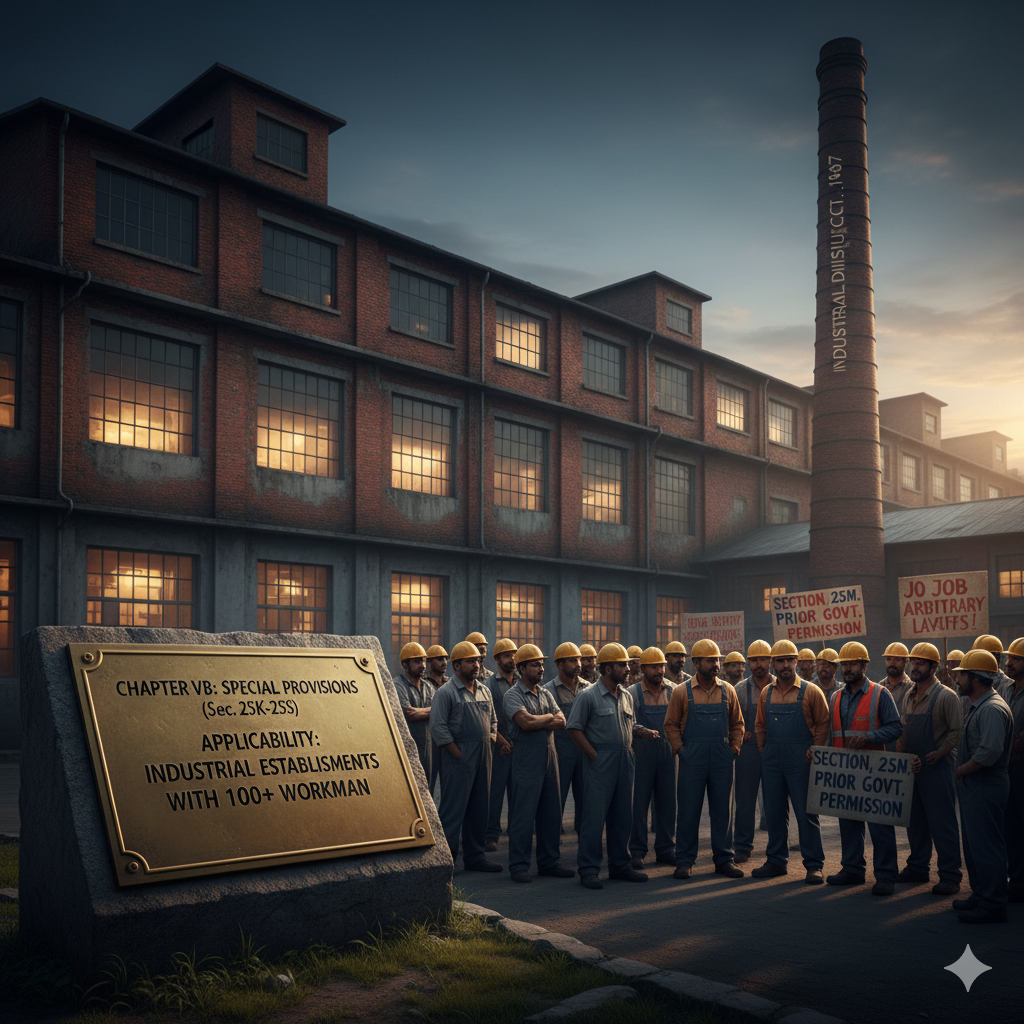
I. The Statutory Framework of Section 25K
Section 25K serves as the “Jurisdictional Gatekeeper” for Chapter VB. It determines whether an employer has the “Right to Manage” via simple notice (Chapter VA) or if they must submit to “State Paternalism” (Chapter VB).
1. The Literal Rule of Construction
The section explicitly states:
“The provisions of this Chapter shall apply to an industrial establishment (not being an establishment of a seasonal character or in which work is performed only intermittently) in which not less than [one hundred] workmen were employed on an average per working day for the preceding twelve months.”
2. Deconstructing the Key Phrases
- “Industrial Establishment”: This isn’t just any office. Under Section 25L, it specifically refers to factories, mines, and plantations.
- “Not of a Seasonal Character”: This is a frequent point of litigation. If a sugar mill or a tea garden only operates during harvest, does 25K apply? The “Appropriate Government” holds the final word on whether an industry is seasonal.
- “Not Less Than 100 Workmen”: This is the magic number. It creates a “cliff.” At 99 workers, you are flexible; at 100, you are functionally “locked in” to your workforce.
II. The Evolution of the “Threshold” (100 vs. 300)
The most contentious part of Section 25K is the number 100.
The Historical Context
Chapter VB was inserted during the Emergency (1976). The original intent was to prevent mass layoffs during a period of political and economic instability. Originally, the threshold was 300, but it was lowered to 100 in 1982 to bring more workers under the protective umbrella of the State.
State Amendments (The Federal Divergence)
Under the Indian Constitution, “Labour” is a Concurrent List subject. This means states can amend the Central Act.
- Pro-Market States: States like Rajasthan, Gujarat, Haryana, and Andhra Pradesh have increased the Section 25K threshold to 300 workmen.
- The Logic: These states argue that the “100-worker rule” prevents small businesses from scaling up because they fear the legal “trap” of Chapter VB.
III. Judicial Interpretations and “Continuous Service”
The courts have had to intervene repeatedly to stop employers from “gaming” Section 25K.
1. Calculation of the “Average per Working Day”
Employers often try to keep the daily count at 98 or 99. However, the courts look at the “preceding twelve months.” If the average hits 100 due to temporary spikes in labor demand, the employer is suddenly bound by the stringent requirements of 25N (Retrenchment) and 25O (Closure).
2. The “Single Establishment” Test
If a company has three units with 40 workers each, does 25K apply?
- Functional Integrality: The Supreme Court (e.g., in SG Chemical and Dyes Trading) has ruled that if there is functional integrality (common management, inter-transferability of workers, shared profits/losses), the units are treated as one establishment. If the total exceeds 100, 25K triggers.
IV. Intellectual Sparing: The “Protection vs. Stagnation” Debate
As your sparring partner, I must challenge the assumption that Section 25K is a “pro-worker” provision. Let’s look at the counter-intuitive reality:
1. The “Dwarfism” of Indian Industry
Economists argue Section 25K creates “The 99-Worker Syndrome.” Small firms refuse to hire the 101st worker because the regulatory cost of “Chapter VB” is higher than the benefit of the extra labor. This keeps Indian factories small, inefficient, and unable to compete with global giants like China or Vietnam.
2. The Rise of the “Ghost Workforce”
To avoid Section 25K, employers rely heavily on Contract Labour.
- The Irony: By trying to protect permanent workers with Section 25K, the law has inadvertently created a massive class of “precarious” contract workers who have no protections at all.
3. The “State as Boss” Critique
Section 25K forces an employer to ask the Government for permission to close a business (Section 25O).
- Logic Test: If a business is bankrupt and cannot pay electricity bills, how can a Government “refuse” permission to close? The Supreme Court in Excel Wear v. Union of India actually struck down the original Section 25O as unconstitutional, forcing the legislature to rewrite it to include a “right to be heard” and “reasoned orders.”
V. Summary Table of 25K Impact
| Feature | Chapter VA (General) | Chapter VB (Section 25K Applied) |
|---|---|---|
| Threshold | < 100 Workers | \ge 100 Workers |
| Retrenchment | 1 month notice + pay | 3 months notice + Govt. Permission |
| Closure | 60 days notice | 90 days Prior Permission |
| Penalty | Mostly Fines | Imprisonment + Fines |

6 Comments
Very interesting information!Perfect just what I was looking for!
Very interesting details you have observed, regards for putting up. “She had an unequalled gift… of squeezing big mistakes into small opportunities.” by Henry James.
3eh8fg
obviously like your website however you need to test the spelling on quite a few of your posts. Several of them are rife with spelling issues and I in finding it very troublesome to inform the reality then again I will definitely come back again.
We’re a group of volunteers and opening a new scheme in our community. Your web site offered us with valuable info to work on. You have done a formidable job and our entire community will be grateful to you.
Good website! I really love how it is easy on my eyes and the data are well written. I am wondering how I might be notified when a new post has been made. I’ve subscribed to your feed which must do the trick! Have a great day!