
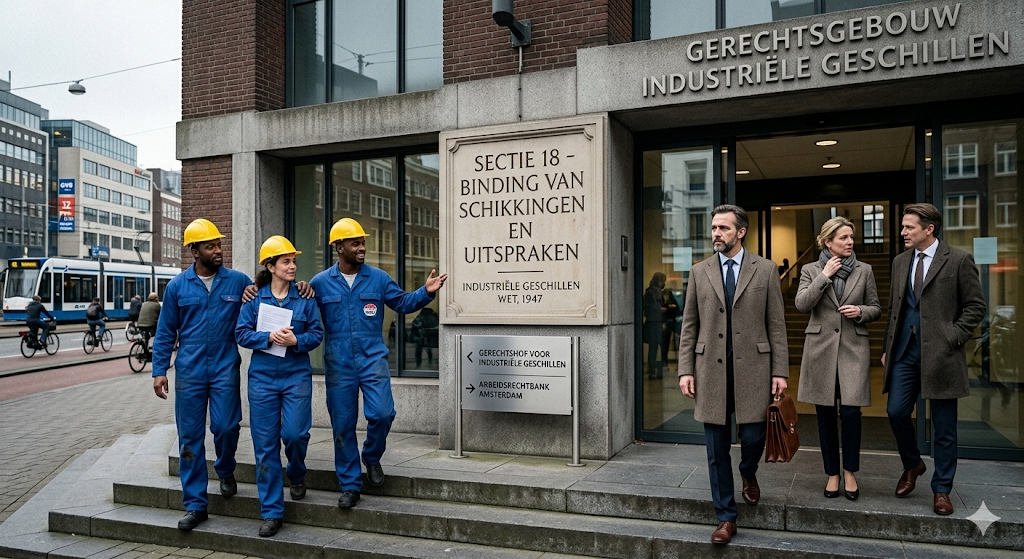
The Core Distinction: Consent vs. Coercion
Section 18 splits binding effects into two fundamentally different scenarios. The entire logic of the section hinges on whether the dispute was resolved privately (Bipartite) or through the formal, government-backed machinery (Tripartite/Adjudication).
1. Section 18(1): The Bipartite Settlement (The “Private Pact”)
This applies when an employer and a trade union reach an agreement outside of conciliation proceedings (often through direct collective bargaining).
- Who it Binds: It is binding only on the specific parties who are signatories to the agreement.
- The “Rebel” Problem: If a factory has three unions (Union A, B, and C), and only Union A (representing 40% of workers) signs a settlement with the management to reduce wages, that agreement does not bind members of Union B and C. Those other unions are free to ignore the agreement and start their own dispute (Section 2k).
2. Section 18(3): The Settlement in Conciliation or an Award (The “Universal Command”)
This applies when:
A) A settlement is reached with the assistance of a Conciliation Officer (Section 12), OR
B) An Award is passed by a Labour Court, Industrial Tribunal, or National Tribunal (Sections 7, 7A, 7B).
Here, the binding effect is vastly expanded. The law decides that for the sake of “Industrial Peace,” consent is no longer necessary for everyone. This “Universal Command” is binding upon:
- (a) All parties to the industrial dispute.
- (b) All other parties summoned to appear in the proceedings as parties to the dispute. (This prevents an employer from setting up a “dummy” union to get a favorable award).
- (c) Where the employer is a party: All his heirs, successors, or assigns in respect of the establishment to which the dispute relates.
- The “Succession” Trap: If Company A loses a bonus dispute and then sells the factory to Company B, Company B is still legally bound by that Tribunal Award. You cannot sell your way out of a labor law judgment.
- (d) Where the workmen are a party: All persons who were employed in the establishment on the date of the dispute, AND all persons who subsequently become employed in that establishment.
- The “Future Worker” Trap: This is the ultimate “free-rider” clause. If a Union fights for two years and gets a 10% wage hike (an Award), a new worker hired next year automatically gets that hike. They didn’t fight, they didn’t pay union dues, but they are trapped (favorably) by the binding Award.
Comparison of Binding Effects
| Feature | Section 18(1) Settlement | Section 18(3) Settlement or Award |
|---|---|---|
| How Reached | Private negotiation (Direct) | Via Conciliation Officer or Court |
| Scope of Binding | Narrow (Signatories Only) | Universal (All present & future) |
| The “Minority Union” | Cannot be bound without consent. | Is bound by the majority decision/award. |
| Long-term Effect | Expires as per contract. | Survives change of ownership. |
The “Democracy vs. Peace” Dilemma
As your sparring partner, I have to challenge the “Social Justice” of Section 18(3). This section is a Philosophical trade-off between the “Right to Individual Dissent” and the “Need for Collectivist Stability.”
1. The Death of Minority Dissent
If a Conciliation Officer helps the majority Union sign a 18(3) settlement that favors management, a smaller, more radical Union (say, 20% of workers) is legally strangled. They cannot strike for a better deal because they are “bound” by a settlement they never agreed to. Doesn’t Section 18 turn the government into a “union-breaker” by forcing a minority to accept a majority’s “surrender”?
2. The Successor’s Burden
Is it fair that Company B, which bought a factory to turn it around, is “inheriting” a 10-year-old bad bonus Award (Section 18(3)(c)) that was lost by the previous, incompetent management? Does this “Successor” binding actually discourage struggling businesses from being acquired, leading to more closures (Section 25O)?
3. Modern Tech Challenge: The “Platform” Binding
Imagine a “Gig Economy Union” (a 18(1) private union) signs a settlement with “Deliveroo India” to secure a basic safety net. If Deliveroo then gets acquired by “Swiggy,” does Section 18(3)(c) apply?
The Sparring Point: If these gig workers aren’t formal “Workmen” (Section 2s) and Swiggy argues it’s an “Aggregator” not a “Successor,” the binding vanishes. Is Section 18—the binding agent—becoming “unstuck” in the digital age, leaving future workers with no “successor” protections?
The “Partner” Verdict
Section 18 is an “Illiberal” tool used to achieve a “Liberal” outcome. It strips individuals of their right to disagree (18(3)) in order to provide the “Industrial Peace” that the capitalist economy demands. It is the section that proves the IDA (1947) values Stability over Consent.
