
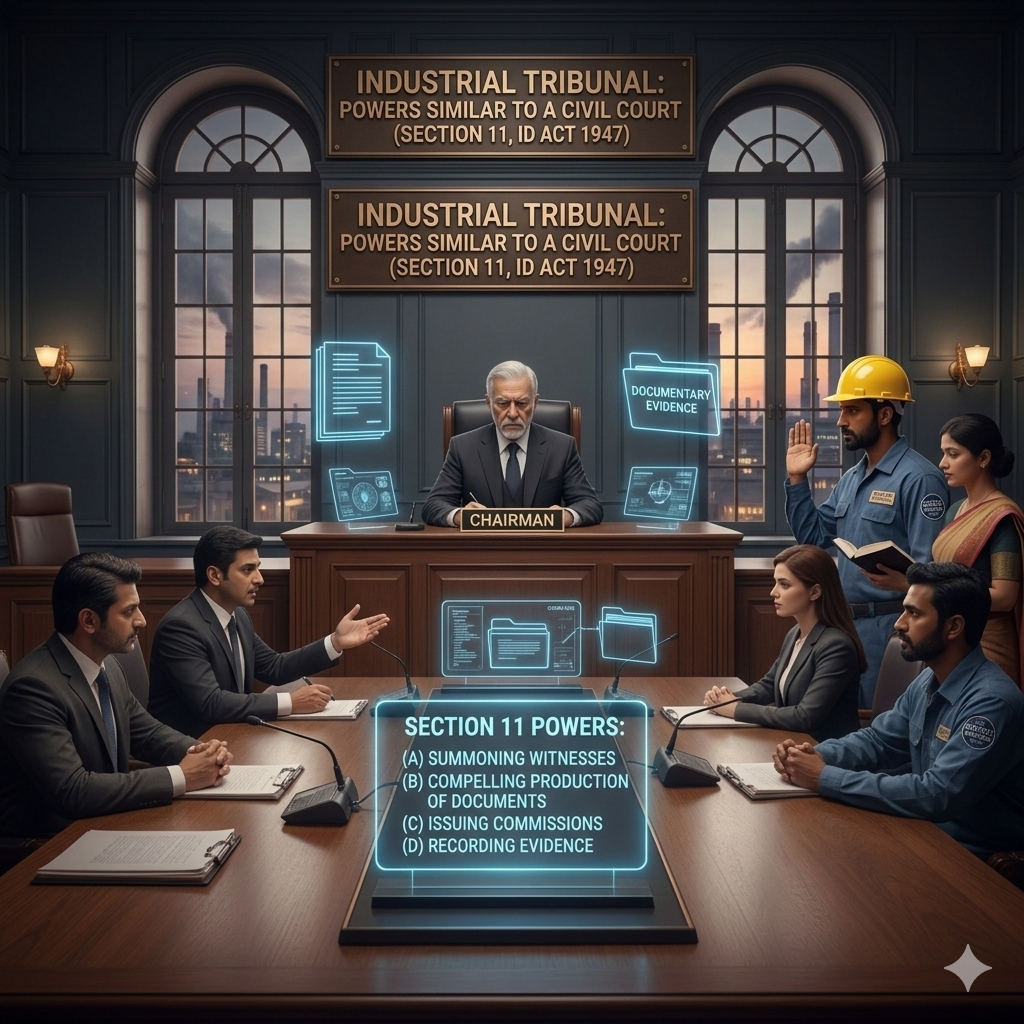
Section 11 of the Industrial Disputes Act, 1947 is the “Engine Room” of the judicial machinery. It defines how Conciliation Officers, Boards, Courts, and Tribunals actually operate. While Section 7 sets up the courtrooms, Section 11 gives the judges their gavels, their warrants, and their rules of engagement.
To meet your request for an exhaustive deep-dive, we will break this down into the statutory powers, the procedural flexibility, and the specific “Civil Court” functions that make these authorities formidable.
1. The Principle of Procedural Autonomy [Section 11(1)]
The first rule of Section 11 is that there are very few rigid rules.
- The Provision: Subject to any specific rules made by the Government, an arbitrator, Board, Court, or Tribunal “shall follow such procedure as the arbitrator or other authority concerned may think fit.”
- The Logic: Unlike a traditional Civil Court which is bound by the strict, often slow, chains of the Code of Civil Procedure (CPC), a Labour Tribunal is designed for speed and “substantial justice.”
- The Sparring Point: This “fit-to-suit” procedure is a double-edged sword. It allows a judge to cut through red tape, but it also opens the door to inconsistency. One Tribunal might allow a certain type of digital evidence while another rejects it. In 2026, as we move toward “AI-driven evidence,” this procedural freedom is where the most intense legal battles occur.
2. The Right of Entry [Section 11(2)]
This is the “Warrantless Entry” power.
- The Power: A Conciliation Officer or a member of a Board/Tribunal may, after giving reasonable notice, enter the premises of any establishment to which a dispute relates.
- The Purpose: To conduct an inquiry, inspect the machinery, or verify the “Conditions of Labour.”
- The Real-World Example: If workers claim that a chemical plant is leaking toxic fumes (a dispute over “Conditions of Labour”), the Presiding Officer doesn’t have to wait for a 3-month trial. They can give notice, walk into the factory, and smell the air for themselves.
3. The “Civil Court” Quad-Power [Section 11(3)]
This is the heart of your question. Section 11(3) explicitly vests these authorities with the same powers as a Civil Court under the CPC, 1908, specifically for four major actions:
A. Enforcing Attendance and Examination on Oath
The Tribunal can issue a Summons. If a CEO refuses to show up to testify about a mass layoff, the Tribunal has the power to compel their attendance.
The Legal Teeth: If you lie under oath before a Tribunal, it is treated as Perjury, just like in the High Court.
B. Compelling Production of Documents
The “Discovery” power. The Tribunal can order an employer to produce “Secret” balance sheets, internal emails, or disciplinary records.
- Example: In a dispute over a “Bonus,” the employer claims they have no profit. The Tribunal can order the production of the raw accounting logs to verify the claim.
C. Issuing Commissions
If a witness is too ill to travel or resides in a different state, the Tribunal can appoint a “Commission” (a lawyer or official) to go to that person, record their testimony, and bring it back to the court.
D. Other Prescribed Matters
This is a “residuary” power, allowing the Government to add more powers as needed through Rules (like the power to add parties to a dispute).
4. The Power to Appoint Assessors [Section 11(5)]
Since a Judge is usually a legal expert and not a technical one, Section 11(5) allows the Tribunal to appoint Assessors.
- These are people with “special knowledge” of the matter (e.g., an engineer for a machine safety dispute, or a chartered accountant for a complex wage dispute).
- The Sparring Twist: In 2026, we are seeing the rise of “Algorithmic Assessors.” Courts are starting to appoint data scientists to explain the “Black Box” of a tech company’s dispatch logic.
5. The Power of Costs [Section 11(7)]
”Justice isn’t free.” The Tribunal has full power to determine who pays the legal costs.
- If an employer drags a poor workman through 5 years of unnecessary litigation, the Tribunal can order the employer to pay the workman’s lawyer fees.
- Recovery: These costs can be recovered by the Government in the same manner as “Arrears of Land Revenue”—meaning the government can seize and sell property to pay the costs if the party refuses.
6. Execution Power: Section 11(9) & (10)
For decades, a Labour Court “Award” was just a piece of paper. You had to go to a different Civil Court to get it enforced. No more.
- Under recent amendments, every award or order is transmitted to a Civil Court, which then executes it as if it were a Decree of that court.
- In some states (like Tamil Nadu), the Labour Court itself has been given the power of a Civil Court to execute its own awards.
7. Section 11A: The “Super-Power” of Reinstatement
You cannot describe Section 11 without mentioning 11A (inserted in 1971).
- The History: Before 11A, if an employer held a “proper” internal inquiry and fired a worker, the Tribunal couldn’t interfere unless there was “victimization.”
- The Current Power: The Tribunal can now act as an Appellate Authority. It can look at the evidence and say: “Yes, the worker made a mistake, but firing him was too harsh. Reinstatement with 50% back-wages is a better punishment.”
- The Limit: The Tribunal must rely only on the materials on record; it cannot take “fresh evidence” unless the original internal inquiry was totally botched.
Intellectual Sparring: Is Section 11 “Too Much” or “Too Little”?
1. The “Pseudo-Court” Problem
We call them “Authorities” and give them “Civil Court Powers,” but the Presiding Officers are often Executive Appointees.
The Sparring Point: Can a Tribunal truly be “Independent” when its budget, its staff, and the Judge’s tenure are controlled by the very Government that is often a party to the dispute? Are these “Handcuffs” made of iron, or are they made of political plastic?
2. The “Procedural Chaos” Trap
Section 11(1) says “follow such procedure as they think fit.”
- In a 2026 digital economy, “Thinking Fit” leads to massive delays. If we don’t have a Standardized Digital Procedure, we end up with “Justice by Whim.”
- The Proposal: Should we replace Section 11(1) with a “Mandatory Digital Timeline”? If the “procedure” isn’t completed in 90 days, the case automatically moves to the next tier?
3. The Evidence Gap
Section 11(3) allows for “compelling documents.” But in 2026, the “documents” are ephemeral—Slack messages, deleted logs, and encrypted databases. Does the 1947 power to “call for documents” cover the 2026 power to “audit a private server”?
Comparison: Powers vs. Duties
| Authority | Key Power (Sec 11) | Key Duty (Sec 12/15) |
|---|---|---|
| Conciliation Officer | Right of Entry / Call for Docs | Promote Settlement / Report Failure |
| Labour Court | Adjudication / Reinstatement | Expeditious Disposal of Disputes |
| Tribunal | Appoint Assessors / Full Civil Powers | Final Determination (Award) |
Section 11 is the “Bridge” between the 19th-century factory and the 21st-century courtroom. It tries to give the Judge enough power to be effective (Civil Court powers) but enough flexibility to be human (Procedural Autonomy).
However, as we move into the Algorithmic Age, the “Handcuffs” of Section 11 look increasingly like antiques. We don’t just need the power to “Summon a Person”; we need the power to “Subpoena an Algorithm.”
