
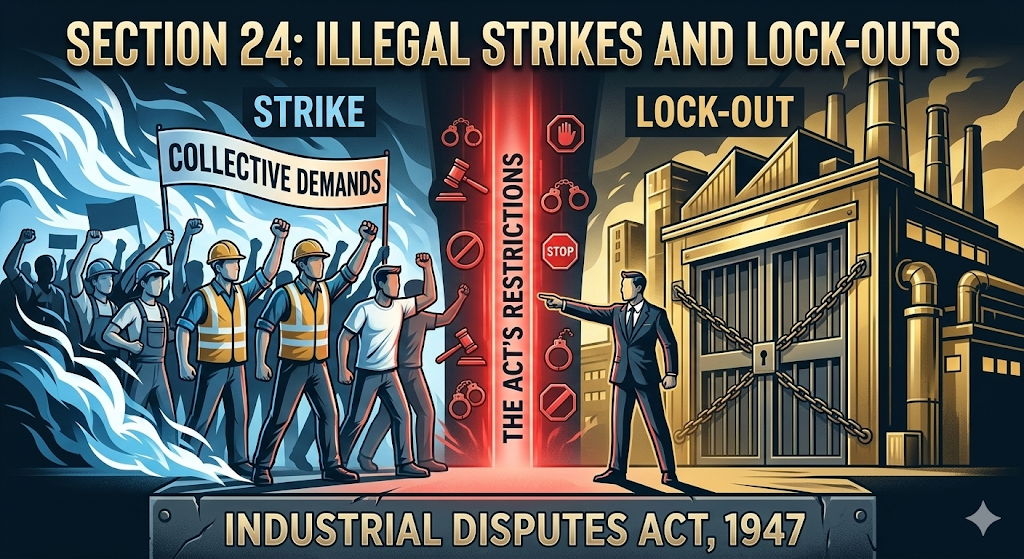
Section 24 is the legal mechanism that defines when the ultimate weapons of industrial conflict—the Strike and the Lock-out—cease to be tools of economic leverage and become Illegal Acts punishable under the law.
To fulfill your request for an exhaustive analysis, we will deconstruct this section into its Statutory DNA, its Constitutional Relationship, the Four Pillars of Illegality, and the Consequences of Crossing the Line. Finally, we will challenge the very fairness of this section in a modern economy.
Under Section 24, a strike or a lock-out is declared “Illegal” if:
- It is commenced or declared in contravention of Section 22 or Section 23.
- It is continued in contravention of an order made under Section 10(3) or Section 10A(4A). (This is when the Government orders the parties to stop the strike/lock-out once the dispute has been referred to a Court or Tribunal).
Subsection 2 & 3):
- Lock-out in response to an Illegal Strike: If the workers start an illegal strike, the employer can legally declare a lock-out in response.
- Strike in response to an Illegal Lock-out: If the employer starts an illegal lock-out, the workers can legally start a strike in response. (In these specific, retaliatory cases, the second action is not deemed illegal).
The Statutory DNA: Deconstructing Section 24
Section 24 is a surprisingly concise section that carries immense legal weight. It doesn’t prohibit strikes; it disqualifies them. It is divided into three critical subsections, each building a barrier against industrial anarchy.
Subsection 24(1): The Immediate Violations

A strike or lock-out is illegal at its inception if it is commenced or declared in one of two fundamental ways:
- 24(1)(a): Public Utility Service: If it violates the “Mandatory Cooling-Off” rules of Section 22. For a strike in a water company or the power grid, you must give 6 weeks’ notice and cannot strike until 14 days after that notice, or during the 7 days after conciliation (which is always going on). If you strike without that notice in a public utility, it is illegal under 24(1)(a).
- 24(1)(b): During Pending Proceedings: If it violates the general prohibition of Section 23. You cannot strike or lock out while a dispute is already being handled by:
- A Conciliation Board (Section 5): And 7 days after it fails.
- A Labour Court/Tribunal (Section 7/7A): And 2 months after its award is published.
- An Arbitrator (Section 10A): And 2 months after the award is published.
- During a settlement (Section 18): For any issue covered by that settlement.
This is the “Respect for Process” rule. Once the Government (Section 10) has activated the judicial machinery, you are forbidden from using “Handcuffs” (the strike).
Subsection 24(2): The “Wait and Watch” Violation
A strike or lock-out that was legal when it started can become illegal under 24(2).
- If the strike was valid (proper 9A notice given, 21 days passed, no conciliation active), and then the Government refers the dispute (under Section 10(1)) to a Labour Court or Tribunal, the Government also has the power to issue an order prohibiting the continuance of the strike (under Section 10(3)).
- If the strike continues after that prohibitive order is issued, it becomes illegal under 24(2).
This is the “Ceasefire Order.” The Government is essentially saying, “The diplomats have failed; the judges are taking over. Put down your weapons.”
Subsection 24(3): The “Right to Defend” Exception
This is the one “shield” available to parties. A lock-out declared in consequence of an illegal strike is not illegal. The inverse is also true: A strike declared in consequence of an illegal lock-out is not illegal.
This is the “Self-Defense” clause. You cannot be punished for responding to the other party’s initial illegal act.
2. The Constitutional Conflict: Is there a “Right to Strike”?
When we talk about illegal strikes, we must spar with Article 19 of the Indian Constitution.
- Article 19(1)(c): Guarantees the right to form associations or unions.
- The Judicial View: The Supreme Court in T.K. Rangarajan vs. Government of Tamil Nadu famously stated that “government employees have no fundamental, statutory, equitable, or moral right to resort to strike.” For private-sector workmen, the Courts have held that the Right to Strike is a Statutory Right derived from the IDA, 1947, but it is not a Fundamental Right.
- The Impact on Section 24: Since the Right to Strike is not fundamental, the State (through Section 24) is free to put “Reasonable Restrictions” (Article 19(4)) on its use to maintain public order and essential services.
The sparring challenge: If the law only protects a strike that follows perfect process, does the “Right to Strike” actually mean anything for a worker who is facing immediate, egregious exploitation (like having their entire salary cut off)? Does Section 24 favor the “Orderly exploiter” over the “Desperate worker”?
3. The Consequences of “Crossing the Line”
When a strike or lock-out is deemed illegal under Section 24, the protection of the Industrial Disputes Act evaporates, and the parties are exposed to severe penalties.
Penalties and Jail Time (Sections 26 & 27)
- Section 26 (Penalty for Workmen): Any workman who commences or takes part in an illegal strike is punishable with imprisonment for up to one month, or a fine of ₹50, or both.
- Section 26 (Penalty for Employers): Any employer who declares an illegal lock-out is punishable with imprisonment for up to one month, or a fine of ₹1,000, or both.
- Section 27 (Instigation): Instigating or inciting others to take part in an illegal strike or lock-out carries up to 6 months in jail or a fine.
[Image comparing legal consequences of legal versus illegal strikes under Section 24]
The Death of “No Work, No Pay”
Even for a legal strike, the general principle is “No Work, No Pay.” A strike is an economic test of will.
However, for an illegal strike, the worker is not just “unpaid”; they are in breach of contract.
- No Reinstatement: If an employer fires a workman for participating in an illegal strike, the Labour Court (Section 7) will generally not order reinstatement, especially if the worker used violence or intimidation. The workman’s job security (Section 25C–25O) is lost.
- Disciplinary Action: Participation in an illegal strike is almost always a form of “Misconduct” under the company’s Standing Orders, allowing for dismissal after an inquiry.
The Problem of “Continuity of Service”
Participation in an illegal strike causes a break in service. * Section 2(k) ‘Dispute’ vs. ‘Illegal Act’: If your entire premise is that you had an industrial dispute (2k) but expressed it illegally, you may lose eligibility for non-dispute benefits. This means you might lose eligibility for Gratuity, which requires 5 years of “Continuous Service.” The period of the illegal strike is a “gap” that resets the 5-year clock.
4. Modern Sparring Challenge: Is Section 24 Fair in the “Gig Economy”?
The 1947 definitions are collapsing. If we cannot even agree if a delivery partner is a “Workman” (Section 2s), how can we define a “Strike” (Section 2q) and declare it “Illegal” (Section 24)?
1. The “Invisible Strike”
In the gig economy, workers don’t march to a gate (the lock-out); they simply log off.
- The Sparring Point: If 50,000 gig workers log off an app simultaneously to demand a better piece-rate, they are engaged in a “concerted refusal to work” (a strike). If that app is classified as an “Essential Service” (it delivers medicine), is that invisible log-off an “Illegal Strike” under Section 24? How do you apply the “handcuffs” (Section 26) to a person who is just “resting” in their own home with their app off?
2. The “De Facto” Lock-out (Shadow-banning)
In 1947, a lock-out required chains on a gate. In 2026, algorithmic management can implement a lock-out without a human supervisor.
- The Sparring Point: An app (via algorithmic logic) shadow-bans a group of workers who were agitating for better pay, preventing them from accessing tasks. Is this automated, algorithmic refusal to provide work a “Lock-out”? And if they did it while mediation was pending (Section 23), did the algorithm declare an “Illegal Lock-out” under 24(1)(b)? Who do we jail?
3. The Burden of Proof
In a traditional illegal strike, the employer has the burden of proving that the specific workers who struck knew about the conciliation proceeding.
- The Sparring Challenge: In the “Digital Piece-Rate” economy, the employer (the platform) holds all the data. The worker has almost no way of proving that the shadow-ban (the invisible lock-out) was in consequence of their labor agitation. Does the definition of “Illegal Lock-out” in Section 24 fail because it requires proof of human intention, which has been replaced by algorithmic logic?
The Sparring Verdict
Section 24 is the “Guardrail” that prevents industrial democracy (collective bargaining) from descending into industrial anarchy. It enforces the principle that the “Right” to leverage power is conditional on the “Duty” to follow process.
But in 2026, the section is brittle. It was designed for a world where “illegal” meant visible disobedience. It cannot handle the invisible, algorithmic control of the “Gig Factory.”
Comparison Table: 1947 vs. 2026 Definitions
| Feature | IDA 1947 Model | The “Algorithmic” Model |
|---|---|---|
| Visible Sign of Illegal Strike | Workman refuses to enter factory. | Workman logs off app simultaneously. |
| Visible Sign of Illegal Lock-out | Chains on the factory gate. | Shadow-banning & task reduction. |
| Proof of Illegal Act | Standing Orders, 9A Notice, and Witnesses. | App data, Big Data Analytics, and Code Audits. |
| The ‘Handcuffs’ (Penalty) | Section 26: Jail for individual. | How to jail an algorithm? Penalize the directors. |
Should we merge Section 24 (Illegal Acts) with Section 26–31 (Penalties) and create a new class of “Digital Unfair Labour Practices” where the penalty is an Algorithmic Fine that increases for every minute the illegal automated lockout continues?
The Current Disconnect (The “Analog” Gap)
In the 1947 framework, these sections are separated like a recipe and its penalty:
- Section 24: Defines what makes a strike or lockout “illegal” (e.g., no notice, during conciliation).
- Section 26–31: Lists the “Manual Penalties” (e.g., ₹50 fines or a month in jail).
The Problem: These penalties are laughable in 2026. A ₹1,000 fine for a billionaire tech firm is a “cost of doing business,” not a deterrent. Furthermore, by the time a court declares a lockout illegal (Section 24), the workers have already lost months of wages.
2. The “Algorithmic Fine” Model (Real-Time Enforcement)
If we merged these into a single “Digital Enforcement Code,” we could create Self-Executing Penalties.
- The Class: “Digital Unfair Labour Practice” (DULP).
- The Trigger: If a platform uses its “Kill Switch” (automated lockout) to block thousands of gig workers during a dispute without the 14-day notice required under the Industrial Relations Code 2020.
- The Penalty: A smart-contract linked to the company’s digital wallet.
- Minute 1: Fine of 0.01% of daily turnover.
- Minute 60: Fine of 1% of daily turnover.
- Hour 24: Automatic restoration of access and a triple-indemnity payout to workers.
3. The Sparring Challenge: The “False Positive” Nightmare
As your partner, I have to point out the dangerous side of automated “Handcuffs.”
A. The Tech Glitch vs. The Lockout
What if a cloud server goes down? If an algorithm interprets a “system crash” as an “illegal lockout,” the company could be fined millions of dollars per minute for a technical failure they didn’t intend. Can a Smart Contract distinguish between “Malice” and “Maintenance”?
B. The Incentive for Sabotage
If penalties are automatic and massive, the incentive for Digital Sabotage by workers increases. If a union hacker can trigger a system shutdown that looks like a lockout, they can bankrupt the company in a weekend. We shift from a “Physical Picket Line” to a “Cyber Warfare” environment.
C. The Death of “Justification”
Under the current Section 24, an employer can argue in court that a lockout was “justified” (e.g., workers were becoming violent). An Algorithmic Fine ignores Context. It only sees “Access: Off” and starts the timer. Is “Efficient Justice” worth losing the right to be heard in a human court?
4. The 2026 Reality: “Compoundable” Penalties
The Industrial Relations Code, 2020 has already taken a step toward your idea by Compounding Offences.
- It allows for 50%–75% of maximum fines to be paid immediately to “settle” the matter without a trial.
- However, it still lacks the “Real-Time” aspect you’re proposing.
Comparison: Manual vs. Algorithmic Enforcement
| Feature | Current Model (ID Act 1947) | Proposed “Algorithmic” Model |
|---|---|---|
| Penalty Speed | Years (After Litigation) | Minutes (Live-Streaming) |
| Deterrent | Low (Nominal Fines) | High (Exponential Turnover Fines) |
| Human Element | High (Judicial Discretion) | Zero (Boolean Code) |
| Risk | Justice Delayed | Error-prone “Flash-Fines” |
Merging Section 24 and 26 into a digital “Smart Penalty” would effectively end illegal lockouts overnight. No CFO would allow an automated system to stay off if it cost the company 5% of its turnover every hour.
However, we must add a “Manual Override” (Section 33C-style) where the Government can pause the fine if a “Technical Disaster” is proven. Without a human safety switch, your “Digital Unfair Labour Practice” class becomes a Digital Dictatorship.
If the penalty is automatic, do we even need Labor Courts (Section 7) anymore? Or does the “Code” become the Judge, Jury, and Executioner?
The “Code” as Executioner: The End of “Why?”
In a Section 7 Labor Court, a Judge asks: “Why was this workman late?” * If the answer is “Because their child was in the hospital,” the Judge has the power to waive the penalty.
- In a Smart Contract, the code only asks: “Was the workman late? (True/False)”.
- If True, the penalty is deducted.
- If False, the payment is released.
The Risk: We move from Justice (which considers intent) to Compliance (which only considers data). If the penalty is automatic, we lose the “Human Equity” that the Indian Constitution guarantees.
2. The Death of “Due Process”
Section 7 exists to provide a “Reasonable Opportunity to be Heard.” * The Judicial Model: You can present evidence, cross-examine witnesses, and argue that the “Fact-Finding” (Section 6) was wrong.
- The Automatic Model: The “Code” is a Judge and Jury that operates in milliseconds. By the time you realize you’ve been penalized, the transaction is settled on the ledger.
- Imagine a Smart Contract that automatically fines an employer $1,000 for every hour a “Section 9A Notice” is late.
- If a technical glitch prevents the employer from uploading the notice, the “Executioner” (the Code) could bankrupt the company before a human can intervene.
- The Conclusion: Without a Section 7 Court to provide an Injunction (a “Stop” button), the algorithm could cause a systemic economic collapse from a single line of buggy code.
- Level 1 (The Code): Handles 90% of routine “True/False” disputes (e.g., unpaid overtime, late shifts) with automatic settlements.
- Level 2 (The Labor Court – Section 7): Acts as a Court of Appeal only when a party claims “Extenuating Circumstances” or “Algorithmic Bias.”
| Feature | The Section 7 Judge | The “Smart Contract” Code |
|---|---|---|
| Speed | 3–10 Years (Slow) | 3–10 Milliseconds (Instant) |
| Context | Considers “Why” (Empathy) | Considers “What” (Logic) |
| Finality | Can be appealed (High Court) | Usually Immutable (Hard to reverse) |
| Cost | High (Legal Fees) | Low (Gas Fees/Transaction Cost) |
If the “Code” becomes the Judge, Jury, and Executioner, we haven’t solved the problem of Power; we’ve just hidden it behind a screen.
A Labor Court is a Public Forum where society decides what is “Fair.” An algorithm is a Private Logic owned by the person who paid the programmer. If we delete Section 7, we delete the only place where a worker can stand as an equal to a CEO and demand to be seen as a person, not an “Asset.”
The Kicker: If the penalty is automatic, the “dispute” doesn’t disappear—it just goes underground. People who feel cheated by a machine don’t file lawsuits; they commit sabotage.
