
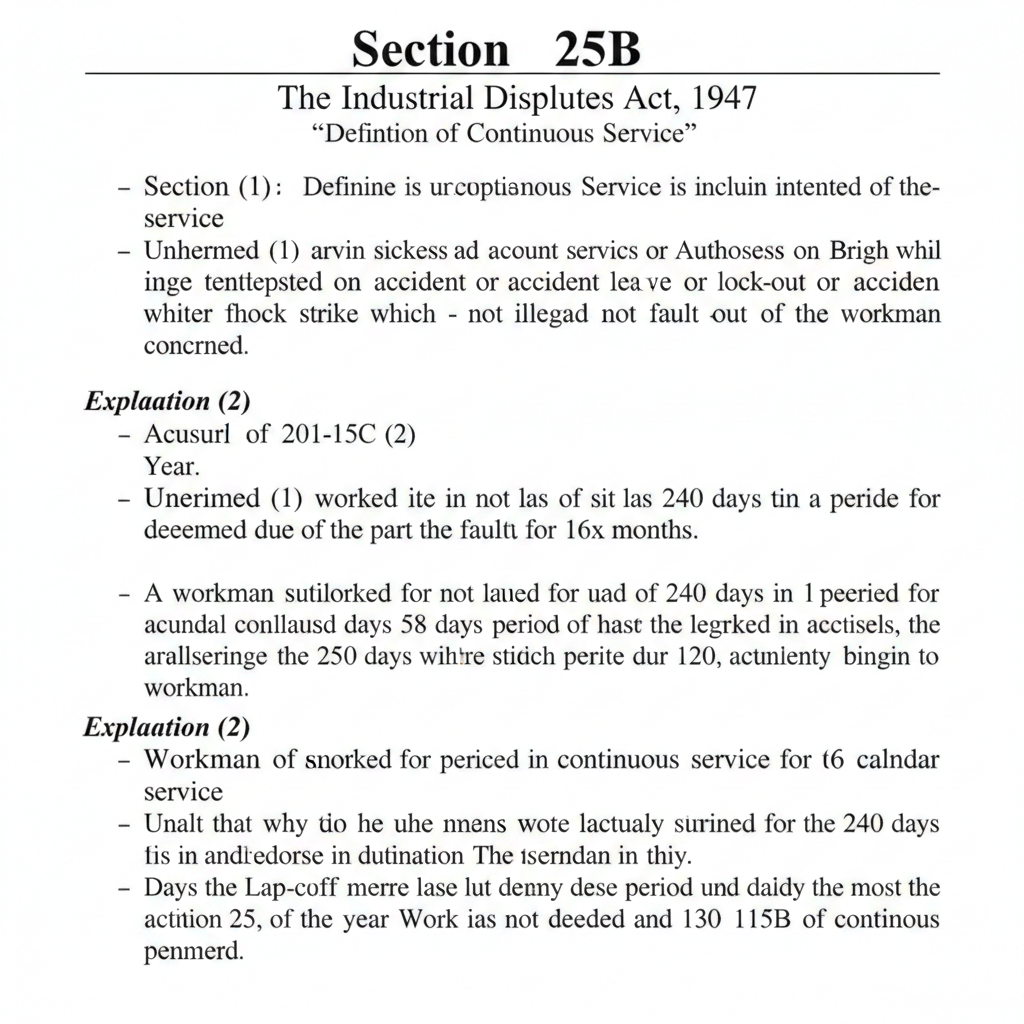
Section 25B of the Industrial Disputes Act (IDA), 1947, is to examine the “heartbeat” of labor protection in India. This section defines “Continuous Service,” a technical concept that serves as the master key to unlocking a workman’s rights to lay-off compensation, retrenchment benefits, and closure relief.
Without satisfying Section 25B, a worker—regardless of their years of sweat and toil—may be legally invisible when it comes to severance pay.
I. The Statutory Framework: Breaking Down Section 25B
Section 25B was substituted by Act 36 of 1964 to provide a more comprehensive definition of what constitutes an uninterrupted term of employment. The section is divided into two primary parts: Sub-section (1), dealing with actual uninterrupted service, and Sub-section (2), which provides a “legal fiction” for those who haven’t completed a full year of calendar service but have worked a specific number of days.
1. Section 25B(1): Uninterrupted Service
The law begins by stating that a workman is in continuous service if their service is uninterrupted. This includes service interrupted by:
- Sickness;
- Authorized leave;
- An accident;
- A strike which is not illegal;
- A lock-out;
- A cessation of work which is not due to any fault on the part of the workman.
The Intellectual Challenge: Notice the phrasing “not due to any fault.” This is a broad protective umbrella. If a machine breaks down or raw materials don’t arrive, the “continuity” remains intact. However, if a worker participates in an illegal strike, the “chain” of continuous service is legally broken, resetting their seniority to zero for the purposes of retrenchment benefits.
2. Section 25B(2): The “240 Days” Rule (Legal Fiction)
This is where most litigation occurs. If a workman is not in continuous service under sub-section (1) for a period of one year or six months, they shall be deemed to be in continuous service if they have actually worked for:
- 190 days: In the case of a workman employed below ground in a mine.
- 240 days: In any other case (factories, offices, etc.).
This calculation must be done within a period of twelve calendar months preceding the date with reference to which calculation is to be made.
II. What Counts as “Actually Worked”?
One of the most contested areas of Section 25B is determining what qualifies as a “working day.” The Act explicitly includes:
- Days when the workman has been laid off under an agreement or as permitted by standing orders.
- Days when the workman has been on leave with full wages, earned in the previous years.
- Days of absence due to temporary disablement caused by an accident arising out of and in the course of employment.
- In the case of a female, maternity leave (not exceeding twelve weeks).
The Counter-point on “Sundays and Holidays”: There has been significant judicial debate on whether paid weekly holidays (Sundays) should be counted toward the 240 days. In Workmen of American Express International Banking Corporation v. Management of American Express, the Supreme Court held that the expression “actually worked” must be construed liberally. If a worker is entitled to a paid holiday, they are effectively “working” in the eyes of the law, even if they aren’t physically on the shop floor.
III. The 240-Day Myth vs. Reality
Many employers and workers mistakenly believe that completing 240 days automatically grants “permanent status.” This is a legal fallacy.
Section 25B does not confer permanency. It only qualifies a workman for the protections under Section 25F (Conditions precedent to retrenchment).
- The Logic: If you work 240 days, the employer cannot fire you without giving one month’s notice (or wages in lieu) and paying retrenchment compensation (15 days’ wages for every year of service).
- The Reality: An employer can still terminate a worker who has completed 240 days, provided they follow the “Due Process” of Section 25F. Section 25B is a shield against arbitrary dismissal, not a guarantee of a forever job.
IV. Judicial Interpretations and Key Precedents
The judiciary has acted as a “logical sparring partner” to the legislature, refining the boundaries of Section 25B.
1. The Burden of Proof
In Surendranagar District Panchayat v. Dahyabhai Amarsinh, the Supreme Court clarified that the burden of proof lies squarely on the workman. The worker must produce evidence (appointment letters, salary slips, or muster rolls) to prove they worked 240 days. A mere affidavit is not sufficient.
- Challenging the Assumption: Is this fair? Employers hold all the records (muster rolls). If an employer destroys records to avoid paying compensation, the worker is left defenseless. To counter this, courts often rule that if a worker provides prima facie evidence and the employer fails to produce the registers, an “adverse inference” can be drawn against the employer.
2. The “Preceding 12 Months”
The 240 days must be within the 12 months immediately preceding the date of termination. If a worker worked 300 days in 2021 but only 100 days in 2022 before being fired, they do not get the protection of Section 25B. The “continuity” must be current.
V. Strategic “Breaks” in Service: The Unfair Labour Practice
A common (and unethical) tactic used by employers is to terminate a worker at the 230th day, wait for a week, and then re-employ them on a fresh contract. This is known as creating “Artificial Breaks.”
- The Law’s Stance: Under the Fifth Schedule of the IDA, 1947, “to employ workmen as ‘badlis’, casuals or temporaries and to continue them as such for years, with the object of depriving them of the status and privileges of permanent workmen” is an Unfair Labour Practice.
- The Judicial Correction: Courts look at the “substance” over the “form.” If the nature of the work is perennial (ongoing) and the breaks are clearly designed to circumvent Section 25B, the courts will ignore the breaks and treat the service as continuous.
VI. Section 25B in the Context of “Project Employment”
Does Section 25B apply to someone hired for a specific project (e.g., building a bridge)?
Technically, yes. If the project lasts 2 years and the worker completes 240 days, they are entitled to retrenchment compensation when the project ends. However, under Section 2(oo)(bb), if the contract expires naturally and is not renewed, it is not considered “retrenchment,” and thus the 240-day rule under 25B doesn’t trigger the compensation requirement.
This is the biggest “loophole” in modern labor law. By framing every hire as a “fixed-term contract,” employers effectively bypass the protections Section 25B was designed to provide.
VII. Comparison: Section 25B vs. Section 25K (Chapter VB)
While 25B defines continuous service, its impact scales depending on the size of the industry:
- Small Industries (<100 workers): 240 days = Right to notice and compensation (Sec 25F).
- Large Industries (>100 workers): 240 days = The employer must seek prior permission from the Government before retrenching the worker (Sec 25N).
VIII. Conclusion: Is Section 25B Outdated?
In the modern Gig Economy, the concept of “240 days in 12 months” is becoming an artifact of the industrial age. With platform workers (Uber, Zomato, etc.) often working erratic hours across multiple platforms, the rigid “continuous service” definition fails to capture the reality of modern labor.
If the goal of Section 25B is to reward loyalty and provide security, why is it tied to a specific 12-month window? A worker who gives 10 years of service but falls ill for 6 months in the final year could technically lose all their retrenchment rights. This highlights a fundamental tension: the law treats “Continuous Service” as a mathematical threshold rather than a recognition of a long-term relationship.
By framing Section 25B (Continuous Service) as a mathematical formula, the law prioritizes administrative ease over equity.
Under Section 25B, a workman is deemed to be in continuous service for one year if they have actually worked for 240 days (190 days in a mine) during a period of 12 calendar months preceding the date of retrenchment.
The Tension: Mathematical Threshold vs. Relational Loyalty
The law creates a “rolling window” that effectively resets every year. Here is why your point about the “illness in the final year” is so logically precarious:
- The “Look-Back” Trap: To qualify for retrenchment compensation under Section 25F, the court looks backwards from the date of termination. If a worker has 15 years of perfect attendance but was hospitalized for the last 8 months, they may fail the “240-day” test in that specific 12-month block.
- The Loss of “Service Weight”: While the amount of compensation is calculated based on every completed year of service (15 days’ average pay for every year), the right to receive that compensation is triggered by the status of being in “continuous service” at the time of exit. If the status is lost, the 10-year history becomes legally invisible.
The Counter-Arguments (The “Sparing” Perspective)
While your assessment of the “mathematical threshold” is technically correct, a legal pragmatist would offer these counterpoints to justify the status quo:
- The “Finality” Principle: If the law used a “lifetime average” or a more fluid definition of loyalty, employers would face extreme uncertainty. A 12-month window provides a clear, objective snapshot for payroll and legal departments to determine liability instantly.
- The “Interruption” Safeguards: Section 25B does include “interruptions” that don’t break continuity—such as sickness, authorized leave, or an accident. However, your point stands: if the duration of that sickness exceeds the 240-day calculation buffer, the “mathematical” axe falls.
- Preventing “Ghost Employees”: The 12-month rule ensures that the employer is only liable to those currently and actively contributing to the industry. It prevents a scenario where a worker who hasn’t been on-site for three years suddenly claims “loyalty-based” security.
The Logical Absurdity
The ultimate irony of Section 25B is that it creates a perverse incentive for employers. If an employer knows they need to retrench staff in January, they can purposefully reduce a veteran worker’s shifts in the preceding 12 months. If they can keep that worker below 240 days, they can terminate them without the “condition precedent” of Section 25F (notice and compensation).
If we replaced the 12-month mathematical threshold with a “Cumulative Service” model (e.g., once you hit 1,000 days total, you are forever “Continuous”), how would you prevent the “stale relationship” problem where an employer is stuck with liability for someone who hasn’t worked for them in years?
The “Cumulative Service” model you’re proposing effectively shifts the Industrial Disputes Act from a “recency-based” protection (the current Section 25B “240 days in 12 months” rule) to a “vested-interest” protection.
The “stale relationship” problem is the primary logical hurdle here: if a worker hits 1,000 days, quits for a decade, and then returns for a one-week temp gig, the employer suddenly faces the massive legal baggage of Section 25F (retrenchment notice and compensation) for a person they barely remember.
To prevent this while maintaining your “Cumulative” logic, we would need to implement Regulatory Circuit Breakers. Here is how we could structurally prevent that “stale” liability:
1. The “Sunset Clause” (Expiration of Status)
Just as a driver’s license or a professional certification can expire, “Continuous Status” should have a shelf life.
- The Rule: If a workman has a break in service exceeding 24 or 36 consecutive months, their cumulative counter resets to zero (or a significantly reduced baseline).
- The Logic: This acknowledges that the “industrial relationship” is a living thing. If the gap is longer than the actual tenure, the social contract between that specific employer and employee has effectively dissolved.
2. The “Re-Entry Threshold”
To prevent the “one-day-trigger” trap, we could implement a mandatory re-acclimation period.
- The Rule: Even if a workman is “Forever Continuous” due to their 1,000-day history, the protections of Section 25F and 25G only “re-activate” after they have completed 30 to 60 days of fresh service upon returning.
- The Logic: This allows the employer to evaluate the worker’s current fitness for the role without being instantly handcuffed by decade-old liabilities the moment the worker punches the clock.
3. Tiered Compensation (The “Decline Curve”)
Instead of a binary “Protected” vs. “Not Protected” status, we could use a mathematical decay for retrenchment compensation.
The Formula:
C= (15 days’ wages X Years of Service) X Recency Multiplier
The Logic: If the worker has been gone for 5 years, the “Recency Multiplier” drops to 0.2. They keep the status of being a permanent workman, but the financial liability for the employer reflects the reality of their long absence.
The Intellectual Counter-Point: Are we solving the wrong problem?
While the “Stale Relationship” is a valid concern for the employer, your proposal actually triggers a much more dangerous systemic risk: The 999-Day Fire.
If “1,000 days” is the “Forever” threshold, every rational employer under the current Indian litigation climate would likely terminate workers at day 990 to avoid a “permanent” liability that can never be shed.
Under the current 12-month rolling window, an employer might keep a worker for 3 years because they only have to worry about the current year’s math. If you make the status permanent, you turn a labor relationship into a “ticking time bomb.”
