
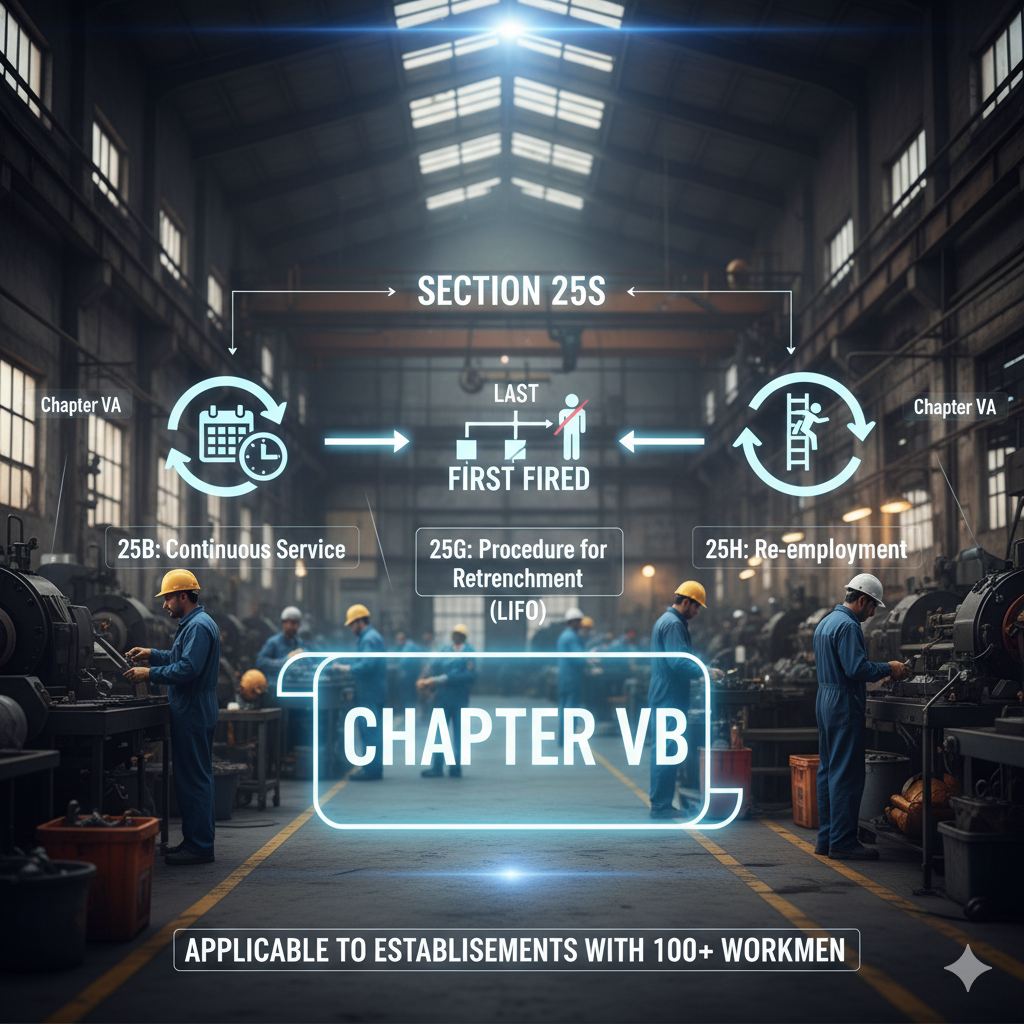
- Clarifies that the definitions of “continuous service” (25B), “procedure for retrenchment” (25G), and “re-employment” (25H) from the general chapter still apply to these larger establishments.
The Comprehensive Analysis of Section 25S: Bridging Chapter VA and VB
Section 25S of the Industrial Disputes Act, 1947, states:
“The provisions of sections 25B, 25D, 25FF, 25G, 25H, and 25J shall, so far as may be, apply also in relation to an industrial establishment to which the provisions of this Chapter apply.”
This section prevents a “legal vacuum.” Without it, a large factory would need government permission to retrench (under 25N), but wouldn’t have a legal definition of how to calculate a “year of service” or what to do if they wanted to hire someone back later.
1. The Foundation: Section 25B (Continuous Service)
Section 25S incorporates Section 25B, which is the most litigated definition in the Act. To qualify for retrenchment compensation or the protections of Chapter VB, a workman must prove “Continuous Service.”
The “240 Days” Rule
Under Section 25B(2), if a workman is not in uninterrupted service, they are deemed to be in continuous service for one year if, during the 12 calendar months preceding the date of calculation, they have actually worked for:
- 190 days in the case of a workman employed below ground in a mine.
- 240 days in any other case.
The Intellectual Sparing Point: Employers often deliberately terminate workers at 230 days to avoid this “Continuous Service” status. While 25S attempts to protect workers, it inadvertently created the “Casualization of Labor,” where workers are kept on a revolving door of short-term contracts to ensure they never hit the 240-day mark.
2. Procedural Fairness: Section 25G (Last Come, First Go)
Under Section 25S, the principle of “Last Come, First Go” (LCFG) is mandatory even for mega-corporations.
The Mechanism of 25G
When an employer decides to retrench workmen, they must retrench the person who was the last to be employed in that specific category.
- The Category Rule: LCFG applies per category (e.g., Welders, Typists, Drivers). You cannot fire a senior welder to keep a junior driver.
- Exceptions: An employer can depart from this rule only if they record reasons in writing (e.g., the junior worker has a specialized skill the senior lacks).
3. The Right of Return: Section 25H (Re-employment)
Section 25S ensures that if a large factory scales back up after a retrenchment, the “old” workers get the first right of refusal.
- Preference: If an employer proposes to take into their employ any persons, they must give an opportunity to the retrenched workmen to offer themselves for re-employment.
- Legal Standing: Retrenched workmen who offer themselves have preference over new applicants.
The Counter-point: Does 25H hinder modernization? If a factory retrenches manual laborers and later re-opens as a fully automated plant, 25H forces them to offer jobs to the manual laborers who may no longer possess the skills required for the new technical roles.
4. Transfer of Undertakings: Section 25FF
Section 25S pulls in the protections for when a company is sold.
- If the ownership of an undertaking is transferred, every workman is entitled to notice and compensation as if they were retrenched.
- The Exception: Compensation isn’t required if the new owner guarantees:
- Uninterrupted service.
- Terms of service not less favorable than before.
- Legal liability for past service (continuity).
5. The Conflict of Laws: Section 25J (Overriding Effect)
Section 25J, applied through 25S, clarifies that this Chapter overrides any other law (including standing orders or contracts) that is inconsistent with it. However, if a workman has a better deal under a different contract, they can choose the more favorable option.
6. Strategic Implementation: The Interplay between 25N and 25G
In a Chapter VB establishment (100+ workers), an employer must follow a dual-track process:
- Substantive/Administrative: Seek government permission under Section 25N.
- Procedural: Follow the LCFG rule under Section 25G (via 25S).
Even if the Government grants permission to retrench 50 people (25N), if the employer picks the “wrong” 50 people by ignoring the seniority list (25G), the retrenchment can be declared void ab initio by a Labour Court.
7. Critical Analysis: The Economic “Deadweight” Argument
By extending these sections via 25S, the law creates a rigid structure for large-scale industry.
- Logic Check: If Section 25S makes it so difficult to manage a workforce of 101 people, the logical economic response is to stay at 99 people. This is known as “the missing middle” in Indian manufacturing—where firms are either tiny or massive, with very few mid-sized companies because the regulatory burden of Chapter VB (and Section 25S) is too high.
Summary Table: The Chapter VA Provisions Applied via 25S
| Section | Subject | Core Requirement |
|---|---|---|
| 25B | Continuous Service | 240 days of work = 1 year of service. |
| 25D | Register of Workmen | Employer must maintain a seniority list. |
| 25FF | Transfer of Ownership | Protects wages/service continuity during a sale. |
| 25G | Procedure | Seniority-based exit (Last Come, First Go). |
| 25H | Re-employment | Retrenched workers get “first dibs” on new openings. |
| 25J | Overriding Effect | ID Act prevails over less favorable contracts. |
