
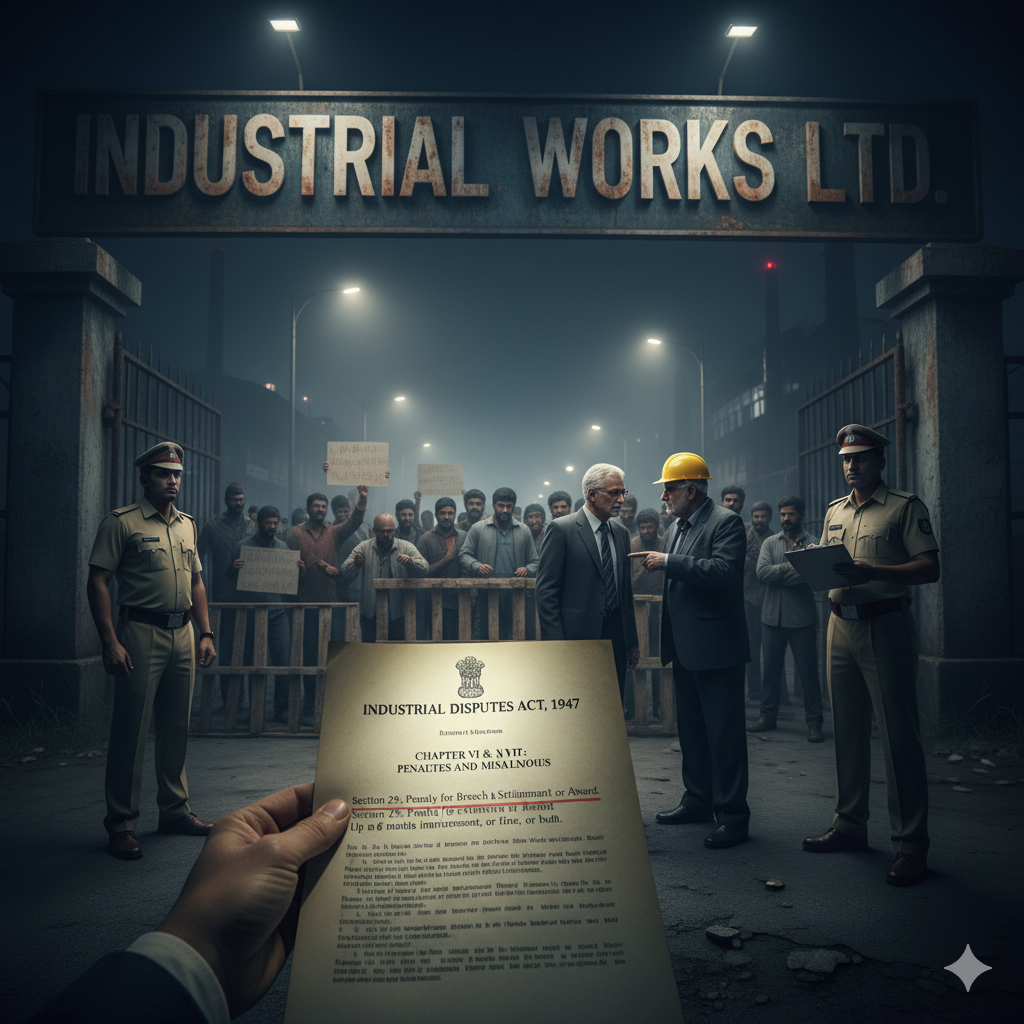
Deep Dive: Section 29 of the Industrial Disputes Act, 1947
Section 29 sits within Chapter VI (Penalties). It is the primary enforcement mechanism for ensuring that once a dispute is “settled”—either through mutual agreement or a court mandate—the parties actually follow through.
1. The Literal Provision
“Any person who commits a breach of any term of any settlement or award, which is binding on him under this Act, shall be punishable with imprisonment for a term which may extend to six months, or with fine, or with both…”
Key Components:
- The Breach: Non-compliance with the specific terms (wages, reinstatement, working hours, etc.).
- Settlement vs. Award: * Settlement: Arrived at during conciliation (Section 12(3)) or via written agreement (Section 18(1)).
- Award: An interim or final determination by a Labour Court or Tribunal.
- Continuous Breach: If the breach continues after conviction, a fine of up to ₹200 per day can be imposed.
- The Beneficiary: The court may direct that the fine recovered (or part of it) be paid as compensation to the person injured by the breach.
2. Procedural Hurdles (The “Gatekeeper” Problem)
Under Section 34, a court cannot take cognizance of an offense under Section 29 unless a complaint is made by (or under the authority of) the Appropriate Government.
The Logic Test: If an employer refuses to pay an award, the worker cannot simply go to a Magistrate. They must petition the Government to prosecute.
- Pros: Prevents frivolous litigation.
- Cons: It politicizes enforcement. If the government is “pro-business” or fears industrial flight, they may sit on the prosecution request for years.
3. Judicial Interpretation & Landmark Principles
The courts have shaped how Section 29 is applied through decades of case law:
A. Mens Rea (Guilty Mind)
Is “intent” necessary? Generally, the breach of an award is considered a statutory offense. However, if an employer can prove an absolute physical or financial impossibility (e.g., the factory burned down and there is no money), courts sometimes mitigate the criminal penalty, focusing instead on the recovery of dues under Section 33C.
B. Who is Liable? (Section 32)
Section 29 does not just target “the company.” Under Section 32, if the person committing the breach is a company, every director, manager, or officer who was in charge at the time is deemed guilty unless they prove the breach happened without their knowledge.
C. The Doctrine of “Continuing Offence”
In State of Bihar v. Deokaran Nenshi, the principle was solidified: as long as the award (like reinstatement) is not implemented, the offense continues daily. This prevents the employer from simply paying a one-time fine and considering the matter closed.
4. Chapter VII: The Miscellaneous Context
Section 29 does not exist in a vacuum. It is supported by the “tools” in Chapter VII:
| Section | Function | Relation to Section 29 |
|---|---|---|
| Section 33C | Recovery of money due | This is the civil alternative. While Sec 29 punishes, Sec 33C(2) computes the actual money owed. |
| Section 34 | Cognizance of Offence | Acts as the “lock” for which the Government holds the “key” to Sec 29 prosecution. |
| Section 36 | Representation | Limits lawyers in conciliation; if lawyers complicate a settlement, it makes Sec 29 breaches more likely due to “legal loopholes.” |
Is Section 29 Effective?
As your intellectual sparring partner, I must challenge the assumption that Section 29 provides “justice.”
Argument 1: The Penalty is Trivial
The fine mentioned in the Act (often ₹1,000 in older versions, though state amendments vary) is negligible for a large corporation. For a multi-million dollar firm, paying a small fine is cheaper than implementing a costly wage hike mandated by an award.
Argument 2: Criminalization vs. Compensation
Does putting a Manager in jail actually help the worker? If the goal is Industrial Peace, criminal prosecution often creates more bitterness. Critics argue that Section 33C (Recovery) is more vital than Section 29 (Punishment).
Argument 3: The Delay Factor
By the time the Government grants permission to prosecute (Sec 34) and the Magistrate concludes the trial, 5–10 years may have passed. In labor law, “Justice delayed is justice denied” is a literal reality.
Summary Table of Penalties (Chapter VI)
| Offence | Section | Punishment |
|---|---|---|
| Illegal Strike/Lock-out | 26 | 1 month jail / Fine |
| Instigation of Strike | 27 | 6 months jail / Fine |
| Breach of Settlement | 29 | 6 months jail / Fine + Daily Fine |
| Confidentiality Breach | 30 | 6 months jail / Fine |
