
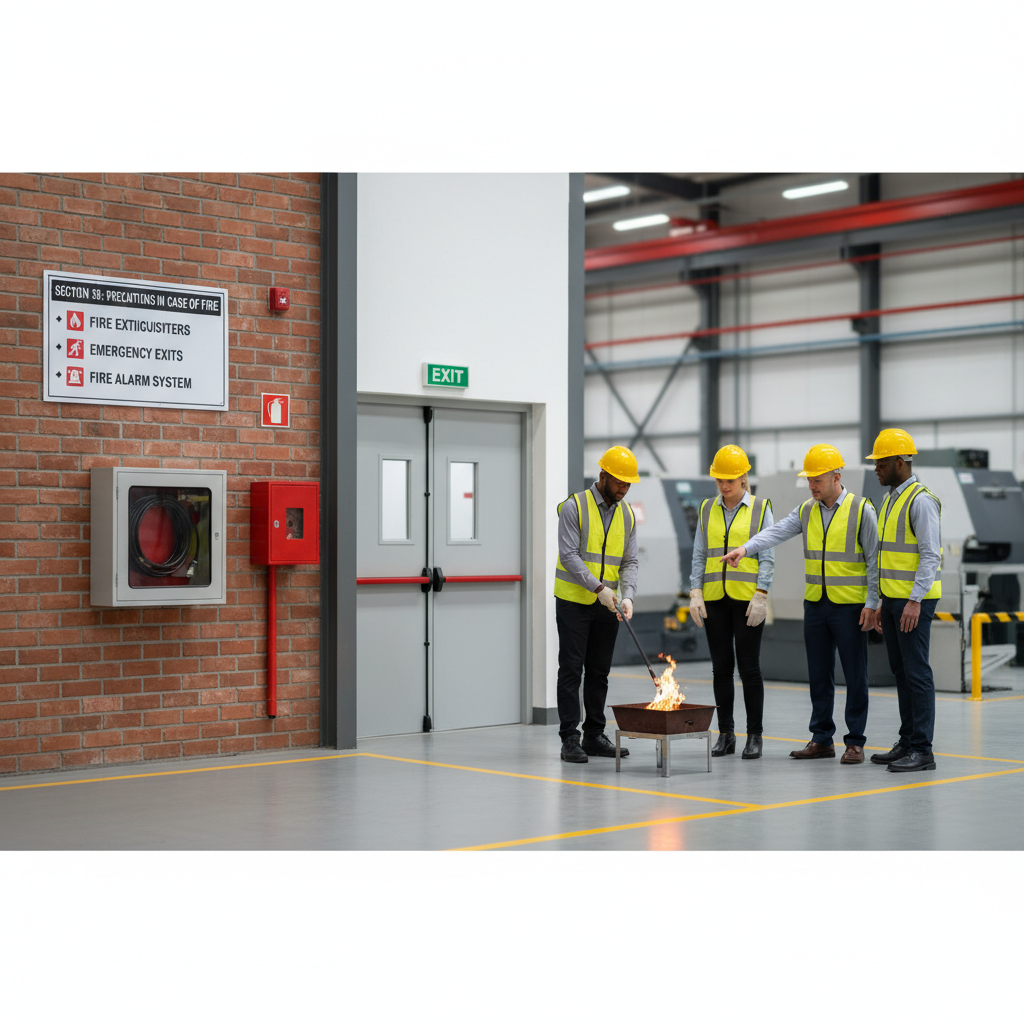
The Statutory Framework of Section 38
In the Factories Act, 1948, Section 38 is not merely a suggestion; it is a mandatory safety performance standard. It dictates that in every factory, all practicable measures shall be taken to prevent the outbreak of fire and its spread, both internally and externally.
The Five Pillars of Section 38:
- Safe Means of Escape: Every person must have a clear, unobstructed path to a safe place.
- Alarm Systems: Effective and clearly audible means of giving warning.
- Firefighting Equipment: Provision of “first-aid” fire-fighting equipment (extinguishers, hydrants).
- Training and Drills: Ensuring workers know what to do when the alarm sounds.
- Structural Maintenance: Keeping exits, stairs, and doors in a state of readiness.
2. Technical Breakdown: The “Means of Escape”
The most litigated aspect of Section 38 is the adequacy of exits. In many industrial disasters (like the Triangle Shirtwaist Fire or more recent incidents in Southeast Asia), the primary cause of death was not the fire itself, but the inability to escape.
- Door Orientation: All doors providing exit from a room must be constructed to open outwards. Why? In a panic, a crowd exerts pressure. If a door opens inward, the crush of people prevents it from ever being opened.
- The “Locked Door” Fallacy: Many factories lock fire exits to prevent “theft” or “unauthorized breaks.” Legally, under Section 38, any door providing an exit must never be locked or fastened such that it cannot be easily and immediately opened from the inside.
- Marking: Exits must be marked in a language understood by the majority of workers, typically in red or a luminous color.
3. Active vs. Passive Fire Protection
To meet the “practicable measures” requirement of Section 38, an Occupier must balance two types of protection:
A. Passive Protection (The “Skeleton”)
This involves the building’s construction.
- Fire Walls: Using materials with high fire-resistance ratings (measured in hours) to compartmentalize the factory.
- Fire Stops: Sealing gaps in floors and walls where pipes or cables pass through to prevent “vertical fire spread.”
B. Active Protection (The “Muscles”)
- Automatic Sprinklers: These are often the most effective “practicable measure” for high-load warehouses.
- Fire Hydrant Systems: A pressurized water network independent of the main manufacturing water line.
- Portable Extinguishers: Categorized by the type of fire (Class A, B, C, D, or K).
4. The Intellectual Sparring: The “Compliance vs. Safety” Paradox
As your intellectual partner, I must challenge the premise that following Section 38 equals being safe.
The Logic Gap in Section 38
Section 38 is largely reactive. It focuses on what to do once a fire has started. However, modern safety science (like the Bowtie Model) suggests that 90% of the effort should be on Prevention (Proactive) rather than Mitigation (Reactive).
The Counterpoint: Does Section 38 do enough to regulate Ignition Sources?
The Act is relatively silent on the “Fire Triangle” (Fuel, Heat, Oxygen). In a modern chemical factory, the “practicable measures” for a dust explosion are vastly different from a textile fire. By providing a “one-size-fits-all” section for fire, the Act risks being too vague to be effective for high-risk industries.
5. Case Study Analysis: Why Section 38 Fails in Practice
When we look at major industrial fires, the violations of Section 38 are almost always identical:
- Storage near Exits: Using the “dead space” behind a fire door to store raw materials.
- Non-functional Alarms: Alarms that are disconnected because they “false trigger” too often.
- The “Ghost” Fire Drill: Registering a fire drill in the logbook that never actually happened.
The Truth over Agreement:
The failure isn’t in the law; it’s in the Inspection Machinery. If a factory inspector is overburdened (often responsible for 500+ factories), the “verification” of Section 38 becomes a paperwork exercise rather than a physical inspection.
6. The Physics of Industrial Fire (For the Professional)
To truly understand Section 38, one must understand Flashover. Flashover is the near-simultaneous ignition of most of the directly exposed combustible material in an enclosed area.
Once a room reaches flashover (usually around 500°C to 600°C), survival is impossible, even with the best “Means of Escape.” Therefore, Section 38’s focus on “speed of evacuation” is a race against the clock of physics.

If the time to evacuate is greater than the time to flashover, the factory design has failed, regardless of how many fire extinguishers are on the wall.
7. Responsibility and Penalties
Under Section 92, if Section 38 is violated, the Occupier and the Manager are held jointly responsible.
- Culpability: In the event of death, the lack of a “safe means of escape” can transition from a civil fine to Culpable Homicide in several jurisdictions.
- The “Occupier” Defense: Owners often try to delegate fire safety to a low-level “Safety Officer.” However, the courts have consistently ruled that the “Occupier” (the person with ultimate control over the affairs of the factory) cannot delegate the legal liability of Section 38.
Conclusion: Is Section 38 Enough?
Section 38 provides the legal skeleton, but it lacks the “brain” of a modern Fire Risk Assessment (FRA). A factory that merely complies with the letter of Section 38 might still be a death trap if it doesn’t account for specific chemical reactivities or modern building materials that emit toxic cyanide gas when burned.
Draft a “Fire Risk Assessment Checklist” that goes beyond Section 38
To move beyond the bare minimum of Section 38 (which focuses primarily on exits and basic equipment), we must shift from a “compliance” mindset to a “risk management” mindset.
Section 38 is reactive; a true Fire Risk Assessment (FRA) is proactive. It doesn’t just ask if you have an extinguisher; it asks if the extinguisher is actually accessible when a panicked human is running through smoke.
1. Ignition & Fuel Source Control (The “Fire Triangle”)
Section 38 barely mentions the causes of fire. A robust checklist must address the chemical and electrical reality of your specific floor.
- Electrical Load: Are “temporary” extension cords being used as permanent wiring? (A common cause of industrial fires).
- Arson/Security: Are external waste skips or fuel tanks secured against unauthorized access?
- Hot Work Permits: Is there a formal sign-off process for welding or grinding that lasts after the work is done to check for smoldering?
- Static Electricity: In areas with flammable vapors, are all containers and pipes properly bonded and earthed?
2. Structural & Passive Fire Protection
Compliance often stops at “clear exits.” A strategic assessment looks at how the building itself will behave during a “flashover.”
- Fire Compartmentation: Are “fire stops” (intumescent seals) present where cables or pipes pass through walls? (If not, a fire in one room becomes a fire in the whole factory in minutes).
- Fire Doors: Are they just present, or are they propped open with wooden wedges? (A propped-open fire door is legally a “door,” but functionally a “chimney”).
- Surface Spread of Flame: Are wall linings (insulation, soundproofing) fire-rated, or will they accelerate the fire?
3. The “Human Element” & Ergonomics of Escape
Section 38 mandates “training,” but it doesn’t account for human psychology under stress (the “bystander effect” or “herd behavior”).
- Travel Distance Logic: Don’t just measure the distance to the exit. Is the path blocked by “temporary” pallets? (In a fire, 10 extra seconds spent moving a pallet is the difference between life and death).
- Vulnerable Persons (PEEPs): Are there Personal Emergency Evacuation Plans for staff with disabilities or temporary injuries?
- Night Shift Readiness: Is the emergency lighting sufficient for a power-outage at 3:00 AM?
- False Alarm Fatigue: Does the staff ignore the alarm because it goes off “all the time”? If so, your technical system has failed.
4. Maintenance & Technological Redundancy
- Remote Monitoring: If the factory is empty at night, who receives the alarm? A local siren is useless if no one is there to hear it.
- Integrated Shutdowns: Does the fire alarm trigger the HVAC system to shut down? (Otherwise, your ventilation might literally “fan the flames”).
- Water Supply Pressure: Has the flow rate of the hydrants been tested recently, or is the pipe corroded and choked?
Intellectual Sparing: The Illusion of Safety
I’ll challenge the very idea of a “Checklist.” The danger of a checklist is that it creates a “Checked-Box Fallacy.” A manager walks the floor, ticks the boxes, and feels safe.
The Counterpoint: Fire is dynamic; checklists are static.
- Logic Test: If your checklist says “Extinguishers Present,” it’s technically “True.” But if that extinguisher is a CO2 model placed next to a wood pile (Class A fire), it is effectively useless and potentially dangerous (it could blow the burning embers around).
- Truth over Agreement: Most “compliant” factories are one poorly placed lithium-ion battery or one oily rag away from a total loss because the system is compliant but the culture is lazy.
Draft a “Scenario-Based Audit” (e.g., “The Loading Dock Fire”) to test your team’s logic beyond a simple yes/no checklist?
To move beyond the “Compliance Checklist” mindset, we need to test systems thinking and compounding risk. A simple checklist asks, “Is there a fire extinguisher?” A scenario-based audit asks, “Can you actually reach it, and does the staff know why the fire started in the first place?”
Here is a high-stakes scenario designed to expose the gaps between the Factories Act (Sections 38 & 41) and real-world operational chaos.
The Scenario: “The Midnight Flashover”
The Setting: It is 11:30 PM (Night Shift). A heavy rainstorm has caused minor flooding near the secondary exit of the Loading Dock.
The Incident: A forklift operator, rushing to meet a midnight shipping deadline, clips a stack of “non-hazardous” solvent drums. One drum leaks. Simultaneously, a maintenance worker 10 feet away is using a portable angle grinder to fix a jammed dock leveler. A spark hits the vapor trail. Flash fire occurs.
Phase 1: The Immediate Response (Testing Sections 38 & 41A)
The Conflict: * The nearest fire extinguisher is blocked by three “temporary” pallets of finished goods.
- The “Emergency Exit” near the flooding is padlocked because “rain was getting in and damaging the inventory.”
- The night-shift supervisor is a new hire who hasn’t been added to the “Emergency Coordination” WhatsApp group yet.
Audit Questions for your Team:
- Prioritization: If the primary exit is blocked by fire and the secondary is padlocked to “protect inventory,” who holds the legal liability for the lockout—the Floor Supervisor or the Warehouse Manager?
- The “Checklist” Failure: The monthly audit marked the fire extinguisher as “Present and Charged.” Why did that audit fail to account for “Spatial Accessibility” under dynamic loading conditions?
Phase 2: The Cascading Failure (Testing Section 7 & 41C)
The Conflict: As the fire spreads, the heat triggers the overhead sprinklers. However, the runoff water—now mixed with the spilled solvent—flows into the factory’s internal drainage system, which was recently modified but not updated in the “Site Plan” submitted to the Inspector of Factories.
Audit Questions for your Team:
- Logic Test: We focus on stopping the fire. But under Section 41C, did we fail the “Hazardous Process” mandate by not having a containment bund for “non-hazardous” volumes that become hazardous when mixed with fire-suppressant water?
- The Disclosure Gap: If the drainage modification wasn’t reported (Section 7), does the “Act of God” (the rain/flood) absolve the Occupier, or does the “unauthorized structural change” nullify our insurance and legal standing?
Phase 3: The Human Element (Testing Section 59 & 64)
The Conflict: The forklift operator has been working “Double-Back” shifts (16 hours total) to cover for a sick colleague. His reaction time was arguably slowed by fatigue.
Audit Questions for your Team:
- The Root Cause: Was the fire an “Equipment Failure” (the forklift) or a “Regulatory Failure” (violation of Section 51/54 regarding working hours)?
- The Ethics of Overtime: If the factory pays double wages for overtime (Section 59), does the financial “incentive” to work longer hours create a “Moral Hazard” that the Factories Act fails to regulate?
The “Socratic” Debrief
To truly spark an intellectual duel with your team, present them with this Counter-Point:
”The Factories Act mandates physical barriers and static rules. However, this fire happened because of fluid decisions (locking a door for rain, working a tired employee). If our safety manual is 500 pages of rules, but our culture allows ‘one-time’ shortcuts for deadlines, does the manual actually exist?“
Provide the “Ideal Auditor’s Scorecard” for this specific scenario to see how you would grade your team’s responses?
To evaluate a team’s performance against the Factories Act, an auditor shouldn’t just look for “compliance” (which is a low bar); they should look for systemic resilience.
Grading team on their ability to close the gap between de jure (the law) and de facto (the reality). Here is the “Ideal Auditor’s Scorecard”
🏆 The Auditor’s Strategic Scorecard
| Category | High-Performance Metric (A-Grade) | Failure Mode (F-Grade) | Weight |
|---|---|---|---|
| Operational Logic | Can the team explain why Section 21 (Fencing) fails in high-speed changeover environments? | Merely pointing at a guard and saying “it exists.” | 25% |
| The “Ghost Worker” Test | Does the welfare provision (Sec 46-48) account for contract/gig workers, or only “permanent” staff? | Ignoring non-payroll staff who use the same floor. | 20% |
| Hazardous Foresight | Is the Sec 41B disclosure understandable to a worker with primary education, or is it “legalese”? | Hiding risk behind complex MSDS sheets. | 20% |
| Overtime Integrity | Does the biometric data match the Sec 59 payout, or is there “off-clock” maintenance happening? | Accepting manual logs at face value. | 15% |
| Occupier Accountability | Is the “Occupier” (Sec 2n) a C-suite executive with skin in the game, or a “sacrificial” junior manager? | Identifying a person with no budgetary power. | 20% |
🧠 The Intellectual Challenge: Three “Audit Traps”
I would set these traps for your team to see if they are actually thinking or just reciting the Act:
1. The “Cleanliness” Paradox (Section 11)
- The Trap: An auditor walks into a factory that is “spotless.”
- The Sparring Point: Extreme cleanliness in a chemical or wood-processing plant often indicates that cleaning happened just for the audit, potentially masking chronic dust accumulation (Section 14) in ventilation ducts. I grade higher for “working mess” with localized extraction than for “theatrical” cleanliness.
2. The Welfare Ceiling (Section 46)
- The Trap: A factory has 248 workers and no canteen.
- The Sparring Point: If the team doesn’t flag this as a “compliance dodge,” they fail. An ideal auditor looks for “artificial headcount suppression”—where a company uses 50 contractors to stay under the 250-worker threshold for mandated canteens.
3. The “Silent” Safety Hazard (Section 13)
- The Trap: The thermometer says 25°C.
- The Sparring Point: Temperature isn’t just a number; it’s about Wet Bulb Globe Temperature (WBGT). If the team hasn’t measured humidity in a textile mill, the “25°C” is a lie. Do they understand the physics of heat stress, or just the text of the law?
