


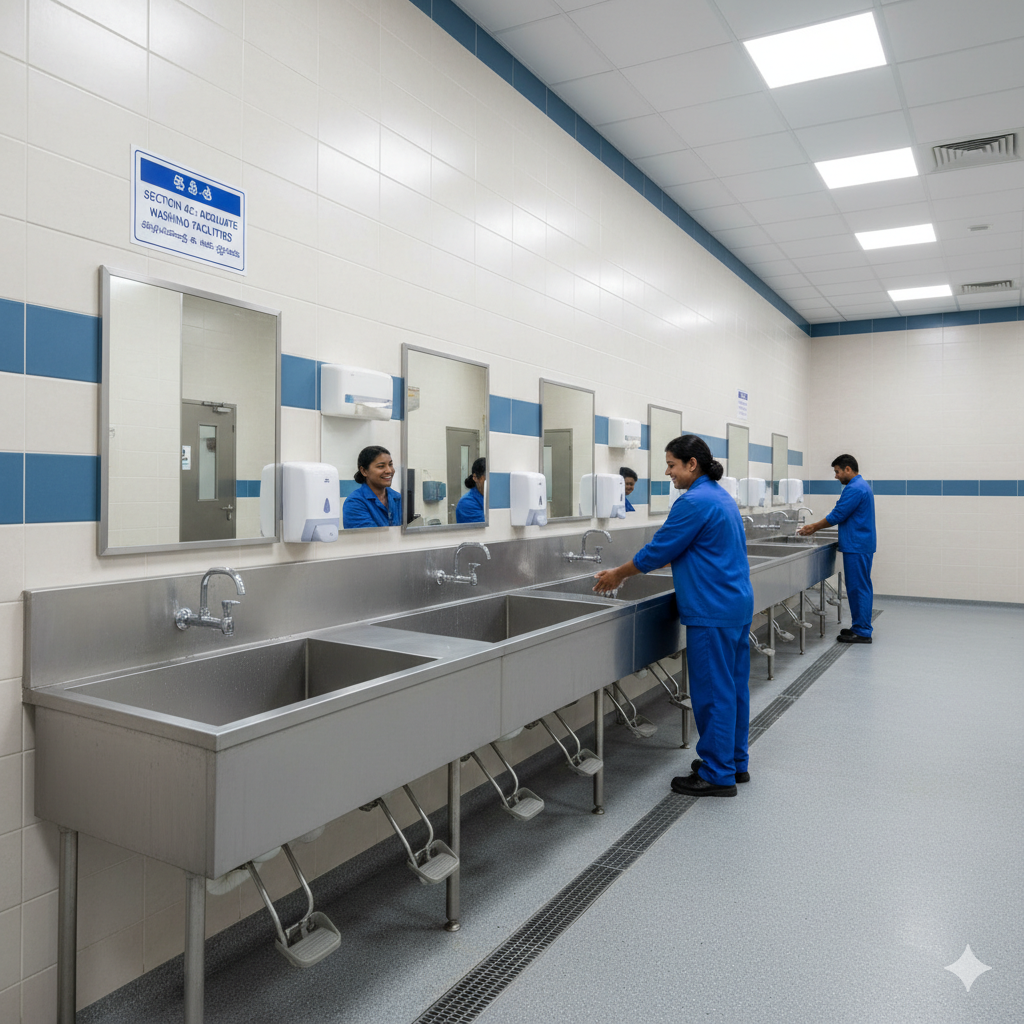


Section 42 of the Factories Act, 1948, is deceptively simple. It mandates that in every factory:
- Adequate and suitable facilities for washing shall be provided and maintained for the use of the workers therein.
- Separate and adequately screened facilities shall be provided for the use of male and female workers.
- Such facilities shall be conveniently accessible and shall be kept in a clean and orderly condition.
II. Technical Deconstruction: What is “Adequate”?
The primary criticism of Section 42 is the ambiguity of the word “adequate.” In legal sparring, ambiguity is either a tool for flexibility or a loophole for negligence.
1. The Ratio Problem
While the Act itself is vague, state-specific Factory Rules usually define “adequacy” based on headcount.
- The Logic: If you have 500 workers ending a shift at 5:00 PM, and only 5 taps, the facility is not “adequate” because the “time-cost” to the worker is too high.
- The Counterpoint: Does the law account for the nature of the work? A software assembly plant (clean) and a lead-acid battery plant (toxic) are governed by the same “washing facility” heading, yet the biological necessity for decontamination in the latter is infinitely higher.
2. The “Suitable” Criterion
- Enclosure: Facilities must be screened. This is a matter of dignity and privacy.
- Maintenance: “Maintained” implies a continuous duty. An empty soap dispenser or a broken pipe is a violation of Section 42 just as much as a missing sink.
III. Gender Segregation and the “Hidden” Architecture
Section 42(1)(b) mandates separate facilities for men and women.
- The Assumption: The law assumes a binary workforce. In 1948, this was the social norm. In 2026, the lack of provisions for non-binary or transgender workers in industrial legislation creates a “legal vacuum.”
- The Design Flaw: Frequently, female washing facilities are placed in “out of the way” areas for privacy, which can inadvertently create safety risks (harassment/dark corridors). True “suitability” requires integrating security with privacy.
IV. The Economic Sparring: Compliance vs. Cost
Why do factories struggle with Section 42?
| Factor | Employer’s Perspective | Worker’s Perspective |
|---|---|---|
| Water Scarcity | Cost of water and effluent treatment is a “non-productive” expense. | Essential for post-shift hygiene and preventing “take-home” toxins. |
| Space | Every square foot of washing area is a square foot lost for machinery. | Crowded facilities lead to skin infections and poor morale. |
| Automation | Sensor-based taps save water but have high maintenance costs. | Touchless systems are more “suitable” for preventing cross-contamination. |
The “Toxic” Oversight
Section 42 is often treated as a “comfort” provision, but in chemical or heavy metal industries, it is a Safety provision.
The Argument: If a worker in a dyes and chemicals factory cannot wash their hands thoroughly due to poor Section 42 compliance, they ingest toxins during lunch.
The Counterpoint: Should Section 42 be merged with Section 14 (Dust and Fumes)? By separating “Health” and “Washing,” the law treats hygiene as an afterthought rather than a primary defense against occupational disease.
VI. Modern Industrial Reality: Beyond the 1948 Lens
In the 21st century, we must ask if Section 42 is enough.
- Sustainability: Does the Act encourage water recycling? (No).
- Ergonomics: Does it specify the height of sinks or the type of flooring to prevent slips? (Rarely).
- Micro-biological Safety: In a post-pandemic world, “washing facilities” must include high-grade sanitization, which the 1948 Act never envisioned.
Section 42 is the bridge between Industrial Labor and Human Dignity. While the text is brief, its implementation is a battleground between operational efficiency and the biological needs of the human “component” in the manufacturing process.


3 Comments
You can definitely see your enthusiasm within the work you write. The arena hopes for more passionate writers like you who are not afraid to mention how they believe. All the time follow your heart.
This is a very good tips especially to those new to blogosphere, brief and accurate information… Thanks for sharing this one. A must read article.
Hi there! This post couldn’t be written any better! Reading through this post reminds me of my previous room mate! He always kept talking about this. I will forward this article to him. Pretty sure he will have a good read. Thank you for sharing!