


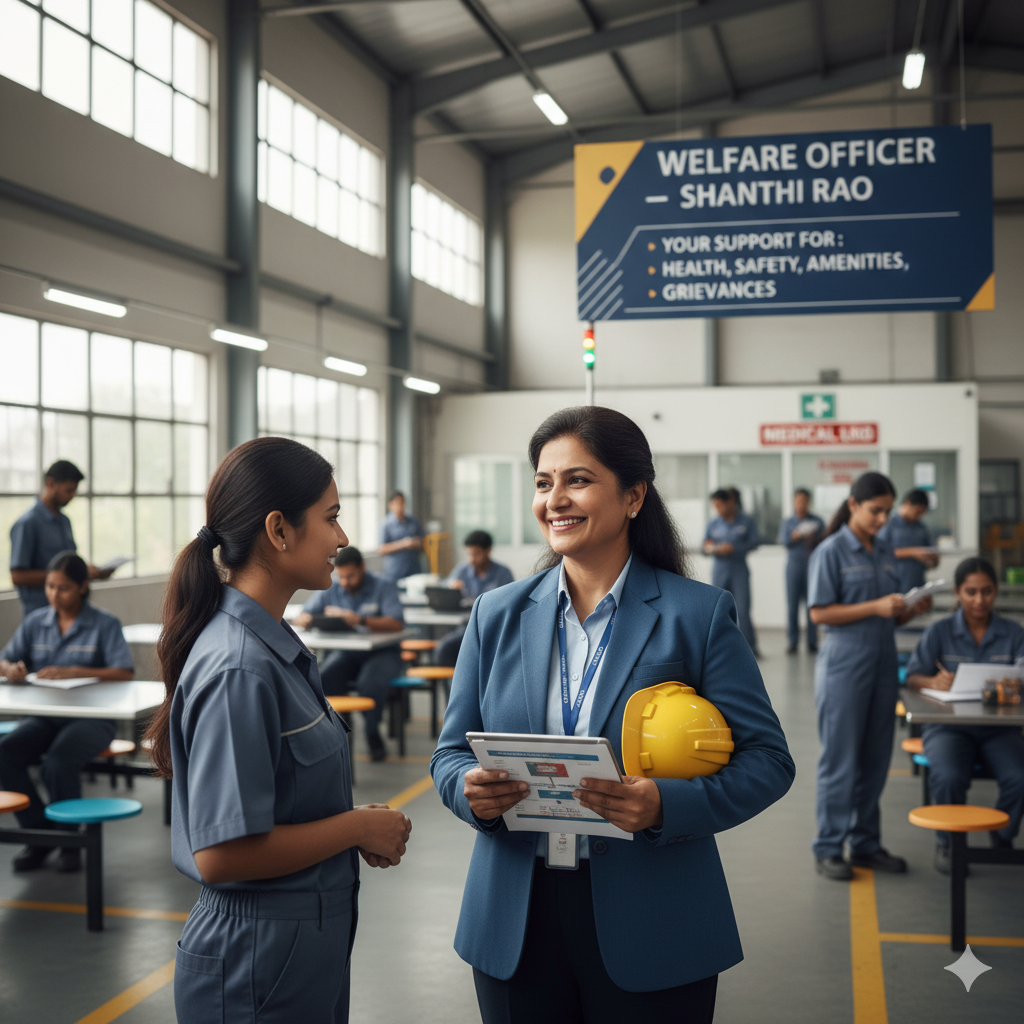


The Anatomy of Section 49: The Welfare Officer
1. The Statutory Mandate: The “Why” and “When”
Section 49 is deceptively short in the original text, but it carries immense weight. It states:
- In every factory wherein five hundred or more workers are ordinarily employed, the occupier shall employ in the factory such number of welfare officers as may be prescribed.
- The State Government may prescribe the duties, qualifications, and conditions of service of officers employed under sub-section (1).
The Logic Test: The “500” Threshold
Why 500? In 1948, this number represented a “large-scale” industrial unit where personal contact between the owner (Occupier) and the laborer was lost. The Welfare Officer was intended to be the bridge.
Counterpoint: In the modern context, a factory of 450 workers dealing with high-stress precision electronics might need a Welfare Officer more than a textile mill of 550. The rigid numerical threshold ignores the intensity of labor and the psychological complexity of modern manufacturing.
2. Qualifications: The Intellectual vs. The Practitioner
State Rules (such as the Maharashtra or Tamil Nadu Factory Rules) typically demand:
- A University degree.
- A Degree or Diploma in Social Sciences/Labor Welfare/Industrial Relations.
- Knowledge of the local language (Crucial for the “Bridge” function).
The Sparring Perspective: Qualification vs. Competence
The Act mandates “Social Science” training. This assumes the Welfare Officer is a social worker in an industrial setting. However, in the 21st century, is a social worker equipped to handle the ergonomics of robotic assembly lines or the mental health crises of a high-pressure KPIs environment? We are seeing a shift where the “Statutory Welfare Officer” is often sidelined by “HR Business Partners” because the law focuses on certificates rather than organizational psychology.
3. The Tripartite Conflict: The Officer’s “Identity Crisis”
The Welfare Officer occupies a unique, often uncomfortable, space between three forces:
| Stakeholder | Expectation of the Welfare Officer | The Reality |
|---|---|---|
| The State | A “Neutral Watchdog” ensuring the Act is followed. | Often viewed as a “snitch” by Management. |
| The Occupier | An employee who maintains peace and avoids strikes. | Viewed as a cost center rather than a profit center. |
| The Workers | A champion of their rights and grievances. | Often viewed with suspicion as “the boss’s man.” |
The Paradox: Can a person paid by the employer truly be a neutral advocate for the worker? Section 49 attempts to protect their “Conditions of Service” to prevent arbitrary firing, but the power dynamic is inherently skewed.
4. Duties and Responsibilities (The Micro-Level)
Under the State Rules associated with Section 49, the duties are expansive:
A. Supervisory Duties
- Canteens & Creches: Ensuring the quality of food and the safety of children (Sections 46 & 48).
- Sanitation: Monitoring the “Health” chapters of the Act.
- Medical Facilities: Coordinating with the Certifying Surgeon.
B. Advisory Duties
- Advising management on the formulation of a labor policy.
- Helping to maintain harmonious industrial relations.
- Advising on the payment of bonuses and wages (The economic bridge).
C. The “Safety Liaison”
While there are separate Safety Officers (Section 40-B), the Welfare Officer must monitor the human impact of safety. If a machine is “fenced” (Section 21) but the worker finds it impossible to meet their quota because of the fence, the Welfare Officer is the one who must address the resulting stress or “work-around” behaviors that lead to accidents.
5. Challenging the “Welfare” Philosophy
The term “Welfare” itself is paternalistic. It suggests that the worker is a passive recipient of the factory’s “kindness” (clean water, a place to sit, a canteen).
The Counter-Argument:
In a rights-based framework, these aren’t “welfare” perks; they are fundamental industrial rights. By labeling the officer as a “Welfare Officer,” the law frames these needs as “charity” or “amenities” rather than “infrastructure for dignity.”
The Evolution: From Welfare to Wellbeing
If we were to rewrite Section 49 today, we would likely replace “Welfare” with “Wellbeing.”
- Welfare: “Is there enough water in the tank?”
- Wellbeing: “Is the heat stress in the boiler room causing long-term kidney damage?”
6. Judicial Interpretations and Protection
Courts have often had to step in to protect the Welfare Officer. In various landmark cases, Indian High Courts have ruled that a Welfare Officer cannot be dismissed as easily as a regular clerk. Since they perform a statutory duty, their termination often requires the concurrence of the Labor Commissioner.
Logic Check: If the Welfare Officer reports that the Canteen is unhygienic, and the Occupier gets angry and fires them, the Act fails. Therefore, Section 49(2) gives the State Government the power to regulate their “Conditions of Service.” This makes the Welfare Officer a “Quasi-Public Servant” embedded in a private entity.
7. The Future of Section 49 in the “New Labor Codes”
As many jurisdictions move toward consolidating labor laws (like the Occupational Safety, Health and Working Conditions Code in India), the role of the Welfare Officer is being merged into broader HR and Safety roles.
The Risk: By merging the Welfare Officer into HR, we lose the “Social Work” aspect. HR’s primary loyalty is to the brand and productivity. The Welfare Officer’s primary loyalty (theoretically) is to the human being.
Summary for your Sparring Session:
Section 49 is the “Conscience” of the factory. However, it is a conscience that is:
- Underfunded: Management often treats the office as a storage closet.
- Underpowered: They have the duty to report, but rarely the power to enforce.
- Outdated: It focuses on physical amenities while modern workers suffer from mental burnout and “invisible” occupational diseases.


1 Comment
Thank you for some other magnificent post. The place else may anyone get that kind of info in such an ideal way of writing? I’ve a presentation subsequent week, and I am on the look for such information.