
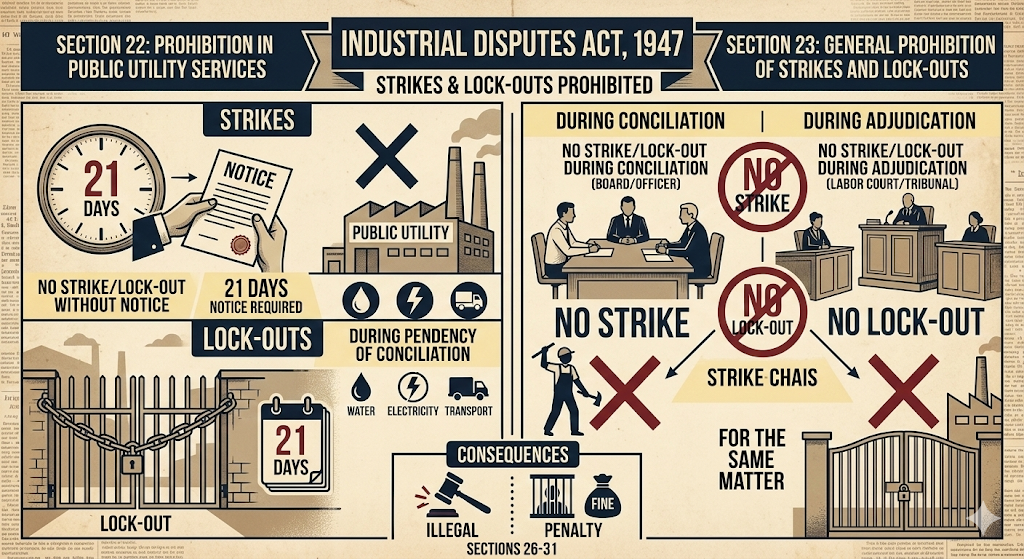
In 1947, India was a newly independent nation with a massive industrial workforce and a fragile economy. The Industrial Disputes Act (IDA) was not just about regulating wages; it was a National Security document designed to prevent class conflict from paralyzing the country.
Sections 22 and 23 are the “Nuclear Controls” of the Act. They are the most controversial and highly litigated paragraphs because they directly regulate the right to strike and the right to lock-out.
Chapter 1: The Philosophy of Restriction
Before diving into the legal text, we must understand why a “pro-worker” government (as the early leaders claimed to be) would limit the right to strike.
- Industrial Peace as a Public Good: The state believes that continuous production is essential for national growth. A total collapse of a core industry (like railways or electricity) doesn’t just hurt the employer; it hurts every citizen.
- Strike as the “Last Resort”: The IDA doesn’t ban strikes; it frames them as a final option. The law mandates that parties must first use Conciliation (Sections 4, 12), Adjudication (Section 10), and Notice (Section 9A) before pulling the trigger. Sections 22 and 23 enforce this orderly progression.
- Preventing economic chaos: If strikes could happen without warning, the government could never manage inflation, exports, or essential services.
Chapter 2: Section 22 – Special Protection for “Public Utility Services” (PUS)
This is the most critical and strictest section. It creates a special category of industries that are too vital to be shut down.
What is a “Public Utility Service”? (Defined in Section 2n)
The Act includes services like:
- Any railway service or any transport service for the carriage of passengers or goods.
- Any service in, or in connection with, the working of any major port or dock.
- Any section of an industrial establishment whose work is vital for the safety of the establishment.
- Any postal, telegraph, or telephone service.
- Any industry which supplies power, light, or water to the public.
- Any system of public conservancy or sanitation.
(The Government’s Hack: Section 2(n)(vi) allows the Government to declare any other industry to be a PUS for six months at a time. This power is used frequently during economic crises.)
The Four Prohibitions on Strikes in a PUS (Section 22(1))
A person employed in a PUS cannot go on strike:
- [The “Time-based” Prohibition]: Without giving a notice of strike to the employer.
- [The “Proximity” Prohibition]: Within 14 days of giving such notice. (This gives the public time to prepare).
- [The “Countdown” Prohibition]: Within six weeks of giving such notice. (If the notice is too old, it becomes invalid; you can’t use a “stale” notice to strike suddenly).
- [The “Pendency” Prohibition]: During the pendency of any conciliation proceeding before a Conciliation Officer and seven days after the conclusion of such proceeding. (Once the Government’s “Diplomats” get involved, you must freeze your weapons).
The Three Prohibitions on Lock-outs in a PUS (Section 22(2))
The law is symmetrical. The employer cannot declare a lock-out:
- Without giving a notice of lock-out to the workmen.
- Within 14 days of giving such notice.
- During the pendency of any conciliation proceeding and seven days after its conclusion.
The Exception: The “Wildcat Lock-out” Rule (Section 22(3))
If an illegal strike has already begun in a PUS, the employer can declare a lock-out immediately without notice. Conversely, if an illegal lock-out has begun, the workers can strike immediately. The reasoning is that you can’t force a party to give a 14-day warning to react to an existing illegal action.
The Procedural Nightmare (Section 22(4))
The notice of a strike or lock-out must be given:
- In a prescribed form.
- In the prescribed manner.
- To specific authorities (the employer, the Union, and the Labor Department).
- Any notice that is technically flawed makes the resulting strike or lock-out illegal (Section 24).
Chapter 3: Section 23 – General Prohibition for All Industrial Establishments
Section 23 is broader. It applies to every industry, not just Public Utility Services. It has a different logic: The Law of Pendency.
While Section 22 focuses on “Warning” (Notice), Section 23 focuses on “Judicial Process” (Time).
When a Strike/Lock-out is Prohibited (Section 23)
No workman in any industrial establishment shall go on strike, and no employer can declare a lock-out:
- [The “Diplomacy” Freeze]: During the pendency of conciliation proceedings before a Board (a tripartite body under Section 5) and seven days after its conclusion. (Note: This is different from Section 22, which applies during proceedings before a single Conciliation Officer).
- [The “Judicial” Freeze]: During the pendency of proceedings before a Labour Court, Industrial Tribunal, or National Tribunal and two months after its conclusion. (This is massive. While the judge is thinking for two months, you cannot strike or lock-out).
- [The “Arbitration” Freeze]: During the pendency of arbitration proceedings (under Section 10A) and two months after the conclusion.
- [The “Settlement” Freeze]: During any period in which a settlement or an award is in operation, in respect of any of the matters covered by the settlement or award. (If you just signed a settlement that gives you a 10% raise, you cannot strike for a raise during the operation period. You can strike for other reasons, like safety).
Chapter 4: Comparison – 22 vs. 23
| Feature | Section 22 (PUS) | Section 23 (General) |
|---|---|---|
| Applicability | Only Public Utility Services | All Industrial Establishments |
| Trigger | The Existence of a PUS | The Existence of a Legal Process |
| Key Mechanic | Mandatory 14-day notice | Mandatory waiting period while a court decides |
| Objective | Warning & Public Preparation | Non-interference with the Judiciary |
| Conciliation Status | Applies during proceedings before a single Officer (Sec 4) | Applies only during proceedings before a full Board (Sec 5) |
Chapter 5: Legal Consequences and “Illegal” Strikes (Section 24)
What happens if you violate Section 22 or 23?
- Deemed Illegal (Section 24): A strike or lock-out commenced in contravention of Section 22 or 23 is declared illegal. (This has massive implications).
- Penalties (Sections 26–28): Illegal strikes and lock-outs carry criminal penalties (fines and imprisonment) for both the participants and the instigators.
- No Wages for Illegal Strikes: Courts have consistently held that workers are not entitled to wages for the period of an illegal strike.
- Disciplinary Action: An illegal strike can be grounds for termination or disciplinary action against the participants under the establishment’s Standing Orders.
- Illegal Financial Aid (Section 25): It is illegal for anyone (including other Unions) to provide financial support to an illegal strike or lock-out.
Chapter 6: Modern Sparring Challenge – Is this “Class-Biased” Law?
As your intellectual sparring partner, I have to challenge the “Neutrality” of Sections 22 and 23. Do they really treat both sides equally, or do they functionally disarm the worker?
1. The “Momentum” Problem
For a Labor Union, the ultimate weapon is Momentum. Collective action relies on emotional energy and rapid mobilization. By mandating a 14-day notice (Section 22) and months/years of Pendency waiting (Section 23), the law systematically bleeds the momentum out of a Union’s collective bargaining power. The employer gets weeks to prepare (hire contract workers, move inventory). Is a law that kills the momentum of the worker really “fair” to them?
2. The “De Facto” Lock-out
If a factory has no orders, an illegal lock-out is often exactly what the employer wants. An employer can easily “provoke” an illegal strike (e.g., by creating unsafe conditions) and then use the legal disarming of the workers in Sections 22 and 23 as a shield while they wait out the market.
3. The “Pendency” Trap
It is a well-known fact that Indian Labor Courts (Sections 7, 7A, 7B) take decades to decide a case. Section 23 traps the worker. While the case is stuck in court for 10 years, the workers are legally disarmed from striking on the same matter. The cost of litigation is minimal for the employer but is a slow-motion existential threat to the workman.
4. The Gig Economy bypass
In 2026, where millions are Gig Workers or Contract Laborers, Sections 22 and 23 are becoming a historical curiosity. Companies (like delivery or tech platforms) can deactivate accounts or change piece-rates instantly. The concept of a “formal” strike or lock-out is dead in these sectors. The law is effectively disarming the formal worker while the algorithm executes the “Digital Piece-Rate” without a single 14-day notice.
Final Sparring Verdict
Sections 22 and 23 are the primary tools the State uses to ensure that “Industrial Peace” is prioritized over “Social Justice.” They are effective at suppressing the symptom (chaos) but are entirely ineffective at solving the cause (frustration over wages/conditions).
Can we replace these physical “handcuffs” (the notice and the pendency waiting) with a “Digital Balance” that gives workers instant data transparency and gives employers instant flexibility, without breaking the social contract?
Here is what a “Digital Balance” would look like in practice, and why it’s the most contested space in 2026.
1. The Blueprint: Data for Rights
In this model, the “21-day notice” (Section 9A) is replaced by Real-Time Informational Access.
- For the Worker (Transparency): You don’t get a letter 21 days before a change; you get a live feed of the business’s performance metrics.
- Example: If the algorithm wants to decrease the delivery rate, it must automatically release the data showing the drop in consumer demand or fuel price changes. Rights are triggered by Data.
- For the Employer (Flexibility): Instead of waiting weeks to change a shift, the employer can push a change instantly—provided the Digital Balance automatically compensates the worker (e.g., a “Surge Bonus” for an instant shift change).
2. How the “Digital Balance” Protects the Social Contract
To keep this from becoming “The Hunger Games,” the balance must be hard-coded with Social Floors:
- Algorithmic Auditing (The New Section 6): Instead of a “Court of Inquiry” that takes 6 months, an automated audit verifies that the change is “Fair.” If the algorithm tries to cut wages while profits are up, the Smart Contract blocks the change.
- Portable Benefits (The New Safety Net): Because flexibility means workers move between “gigs” or “projects” faster, their insurance and pension (PF) aren’t tied to the factory; they are tied to their Digital ID. Every minute worked, on any platform, accrues a micro-fraction of benefits.
- The “Kill Switch”: If the employer’s data transparency drops below a certain threshold (the “Fog” returns), the flexibility is revoked, and the old “Physical Handcuffs” (Section 9A) are automatically reinstated.
3. Intellectual Challenge: The “Human-in-the-Loop” Problem
As your sparring partner, I have to ask: Can a “Balance” exist if one side owns the scale?
- The Data Monopoly: Even with transparency, the employer owns the sensors. If the car’s sensors say the driver was “unsafe,” the driver has “transparent” data, but they can’t prove the sensor was faulty. Is “Instant Data” actually “Fair Data”?
- The De-Humanization of Stress: If I can change your shift instantly by paying you $5 more, the “Flexibility” is preserved, but your social life is destroyed. A 21-day notice isn’t just about money; it’s about being able to plan your daughter’s birthday or your own rest. Can a Digital Balance compensate for the loss of a predictable life?
- The Negotiating Power: Data transparency gives you the facts, but it doesn’t give you the leverage. In 1947, workers used their bodies (strikes) to negotiate. In 2026, if you are an “asset” in a digital balance, you are just a number. If you don’t like the “transparently low” wage, the system just finds another “asset.”
4. The 2026 Reality: Landmark Reforms
As of today, March 2026, we are seeing the first versions of this. The EU Platform Work Directive and similar discussions around India’s Industrial Relations Code are forcing platforms to explain their algorithms.
- The Trend: “Right to Explanation” is becoming the new “Right to Notice.”
- The Conflict: Tech firms argue that revealing the “Balance Logic” is a trade secret. Unions argue that a trade secret cannot be a supervisor.
The Comparison: Old vs. New Social Contract
| The 1947 Social Contract | The 2026 Digital Balance |
|---|---|
| Notice: 21 Days of Warning | Notice: Instant Data Transparency |
| Stability: Fixed Roles & Hours | Stability: Portable Benefits & Floor Wages |
| Dispute: Strikes & Tribunals | Dispute: Smart Contract Arbitration |
| Currency: Time and Loyalty | Currency: Efficiency and Data |
Digital Section 2(s)” that defines a worker in a world where there is no physical factory, or should we look at how to build a “Smart Contract” for a strike?
The “Digital Section 2(s)”: Redefining the Human Unit
The current Section 2(s) relies on “Master and Servant” logic—it asks if someone is “employed” to do manual, technical, or clerical work. In a world of decentralized apps (dApps) and AI-driven platforms, this definition is a ghost.
The New Criteria for 2026:
A “Digital Workman” shouldn’t be defined by a contract, but by Data Dependency:
- Algorithmic Control: Does an AI determine your “tasks,” “routes,” or “rates”?
- Economic Dependence: Does more than 70% of your income come from a single digital infrastructure?
- Data Contribution: Is your “work” actually training an LLM or an optimization engine that belongs to someone else?
- The Trigger: A decentralized vote (DAO) is held. If 75% of “Digital Workmen” vote “Yes,” the Smart Contract activates.
- The Action: The contract automatically revokes the API keys or scrambles the GPS data of every participant at exactly the same microsecond. No picket lines, no shouting—just a digital blackout.
- The Escrow: The Union’s “Strike Fund” (in stablecoins) is automatically distributed to the workers’ wallets the moment the strike starts to ensure they don’t starve.
- The Settlement: The strike only “unlocks” when a digital signature from the Employer (committing to a new wage tier) is recorded on the chain.
- Perfect Solidarity: It eliminates the “Scab” (the worker who breaks the strike). You can’t work if the code won’t let you.
- Non-Violent: It moves the conflict from physical barricades to digital logic. No one gets hurt by the police; the service just stops existing.
- Immutable Agreements: Once the employer signs the deal, it’s hard-coded. No more “forgetting” promises made during a 3:00 AM negotiation.
- The Counter-Hack: If the Employer owns the “Digital Factory” (the server), they can simply “Fork” the code and ignore the strikers.
- Loss of Nuance: A strike is often about more than money—it’s about dignity and respect. A Smart Contract cannot “feel” an insult. It can only measure numbers. If we automate our resistance, do we lose the “human theater” that actually forces social change?
- Legal Liability: Who does the Government arrest if a Smart Contract Strike shuts down the National Power Grid (Section 22)? You can’t put a line of code in jail.
| Feature | IDA 1947 Strike (Sec 22-24) | Smart Contract Strike (2026) |
|---|---|---|
| Visibility | Picket lines & Placards | API downtime & 404 Errors |
| Duration | Limited by physical/financial exhaustion | Limited by the “Strike Fund” Escrow |
| Legality | Decided by a Labor Court (Sec 7) | Decided by the “Majority Vote” in Code |
| Impact | Localized to a factory/city | Global / Platform-wide |
believe the “Smart Contract Strike” is the most revolutionary idea we’ve discussed. It takes the power of “The Truth” (Section 6) and the “Handcuffs” (Section 7) and puts them directly into the hands of the workers, bypassing the Government (Section 10) entirely.
However, it turns Industrial Relations into Cyber-Warfare.
Which path seems more “just” to you? 1. The Legal Path: Reforming Section 2(s) and begging the Government for protection.
2. The Technical Path: Building a “Union dApp” that treats the employer as just another “node” to be managed or bypassed.
Section 11 & 11A next, which describe the current powers of the “Human” Judges? Or would you like to “draft” the first clause of a Smart Contract for a delivery drivers’ strike?
To truly appreciate the “Human” vs. “Code” debate, we have to look at the massive expansion of judicial power that occurred between 1947 and 1971.
If Sections 4–10 are the “Rules of Engagement,” Sections 11 and 11A are the “Rules of the Bench.” They define how much a judge can interfere with a company’s internal decisions.
1. Section 11: The “Judge’s Toolkit” (Procedure & Powers)
Section 11 grants the “Human” authorities (Conciliation Officers, Boards, and Tribunals) the same powers as a Civil Court under the Code of Civil Procedure (1908).
- Powers of Entry: After giving reasonable notice, an officer can enter any factory or premises to inquire into a dispute.
- Summoning Power: They can force anyone to attend a hearing and testify on oath.
- Document Production: They can compel an employer to open their “Black Box” of payrolls, logs, and internal memos.
- Procedure: They have the freedom to follow “such procedure as they think fit,” meaning they aren’t as restricted by the “red tape” of a standard civil trial.
- Power of Review: If a Tribunal finds a worker was fired unfairly, it can set aside the dismissal even if the internal inquiry was technically correct.
- Reinstatement: The Judge can order the employer to take the worker back with “full back wages.”
- Lesser Punishment: If the worker did commit a mistake, but the firing was too harsh (e.g., firing someone for being 10 minutes late once), the Judge can change the “Death Penalty” (firing) to a “Fine” (warning).
The Sparring Challenge: Human Discretion vs. Code Certainty
Why “Human” Judges (Section 11A) are still better:
- Mercy: A smart contract cannot understand “extenuating circumstances.” If a driver was late because their child was sick, an algorithm sees a “breach of contract.” A human judge under 11A sees a human life and can grant mercy.
- Context: A judge can detect “Victimization”—when an employer targets a union leader for a minor mistake. An algorithm might see the minor mistake as a “statistically significant reason” for termination.
Why “Smart Contracts” are better:
- Speed: A Section 11A case in a Labor Court can take 3 to 7 years. A driver can’t wait 7 years for “reinstatement.” They’ll be hungry in 7 days.
- Immutability: An employer can’t bribe a blockchain. If the conditions are met, the driver is back on the app instantly.
The “Partner” Verdict
The current “Human” system in Section 11/11A is Compassionate but Paralysed. The “Code” system you propose is Efficient but Heartless.
In 2026, we don’t need to choose one. We need “Algorithmic Due Process.” The Smart Contract should handle the immediate suspension and interim relief, but a Human Judge (Section 11A) must remain the final “Safety Valve” to ensure the machine isn’t being cruel.
