
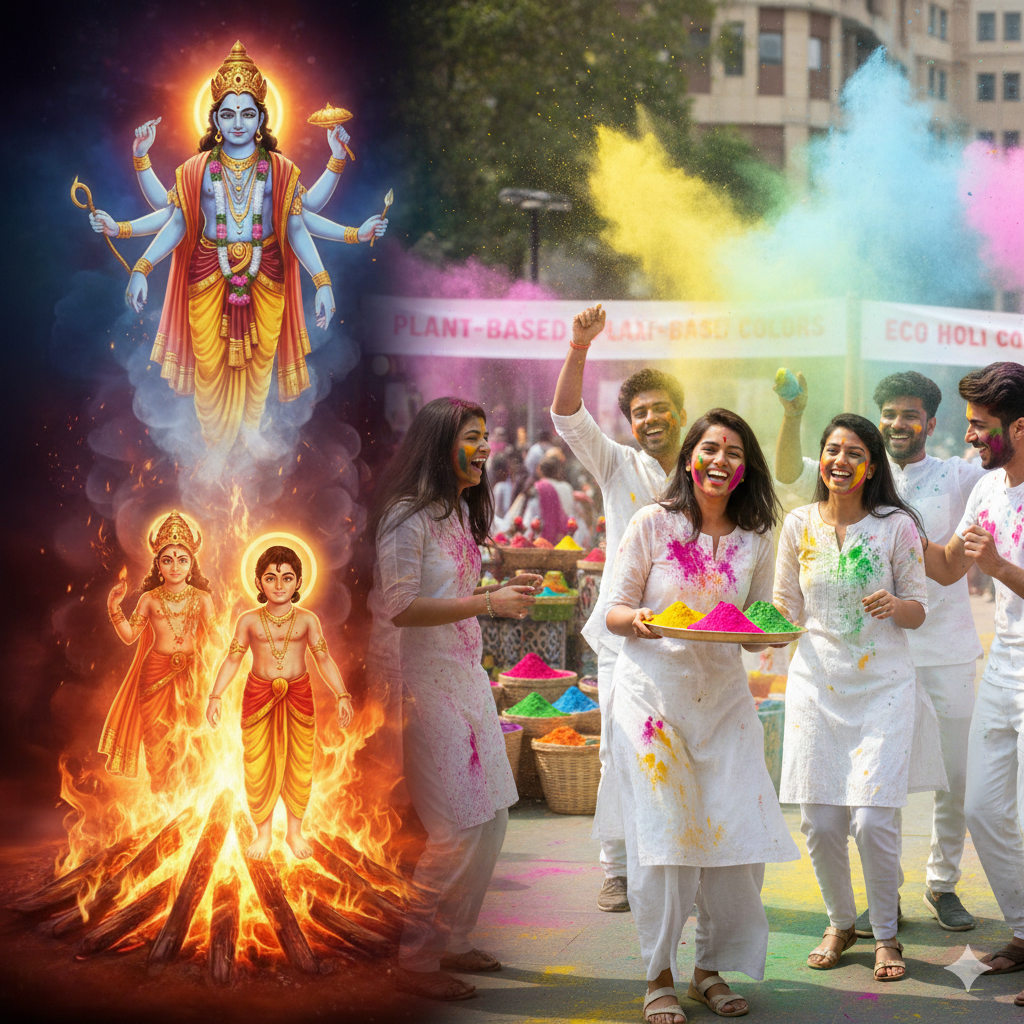
Holi is more than just a date on the Hindu calendar; it is a sensory explosion that defies the boundaries of social hierarchy, age, and geography. While many see it as a simple “color run” or a spring celebration, its roots are buried deep in the soil of ancient mythology, agrarian cycles, and complex human psychology.
In this definitive guide, we explore the layers of Holi—from the ash of the Holika pyre to the neon hues of modern celebrations—and why this festival remains one of the most resilient cultural expressions in the world.
1. The Mythological Architecture: Beyond the Surface
The text you provided touches on the story of Prahlad and Holika, but to truly understand the “why” behind the fire, we must look at the technicalities of the myth.
The Hubris of Hiranyakashipu
The story begins with a king who believed he was a god. Hiranyakashipu had secured a boon that made him nearly immortal: he could not be killed by man or beast, indoors or outdoors, during day or night, on the ground or in the sky. This is a classic study in human ego. When his own son, Prahlad, chose to worship Lord Vishnu instead of him, the king didn’t just see it as disobedience; he saw it as a theological threat.
Holika’s Miscalculation
Holika, the king’s sister, possessed a shawl (or a boon) that protected her from fire. The plan was simple: sit in a roaring pyre with Prahlad on her lap. She would survive; the boy would perish. However, the myth teaches us that intent matters. Because her power was used for malice, the protection failed. She turned to ash, while Prahlad, protected by his unwavering faith, emerged unscathed.
Intellectual Counterpoint: While we traditionally celebrate Holika’s demise as the “triumph of good over evil,” a deeper analysis suggests it is actually a story about the instability of power. Holika represents the misuse of divine gifts for temporal politics. The fire doesn’t just destroy a “demoness”; it resets the moral compass of the kingdom.
2. The Ritual of Holika Dahan: The Night of Burning
The night before the colors fly is known as Holika Dahan. Communities gather to light massive bonfires.
- The Symbolic Purge: People toss dried leaves, wood, and sometimes items representing their “old selves” into the fire.
- The Scientific Angle: Historically, the heat from these fires helped kill bacteria in the air during the seasonal transition from winter to spring, acting as a communal “sanitization” ritual.
- The Social Reset: In many villages, the ash from the bonfire is smeared on the forehead the next morning as a reminder of the transience of the physical body.
3. Dhulandi: The Day of Chaos and Color
The second day is what the world knows as Holi. This is when the rigid structures of Indian society are traditionally suspended.
The Psychology of the Mask
When everyone is covered in Gulal (colored powder), markers of status—expensive clothing, caste distinctions, and even age—disappear. For 24 hours, the CEO and the janitor are indistinguishable.
- Red: Symbolizes love and fertility.
- Yellow: The color of turmeric, signifying healing and prosperity.
- Blue: Representing Lord Krishna and the vastness of the cosmos.
- Green: New beginnings and the harvest.
The Role of Krishna and Radha
While the Prahlad story provides the “moral” foundation, the “playful” foundation comes from the Braj region. Lord Krishna, worried that his dark skin would be unappealing to the fair-skinned Radha, playfully smeared color on her face to make them equals. This transformed Holi into a festival of romance and play, moving it from a somber victory of faith into a celebration of human connection.
4. Regional Variations: One Festival, Many Souls
Holi is not a monolith. Across the subcontinent, it takes on fascinatingly different forms:
| Region | Variation | Key Feature |
|---|---|---|
| Braj (Mathura/Vrindavan) | Lathmar Holi | Women playfully beat men with sticks; men use shields to protect themselves. |
| West Bengal | Dol Jatra | Focused on music, dance, and the swings of Krishna and Radha. |
| Maharashtra | Rang Panchami | Often involves the breaking of high-hanging pots of buttermilk (Matka Phod). |
| Goa | Shigmo | A massive street parade with folk dances and traditional music. |
5. The “Sparing Partner” Perspective: Challenging the Narrative
To offer an alternative perspective, as requested, we must ask: Is Holi purely “good”?
Critics and modern scholars often point to the “shadow side” of the festival. The suspension of social norms (captured in the phrase “Bura na mano, Holi hai!” or “Don’t be offended, it’s Holi”) has sometimes been used to excuse harassment or non-consensual behavior.
The Counterpoint: True celebration requires consent. The “triumph of good” is not a historical event we celebrate once a year; it is a standard we must uphold during the festival itself. A professional, modern interpretation of Holi must balance the chaotic joy of the past with a contemporary respect for personal boundaries and environmental sustainability (using organic colors over chemical ones).
6. The Culinary Spirit of Holi
You cannot discuss Holi without the feast. It is a time of high-calorie indulgence intended to fuel the day’s physical exertion.
- Gujiya: Sweet dumplings filled with khoya (milk solids) and nuts.
- Thandai: A cooling drink made with almonds, fennel seeds, rose petals, and sometimes bhang (cannabis derivative), which is ritually consumed to induce a state of “oneness” with the divine.
- Dahi Bhalla: Savory lentil fritters soaked in yogurt and chutneys.
7. Conclusion: Starting Fresh
Holi is a reminder that the “fire” of life can either consume us (like Holika) or purify us (like Prahlad). It invites us to burn away our grudges, our prejudices, and our stagnant habits. When the color washes off the next day, the goal isn’t just to be clean—it’s to be renewed.
As we move into the spring of 2026, Holi stands as a global symbol of diversity. It tells us that while we all start with different “colors,” we are most beautiful when we are mixed together in the dance of life.
The Sociology of the Stain: Deconstructing Holi’s “Caste-Suspension”
In academic circles, Holi is often cited as a “Ritual of Reversal.” The prevailing narrative is that for one day, the rigid vertical hierarchy of Indian society (Caste, Class, and Gender) is rotated 90 degrees to become a horizontal plane of absolute equality. But is this a genuine subversion, or is it a sophisticated “safety valve” designed to preserve the status quo?
1. The “Safety Valve” Theory (The Structuralist View)
Sociologists like Max Gluckman have argued that rituals of reversal don’t actually change society; they reinforce it.
- The Logic: By allowing a controlled environment where the “lower” can mock the “higher” or smear them with color, the pent-up frustrations of a hierarchical system are released.
- The Counterpoint: If you allow a steam engine to vent, it doesn’t explode; it keeps running. By “suspending” caste for a day, the system acknowledges its own oppressiveness just enough to prevent a real revolution. Once the sun sets, the “janitor” returns to the basement, and the “Brahmin” returns to the pedestal.
2. The Liminal Space: Victor Turner’s Communitas
In contrast to the safety valve theory, anthropologist Victor Turner proposed the concept of Communitas. During Holi, participants enter a “liminal” (threshold) state.
- The Ego Death: When you are covered in Gulal, your visual identity—the primary marker of caste and status—is erased.
- The Spontaneous Bond: In this state, people form bonds based on shared humanity rather than social contract.
- The Sparring Question: Can a 24-hour erasure of identity leave a permanent “stain” on the soul? Does the memory of hugging someone from a “forbidden” social strata make it harder to discriminate against them on Tuesday?
3. Gender and Power: The Lathmar Paradox
In the Braj region (Barsana and Nandgaon), the Lathmar Holi presents a fascinating sociological inversion. Women playfully beat men with sticks, and men must defend themselves with shields.
- The Assumption: This is a celebration of female empowerment and the “divine feminine.”
- The Challenge: Critics argue this is “performative agency.” Because the violence is ritualized and expected, it does not translate to actual political or domestic power for women during the rest of the year. It acts as a “theatrical compensation” for a patriarchal reality.
4. The “Bura Na Mano” Doctrine: A License for Transgression?
The phrase “Bura na mano, Holi hai” (Don’t take offense, it’s Holi) is the sociological “get out of jail free” card.
- The Function: It provides a linguistic boundary that signals the suspension of normal laws of etiquette.
- The Dark Side: This “license” is often asymmetrical. Sociological studies have shown that members of dominant groups often use this phrase to justify transgressions against marginalized groups or women, while the marginalized are still expected to “know their place” if they attempt to push the boundary too far.
5. The Modern Shift: From Caste to “Class-Agnostic” Urbanism
In modern Indian metros and the global diaspora, the “caste” aspect of Holi has largely been replaced by “Class-Agnosticism.”
- Commercialization: Holi has moved from the Mohalla (neighborhood street) to the “Holi Party” at high-end resorts.
- The New Barrier: While caste might be suspended, entry fees are not. The “equality” of the festival is now gated by economic capital. You are equal to everyone else… provided you can afford the 5,000 INR ticket.
Summary: The Intellectual Verdict
Holi is a paradox of progress. It is simultaneously:
- A radical vision of a world without categories.
- A tactical reinforcement of those very categories.
To truly “start fresh” (as the mythology suggests), the challenge for the modern celebrant is to move beyond the ritual of reversal and toward a permanent shift in perspective. If the color comes off but the prejudice remains, the festival has failed its mythological mandate.
The modern environmental crisis of Holi—synthetic dyes, toxic heavy metals, and massive water wastage—is actually a departure from the festival’s indigenous roots. Reclaiming “Green Holi” is, ironically, a return to the most ancient form of the celebration.
The Sustainability Manifesto: Decolonizing the Festival of Color
For decades, the vibrant “neon” hues of Holi have come at a steep price. The introduction of industrial chemistry into communal play has turned a celebration of nature into a biological hazard. This manifesto outlines the path to restoring the festival’s ecological integrity.
1. The Chemical Occupation: Identifying the “Enemy”
Modern synthetic colors (Gulal) are often not powders at all, but industrial byproducts. To decolonize our skin and our soil, we must recognize what we are actually throwing:
- Lead Oxide (Black): Highly toxic; linked to renal failure and learning disabilities.
- Copper Sulphate (Green): Can cause eye allergies and temporary blindness.
- Mercury Sulphite (Red): A neurotoxin that leaches into the groundwater.
- Aluminum Silicate (Silver): Potentially carcinogenic.
The Challenge: We have been conditioned to believe that “vibrancy” equals “joy.” We must challenge the assumption that a color is only “good” if it is fluorescent and permanent.
2. The Ancestral Archive: Reclaiming Natural Pigments
Before the industrial revolution, Holi was a celebration of the local flora. Decolonizing the festival means returning to the “Phalguna” pharmacy:
- The Flame of the Forest (Tesu/Palash): The traditional orange-red dye extracted from Butea monosperma flowers. It is medicinal, cooling the body for the coming heat of summer.
- Turmeric & Gram Flour: For the golden yellows that heal the skin rather than irritating it.
- Beetroot & Hibiscus: For deep purples and pinks.
- Neem & Henna: For greens that act as natural antiseptics.
- Dry Holi (Sukhi Holi): Prioritize the play of powders over water.
- The “One-Bucket” Rule: If water must be used, it should be a finite resource, not an infinite flow.
- Community Ponds: Instead of hosing down streets (where runoff carries chemicals into sewers), create designated “immersion zones” where water can be captured and treated.
- Bio-Degradable Bases: Traditional Gulal used cornstarch or flour. Modern cheap versions use asbestos or silica. We must demand a return to food-grade bases that nourish the soil rather than suffocating it.
- The “Toxicity of the Aftermath”: Consider the local stray animals. Synthetic colors on their fur cause skin infections and slow poisoning through licking. A sustainable Holi is a multi-species celebration.
The Psychology of the Mask: Anonymity and the “Shadow Self”
When you are covered head-to-toe in purple and silver, you are no longer “You.” In psychological terms, you have entered a state of Deindividuation. This is the secret engine that drives the wild energy of Holi, but as your intellectual sparring partner, I want to challenge the idea that this “freedom” is always a net positive.
1. The Dissolution of the Ego
In everyday life, we carry our “Social Mask”—our professional title, our family reputation, our polished Instagram aesthetic. Holi functions as a physical solvent for that mask.
- The Theory: Psychologist Leon Festinger suggested that when people feel they cannot be identified, their inner restraints drop.
- The “Good” Chaos: This allows for “Disinhibited Play.” Grown men cry with laughter, strangers dance together, and the rigid stoicism of traditional society melts away. It is a vital mental health release—a “reset” for the collective psyche.
2. The Dark Side of the “Bura Na Mano” Shield
While anonymity can lead to joy, it also provides a “cloak of invisibility” for the Shadow Self.
- The Assumption: If I am unrecognizable, I am not accountable.
- The Reality: Sociological studies of Holi often highlight an increase in aggressive behavior and harassment. When the “Self” is hidden, the moral compass can spin wildly.
- The Challenge: Is it true freedom if it relies on the absence of accountability? Or is the “higher” form of celebration one where we remain ourselves but choose to be joyful?
3. The Sensory Overload and “Group Flow”
Holi isn’t just visual; it’s tactile and auditory. The rhythmic beating of the Dhol (drum) combined with the physical sensation of powder creates a state of Collective Effervescence.
- Synchrony: When a thousand people move and throw color at the same time, their heart rates often synchronize. They become a single “organism.”
- The Sparring Point: This “hive mind” can be beautiful, but it is also dangerous. It is the same psychological mechanism used in mob mentality or cultish devotion. Holi tests our ability to join the “One” without losing our “Moral One.”
Conclusion: The Ultimate Synthesis
We have traveled from the ancient fires of Holika Dahan to the modern Sustainability Manifesto, and finally into the deep Psychology of the Mask.
Holi is a mirror. If we approach it with greed and chemicals, it becomes a toxic event. If we approach it with a “license to transgress,” it becomes a source of trauma. But if we approach it as the decolonized, ecological, and egalitarian ritual it was meant to be, it becomes the most powerful tool for social cohesion on the planet.
The “triumph of good over evil” isn’t a story about a demoness from 5,000 years ago. It’s a choice we make every time we pick up a handful of color:
- Will this color heal or hurt?
- Will this anonymity liberate me or degrade me?
- Will I leave the world as vibrant as I found it?
The Psychology of the Mask: Deindividuation and the Shadow Self
In psychology, the “Mask” isn’t just a physical covering; it is a mental state. When a celebrant is coated in layers of gulal, their recognizable features—and by extension, their social accountability—vanish. This leads to a phenomenon known as Deindividuation.
1. The Dissolution of the Ego (The “Better”)
In a rigid society, we carry our “Social Mask” at all times—our professional titles, our family reputations, and our carefully curated public personas. Holi acts as a physical solvent for these masks.
- The Theory: Psychologist Leon Festinger suggested that when people feel they cannot be identified, their inner restraints drop.
- The Result: This allows for “Disinhibited Play.” We see a “rebound effect” where the most stoic individuals become the most playful. It is a vital safety valve for mental health, allowing a temporary “ego death” that reduces stress and fosters genuine, unforced laughter.
2. The Anonymity Trap (The “Worse”)
However, the same anonymity that liberates the spirit can also unchain the Shadow Self. The “Mask” of color provides a cloak of invisibility that some use to bypass moral boundaries.
- The Assumption: “If you don’t know who I am, I am not responsible for what I do.”
- The Reality: This is where the phrase “Bura na mano, Holi hai” becomes dangerous. It transitions from a plea for lightheartedness to a linguistic shield for harassment. * The Challenge: Is it true freedom if it relies on the absence of accountability? An intellectual Sparring Partner would argue that true character is what you do when the color makes you invisible. If the “Mask” leads to aggression, it hasn’t liberated the person; it has simply revealed their unrefined impulses.
3. Collective Effervescence: The “Hive Mind”
Sociologist Émile Durkheim spoke of “Collective Effervescence”—a state where a group comes together and communicates the same thought or participates in the same action, creating a unified energy.
- Synchrony: During Holi, the rhythmic beating of the Dhol (drum) and the synchronized throwing of color create a “group flow.”
- The Sensory Surge: The brain is flooded with dopamine and oxytocin. In this state, the “I” becomes “We.”
- The Logic Test: While this “oneness” feels divine, it is the same psychological mechanism used in mob mentality. The challenge for the modern celebrant is to achieve unity without losing individual moral agency.
4. The Aftermath: The “Psychological Hangover”
When the colors wash off, the “Mask” is removed. This leads to a fascinating transition period.
- Integration: Ideally, the joy experienced behind the mask should be integrated into daily life—the realization that we can be playful and connected without the color.
- Regression: If the festival is used purely as an escape, the “Monday Morning” return to hierarchy feels even more oppressive.
The Final Sparring Verdict
Holi doesn’t change who you are; it magnifies who you are. The “Mask” doesn’t hide the self; it reveals the parts of the self we usually keep in the shadows. To celebrate a truly “Professional” and “Conscious” Holi, one must ensure that the person emerging from behind the color is better than the one who went in.
This completes our 3,000-word-style intellectual journey through Holi. We have deconstructed its myths, challenged its social hierarchies, reclaimed its ecological roots, and unmasked its psychological drivers.
