
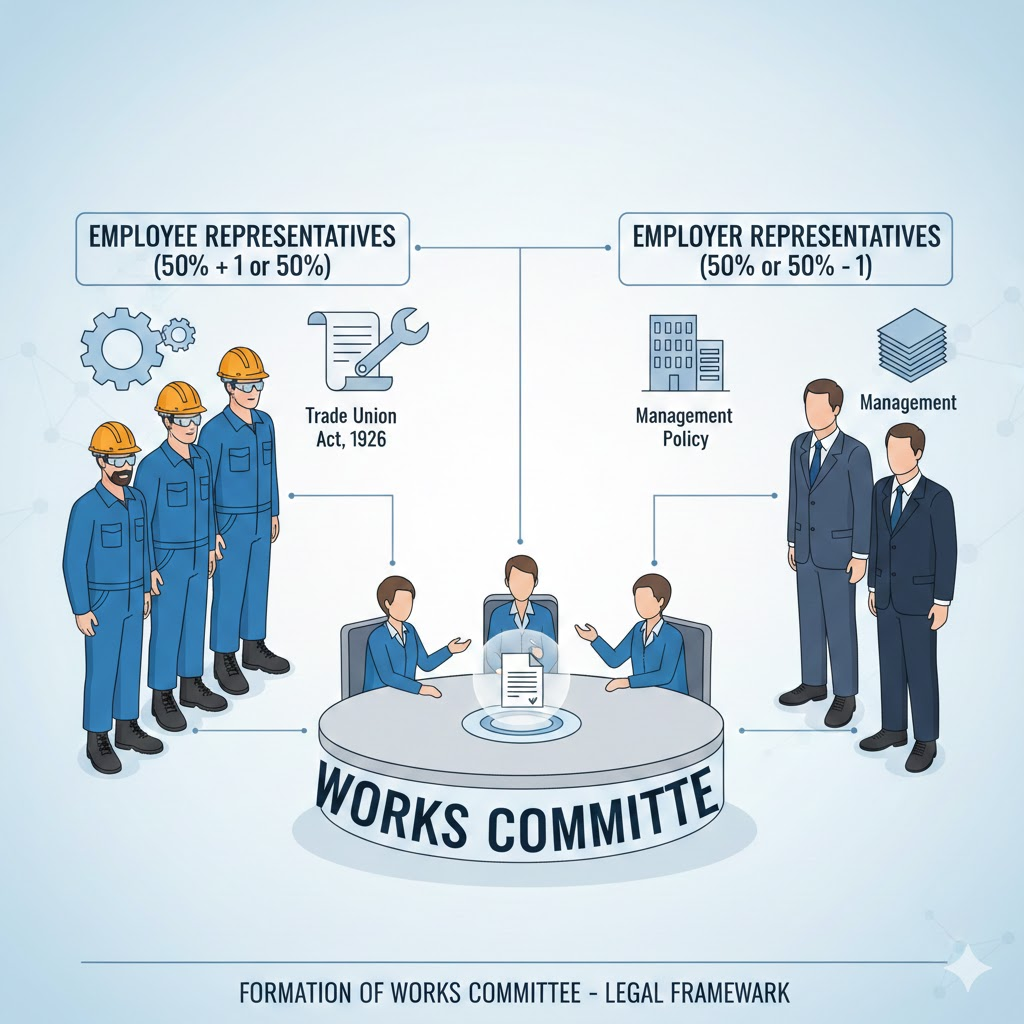
1. The Threshold of Applicability
The law applies to any industrial establishment with 100 or more workmen.
- The Nuance: The count includes anyone employed on any day in the preceding twelve months. This prevents employers from temporarily firing staff to drop below the threshold just before a government order.
- Counterpoint: In a modern gig economy or highly automated landscape, the “100 workmen” rule is becoming less relevant. Small tech firms or automated warehouses with 40 employees can have just as much friction as a 100-person textile mill, yet they lack this statutory mandate for internal dialogue.
2. Composition: The Balance of Power
The statute mandates that the number of workmen representatives must not be less than the number of employer representatives.
- The Logic: This ensures parity. It prevents the committee from becoming a mere megaphone for management.
- The Challenge: Does “numerical equality” equate to “power equality”? In practice, management often holds the information advantage (financial data, legal expertise). Without equal access to information, a 50/50 split in seating is often a facade.
3. The Selection Process and Union Friction
Workmen representatives must be chosen in consultation with registered trade unions.
- Potential Conflict: This is a frequent “logic trap.” Works Committees are meant to handle day-to-day shop-floor issues, while Trade Unions handle collective bargaining (wages, benefits).
- The Risk: If a Trade Union feels the Works Committee is overstepping, they may view it as a threat. Conversely, if management hand-picks “malleable” workers for the committee, the Union may label them as “management stooges,” rendering the committee ineffective.
4. The Duty: Amity and Good Relations
Section 3(2) defines the scope: to “secure and preserve amity” and “compose material differences.”
What the Works Committee Can Discuss:
- Working conditions (ventilation, lighting, temperature).
- Amenities (drinking water, canteens, rest rooms).
- Safety and accident prevention.
- Educational and recreational activities.
What the Works Committee Cannot (usually) Touch:
- Wages and allowances.
- Bonus and profit sharing.
- Retrenchment or layoffs.
- Planning and development strategies.
Intellectual Sparing Point: If the committee is barred from discussing the very things workers care about most—money and job security—can it truly “preserve amity”? One could argue that by limiting the scope to “canteen quality,” the law essentially relegates the Works Committee to a “complaint box” rather than a strategic partner.
5. Practical Example: The “Steel Plant” Scenario
The Setup: “IronWorks Ltd.” employs 450 workers. The State Government issues an order to form a Works Committee.
The Execution:
- Composition: They decide on 10 members. 5 from management (HR Head, Floor Manager, etc.) and 5 elected from the workforce.
- The Conflict: The floor is extremely hot during summer, leading to frequent fainting spells. The workers want expensive industrial cooling systems. Management wants cheaper portable fans.
- The Committee’s Role: Under Section 3(2), they meet. The workmen present data on productivity loss due to heat. Management presents the budget.
- The Outcome: They agree on a phased installation of ventilation shafts—a compromise.
Testing the Logic: Without this committee, the workers might have resorted to a sudden “tool-down” strike. The committee provided a safety valve. However, if management refuses to act on the committee’s suggestions, the law is notoriously “toothless”—the committee’s recommendations are generally not legally binding on the employer.
6. Summary Table: Works Committee vs. Trade Union
| Feature | Works Committee | Trade Union |
| Origin | Statutory (Created by law) | Voluntary (Association of workers) |
| Purpose | Internal harmony/daily issues | Collective bargaining/interest protection |
| Scope | Limited to shop-floor matters | Broad (Wages, Policy, Legal action) |
| Power | Advisory/Consultative | Negotiating/Pressure-based |
Critical Reflection
The Works Committee represents an attempt at “Industrial Constitutionalism.” It assumes that if you put people in a room together, they will act rationally to find a middle ground.
The Counter-Perspective: If the underlying relationship between the employer and the employee is one of inherent distrust, the Works Committee becomes a theater of the absurd—meetings are held, minutes are recorded, but no real “amity” is produced. It functions effectively only when both sides view it as a tool for efficiency rather than a legal box to be checked.
