
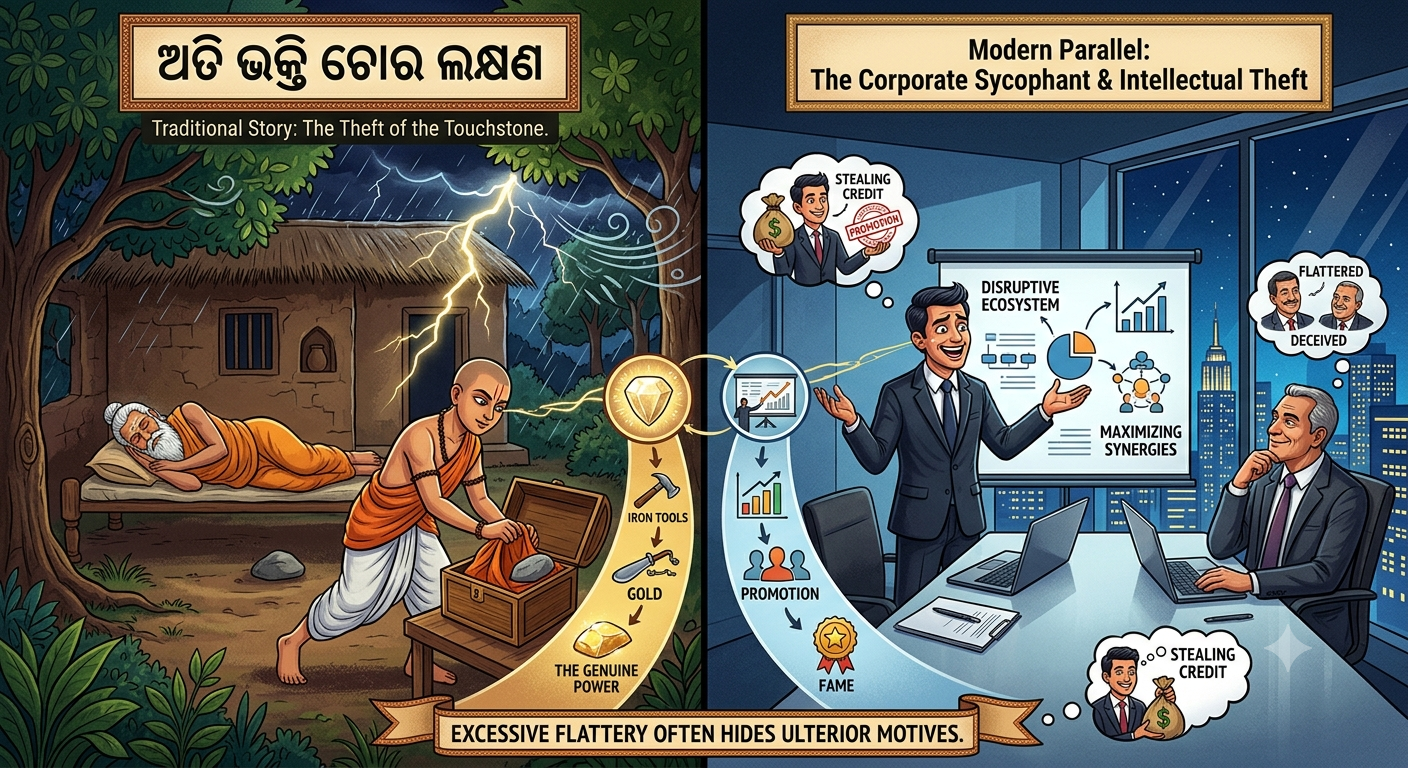
Excessive flattery or artificial politeness usually hides ulterior motives.
The Odia proverb “ଅତି ଭକ୍ତି ଚୋର ଲକ୍ଷଣ” (Ati bhakti chora lakshana) is one of the most profound behavioral truths captured in Eastern folklore. Literally translating to “Excessive devotion is the sign of a thief,” it serves as a psychological warning system. It teaches us that when someone’s politeness, flattery, or humbleness crosses the boundary of normal social courtesy, it is rarely driven by genuine affection. Instead, it is almost always a smoke screen designed to mask an underlying ulterior motive or an impending deception.
True respect is quiet, steady, and comfortable with boundaries. Artificial devotion, on the other hand, is loud, performative, and impatient. It seeks to disarm your skepticism by inflating your ego.
Part 1: The Traditional Folktale of the Sage and the Disciple
To understand how this proverb took root in our collective consciousness, we must travel back to an ancient Odia folktale that has been passed down through generations of oral storytelling.
The Hermitage of Swami Ramananda
Deep within the dense, green canopies of the Chandaka forest lived a revered ascetic named Swami Ramananda. The Swami was known across kingdoms not just for his spiritual insights, but for a unique worldly possession—a flawless, fist-sized touchstone known as a Sparshamani. It was rumored that a single touch of this stone could convert ordinary iron into pure gold. Despite owning something of such unimaginable wealth, the Swami lived a life of absolute simplicity. He kept the stone wrapped in a piece of torn saffron cloth inside a humble wooden box in his mud hut.
The Swami used the stone rarely, only when a desperate villager needed a small dynamic shift to survive a famine or cure a terminal illness. He was completely detached from its material value, viewing it merely as a tool entrusted to him by the divine.
The Arrival of Madhava
One evening, as the monsoon rains lashed against the forest, a young traveler named Madhava collapsed at the threshold of the hermitage. He was drenched, shivering, and crying out for help. The compassionate Swami immediately rushed to his rescue, wrapped him in dry blankets, fed him hot herbal broth, and allowed him to stay until he recovered.
Within two days, Madhava was entirely healthy. Yet, instead of preparing to leave for his home village, he threw himself at the Swami’s feet. Tears streamed down his face as he choked out his words:
“Oh, divine master! The worldly life is a illusion. I have seen the emptiness of material pursuits. Looking upon your serene face, my heart has been filled with a spiritual fire. Please accept me as your lowest disciple. I do not ask for secret mantras or high positions; let me just wash your feet, sweep your floor, and live in your shadow.”
Swami Ramananda smiled gently. He was a simple soul who always looked for the good in others. Though he told Madhava that true spirituality requires long internal cultivation rather than sudden emotional outbursts, he permitted the young man to stay and serve the ashram.
The Pattern of “Ati Bhakti”
From that very hour, Madhava’s display of devotion became extraordinary. It was not just ordinary service; it was a masterclass in performative humility.
- Anticipating Every Move: Before the Swami could even think of waking up at 4:00 AM for his morning prayers, Madhava would already have the warm water ready for his bath.
- Physical Servitude: If the Swami walked across the ashram courtyard, Madhava would run ahead to clear even the smallest pebbles or thorns from the path.
- Constant Praise: Every time the Swami spoke a sentence, Madhava would clasp his hands together, close his eyes as if witnessing a divine revelation, and murmur, “Satyavachan, Prabhu! Your words are more precious than the Vedas.”
- Exaggerated Self-Abasement: When sitting down to eat, Madhava refused to eat until the Swami had finished, choosing to consume only the tiny scraps left behind on the banana leaf, claiming he was unworthy of anything more.
Other ascetics and villagers who visited the ashram were deeply impressed. They openly praised Madhava, saying, “We have never seen a disciple so utterly consumed by love for his guru. He is a saint in the making!”
However, an old, wise village elder named Dibakar observed Madhava’s behavior from a distance. He noticed how Madhava’s eyes constantly scanned the room whenever the Swami moved toward the wooden box, and how his extreme politeness seemed to switch on the moment someone was watching. Dibakar whispered a warning to the Swami: “Prabhu, beware. Nature operates on balance. Water that flows too fast causes a flash flood. Ati bhakti chora lakshana—such extreme devotion often carries the mind of a thief.”
The Swami laughed it off, believing that Dibakar was being cynical. He felt that doubting such a dedicated boy would be a sin against human goodness.
The Fateful Night
Weeks passed, and Madhava completely won over the inner circle of the ashram. He earned the ultimate privilege: he was given the key to clean the inner sanctum where the Swami kept his spiritual items and the wooden box.
One dark, moonless night (Amavasya), a massive thunderstorm struck the forest. The wind howled through the trees, creating an unsettling environment. Trusting Madhava completely, the Swami fell into a deep sleep, exhausted from a day of fasting.
Madhava, who had been waiting for weeks for this exact moment, crept into the Swami’s room. His exaggerated limp and bowed posture vanished instantly. Moving with the silent speed of a predator, he opened the wooden box, slipped the Sparshamani into his waist cloth, and replaced it with a common river stone of similar weight.
Without a sound, he slipped out of the hermitage and ran into the pouring rain. He didn’t look back at the master whose feet he had washed with tears just hours prior.
The Awakening
The next morning, the sun rose over a quiet ashram. The warm water was missing. The courtyard was covered in fallen leaves. The Swami called out, “Madhava! Madhava!” but there was no response.
When the Swami entered the inner sanctum, he found the wooden box slightly ajar. He lifted the cloth and discovered the worthless river stone. In that moment of quiet realization, Dibakar’s words echoed clearly in his mind. The extreme devotion wasn’t a reflection of Madhava’s purity; it was a calculated strategy to blind the master so that the thief could strike without suspicion.
Part 2: The Modern Evolution of “Ati Bhakti”
While traditional folktales feature physical thieves stealing physical treasures like the Sparshamani, modern society has adapted this behavioral pattern on a massive scale. Today, we live in a hyper-connected, transactional world where attention, validation, data, and corporate advancement are the new currencies.
Consequently, the “thieves” of today rarely carry crowbars or slip away into stormy nights. Instead, they wear designer suits, send perfectly formatted emails, use emotional manipulation, or curate flawless digital personas.
Let us analyze how Ati Bhakti Chora Lakshana manifests across different sectors of contemporary life.
+————————————————————————–+
| THE MECHANICS OF PERFORMANCE |
+————————————————————————–+
| Traditional Folktale: |
| [Madhava’s Tears/Foot Washing] —> Blinds Guru —> Steals Sparshamani |
| |
| Corporate Sector: |
| [Excessive Flattery/Yes-Manism] –> Blinds Boss —> Steals Credit/Promo |
| |
| Digital Era: |
| [Clout-Chasing/Fake Empathy] —–> Blinds Public -> Steals Data/Money |
+————————————————————————–+
3. The Corporate Workplace and “The Art of Bootlicking”
In the modern corporate ecosystem, performance metrics are supposed to be objective. However, human organizations are inherently driven by emotion. This vulnerability is exploited beautifully by the modern workplace equivalent of Madhava: the professional corporate sycophant.
The “Yes-Man” Strategy
In almost every office, there is an individual who practices Ati Bhakti toward upper management. They are the first to applaud the CEO’s uninspired presentation on LinkedIn, the loudest to laugh at the manager’s bad jokes during team meetings, and the most eager to volunteer for visible but low-effort tasks that catch executive attention.
This individual rarely spends energy on actual execution or skill development. Instead, their entire operational strategy relies on emotional engineering. By building an artificial wall of absolute devotion around their manager, they achieve two primary objectives:
- Inoculation Against Criticism: A manager who is constantly fed ego-boosting flattery becomes psychologically incapable of objectively evaluating the sycophant’s poor work quality. Any criticism feels like an attack on someone who is “deeply loyal.”
- Intellectual Theft: This is where the Chora (thief) aspect clearly shines. While quiet, hardworking engineers or analysts spend long hours building projects, the sycophant spends their time presenting those projects to leadership, subtly tweaking the narrative to steal the intellectual credit.
[ The "Clout Chasing" Loop ]+————————————————————–+
[Performative Devotion] -> [Algorithm Reward] -> [User Trust] -> [Exploitation]
(Over-the-top Charity/ (High Views/Likes) (Blind Devotion (Financial Gain/
Monetized Tears) from Public) Data Harvesting)
In many cases, this public display of moral excellence is a calculated front. The true objective is to trick the platform’s algorithm, gain millions of followers, and monetize that attention through sponsorships, merchandise, or crowdfunding campaigns.
The “theft” here is highly sophisticated: they are stealing the public’s genuine empathy and emotional energy to convert it into financial wealth or personal fame. When the cameras turn off, the devotion vanishes instantly, leaving the actual cause completely unsupported.
5. Political Landscapes: The Cult of Personality
Historically and contemporaneously, politics is the ultimate playground for Ati Bhakti. Democratic structures are built on institutional checks and balances, but these protections can easily erode when political figures demand absolute, unquestioning devotion.
The Rise of the Sycophant Politician
When a political system shifts away from policy debates and toward a cult of personality, the proverb manifests on a national scale. Leaders surround themselves not with competent advisors who offer grounded counterpoints, but with sycophants who treat them like deities.
These followers will defend every error, rewrite history to justify failures, and demonize anyone who asks logical questions. This extreme devotion is rarely rooted in ideological conviction. Instead, it is an investment strategy. The absolute loyalty is designed to secure high cabinet positions, lucrative government contracts, or protection from legal accountability.
The ultimate victim of this dynamic is the citizen. When leadership is blinded by artificial devotion, they become isolated from reality, leading to policy failures, systemic corruption, and economic hardship.
6. Personal Relationships: Love-Bombing and Narcissistic Manipulation
On an interpersonal level, Ati Bhakti takes a highly destructive form known in modern psychology as love-bombing. This behavior is common in toxic or narcissistic relationships.
The Dynamics of Love-Bombing
At the beginning of a relationship, a toxic partner does not display red flags. Instead, they show an overwhelming, breathless level of affection and devotion. They will tell you that you are their soulmate within three days, bombard you with gifts, write long poems, and insist on spending every waking moment with you.
This intense adoration feels validating, causing the recipient’s natural defenses to drop completely. They begin to believe they have found a rare, completely selfless love.
Once that absolute trust is secure, the behavior shifts dramatically. The predator begins to isolate the victim from friends and family, demand control over their life, and use guilt as a weapon. The overwhelming devotion was never about love; it was an initial psychological maneuver designed to capture the victim’s emotional autonomy and self-esteem.
Part 3: Deep Psychological Analysis: Why Do We Fall For It?
If Ati Bhakti Chora Lakshana is such an ancient, well-documented pattern of human behavior, why does it continue to work so effectively today? The answer lies in our deeply rooted cognitive vulnerabilities.
1. The Power of Ego Inflation
Human beings possess an inherent desire to feel important, validated, and respected. When someone flatters us excessively, it triggers a powerful dopamine release. Even if our rational mind whispers that the praise is unearned or exaggerated, our emotional self wants to believe it is true. We think, “Perhaps I really am as brilliant, kind, and special as this person says.” The flatterer weaponizes our own vanity against us.
2. Confirmation Bias
If we hold a high opinion of ourselves, we naturally gravitate toward people who confirm that perspective. A sycophant provides a constant stream of confirmation. We mistake their calculated agreement for shared values or deep intellectual alignment.
3. The Reciprocity Reflex
Psychologist Robert Cialdini identified reciprocity as a primary weapon of influence. When someone does something extraordinarily nice for us—such as showing deep devotion or offering intense help—our brain feels a strong obligation to return the favor. We feel guilty doubting them, and we feel compelled to reward them with trust, opportunities, or resources.
Part 4: Cultivating the Antidote: How to Protect Yourself
Navigating a world filled with performative behavior requires developing high emotional intelligence and sharp critical thinking skills. Here is a guide to protecting your boundaries against modern forms of Ati Bhakti.
———————————————————————-+
| PROTECTIVE BEHAVIORAL MATRIX |
+———————————————————————-+
| Red Flag Indicator | Healthy Countermeasure |
|—————————–+—————————————-|
| Exaggerated public praise | Look for private consistency |
| Impatience with boundaries | Enforce slow relationship pacing |
| Total lack of constructive | Value individuals who offer polite, |
| disagreement | grounded counterpoints |
+———————————————————————-+
1. Look for Consistency, Not Intensity
True respect and love are sustainable, measured, and consistent over long periods. Performative devotion is intense but fragile. Watch how a person treats people they do not need—such as restaurant servers, cleaning staff, or junior colleagues. If their intense kindness is reserved only for people with power or resources, it is a clear sign of calculation.
2. Value Constructive Counterpoints
Surround yourself with friends, partners, and colleagues who value truth over comfort. A true ally will not agree with your every mistake just to keep you happy. They will politely challenge your logic, point out your blind spots, and offer alternative perspectives because they care about your long-term success. If someone never disagrees with you, start looking for their hidden agenda.
3. Test Boundaries Early
If you suspect someone is love-bombing you or playing a sycophantic role, gently establish a boundary or say “no” to a small request. A genuine person will respect your space and understand your limits comfortably. A manipulator, however, will often react with hidden irritation, guilt trips, or an immediate drop in their performative devotion, because your boundary disrupts their timeline.
Conclusion: The Timeless Relevance of Odia Wisdom
The ancient rishis and folk-storytellers of Odisha did not write their proverbs for a static agrarian society. They wrote them for the enduring realities of human psychology. Whether it is Madhava stealing the Sparshamani in a mud hut thousands of years ago, or a modern corporate climber stealing a project strategy in a glass skyscraper today, the core human dynamic remains identical.
“ଅତି ଭକ୍ତି ଚୋର ଲକ୍ଷଣ” is not a cynical call to suspect everyone who shows you kindness. Rather, it is a profound guide to mindfulness. It reminds us to keep our eyes wide open, to value quiet integrity over loud performance, and to remember that the most dangerous traps in life are always covered in the sweetest flowers.
This animated short film tells a variation of this exact Odia folktale, illustrating the classic narrative of Ati Bhakti Chora ra Lakshana through traditional storytelling that brings the lessons of the proverb to life.
