
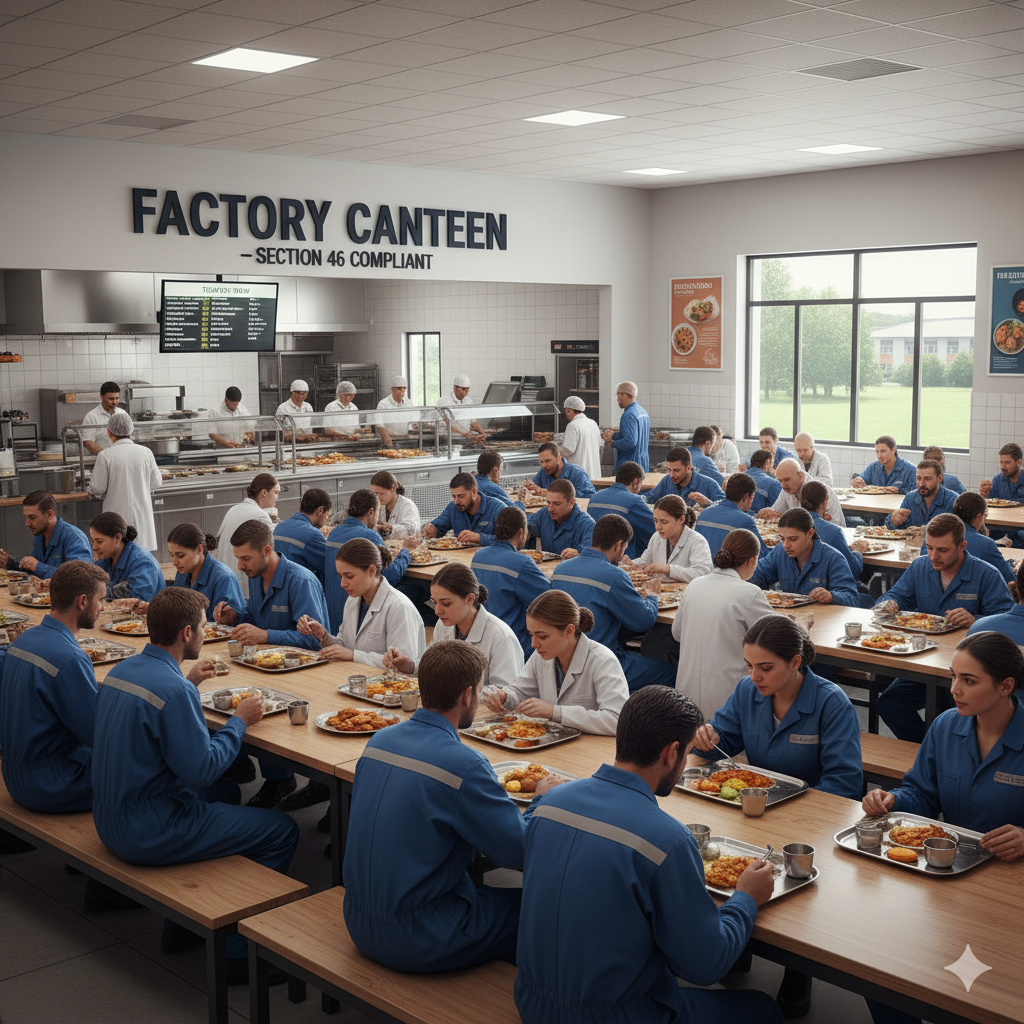
The Anatomy of Section 46: The Canteen Mandate
1. The Statutory Requirement
Section 46 of the Factories Act, 1948, is a “Conditional Mandate.” It doesn’t apply to every workshop or startup.
- The Threshold: The State Government may make rules requiring that in any specified factory where more than 250 workers are ordinarily employed, a canteen shall be provided and maintained by the occupier for the use of the workers.
- The Delegation of Power: Unlike other sections, Section 46 is a “framework” clause. It gives the State Government the power to dictate the specifics of how that canteen looks, smells, and operates.
2. The Multi-Layered Compliance Framework
To meet the “spirit” of Section 46, an occupier must navigate four distinct layers of regulation:
A. Construction and Accommodation
The canteen cannot be a shack. State rules typically mandate:
- Distance: It must be situated at least 15 meters from any latrine, urinal, boiler house, or coal stack.
- Space: Usually, it must accommodate at least 30% of the workers at any one time.
- Hygiene: Walls must be lime-washed or painted (typically every 12 to 24 months), and floors must be smooth, impervious, and easily cleaned.
B. The “No-Profit” Pricing Model
This is where the Act becomes an economic intervention.
- The Act specifies that the food must be served on a non-profit basis.
- In many jurisdictions, the “Occupier” (employer) must bear the costs of the building, the equipment (tables, chairs, utensils), and the salaries of the canteen staff. Only the actual cost of the raw ingredients and fuel can be used to calculate the price of the meals.
C. The Canteen Managing Committee
To prevent the employer from serving “substandard” food, the Act mandates a democratic element:
- Constitution: A committee consisting of an equal number of persons nominated by the occupier and elected by the workers.
- Function: They consult on the quality and quantity of food, the menu, and the pricing.
- Logic Check: This is one of the few places in the Act where workers get a direct vote on operational management.
D. Equipment and Sanitation
- Storage: Proper refrigeration and pest-proof storage for raw materials.
- Waste: A strict drainage system to prevent waterlogging or contamination.
The Intellectual Counterpoint: Is Section 46 Obsolete?
Now, let’s challenge the assumptions behind this law. While Section 46 was written with noble intentions (preventing malnutrition in the 1940s industrial workforce), modern critics argue it creates several perverse incentives:
1. The “249 Worker” Ceiling
By setting a hard threshold at 250 workers, the law creates a “regulatory cliff.” A factory with 240 workers has zero legal obligation to provide a canteen. A factory with 251 workers suddenly faces a massive capital expenditure (CAPEX) and recurring operational expenditure (OPEX).
- The Result: Smaller factories often stay intentionally small or use “contract labor” to keep their official “worker” count below 250, thereby depriving workers of the very welfare the Act intended to provide.
2. The Quality vs. Cost Paradox
Because the canteen must be “non-profit,” there is zero incentive for the employer to innovate or provide high-quality culinary options.
- If the employer loses money on every meal, the natural tendency is to provide the minimum viable product (the cheapest possible grain and vegetables).
- In the modern world, would workers be better off with a “meal allowance” or a digital voucher (like Sodexo) that allows them to choose their own food, rather than being forced to eat at a state-mandated industrial trough?
3. The Liability Trap
Under Section 46, the “Occupier” is legally responsible for food safety. If a worker gets food poisoning from a canteen managed by an outside contractor, the Factory Manager can still face criminal prosecution.
- The Logic Test: Should a manufacturing expert (a Factory Manager) be legally liable for the temperature of a soup? Many argue this “vicarious liability” discourages large-scale employment.
Comparison Table: Mandated Canteen vs. Modern Food Subsidy
| Feature | Section 46 Mandate | Modern Digital Voucher System |
|---|---|---|
| Control | Employer-managed/Committee-run | Worker-choice (Market-driven) |
| Cost to Employer | High (Real estate + Equipment + Staff) | Low (Direct transfer) |
| Hygiene Responsibility | Factory Manager (Criminal Liability) | Restaurant/Vendor (External) |
| Scalability | Fixed (Hard to expand/shrink) | Infinite (Scales with headcount) |
Section 46 is a relic of Industrial Paternalism. It assumes the worker is incapable of procuring their own food and the employer is a provider of all life’s necessities. While it ensures a “safety net” for calories, it often results in subpar facilities that prioritize compliance over actual “welfare.”
