


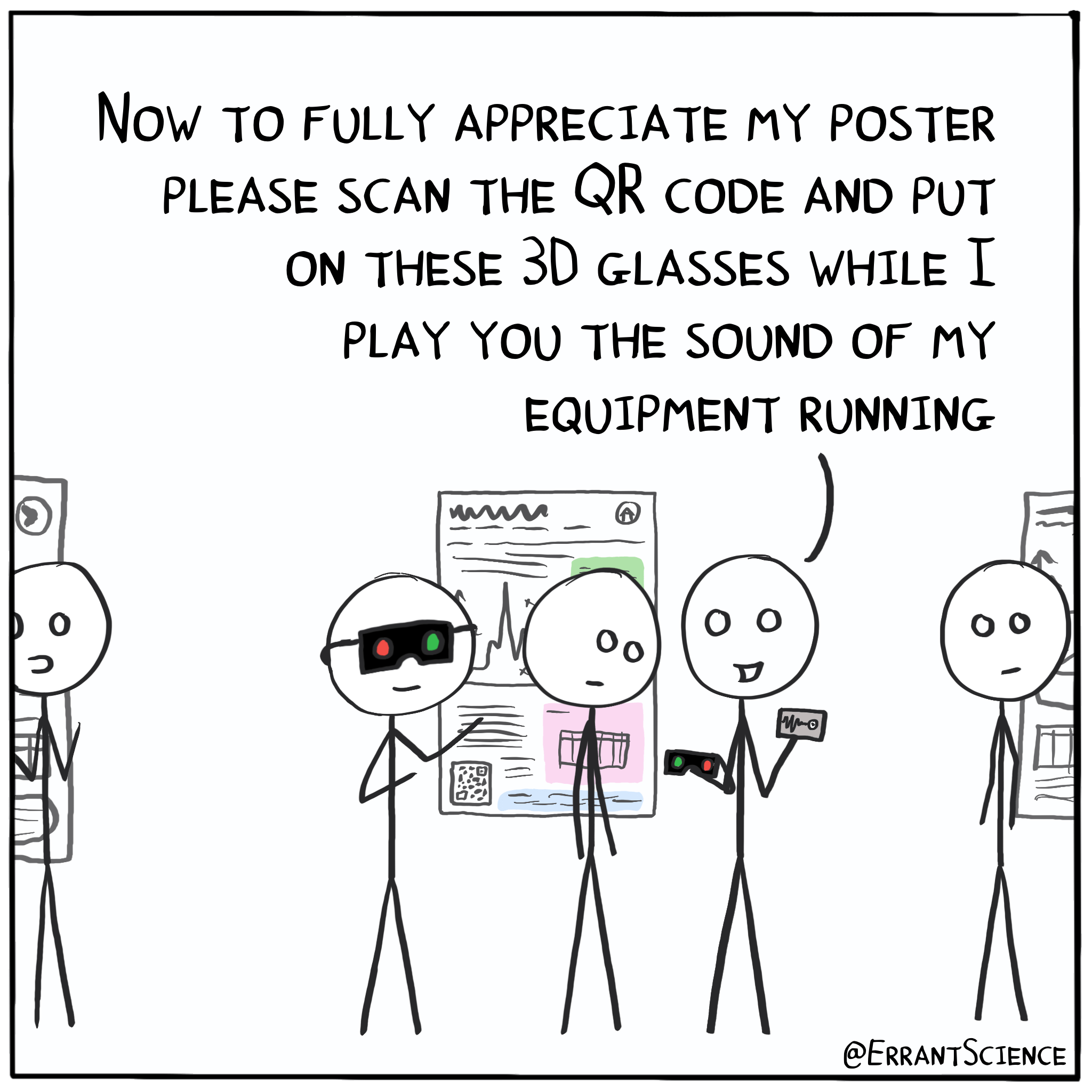
If you had told me while I was doing my undergrad degree that a key skill in research was poster making, I would have assumed you were making a rather strange arts and crafts-related joke.
If you had told me while I was doing my PhD that I would continue to need this poster skill well into my later career, I would have assumed you were a tiredness-induced hallucination (happens a lot during PhD).
But here we are, double-digit years later, and I find myself, this morning, opening a file on my computer called “poster_first_draft“. I have now lost count of the number of posters I have made in my research career and the number of posters I’ve reviewed, judged, and cartooned. Every year, I have the absolute pleasure of live cartooning #RSCPoster, resulting in me reading about 100 posters, an annual 24-hour sprint of science communication.
So, despite my younger self, I want to share my top tips for preparing a good research poster and avoiding all the mistakes you often see in a typical research poster.
Remember, it’s a poster, not a thesis!
It’s very tempting when planning your poster to treat it like a report, thesis or academic paper. This can lead you to cram too many ideas into what is fundamentally a small space.
A poster is something that is meant to highlight a specific point or results in a way that is quickly understandable and presentable. Not a thoroughly detailed breakdown of an entire project or experiment. It’s the one time you can show your results and not show ALL of your work. Show the bits and key to understanding the point you want to present only.
Before you even think about what you are going to write, make sure you understand what the key thing is that you want to share in your poster and what you need to show to explain that. If you find yourself detailing the model number of equipment or explaining the experiment before the experiment in which you made a precursor for the things in this experiment, you’ve gone badly wrong.
First off is the size of the text. You might think it’s the content, but that can only come once you’ve got some idea of the amount of text space you’ve got. If you start content first, you’ll either need to take a hatchet to your carefully crafted words or do what is all to comment and reduce the text size to unreadable.
A rule of thumb is that you want the text to be readable a few meters away from a poster (or, in the case of #RSCPoster, readable on a 15″ screen). A good rule of thumb is that when editing your poster, you should be able to comfortably read the smallest text when the entire poster is visible on the screen. If you have to zoom in to read it or read the text with your nose pressed against your screen, you’ve gone too small.
Now the diagram complexity.
Next are your diagrams and graphs. When preparing these, you need to remember that, ideally, everyone would read your poster and understand the context of your figure. In reality, most people are going to immediately look at your figure and not read anything because we’re all lazy skim readers at heart.
So don’t try to cram a million things into a graph, don’t make a flow diagram that makes MC Escher look confused, and don’t have diagrams which are only understandable by reading a 2000-word key. Think carefully about the key message you want to convey in your poster and present that as your biggest, clearest figure. Better yet, draw a cartoon 😉
This article was also presented in poster format, but sadly, we were given a poster board furthest from the conference buffet, so you probably didn’t get to see it.
[Disclaimer: The content in this RSS feed is automatically fetched from external sources. All trademarks, images, and opinions belong to their respective owners. We are not responsible for the accuracy or reliability of third-party content.]
Source link


