


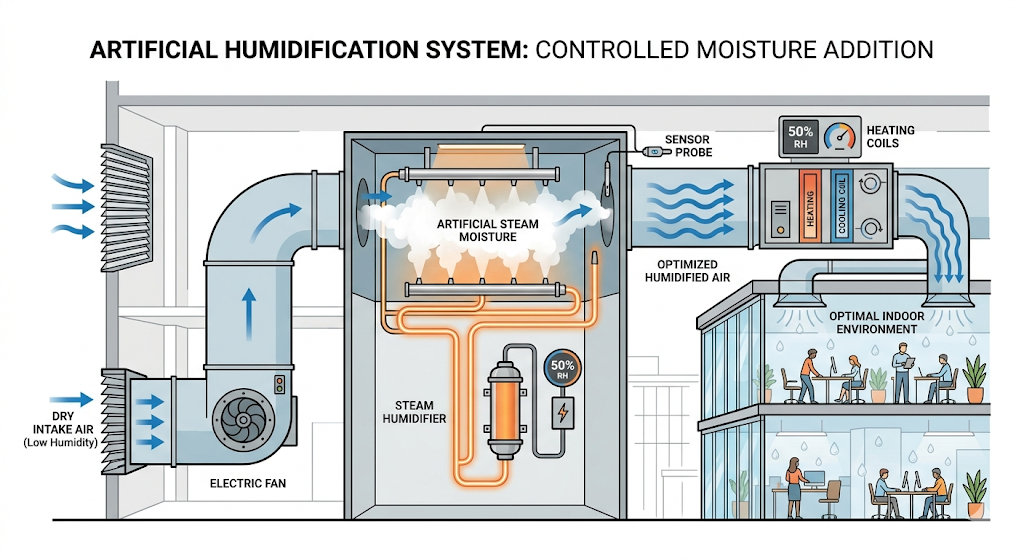


In industrial manufacturing, particularly within the textile and garment sectors, the atmospheric environment is not merely a matter of worker comfort—it is a critical factor in both material integrity and physiological safety. Section 15 of the Factories Act provides the legal framework for Artificial Humidification, ensuring that when industries must manipulate air moisture, they do so without compromising the health of the workforce.
1. Statutory Definition and Scope
Under the Act, artificial humidification refers to any process where the moisture content of the air is increased by artificial means (such as steam injection, water atomization, or mechanical sprayers) to facilitate manufacturing.
While humidity is essential to prevent fiber breakage in spinning or to stabilize chemical reactions, excessive humidity combined with high temperatures creates a “wet-bulb” effect. This prevents the human body from cooling itself through sweat evaporation, leading to heat exhaustion or long-term respiratory distress. Section 15 acts as the “safety valve” to prevent these outcomes.
2. The Limits of Humidity (The Schedule)
The core of Section 15 is the adherence to prescribed standards of humidification. State Governments are empowered to create “Schedules” that define the maximum hygrometric limits.
The Correlation of Temperature and Moisture
The law typically dictates that for any given dry-bulb temperature (the actual air temperature), there is a maximum allowable wet-bulb temperature. As the dry-bulb temperature increases, the gap between the two must be maintained to ensure the air is not “saturated.”
| Dry-Bulb Temp (°C) | Max Wet-Bulb Temp (°C) | Minimum Difference |
|---|---|---|
| 20°C | 18°C | 2°C |
| 30°C | 27°C | 3°C |
| 35°C | 29°C | 6°C |
Note: These values vary by jurisdiction, but the principle remains: the higher the heat, the lower the relative humidity must be to allow for human thermoregulation.
3. Standards for Water Purity
One of the most overlooked aspects of Section 15 is the quality of water used for humidification. If water is drawn from a stagnant source or an unpurified well, the atomization process turns that water into an aerosol of bacteria and pathogens (such as Legionella).
- Source Regulation: Water must be taken from a public supply or a source certified as potable.
- Purification: If the source is internal, it must be filtered and treated to ensure it is free from organic impurities and foul odors.
- Inspections: Inspectors have the right to take water samples from the humidifying plant to test for microbial loads.
4. Mandatory Testing and Record-Keeping
A factory cannot simply “set and forget” its humidification system. Section 15 mandates a rigorous monitoring regime:
- Hygrometers: Every department where artificial humidification is used must be equipped with at least two accurate hygrometers. One is placed in the center of the room, and one is placed near the side, away from direct moisture vents.
- Daily Observations: Readings must be taken by a designated competent person at least three times daily (typically morning, noon, and afternoon).
- The Humidity Register: These readings must be recorded in a bound register (Form No. 15 in many regions). This register must be available for inspection at all times. If the humidity exceeds the limits, the humidification must be shut off immediately.
5. Methods of Humidification: Best Practices
To comply with the Act while maintaining production, factories typically employ three methods. Each has specific compliance hurdles:
A. Steam Injection
Injecting live steam is efficient but risky. It rapidly increases the dry-bulb temperature. Section 15 often restricts steam injection if the room temperature exceeds a certain threshold (often 29°C), as it becomes counterproductive to worker health.
B. Water Spraying (Atomization)
Fine nozzles spray water into the air. Compliance here focuses on ventilation. If the air is stagnant, the water droplets won’t evaporate properly, leading to damp floors (a slip hazard) and “heavy” air.
C. Evaporative Cooling (Desert Coolers)
Large-scale fans blow air through wet pads. This is often the preferred “compliant” method because it naturally lowers the temperature while adding moisture, making it easier to stay within the wet-bulb limits.
6. Ventilation and Air Movement
Section 15 does not exist in a vacuum; it is supported by Section 13 (Ventilation). Artificial humidification is prohibited unless there is adequate air movement.
The air in a humidified room must be changed a specific number of times per hour. If the air is not moving, the “micro-climate” around a worker’s body becomes saturated, creating a localized heat trap. Compliance requires that exhaust fans and inlets be positioned to ensure a cross-flow that carries away excess moisture.
7. The Role of the Inspector
The Factory Inspector plays a “logic-testing” role during audits. They don’t just look at the register; they look for:
- Corrosion: Excessive humidity often leads to structural damage or electrical hazards.
- Worker Health Records: Are there spikes in respiratory complaints or skin infections in specific departments?
- Calibration: Are the hygrometers actually working, or are they “stuck” on a compliant reading?
8. Penalties for Non-Compliance
Failure to maintain the humidity schedule or using contaminated water can lead to:
- Improvement Notices: A deadline to fix the ventilation or water source.
- Prohibition Orders: Immediate shutdown of the humidification plant if a high risk to health is identified.
- Fines and Imprisonment: Under Section 92, the occupier and manager can face significant penalties for endangering worker safety.
Summary of Compliance Checklist
- [ ] Are hygrometers calibrated and placed correctly?
- [ ] Is the water source tested for purity?
- [ ] Are 3x daily readings being recorded?
- [ ] Is there a “cutoff” protocol for when temperatures hit the limit?
- [ ] Is the ventilation sufficient to prevent air stagnation?




2 Comments
Very interesting details you have mentioned, thankyou for posting.
Real excellent info can be found on website. “Compassion for myself is the most powerful healer of them all.” by Theodore Isaac Rubin.