


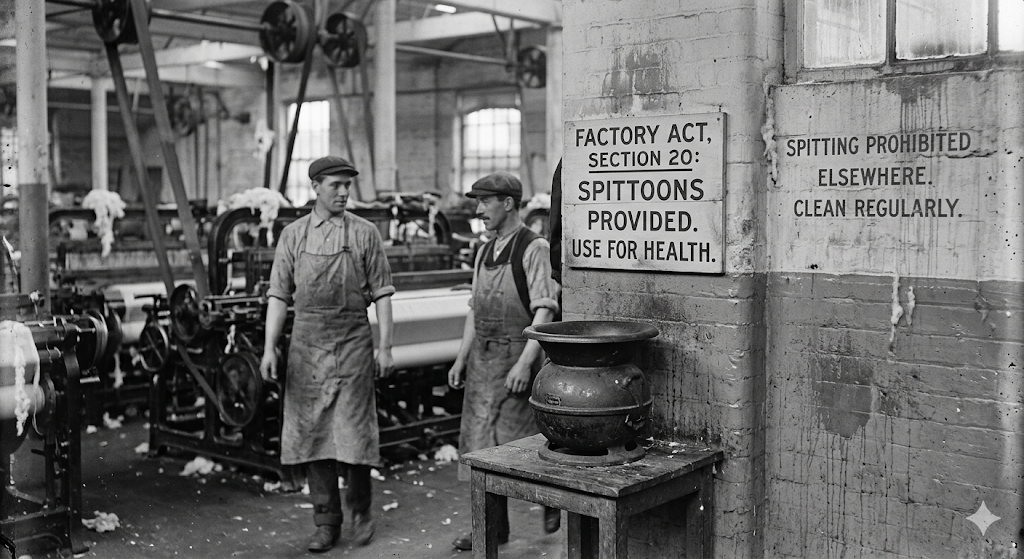


Section 20 of the Factories Act: Spittoons, Hygiene, and Industrial Health Management
Introduction: The Philosophy of Industrial Hygiene
The Factories Act stands as the bedrock of labor welfare and occupational safety in modern industrial jurisprudence. While much of the public and academic focus remains on high-stakes safety protocols—such as machine guarding (Section 21) or fire safety (Section 38)—the Act recognizes that long-term industrial productivity is inextricably linked to the biological health and dignity of the workforce. Within the “Health” chapter of the Act lies Section 20: Spittoons.
To the modern observer, a dedicated legal mandate for spittoons might seem like an archaic relic of the mid-20th century. However, from a public health and industrial hygiene perspective, Section 20 represents a sophisticated understanding of disease transmission and behavioral psychology in the workplace. This section is not merely about providing a receptacle for saliva; it is about the systemic containment of airborne and waterborne pathogens, the maintenance of a sterile environment, and the enforcement of personal discipline within a collective industrial setting.
I. Statutory Analysis of Section 20: The Legal Framework
Section 20 of the Factories Act provides a tripartite framework for the provision, maintenance, and enforcement of spitting regulations. The statutory language is precise, focusing on three distinct pillars:
1. The Mandate for Provision (Sub-section 1)
The Act dictates that in every factory, there shall be provided a sufficient number of spittoons in convenient places and they shall be maintained in a clean and hygienic condition.
The keywords here are “sufficient” and “convenient.”
- Sufficient: This is a relative term that depends on the number of workers and the layout of the factory. A massive textile mill with 2,000 workers requires a vastly different scale of provision than a small chemical processing unit.
- Convenient: This addresses the “path of least resistance.” If a worker must walk five minutes to find a spittoon, they are more likely to spit on the floor or in a corner. “Convenient” implies placement near transit points, rest areas, and workstations, provided they do not interfere with safety or contaminate the product.
2. Regulatory Authority (Sub-section 2)
The State Government is empowered to make rules prescribing the type and the number of spittoons to be provided and their location in any factory.
This recognizes that industrial needs vary by geography and industry type. For example, a factory in a humid coastal region might require different maintenance schedules than one in an arid zone. The State Government also defines the “hygienic condition”—often specifying the use of disinfectants like lime or carbolic acid within the spittoons.
3. Prohibition and Penalties (Sub-section 3)
This is the “stick” in the legislative framework. It states that no person shall spit within the premises of a factory except in the spittoons provided for the purpose. A notice containing this provision and the penalty for its violation must be prominently displayed.
The Act allows for a fine (often up to five rupees in the original text, though updated in various state amendments) to be imposed on any person contravening this provision. Crucially, this applies to everyone on the premises—workers, managers, and visitors alike.
II. The Medical and Pathological Necessity
To understand why Section 20 exists, one must look at the pathology of the mid-20th century, particularly the prevalence of Tuberculosis (TB) and other respiratory ailments.
1. The Mechanics of Droplet Transmission
Saliva is a primary vector for Mycobacterium tuberculosis. In an enclosed factory environment, dried sputum can become pulverized into dust, which is then inhaled by other workers. By mandating spittoons, the Act creates a “point-of-capture” system for pathogens.
2. Industrial Dust and the “Spit Reflex”
In many factories—especially those involving cotton, silica, or grain—workers are exposed to high levels of suspended particulate matter. The body’s natural defense mechanism is to trap these particles in mucus and expel them. In the absence of spittoons, the natural physical response of the worker becomes a health hazard for the entire collective.
3. Beyond TB: Modern Viral Considerations
While TB was the original driver, the principles of Section 20 remain relevant in the context of modern outbreaks, including influenza and Coronaviruses. The discipline of not spitting in open areas is a fundamental tenet of “Respiratory Etiquette.”
III. Integration with Industrial Safety Management (ISO 45001 & OSHA)
While Section 20 is a specific local statutory requirement, it aligns perfectly with international safety standards like ISO 45001 (Occupational Health and Safety Management Systems) and OSHA standards.
1. Hazard Elimination and Substitution
Under the hierarchy of controls, “Administrative Controls” and “Work Practice Controls” are vital. Section 20 acts as an Administrative Control. By providing a designated spot for a biological waste product (saliva), the factory “substitutes” a hazardous practice (open spitting) with a managed one (spittoon usage).
2. The Role of HR and Safety Officers
The implementation of Section 20 falls under the joint jurisdiction of the Safety Officer and the HR department.
- Safety Officers must ensure the spittoons are emptied and disinfected daily.
- HR Departments must handle the communication aspect—ensuring that the notices are not only “prominent” but also in a language and format the workforce understands (incorporating pictograms for low-literacy environments).
IV. The “Spittoon Strategy” in Modern Factory Design
Designing a compliant factory requires more than just buying metal bins. A strategic approach to Section 20 involves:
1. Material Selection
Modern spittoons should be made of non-porous materials. Stainless steel or high-density polymers are preferred over ceramic or brass, as they resist corrosion from the harsh disinfectants required by law.
2. Strategic Placement (The “Nudge” Theory)
Using behavioral science, spittoons should be placed at “decision points”—near exits, water coolers (but at a safe distance), and smoking zones (where permitted).
3. Maintenance Logistics
A spittoon is only “hygienic” (as per Sub-section 1) if it is part of a documented cleaning cycle. This includes:
- Daily emptying into a biological waste stream.
- Deep cleaning with specified chemical agents (e.g., phenolics or chlorine-based solutions).
- Regular inspection for leaks or cracks.
V. Challenges in Enforcement and Cultural Barriers
Despite the clear legal mandate, Section 20 faces significant hurdles in real-world application.
1. The Cultural Habit of Chewing Tobacco/Pan
In many industrial regions, the use of smokeless tobacco (Pan, Gutka) is prevalent. This creates a high volume of liquid waste that can quickly overwhelm a standard spittoon. It also leads to staining of walls and corners, which undermines the “clean and hygienic” mandate of the Act.
2. The Stigma of Information
Displaying “Penalty for Spitting” signs can sometimes be viewed as an affront to worker dignity if not handled with sensitivity. The challenge for management is to frame Section 20 as a “Health Protection Right” rather than a “Behavioral Restriction.”
3. Compliance vs. Reality
In many small-scale industries (MSMEs), Section 20 is often ignored or treated as a “paper compliance” issue. However, during health audits or inspections by the Factory Inspector, the absence of clean spittoons is one of the easiest ways for a factory to fail a compliance check.
VI. Legal Precedents and Judicial View
The courts have generally viewed the health provisions of the Factories Act (Sections 11 to 20) as mandatory, not directory.
In various litigations regarding worker compensation for occupational diseases (like Silicosis or Byssinosis), the lack of adherence to Section 20 has been used as evidence of a “negligent environment.” While a lack of spittoons may not directly cause Silicosis, it indicates a broader failure of the employer to maintain the “health standards” required by law, thereby strengthening the worker’s case for employer liability.
VII. Conclusion: The Future of Section 20
As we move toward “Industry 4.0,” the physical spittoon may eventually evolve into more sophisticated bio-disposal stations. However, the underlying logic of Section 20 remains timeless:
- Containment: Dangerous biological outputs must be isolated.
- Notification: Rules must be communicated and visible.
- Accountability: Both the employer (provision) and the employee (usage) share responsibility for workplace health.
For the factory blog, it is essential to communicate that Section 20 is not a “minor” rule. It is a vital link in the chain of Industrial Hygiene. A factory that masters the “small” discipline of managing spittoons is often a factory that excels in the “large” disciplines of machine safety and process efficiency. Hygiene is the foundation upon which the structure of safety is built.
Summary Checklist for Factory Managers:
- [ ] Quantity: Do you have at least one spittoon for every 20-50 workers (depending on state-specific rules)?
- [ ] Condition: Are they filled with an approved disinfectant?
- [ ] Signage: Is there a sign in the local language stating the fine for spitting?
- [ ] Records: Do you have a cleaning log signed by the housekeeping supervisor?
- [ ] Accessibility: Are they placed in areas where workers actually transition, rather than tucked away in unreachable corners?





1 Comment
Hi, Neat post. There’s a problem with your site in internet explorer, would test this… IE still is the market leader and a good portion of people will miss your great writing because of this problem.