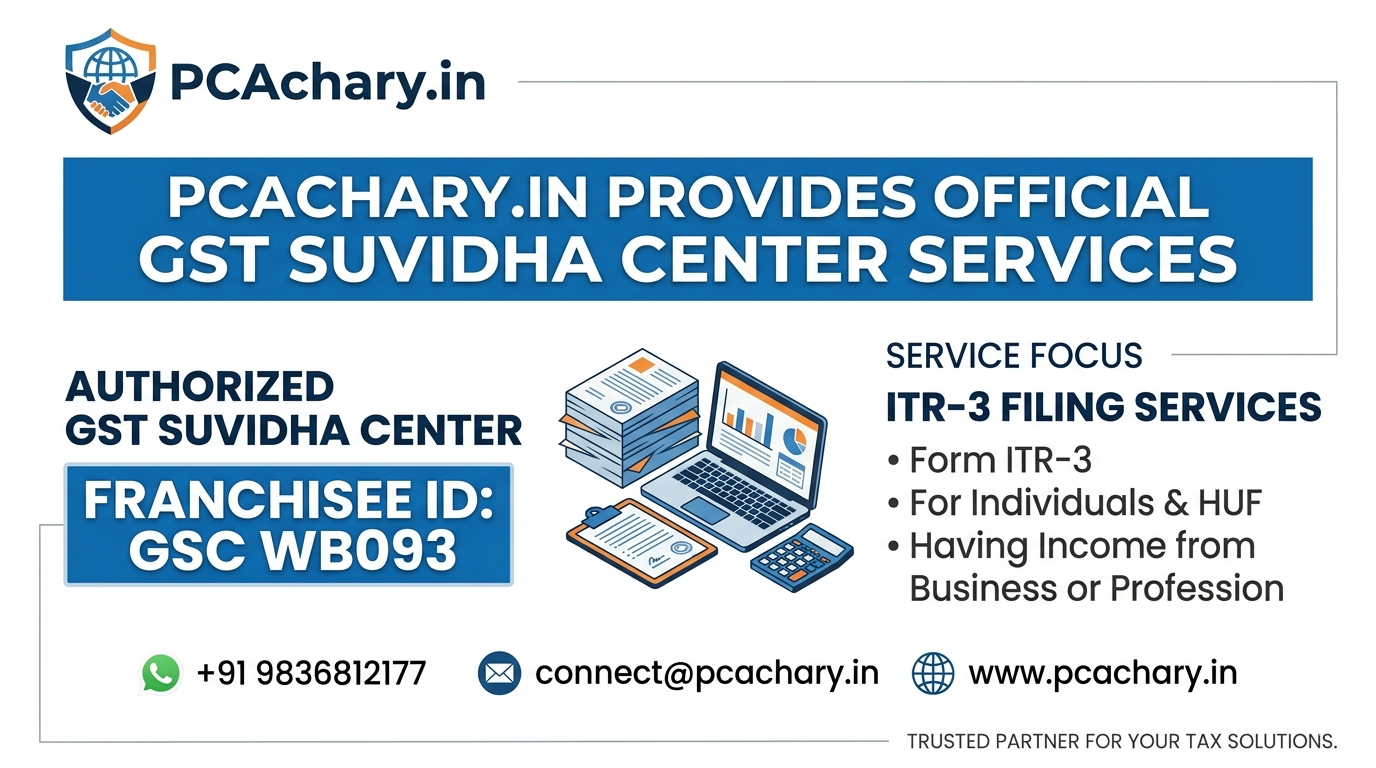
This comprehensive guide is designed to provide an in-depth understanding of ITR-3 filing services for individuals and Hindu Undivided Families (HUF) who earn income from a business or profession. Managed through the professional expertise of a certified GST Suvidha Center (Franchisee ID: GSC WB093), this documentation serves as both an educational resource and a service overview.
For professional assistance, you may connect via:
- Website: Pcachary.in
- Email: connect@pcachary.in
- WhatsApp: +91 9836812177
Introduction to ITR-3 and the GST Suvidha Center Ecosystem
The Indian taxation system is a sophisticated framework designed to ensure that every citizen contributes to the nation’s growth based on their financial capacity. Among the various Income Tax Return (ITR) forms, ITR-3 stands out as one of the most detailed and critical forms for the entrepreneurial class. It is specifically tailored for individuals and HUFs who are not merely salaried employees but are the engines of the economy—business owners and professionals.
Navigating the complexities of ITR-3 requires precision. Errors in reporting business turnover, depreciation, or carry-forward losses can lead to unwanted scrutiny from the Income Tax Department. This is where the GST Suvidha Center (GSC WB093) acts as a vital bridge. As a specialized service provider, we simplify the bridge between taxpayers and the digital tax infrastructure of India.
What is ITR-3?
ITR-3 is the Income Tax Return form meant for individuals and HUFs who have income under the head “Profits and Gains of Business or Profession.” Unlike ITR-1 (Sahaj) for salaried individuals or ITR-4 (Sugam) for those opting for the Presumptive Taxation Scheme with limited turnover, ITR-3 is the “Gold Standard” for comprehensive reporting.
Who Must File ITR-3?
You are required to file ITR-3 if you fall into any of the following categories:
- Business Owners: If you run a proprietary business, whether it is retail, wholesale, manufacturing, or digital services.
- Professionals: Doctors, Lawyers, Architects, Chartered Accountants, and Independent Consultants who do not opt for the presumptive scheme under Section 44ADA.
- Partners in a Firm: If you are a partner in a partnership firm and receive salary, bonus, commission, or interest from that firm.
- Investors in Unlisted Shares: If you held unlisted equity shares at any time during the financial year.
- Directors: Individuals serving as directors in a company.
- Income from Crypto/VDA: Individuals having income from Virtual Digital Assets.
The Role of GST Suvidha Center (GSC WB093) in Tax Compliance
Operating under Franchisee ID GSC WB093, our center provides a one-stop solution for financial and statutory compliance. While “GST” is in the name, our services extend far beyond Goods and Services Tax. We specialize in the holistic financial health of small and medium enterprises (SMEs).
By choosing Pcachary.in, you leverage a professional network that understands the nuances of Indian tax laws. Filing ITR-3 is not just about entering numbers; it is about tax planning, ensuring all eligible deductions are claimed, and maintaining a clean record for future loan applications or visa processing.
Why Professional Assistance Matters for ITR-3
The ITR-3 form is voluminous. It contains dozens of schedules covering everything from Balance Sheets and Profit & Loss accounts to Capital Gains and Foreign Assets. A single mistake in Schedule BP (Business Profession) or Schedule AL (Assets and Liabilities) can trigger a notice under Section 143(1) or, worse, a full-scale audit. Our center ensures that your data is validated against your Form 26AS, AIS (Annual Information Statement), and TIS (Taxpayer Information Summary) before the final submission.
Detailed Breakdown of Income Sources Covered in ITR-3
1. Profits and Gains from Business or Profession (PGBP)
This is the heart of ITR-3. It includes:
- Speculative Business: Income from trading in shares where delivery is not taken.
- Non-Speculative Business: Standard trading or manufacturing activities.
- Specified Professions: Income from technical consultancy, engineering, or legal services.
In ITR-3, you must provide a detailed Profit and Loss account. This includes reporting your gross turnover, cost of goods sold, administrative expenses, and net profit. We help you identify “allowable expenses”—those costs strictly related to your business that can be deducted to lower your taxable income.
2. Income from House Property
If you own multiple properties or have a rental income, ITR-3 allows for the reporting of “Income from House Property.” You can claim a standard deduction of 30% for repairs and maintenance, as well as deductions for interest paid on home loans.
3. Capital Gains
For business owners who also invest, ITR-3 handles:
- Short-Term Capital Gains (STCG): From assets held for a short duration.
- Long-Term Capital Gains (LTCG): From the sale of property, gold, or equity shares held for a longer period.
4. Income from Other Sources
This includes interest from savings accounts, fixed deposits, dividends, or any other income that doesn’t fit into the other categories.
Critical Schedules in ITR-3 Every Taxpayer Should Know
When you engage with GSC WB093 at Pcachary.in, we meticulously fill out the following schedules to ensure 100% compliance:
- Schedule BS (Balance Sheet): This reflects the financial position of your business as of March 31st. It lists your assets (cash, inventory, machinery) and your liabilities (loans, creditors, capital).
- Schedule PL (Profit and Loss): This summarizes your revenue and expenses.
- Schedule DEP (Depreciation): One of the most common areas for errors. Different assets have different depreciation rates (e.g., 10% for furniture, 15% for motor cars, 40% for computers). We calculate this accurately to ensure maximum tax benefit.
- Schedule CYLA & BFLA: These schedules deal with “Current Year Loss Adjustment” and “Brought Forward Loss Adjustment.” If your business suffered a loss this year, it could potentially be set off against other income or carried forward to future years to reduce tax liability.
The Process of Filing ITR-3 with Pcachary.in
We believe in a transparent and structured approach. Here is how we handle your ITR-3 filing:
Step 1: Document Gathering
We collect all necessary documents via our secure email connect@pcachary.in or through a quick consultation on WhatsApp at +91 9836812177.
Key documents include:
- PAN and Aadhaar Cards.
- Bank statements for the entire financial year.
- Invoices for sales and purchases.
- Expense vouchers (Rent, Electricity, Salary, Travel).
- Investment proofs (80C, 80D, etc.).
- Audit reports (if applicable under Section 44AB).
Step 2: Data Reconciliation
We don’t just take your word for the numbers. We reconcile your records with the Annual Information Statement (AIS) provided by the Income Tax Department. This prevents discrepancies that often lead to tax notices.
Step 3: Drafting the Return
Our experts prepare the draft ITR-3. We analyze whether the “Old Tax Regime” or the “New Tax Regime” is more beneficial for you. With the recent changes in the Finance Acts, the New Tax Regime is now the default, but for many businesses with high deductions, the Old Regime remains superior.
Step 4: Review and Approval
The draft is shared with you for review. We explain the “Tax Payable” or “Refund Due” status.
Step 5: Final Submission and E-Verification
Once approved, we upload the JSON file to the Income Tax portal using our Franchisee credentials. We then assist you in e-verifying the return using Aadhaar OTP or EVC, completing the legal requirement.
Understanding Audit Requirements (Section 44AB)
Many business owners filing ITR-3 often wonder if they need a Tax Audit. As your service provider, we guide you through these thresholds:
- If your business turnover exceeds ₹1 Crore (or ₹10 Crores if 95% of transactions are digital).
- If your professional receipts exceed ₹50 Lakhs (or ₹75 Lakhs under specific conditions).
If an audit is mandatory, the ITR-3 must be filed along with an Audit Report (Form 3CA/3CB-3CD) signed by a Chartered Accountant. Our center coordinates these requirements to ensure you never miss a deadline.
Benefits of Filing ITR-3 on Time
- Avoid Penalties: Filing after the due date (usually July 31st for non-audit cases) attracts a late fee under Section 234F.
- Carry Forward of Losses: You cannot carry forward business losses (other than house property loss) if the return is filed late. This is a massive financial disadvantage.
- Loan and Visa Approval: Banks and embassies look for a consistent history of ITR-3 filings to verify the financial stability of a business owner.
- Claiming Refunds: If you have paid more TDS (Tax Deducted at Source) than your actual liability, the only way to get that money back is by filing your ITR.
Digital Empowerment via GST Suvidha Center
The mission of GST Suvidha Center GSC WB093 is to bring high-end financial services to every doorstep. We understand that as a business owner, your time is best spent growing your enterprise, not wrestling with tax portals and legislative updates.
By visiting Pcachary.in, you gain access to a team that stays updated with every notification from the CBDT (Central Board of Direct Taxes). Whether it is the introduction of new schedules for Dividend income or changes in the treatment of Surcharge, we handle the technicalities so you don’t have to.
Common Myths About ITR-3
- Myth: “ITR-3 is only for big companies.”
- Fact: ITR-3 is for individuals. Companies file ITR-6. Even a small shopkeeper or a freelance graphic designer may need to file ITR-3.
- Myth: “I can file ITR-4 and save time.”
- Fact: While ITR-4 is simpler, it has limitations. If you have brought forward losses or income from more than one house property, you must use ITR-3.
- Myth: “Filing ITR means I have to pay tax.”
- Fact: Filing is a report of your income. If your income is below the taxable limit after deductions, your tax liability will be zero, but filing is still mandatory if you meet certain criteria.
Conclusion: Your Partner in Growth
Taxation should be a byproduct of success, not a barrier to it. At the GST Suvidha Center (Franchisee ID: GSC WB093), we are committed to providing seamless ITR-3 filing services that empower individuals and HUFs across India. Our digital-first approach via Pcachary.in ensures that no matter where you are located, expert tax assistance is just a click away.
Don’t wait until the last minute. The complexity of ITR-3 demands careful preparation. Reach out to us today to streamline your tax compliance and focus on what you do best—running your business.
Contact Information:
- Official Website: Pcachary.in
- Support Email: connect@pcachary.in
- WhatsApp Consultation: +91 9836812177
- GST Suvidha Center Franchisee ID: GSC WB093
We look forward to being your intellectual sparing partner in all matters of tax and logic, ensuring your business stands on a foundation of truth and regulatory excellence.


Reviews
There are no reviews yet.